

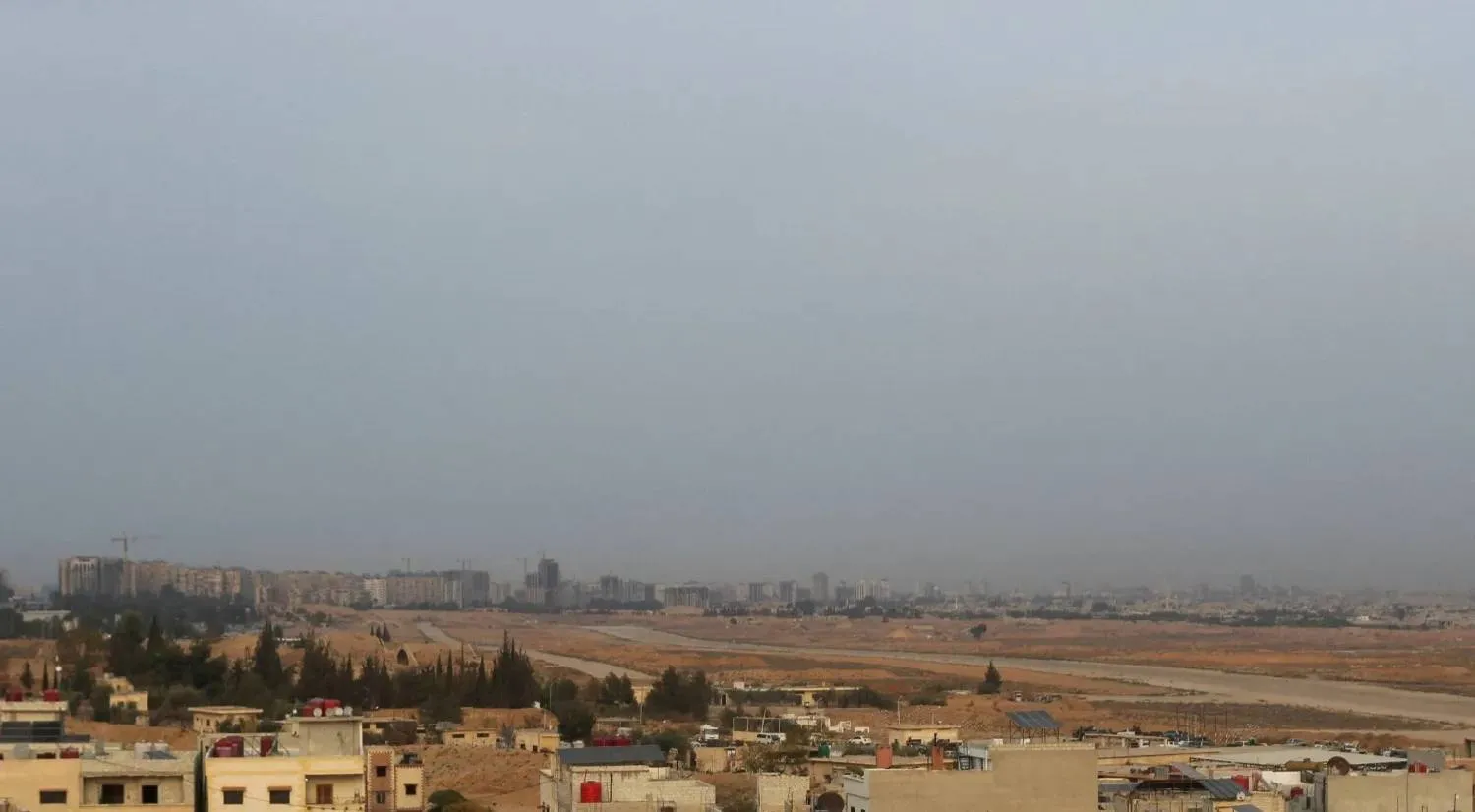

Damascus Denies US Planning to Establish Military Presence in Syria 

A view of the Mezzeh military airbase in southeastern Damascus. (Reuters file photo)
TT

Damascus Denies US Planning to Establish Military Presence in Syria 

A view of the Mezzeh military airbase in southeastern Damascus. (Reuters file photo)

The Syrian Foreign Ministry denied on Thursday reports saying the United States was planning on establishing a military presence in the country.

Six sources familiar with the matter told Reuters that the US is preparing to establish a military presence at an airbase in Damascus to help enable a security pact that Washington is brokering between Syria and Israel.

After publication, a Syrian foreign ministry source denied the report, saying it was "false", state news agency SANA reported late on Thursday.

"Work is underway to transfer the partnerships and understandings that were necessarily made with provisional entities to Damascus, within the framework of joint political, military and economic coordination," SANA added, citing the source.

The US plans for the presence in the Syrian capital, which have not previously been reported, would be a sign of Syria's strategic realignment with the US following the fall last year of longtime leader Bashar al-Assad, an ally of Iran, continued Reuters.

The base sits at the gateway to parts of southern Syria that are expected to make up a demilitarized zone as part of a non-aggression pact between Israel and Syria. That deal is being mediated by US President Donald Trump's administration.

TRUMP SET TO MEET SYRIAN PRESIDENT ON MONDAY

Trump will meet Syrian President Ahmed al-Sharaa at the White House on Monday, the first such visit by a Syrian head of state.

Reuters spoke to six sources familiar with preparations at the base, including two Western officials and a Syrian defense official, who confirmed the US was planning to use the base to help monitor a potential Israel-Syria agreement.

The Pentagon and Syrian foreign ministry did not immediately respond to requests for comment on the plan. The Syrian presidency and defense ministry did not immediately respond to questions about the plan sent via the Syrian information ministry.

A US administration official said the US was "constantly evaluating our necessary posture in Syria to effectively combat ISIS and (we) do not comment on locations or possible locations of (where) forces operate."

The official requested that the name and location of the base be removed for operational security reasons. Reuters has agreed to not reveal the exact location.

A Western military official said the Pentagon had accelerated its plans over the last two months with several reconnaissance missions to the base. Those missions concluded the base's long runway was ready for immediate use.

Two Syrian military sources said the technical talks have been focused on the use of the base for logistics, surveillance, refueling and humanitarian operations, while Syria would retain full sovereignty over the facility.

A Syrian defense official said the US had flown to the base in military C-130 transport aircraft to make sure the runway was usable. A security guard at one of the base's entrances told Reuters that American aircraft were landing there as part of "tests".

It was not immediately clear when US military personnel would be dispatched to the base.

JOINT SYRIAN-AMERICAN PRESENCE

The new US plans appear to mirror two other new US military presences in the region monitoring cessation of hostilities agreements: one in Lebanon, which closely watches last year's ceasefire between Lebanese armed group Hezbollah and Israel, and one in Israel that monitors the Trump-era truce between Palestinian group Hamas and Israel.

The US already has troops stationed in northeastern Syria, as part of a decade-long effort to help a Kurdish-led force there combat ISIS. In April, the Pentagon said it would halve the number of troops there to 1,000.

Sharaa has said any US troop presence should be agreed with the new Syrian state. Syria is set to imminently join the US-led global anti-ISIS coalition, US and Syrian officials say.

A person familiar with the talks over the base said the move was discussed during a trip by Admiral Brad Cooper, commander of the US Central Command (CENTCOM), to Damascus on September 12.

A CENTCOM statement at the time said Cooper and US envoy to Syria Thomas Barrack had met Sharaa and thanked him for contributing to the fight against ISIS in Syria, which it said could help accomplish Trump's "vision of a prosperous Middle East and a stable Syria at peace with itself and its neighbors." The statement did not mention Israel.

The US has been working for months to reach a security pact between Israel and Syria, two longtime foes. It had hoped to announce a deal at the United Nations General Assembly in September but talks hit a last-minute snag.

A Syrian source familiar with the talks told Reuters that Washington was exerting pressure on Syria to reach a deal before the end of the year, and possibly before Sharaa's trip to Washington.



UN Envoy to Yemen Invited to Southern Yemen Conference

Vice President of Yemen's Presidential Leadership Council Abdul Rahman Al-Mahrami and United Nations Special Envoy for Yemen Hans Grundberg meet in Riyadh. (State media)
TT

UN Envoy to Yemen Invited to Southern Yemen Conference

Vice President of Yemen's Presidential Leadership Council Abdul Rahman Al-Mahrami and United Nations Special Envoy for Yemen Hans Grundberg meet in Riyadh. (State media)

Vice President of Yemen's Presidential Leadership Council Abdul Rahman Al-Mahrami, also known as Abou Zaraa, held talks in Riyadh on Thursday with United Nations Special Envoy for Yemen Hans Grundberg on the latest developments in the country.

They tackled UN and international efforts to advance the political process and achieve comprehensive and sustainable peace, said state media.

They addressed preparations to hold a conference on southern Yemen that will be hosted by Riyadh. The conference has been described as pivotal in addressing the Southern Cause through dialogue between various southern parties and figures.

Abou Zaraa Al-Mahrami expressed his gratitude to Saudi Arabia for hosting the meeting, saying it reflects its keenness on the unity of southern ranks and efforts to support Yemenis in overcoming the current crisis.

He underlined the need to reach a fair and just solution to the Southern Cause, which he said is central to bolstering national efforts to defeat the Houthi coup in Sanaa.

Reaching a unified political agenda for the South will help advance efforts to restore state institutions, fortify the internal scene and move forward towards sustainable peace, he remarked.

He invited Grundberg to take part in the conference. The envoy, for his part, stressed the UN's support for PLC efforts to unite ranks. He underscored the importance of intra-southern dialogue, saying it was pivotal to the political process.

Meanwhile, on the ground, calm prevailed in the Yemeni interim capital Aden as National Shield Forces deployed in the city on Thursday morning in wake of the withdrawal of Southern Transitional Council (STC) forces.

Troops from the Giants Brigades, led by Abou Zaraa Al-Mahrami, also deployed in Aden as part of a joint security plan aimed at protecting the interim capital and secure vital installations.


Lebanon’s Economy Minister: Financial Recovery Will Rest on Security and Political Reforms

Amer Bisat, the Lebanese minister of Economy and Trade, speaks during an interview with Associated Press, in Beirut, Lebanon, Thursday, Jan.8, 2026. (AP Photo/Hussein Malla)
TT

Lebanon’s Economy Minister: Financial Recovery Will Rest on Security and Political Reforms

Amer Bisat, the Lebanese minister of Economy and Trade, speaks during an interview with Associated Press, in Beirut, Lebanon, Thursday, Jan.8, 2026. (AP Photo/Hussein Malla)

Lebanon's moves to remove weapons from all non-state groups and assert full state control are as important as financial reforms if the economy is to recover after years of crisis, the economy minister said Thursday.

“You need economic reforms, but you also need security and political reforms,” Amer Bisat told The Associated Press after a cabinet session in which the Lebanese military reported progress on a plan to disarm Hezbollah and non-state groups and expand deployment in southern Lebanon.

“We’re moving, and we’re moving fairly decisively and clearly in that direction,” he said, adding that asserting full sovereignty to boost investor confidence goes beyond disarmament and military deployment in the south.

“(It) is also the control of the borders, control of the airport, control over smuggling, money-laundering, terrorist activities,” said Bisat.

Lebanon's military said Thursday it has completed the first phase of the plan, though Israel maintains that Hezbollah is still present and rearming in areas the army said it now fully controls.

Israel and Hezbollah’s monthslong war in 2024 battered large swaths of the country and set it back the further economically after years of crisis. The World Bank estimates $11 billion in damages and economic losses from the conflict. The country fell into a protracted financial crisis in 2019 after decades of corruption and mismanagement.

Bisat is a member of Prime Minister Nawaf Salam’s reformist government which was appointed last year with a mandate to reform the country’s banks and make the country’s crippled economy viable again.

For years, the government has stalled on making wide-reaching reforms that could implicate the country’s wide network of cronies. However, western countries and other states that once poured large sums of money into the country, say that investment and substantial help won’t come without economic and security reforms.

Years of talks with the International Monetary Fund for a bailout have failed to produce a deal.

“We have a credibility gap. We need an international framework to help us solve our problems,” Bisat said. “The days in which people help us without us doing our homework are gone.”

Bisat is among a slim majority of cabinet ministers, alongside Salam, who last month endorsed a draft fiscal gap law to determine the extent of losses — estimated to be tens of billions of dollars — suffered by Lebanese banks during the country’s financial meltdown in 2019 and provide a mechanism to return depositors’ funds that were wiped out at the time. The draft law has been criticized from all sides and it is unclear whether it will be passed by the parliament.

“This is an extremely important piece of legislation, without which this economy just will not be able to take off,” said Bisat, who insisted that the law is not “Biblical” but a framework to start serious discussions. “This problem is extremely complicated financially. The size of the gap is very large.”

Bisat sees economic opportunities globally. He also cites regional changes, notably the downfall of the Assad dynasty in Syria, and an appetite in boosting international investments and further incentive for Lebanon to accelerate reforms.

But none of these opportunities will materialize without reforms to restructure the banks and tackle corruption.

“Waiting is not an option. Precisely because time is not our friend,” the minister said.


Al-Alimi Urges Civilian Protection, Warns Against Militarizing Politics

Yemen’s Presidential Leadership Council Chairman Rashad al-Alimi receives UN envoy Hans Grundberg in Riyadh (Saba News Agency)
TT

Al-Alimi Urges Civilian Protection, Warns Against Militarizing Politics

Yemen’s Presidential Leadership Council Chairman Rashad al-Alimi receives UN envoy Hans Grundberg in Riyadh (Saba News Agency)

Yemen’s Presidential Leadership Council Chairman Rashad al-Alimi met the United Nations special envoy to Yemen, Hans Grundberg, in Riyadh on Thursday, as the country grapples with fast-moving political and security shifts.

Al-Alimi has been holding talks aimed at locking in recent state gains in liberated provinces and averting a slide into a new internal conflict that could imperil the fragile peace process at a highly sensitive regional moment.

The meeting came amid rapidly evolving political and security developments in Yemen.

Al-Alimi stressed that the sovereign measures taken by the state did not represent a departure from the peace process, but rather a necessary step to protect it from fragmentation and to deter attempts to impose new realities by force that threaten social peace and the unity of state institutions.

According to official media, the Presidential Leadership Council chairman was briefed by the UN envoy on the results of his recent contacts and on developments in coordinated efforts with the international community to revive the political process in line with agreed references, which the Iran-backed Houthi group has overturned.

Al-Alimi and Grundberg discussed local developments, including unilateral moves in some eastern provinces and accompanying escalation measures by the Southern Transitional Council, which Al-Alimi described as a direct threat to social peace and a potential source of regional instability.

Al-Alimi praised UN Secretary General Antonio Guterres’ characterization of the recent events as unilateral actions with serious repercussions, and his holding the Southern Transitional Council fully responsible. He said the UN position helped clarify the background to the new escalation for the international community.

Restoring military camps

According to official sources, Al-Alimi briefed the UN envoy on developments on the ground, stressing that the state had exhausted all avenues of dialogue and containment before taking its decisions, and that the primary objective was to protect civilians, prevent division, and spare Yemen a new internal war.

He confirmed the success of the operation to take control of military camps in Hadhramaut and Al-Mahrah, as well as other southern provinces, in a peaceful and disciplined manner, in coordination with local authorities and with full support from the Saudi-led coalition backing the legitimate government.

Al-Alimi told the UN envoy that the operation marked a turning point in restoring the authority of state institutions and deterring any attempt to militarize political life, reassuring the international community of the smooth implementation of the process and its arrival in the temporary capital Aden under a coordinated plan.

He said extending state authority across all liberated provinces would open safe corridors for humanitarian aid, reduce restrictions on the work of relief organizations, and pave the way for improved living conditions and the provision of basic goods and services.

Al-Alimi reiterated the council’s and the government’s commitment to a comprehensive peace process and full openness to the UN envoy’s efforts, calling on the United Nations to play a more effective role, particularly by activating sanctions mechanisms against those obstructing the political process and by safeguarding Yemen’s sovereignty and territorial integrity.

He also praised the United Nations’ role in sponsoring detainee negotiations in Muscat, which resulted in a humanitarian agreement to release around 2,900 detainees, and affirmed the government’s readiness to provide all necessary facilitation for the release of UN and international organization staff held by the Houthis.