

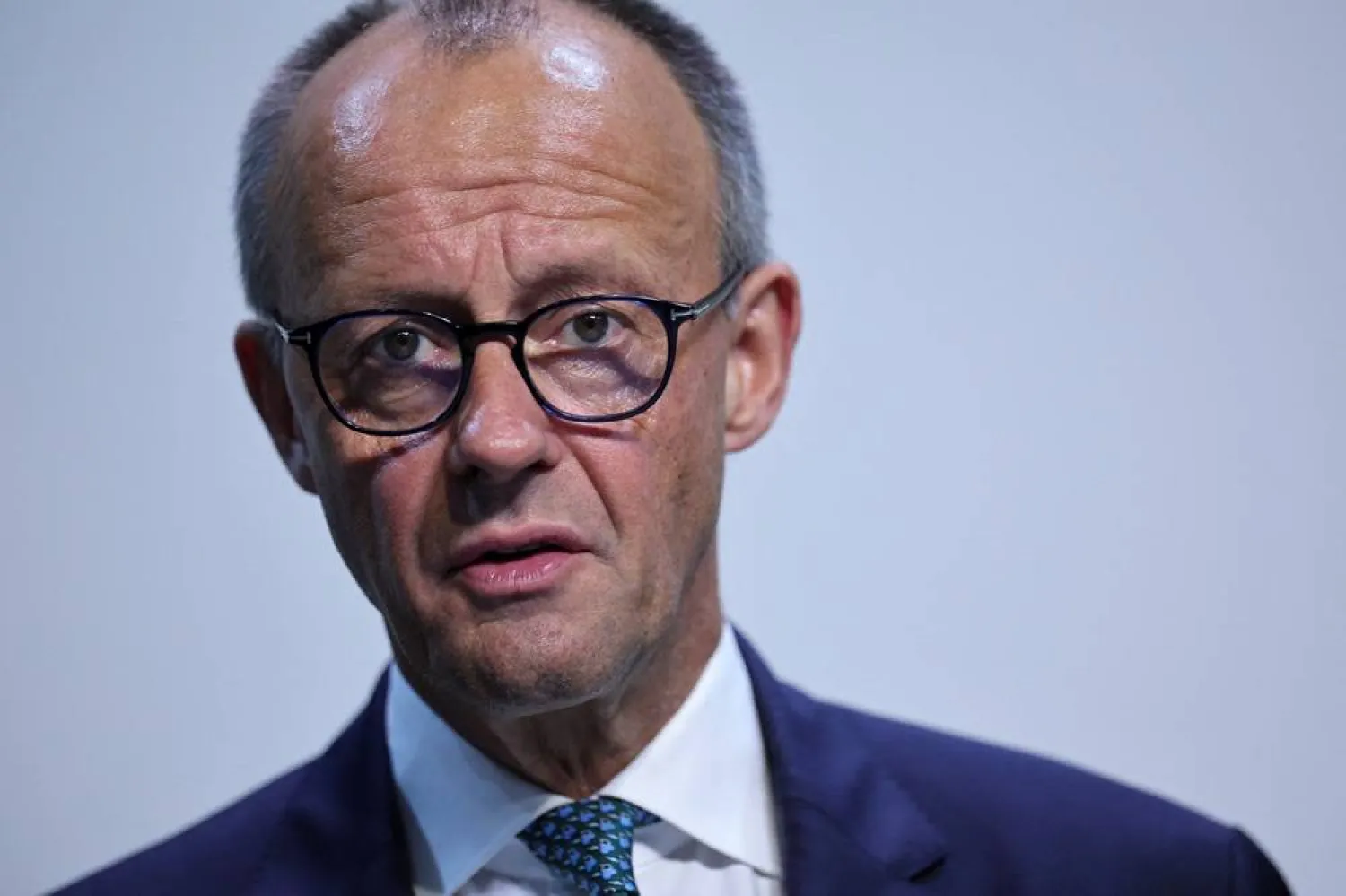

After Six Months, Germany’s Merz Faces Mounting Woes

 Germany's Chancellor Friedrich Merz speaks during the press conference at the Belem Climate Summit of the UN Climate Change Conference (COP30), in Belem, Brazil, November 7, 2025. (Reuters)
Germany's Chancellor Friedrich Merz speaks during the press conference at the Belem Climate Summit of the UN Climate Change Conference (COP30), in Belem, Brazil, November 7, 2025. (Reuters)
TT

After Six Months, Germany’s Merz Faces Mounting Woes

 Germany's Chancellor Friedrich Merz speaks during the press conference at the Belem Climate Summit of the UN Climate Change Conference (COP30), in Belem, Brazil, November 7, 2025. (Reuters)
Germany's Chancellor Friedrich Merz speaks during the press conference at the Belem Climate Summit of the UN Climate Change Conference (COP30), in Belem, Brazil, November 7, 2025. (Reuters)

After just six months in power, German Chancellor Friedrich Merz's coalition is facing infighting, policy deadlock and sliding poll ratings, undermining its efforts to take on the rising far right.

It marks a difficult start for the conservative politician who ran on bold pledges of reviving the stagnant economy, overhauling the threadbare military and toughening immigration policy after years of drift under the previous government.

In German post-war politics, "there has never been such widespread dissatisfaction with a government in such a short period of time", Manfred Guellner, director of the Forsa polling institute, told AFP.

For Germans who hoped for more decisive leadership after the last government's collapse, "their expectations have been dashed", he said.

The winners of February's general election, Merz's center-right CDU/CSU bloc now find themselves neck-and-neck in the polls with the far-right Alternative for Germany (AfD), which came second in the poll and is now the largest opposition party.

Merz's junior coalition partners, the center-left Social Democrats (SPD) of ex-chancellor Olaf Scholz, have seen their popularity slide further after a terrible election performance, and now sit around 13-15 percent in polls.

"It is clear that many citizens are dissatisfied or disappointed with the government's work so far," Roderich Kiesewetter, an MP from Merz's Christian Democrats (CDU), told AFP.

The government appeared to be "focusing only on migration instead of the economy, education and security", he said.

There have been increasing tensions between the ruling parties in Berlin since Merz failed to be elected chancellor in the first round of voting in parliament in early May, a first in post-war Germany.

In July they were unable to agree on the appointment of three judges to the constitutional court, with the conservatives considering the Social Democrats' candidate too left-wing.

A group of young conservative MPs revolted over a pension reform proposal, which had already been adopted by the cabinet, arguing that it burdened future generations.

Meanwhile, an overhaul of the country's military service system, which was supposed to demonstrate Germany's leadership in NATO in the face of the Russian threat, has turned into a stalemate over whether to bring back a limited form of conscription.

Now Foreign Minister Johann Wadephul, a close confidant of Merz, is under fire from conservatives for expressing reservations about the possibility of sending back Syrian refugees living in Germany.

With their support so low after the February polls, the CDU/CSU and the SPD "are finding it more difficult to reach compromises," Aiko Wagner, a political scientist at the Free University of Berlin, told AFP. Both sides fear they "will become even weaker among their own" supporters if they do, said Wagner.

The coalition's own struggles are making it more difficult for Merz to counter the rise of the AfD, which he declared as his party's "main opponent" ahead of five regional elections scheduled for 2026.

Merz has used increasingly tough rhetoric on immigration to counter the AfD, such as a controversial statement in October about the problems of the "German urban cityscape" -- seen as criticism of the impact of migrants on cities.

But this offended many Social Democrats, as well as some moderates among his conservative bloc.

Guellner argued that Merz made "a fatal mistake" by focusing so much on migration when the struggling economy was the main concern of many voters.

The AfD meanwhile sees Merz's struggles as an opportunity.

A clear majority of Germans backed conservative or right-wing parties in the election, AfD MP Sebastian Muenzenmaier told AFP.

But Merz's coalition with the center-left appears incapable of delivering on his promises, he said.

"No one sees this government staying in power for four years," said Muenzenmaier, who predicted that the AfD would have strong showings in next years' state elections.

"Many believe that at the end of next year, after the elections, the situation will become very difficult for the government in Berlin and that it will collapse".

The prospect of another coalition crisis and early elections did not sit well with Stephanie and Bernd Nebel, two visitors to Berlin from Munich who spoke with AFP outside of the Reichstag, the seat of Germany's parliament.

The biggest problem with the coalition so far, Bernd Nebel said, was that Merz's government "made it their mission to boost the economic recovery a little -- and absolutely nothing has happened in that regard".



Netanyahu Says He Will Not Quit Politics if He Receives a Pardon

Israeli Prime Minister Benjamin Netanyahu adjusts his headphones during a joint press conference with German Chancellor Friedrich Merz (not pictured) in Jerusalem, 07 December 2025. (EPA)
TT

Netanyahu Says He Will Not Quit Politics if He Receives a Pardon

Israeli Prime Minister Benjamin Netanyahu adjusts his headphones during a joint press conference with German Chancellor Friedrich Merz (not pictured) in Jerusalem, 07 December 2025. (EPA)

Israeli Prime Minister Benjamin Netanyahu said on Sunday that he would not retire from politics if he receives a pardon from the country’s president in his years-long corruption trial.

Asked by a reporter if planned on retiring from political life if he receives a pardon, Netanyahu replied: “no.”

Netanyahu last month asked President Isaac Herzog for a pardon, with lawyers for the prime minister arguing that frequent court appearances were hindering Netanyahu’s ability to govern and that a pardon would be good for the country.

Pardons in Israel have typically been granted only after legal proceedings have concluded and the accused has been convicted. There is no precedent for issuing a pardon mid-trial.

Netanyahu has repeatedly denied wrongdoing in response to the charges of bribery, fraud and breach of trust, and his lawyers have said that the prime minister still believes the legal proceedings, if concluded, would result in a complete acquittal.

US President Donald Trump wrote to Herzog, before Netanyahu made his request, urging the Israeli president to consider granting the prime minister a pardon.

Some Israeli opposition politicians have argued that any pardon should be conditional on Netanyahu retiring from politics and admitting guilt. Others have said the prime minister must first call national elections, which are due by October 2026.


Man Arrested after Pepper Spray Attack in London's Heathrow Airport Parking Garage

File photo: A plane prepares ahead of taking-off, after radar failure led to the suspension of outbound flights across the UK, at Heathrow Airport in Hounslow, London, Britain, July 30, 2025. (Reuters)
TT

Man Arrested after Pepper Spray Attack in London's Heathrow Airport Parking Garage

File photo: A plane prepares ahead of taking-off, after radar failure led to the suspension of outbound flights across the UK, at Heathrow Airport in Hounslow, London, Britain, July 30, 2025. (Reuters)

Police arrested a man in London on Sunday after a group of people were assaulted with pepper spray in a parking garage at Heathrow Airport.

The victims were taken to the hospital by ambulance but their injuries were not believed to be serious, the Metropolitan Police said.

The incident in the Terminal 3 garage occurred after an argument escalated between two groups who knew each other. It was not being investigated as terrorism, police said.

One man was arrested on suspicion of assault and held in custody. Police were searching for the other suspects who left the scene.


US Envoy Kellogg Says Ukraine Peace Deal Is Really Close

A Ukrainian serviceman walks near apartment buildings damaged by a Russian military strike, amid Russia's attack on Ukraine, in the frontline town of Kostiantynivka in Donetsk region, Ukraine November 15, 2025. (Oleg Petrasiuk/Press Service of the 24th King Danylo Separate Mechanized Brigade of the Ukrainian Armed Forces/Handout via Reuters)
TT

US Envoy Kellogg Says Ukraine Peace Deal Is Really Close

A Ukrainian serviceman walks near apartment buildings damaged by a Russian military strike, amid Russia's attack on Ukraine, in the frontline town of Kostiantynivka in Donetsk region, Ukraine November 15, 2025. (Oleg Petrasiuk/Press Service of the 24th King Danylo Separate Mechanized Brigade of the Ukrainian Armed Forces/Handout via Reuters)

US President Donald Trump's outgoing Ukraine envoy said a deal to end the Ukraine war was "really close" and now depended on resolving two main outstanding issues: the future of Ukraine's Donbas region and the Zaporizhzhia nuclear power plant.

Russia invaded Ukraine in February 2022 after eight years of fighting between Russian-backed separatists and Ukrainian troops in the Donbas, which is made up of the Donetsk and Luhansk regions.

The Ukraine war is the deadliest European conflict since World War Two and has triggered the biggest confrontation between Russia and the West since the depths of the Cold War.

US Special Envoy for Ukraine Keith Kellogg, who is due to step down in January, told the Reagan National Defense Forum that efforts to resolve the conflict were in "the last 10 meters" which he said was always the hardest.

The two main outstanding issues, Kellogg said, were on territory - primarily the future of the Donbas - and the future of Ukraine's Zaporizhzhia nuclear power plant, Europe's largest, which is under Russian control.

"If we get those two issues settled, I think the rest of the things will work out fairly well," Kellogg said on Saturday at the Ronald Reagan Presidential Library and Museum in Simi Valley, California. "We're almost there."

"We're really, really close," said Kellogg.

Kellogg, a retired lieutenant general who served in Vietnam, Panama and Iraq, said the scale of the death and injuries caused by the Ukraine war was "horrific" and unprecedented in terms of a regional war.

He said that, together, Russia and Ukraine have suffered more than 2 million casualties, including dead and wounded since the war began. Neither Russia nor Ukraine disclose credible estimates of their losses.

Moscow says Western and Ukrainian estimates inflate its losses. Kyiv says Moscow inflates estimates of Ukrainian losses.

Russia currently controls 19.2% of Ukraine, including Crimea, which it annexed in 2014, all of Luhansk, more than 80% of Donetsk, about 75% of Kherson and Zaporizhzhia, and slivers of the Kharkiv, Sumy, Mykolaiv and Dnipropetrovsk regions.

A leaked set of 28 US draft peace proposals emerged last month, alarming Ukrainian and European officials who said it bowed to Moscow's main demands on NATO, Russian control of a fifth of Ukraine and restrictions on Ukraine's army.

Those proposals, which Russia now says contain 27 points, have been split up into four different components, according to the Kremlin. The exact contents are not in the public domain.

Under the initial US proposals, the Zaporizhzhia nuclear plant, whose reactors are currently in cold shutdown, would be relaunched under the supervision of the International Atomic Energy Agency, and the electricity produced would be distributed equally between Russia and Ukraine.

Ukrainian President Volodymyr Zelenskiy said on Saturday that he had had a long and "substantive" phone call with Trump's special envoy Steve Witkoff and Trump's son-in-law Jared Kushner.

The Kremlin said on Friday it expected Kushner to be doing the main work on drafting a possible deal.