


Masked Israeli Settlers Attack 2 Palestinian Villages in the West Bank 

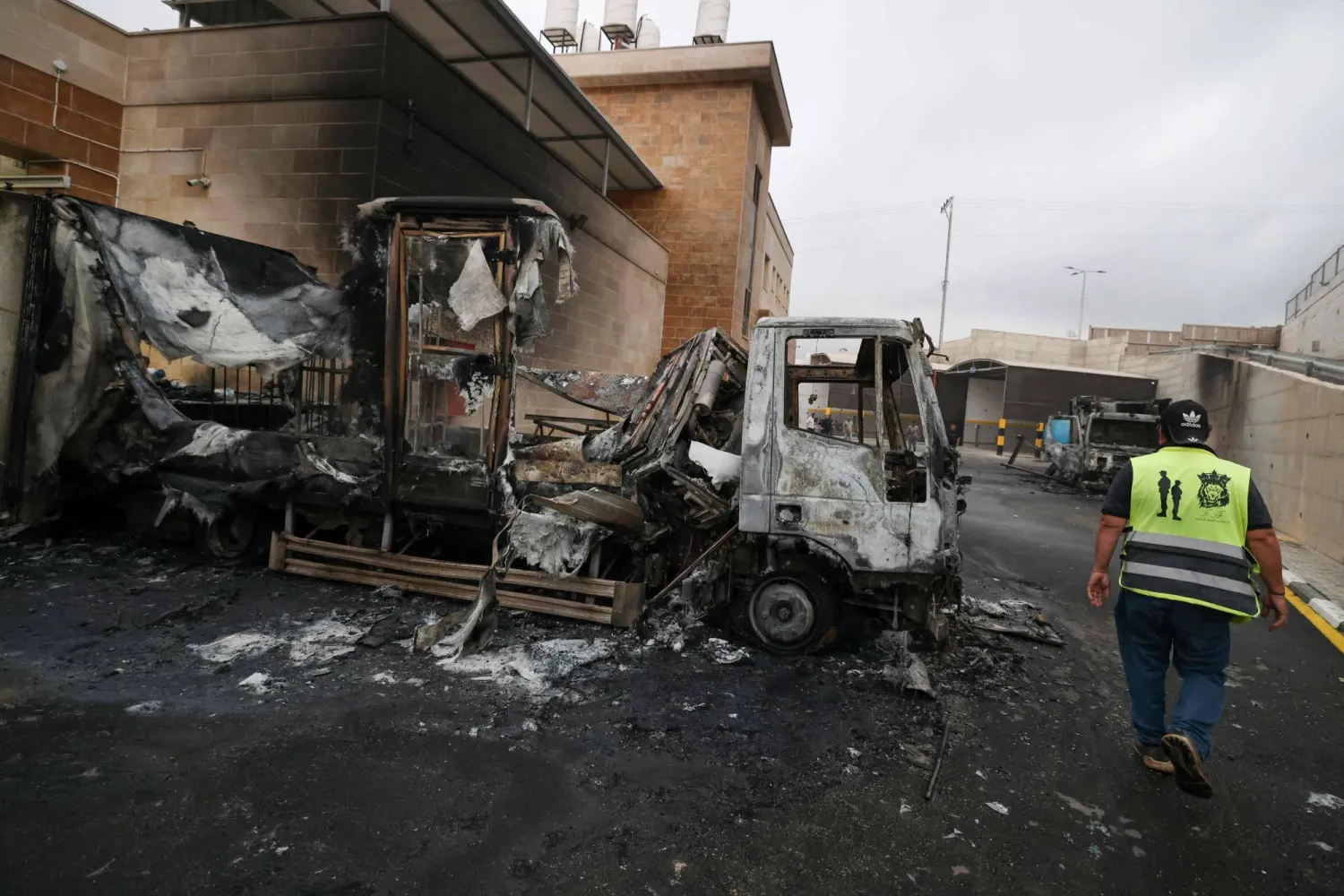
A Palestinian man inspects a burnt truck after an Israeli settlers attack in the village of Beit Lid, east of Tulkarm in the occupied West Bank on November 11, 2025. (AFP)
TT

Masked Israeli Settlers Attack 2 Palestinian Villages in the West Bank 

A Palestinian man inspects a burnt truck after an Israeli settlers attack in the village of Beit Lid, east of Tulkarm in the occupied West Bank on November 11, 2025. (AFP)

Dozens of masked Israeli settlers attacked a pair of Palestinian villages in the occupied West Bank on Tuesday, setting fire to vehicles and other property before clashing with Israeli soldiers sent to halt the rampage, Israeli and Palestinian officials said.

It was the latest in a series of attacks by young settlers in the West Bank.

Israeli police said four Israelis were arrested in what it described as “extremist violence,” while the Israeli military said four Palestinians were wounded. Police and Israel’s Shin Bet internal security agency said they were investigating.

Videos on social media showed two charred trucks engulfed in flames, with a nearby building on fire. Settler violence has surged since the war in Gaza erupted two years ago. The attacks have intensified in recent weeks as Palestinians harvest their olive trees in an annual ritual.

Earlier on Tuesday, tens of thousands of Israelis attended the funeral of an Israeli soldier whose remains had been held in Gaza for 11 years, overflowing and blocking surrounding streets as somber crowds stood with Israeli flags.

The burial of Lt. Hadar Goldin was a moment of closure for his family, which had traveled the world in a public campaign seeking his return. The huge turnout also reflected the importance for the broader public in Israel, where Goldin became a household name.

Hamas returned his remains on Sunday as part of the US-brokered ceasefire deal that began last month. The bodies of four hostages taken in the Hamas-led attack on Israel on Oct. 7, 2023, are still in Gaza.

Settler violence in the West Bank

The UN humanitarian office last week reported more Israeli settler attacks on Palestinians in the West Bank in October than in any other month since it began keeping track in 2006. There were over 260 attacks, the office said.

Palestinians and human rights workers accuse the Israeli army and police of failing to halt attacks by settlers. Israel’s government is dominated by West Bank settlers, and the police force is overseen by Cabinet minister Itamar Ben-Gvir, a hardline settler leader.

In Tuesday’s incident, the army said soldiers initially responded to settler attacks in the villages of Beit Lid and Deir Sharaf. It said the settlers fled to a nearby industrial zone and attacked soldiers sent to the scene and damaged a military vehicle.

Palestinian official Muayyad Shaaban, who heads the government’s Commission against the Wall and Settlements, said the settlers set fire to four dairy trucks, farmland, tin shacks and tents belonging to a Bedouin community.

He said the attacks were part of a campaign to drive Palestinians from their land and accused Israel of giving the settlers protection and immunity. He called for sanctions against groups that “sponsor and support the colonial settlement terrorism project.”

French President Emmanuel Macron denounced the attacks during his meeting with Palestinian President Mahmoud Abbas in Paris on Tuesday, saying that “settler violence and the acceleration of settlement projects are reaching new heights, threatening the stability of the West Bank.”

Palestinians in Gaza still struggling to access food

Displaced Palestinians in central Gaza said they continue to rely heavily on charity kitchens for their only daily meal, as soaring market prices and the lack of income leave them struggling.

Scores of people, most of them children, lined up with empty pots at a charity kitchen in Nuseirat refugee camp on Tuesday waiting to be served rice — the only food available that day.

“The rockets and planes stopped but increasing living costs has been the hardest weapon used against us,” said Mohamed al-Naqlah, a displaced Palestinian.

On Tuesday, Gaza’s Health Ministry said the number of Palestinians killed in Gaza has risen to 69,182. Its count, generally considered by independent experts as reliable, does not distinguish between fighters and civilians, but the ministry says more than half of those killed were women and children.

The latest war began with the 2023 Hamas-led attack on Israel when around 1,200 people, mostly civilians, were killed, and 251 people were kidnapped.

Close adviser to Netanyahu resigns

Cabinet Minister Ron Dermer, one of Prime Minister Benjamin Netanyahu’s closest confidants, announced his resignation on Tuesday, citing family reasons.

In a letter, Dermer said he had promised his family to serve two years but extended his term by an additional year to deal with Iran’s nuclear program and “to end the war in Gaza on Israel’s terms and bring our hostages home.”

The US-born Dermer is a former Israeli ambassador to Washington. As strategic affairs minister, he served as Netanyahu’s envoy throughout the war in dealing with the United States and ceasefire negotiations.



Hamas Postpones Election of Political Bureau Chief Indefinitely

(From left) Nizar Awadallah, Khalil al-Hayya and Mohammad Ismail Darwish during a meeting with Iran’s Supreme Leader Ali Khamenei last February 2025. (Khamenei's website/AFP)
TT

Hamas Postpones Election of Political Bureau Chief Indefinitely

(From left) Nizar Awadallah, Khalil al-Hayya and Mohammad Ismail Darwish during a meeting with Iran’s Supreme Leader Ali Khamenei last February 2025. (Khamenei's website/AFP)

Senior sources within Hamas said the movement has decided to postpone the election of the head of its political bureau, which had been scheduled to take place within the first ten days of January.

The sources told Asharq Al-Awsat that the decision to delay the vote was taken “until further notice,” noting that no new date has been set, although elections “could be held at any moment.”

One source attributed the postponement to “security and political conditions,” as well as Hamas’ current preoccupation with negotiations aimed at moving to the second phase of the ceasefire, amid intensified mediation efforts involving regional brokers and the United States.

Other sources pointed to additional factors, including internal disagreements over organizational arrangements within the Gaza Strip, which have deepened in recent days and are now the subject of efforts to resolve them.

Hamas is facing what sources described as its most severe crisis since its founding in 1987. Israeli strikes launched after the Oct. 7, 2023 attack have targeted various levels and wings of the movement, triggering significant organizational and financial challenges.

Sources said the accelerating momentum surrounding a possible transition to the second phase of the ceasefire has become the main concern for Hamas’s leadership. While electing a new head of the political bureau is seen as a key step in reorganizing the movement’s internal affairs, the process may take longer than initially expected, they added.

Only days ago, sources had told Asharq Al-Awsat that the elections were expected to be held within the first ten days of the new year, with the aim of reinforcing internal stability and reassuring the outside world that the movement remains cohesive.

Those sources said at the time that electing a political bureau chief would not end the role of the current leadership council formed after the assassinations of Ismail Haniyeh and Yahya al-Sinwar. The council would instead continue as an advisory body overseeing Hamas’ internal and external affairs.

Asked whether internal divisions exist over who should lead Hamas, one source said only that “the electoral process is conducted according to established rules and regulations, and there are no disputes over the individual who will lead the movement.”

However, there have been suggestions that Khaled Meshaal, head of Hamas’s political bureau abroad, and Khalil al-Hayya, head of the political bureau in Gaza, are the top contenders for the post.

Some sources said there is strong support within Hamas’ external leadership and in the West Bank for Meshaal to assume the role, while a majority in Gaza favors al-Hayya.

The sources did not rule out the emergence of a third, currently unidentified figure. “Nothing can be predicted at this stage,” one source said. “What is happening should not be seen as rivalry driven by internal disputes over leadership, but rather as a healthy competitive process.”


Syrian Army on Alert after SDF Armed Groups Detected East of Aleppo

People walk down a street as a car drives by following a ceasefire which ended days of fighting between Syrian security forces and Kurdish fighters in the Kurdish-majority Sheikh Maqsoud neighborhood, of the northern city of Aleppo on January 11, 2026. (AFP)
TT

Syrian Army on Alert after SDF Armed Groups Detected East of Aleppo

People walk down a street as a car drives by following a ceasefire which ended days of fighting between Syrian security forces and Kurdish fighters in the Kurdish-majority Sheikh Maqsoud neighborhood, of the northern city of Aleppo on January 11, 2026. (AFP)

The Syrian army went on alert on Sunday after detecting armed groups aligned with the Syrian Democratic Forces (SDF) east of Aleppo city.

In statements to the SANA state news agency, the Operations Command said that the nature and objectives of these military reinforcements and troop concentrations brought by the SDF to eastern Aleppo have not yet been identified.

The Command added that Syrian army forces have been placed on full alert, deployment lines east of Aleppo have been reinforced, and all necessary measures have been taken to be ready for all possible scenarios.

First responders on Sunday entered a contested neighborhood in the northern city of Aleppo after days of deadly clashes between government forces and Kurdish-led forces. Syrian state media said the military was deployed in large numbers.

The clashes broke out Tuesday in the predominantly Kurdish neighborhoods of Sheikh Maqsoud, Achrafieh and Bani Zaid after the government and the SDF, the main Kurdish-led force in the country, failed to make progress on how to merge the SDF into the national army. Security forces captured Achrafieh and Bani Zaid.

The fighting between the two sides was the most intense since the fall of then-President Bashar Assad to opposition groups in December 2024. At least 23 people were killed in five days of clashes and more than 140,000 were displaced amid shelling and drone strikes.

The Kurdish fighters have now evacuated from the Sheikh Maqsoud neighborhood to northeastern Syria, which is under the control of the SDF.

However, they said in a statement they will continue to fight now that the wounded and civilians have been evacuated, in what they called a “partial ceasefire.”


Hadhramaut Governor to Asharq Al-Awsat: Saudi Stance Was Decisive, Situation Is Calm

Governor of Yemen's Hadhramaut governorate Salem al-Khanbashi. (Asharq Al-Awsat)
TT

Hadhramaut Governor to Asharq Al-Awsat: Saudi Stance Was Decisive, Situation Is Calm

Governor of Yemen's Hadhramaut governorate Salem al-Khanbashi. (Asharq Al-Awsat)

Governor of Yemen's Hadhramaut Salem al-Khanbashi stressed that the situation in the governorate was returning to normal in wake of the recent developments and withdrawal of the Southern Transitional Council (STC) forces.

In remarks to Asharq Al-Awsat from his office in Mukalla, he said: "The general situation is calm and stable. Work is underway to resume operations at various public administrations."

"Security measures have also been intensified, especially over the possession of weapons," he added.

He revealed that several suspects involved in looting and the possession of heavy weapons have been arrested.

"Life is gradually returning back to normal and the situation will improve," he stressed.

On Saudi Arabia's role, Khanbashi credited the Kingdom with helping move forward the issue of the STC withdrawal from Hadhramaut in record time.

Coordination with the Kingdom continues, he added.

He also noted that a meeting was held with senior Hadhramaut officials with leaders of the "Hadhramaut elite brigades" to discuss returning the forces to their former military positions.

Coordination with Saudi Arabia is at a "very high level", he revealed. Hadhramaut has received pledges from senior Saudi officials that major projects will be implemented in the governorate to develop infrastructure.

On restructuring the local authority, Khanbashi stressed: "Measures have been taken against officials who had openly expressed their support to the STC or who had taken contentious political positions."

Commenting on the conference Riyadh will be hosting on the southern issue, he said the Hadhramaut leadership has met with several members of the Hadhramaut National Council to discuss the issue.

The details of the talks and mechanism to choose representatives have not taken shape yet, he told Asharq Al-Awsat.

Expanded meetings with various political and social figures will be held in the governorate in the coming days with the aim of coming up with a unified vision that represents Hadhramaut at the conference, he added.

He noted the historic differences that exist between Hadhramaut and other southern governorates that should be taken into consideration and discussed.

On the issue of the Hadhramaut airports, he said the Riyan Airport is ready and expected to resume operations in the next two days.