


Syria’s Sharaa: Trump Backs our Position on Israel’s Withdrawal to Pre-Dec. 8 Borders

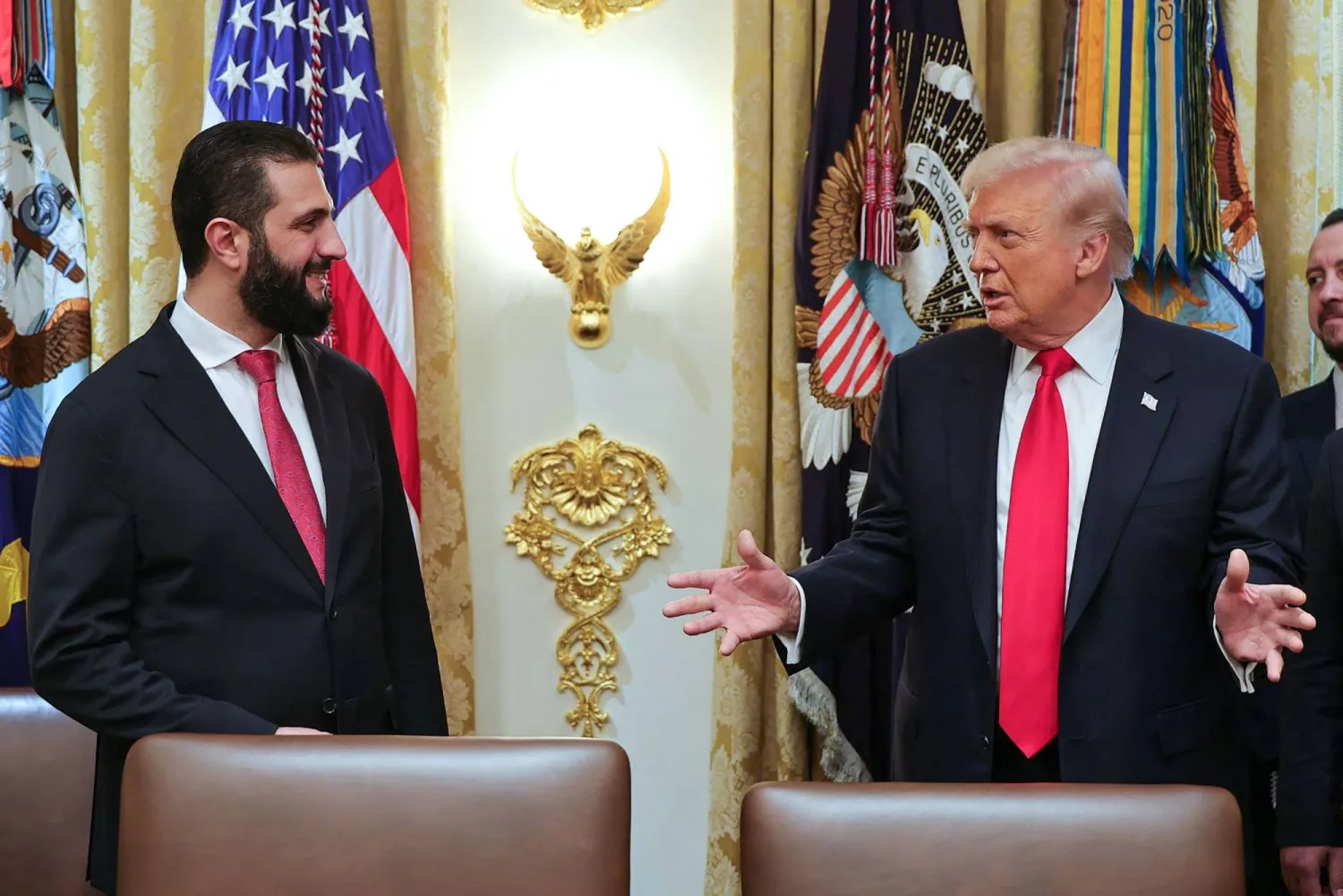
This handout photograph released by the official Syrian Arab News Agency (SANA) on November 10, 2025, shows Syria's President Ahmed al-Sharaa (L) meeting with US President Donald Trump at the White House in Washington DC. (Handout/SANA/AFP)
TT

Syria’s Sharaa: Trump Backs our Position on Israel’s Withdrawal to Pre-Dec. 8 Borders

This handout photograph released by the official Syrian Arab News Agency (SANA) on November 10, 2025, shows Syria's President Ahmed al-Sharaa (L) meeting with US President Donald Trump at the White House in Washington DC. (Handout/SANA/AFP)

Syrian interim President Ahmed al-Sharaa said on Monday he will preserve the right of the Syrian people to see ousted President Bashar al-Assad brought to justice.

Sharaa told the Washington Post that US President Donald Trump supports Syria’s position on the withdrawal of Israeli forces from Syrian territories it occupied after December 8, the date of the regime’s ouster.

Sharaa held a historic meeting with Trump at the White House on Monday, the first by a Syrian president since the country gained its independence in 1946.

Asked about Israel’s repeated attacks against Syria, he said: “Syria got into war with Israel 50 years ago. Then, in 1974, there was a disengagement agreement. This agreement lasted for 50 years, but when the regime fell, Israel revoked this agreement. They expanded their presence in Syria, expelled the UN peacekeeping mission and occupied new territory.”

“They have conducted over 1,000 airstrikes in Syria since December 8, and that included bombing the Presidential Palace and the Ministry of Defense. But because we want to rebuild Syria, we didn’t respond to these aggressions,” he added.

“The advances that Israel made into Syria are not coming from their security concerns, but from their expansionist ambitions,” Sharaa warned.

“Israel has always claimed that it has concerns about Syria because it is afraid of the threats that the Iranian militias and Lebanon’s Hezbollah represent. We are the ones who expelled those forces out of Syria,” he stressed.

He further continued: “We are engaged in direct negotiations with Israel, and we have gone a good distance on the way to reach an agreement. But to reach a final agreement, Israel should withdraw to their pre-December 8 borders.”

“The United States is with us in these negotiations, and so many international parties support our perspective in this regard. Today, we found that Trump supports our perspective as well, and he will push as quickly as possible in order to reach a solution for this,” he revealed.

Asked if Syria would agree to demilitarize the region south of Damascus, he replied: “To talk about an entire region demilitarized, it will be difficult, because if there is any kind of chaos, who will protect it? If this demilitarized zone was used by some parties as a launching pad for hitting Israel, who is going to be responsible for that?”

“And at the end of the day, this is Syrian territory, and Syria should have the freedom of dealing with their own territory,” Sharaa added.

“Israel occupied the Golan Heights in order to protect Israel, and now they are imposing conditions in the south of Syria in order to protect the Golan Heights. So, after a few years, maybe they will occupy the center of Syria in order to protect the south of Syria. They will reach Munich on that pathway,” he said.

Russia and Assad

Noting that Assad is in Moscow being essentially protected by the government of Vladimir Putin, Sharaa was asked if he had raised the issue with the Russians, to which he replied: “We were in war against Russia for 10 years, and it was a hard, difficult war. They announced that they killed me several times.”

However, “we need Russia because it’s a permanent member of the United Nations Security Council. We need their vote to be on our side in some issues, and we have strategic interests with them. We don’t want to push Russia to take alternative or other options in dealing with Syria,” he explained.

“The issue of Bashar al-Assad is troublesome for Russia, and our relationship with them... we’re still in the beginning. We will preserve our rights as Syrians to call for bringing Assad to justice,” he declared.

Common interests with US

On his landmark visit to the White House, he said: “The most important objective is starting on - building the relationship between Syria and the US, because in the past 100 years, it wasn’t a very good relationship.”

“We were looking for common interest between the US and Syria, and we found that we have a lot of common interests that we can build on, such as security interests and economic interests. The stability of Syria will impact the entire region, and the instability of Syria, as well, will impact the region,” he went on to say.

“Stability is linked with the economy, and the economy, or economic development, is linked with the lifting of sanctions. This discussion has been going on for months now, and I believe that we reached good results. But we are still waiting for the final decision,” he remarked.

ISIS fight

On his past as a fighter in Iraq and Syria, Sharaa said: “Fighting is not something shameful if it is done for noble objectives, especially if you are defending your own land and the people who are suffering from injustice. I believe this is something good that people should be commended for. I have fought so many wars, but I have never caused the death of an innocent person.”

“When somebody engages in fighting, they should have a very strong ethical background. The region was affected by the policies - western policies and US policies - and today, we have so many Americans who agree with us that some of these policies were a mistake and that they caused so many wars that were pointless,” he stressed.

On the fight against ISIS, Sharaa said: “We were in a war with the group for 10 years, and we did that without coordination with a Western force or any other country. Syria today is capable of shouldering this responsibility. Keeping Syria divided or having any military force that is not under control of the government, represents the best environment for ISIS to flourish.”

“The best solution is that the US troops present in Syria should supervise the integration of the Syrian Democratic Forces into the central government’s security forces. The task of protecting Syrian territory will be the responsibility of the state,” he explained.



Al-Sharaa: Israel’s Push for a Buffer Zone in Southern Syria Puts the Region at Risk

Syrian President Ahmad al-Sharaa speaks during the 23rd annual Doha Forum (Reuters). 
TT

Al-Sharaa: Israel’s Push for a Buffer Zone in Southern Syria Puts the Region at Risk

Syrian President Ahmad al-Sharaa speaks during the 23rd annual Doha Forum (Reuters). 

Syrian President Ahmad al-Sharaa warned on Saturday that Israel’s effort to establish a demilitarized buffer zone in southern Syria risks pushing the country into a “dangerous place.”

Speaking on the sidelines of the Doha Forum, al-Sharaa said US-mediated negotiations with Israel remain underway to address the “security concerns” of both sides.

Following the ouster of Bashar al-Assad on Dec. 8, Israel has carried out hundreds of airstrikes on Syrian military positions, saying its goal is to prevent the new authorities from seizing the former army’s weapons arsenal.

Over the past year, Israel has repeatedly publicized ground operations and arrests of individuals it accuses of “terrorist” activity in southern Syria. Israeli forces have also entered the Golan Heights disengagement zone established under the 1974 cease-fire agreement.

Al-Sharaa said all major international actors back Syria “in its demand that Israel withdraw and reposition to the lines of Dec. 8.” He emphasized that Damascus insists on full respect for the 1974 accord, describing it as a durable, internationally supported agreement.

“Tampering with this agreement, while proposing alternatives such as a new buffer zone, could drive us into dangerous territory,” he said.

Al-Sharaa accused Israel of “fighting ghosts” and “searching for enemies” in the wake of the Gaza war, adding that since assuming office a year ago he has sent “positive messages about peace and regional stability.”

Thirteen people were killed in late November during an Israeli incursion into the southern town of Beit Jin, a raid Damascus denounced as a “war crime.” Israel said the operation targeted suspects linked to the ISIS group.

Though Syria and Israel maintain no diplomatic relations and remain technically at war, several US-brokered ministerial meetings have been held in recent months.

“Negotiations are ongoing, and the United States is fully engaged,” al-Sharaa said, noting broad international support for addressing “legitimate security concerns so both sides can feel secure.”

He asked: “Syria is the one under attack, so who should be demanding a buffer zone and withdrawal?”

In September, al-Sharaa warned in New York of the risk of renewed Middle East instability if Damascus and Tel Aviv fail to reach a security arrangement, accusing Israel of “delaying negotiations and continuing to violate our airspace and territory.”

Israeli Prime Minister Benjamin Netanyahu visited Israeli forces deployed in the buffer zone outside the occupied Golan Heights in November, a move Damascus condemned as “illegitimate.”

Domestically, al-Sharaa said all segments of Syrian society are now represented in government “on the basis of competence, not sectarian quotas.” Syria, he said, is charting a “new path” for post-conflict governance. He acknowledged the country inherited “deep problems” from the former regime and said investigative bodies are working to address alleged crimes in the coastal region and Sweida.

He stressed that Syria is “a state of law, not a collection of sects,” and that accountability and institutional reform are essential to rebuilding the state.

The Syrian president added that economic revitalization is crucial for lasting stability, which is why Damascus continues to argue for the lifting of the Caesar Act sanctions.


Arab Parliament Backs UNRWA Mandate Renewal, Reaffirms Support for Palestinian Rights

Arab Parliament Backs UNRWA Mandate Renewal, Reaffirms Support for Palestinian Rights
TT

Arab Parliament Backs UNRWA Mandate Renewal, Reaffirms Support for Palestinian Rights

Arab Parliament Backs UNRWA Mandate Renewal, Reaffirms Support for Palestinian Rights

Speaker of the Arab Parliament Mohamed Alyammahi welcomed the UN General Assembly’s decision to renew the mandate of the United Nations Relief and Works Agency for Palestine Refugees in the Near East (UNRWA) for another three years, saying the vote reflects broad international support for Palestinian rights and a clear rejection of efforts to undermine their cause.

Alyammahi stressed that the mandate’s renewal is particularly critical amid the continued aggression and blockade facing Palestinians, ensuring the agency can maintain its essential services. He noted the strong backing for related resolutions calling for an end to the occupation and the establishment of an independent Palestinian state with Jerusalem as its capital.

The speaker urged leveraging this growing international consensus to halt the assault on Gaza, facilitate the entry of humanitarian aid, intensify legal and diplomatic action against the occupation, and advance a credible political process that can help ease the suffering of the Palestinian people.


Israeli Soldiers Kill 55-Year-Old Palestinian and Teenager in West Bank

28 November 2025, Palestinian Territories, Hebron: Israeli forces block Palestinian farmers trying to access to their agricultural fields in the town of Tarqumiyah. (dpa)
TT

Israeli Soldiers Kill 55-Year-Old Palestinian and Teenager in West Bank

28 November 2025, Palestinian Territories, Hebron: Israeli forces block Palestinian farmers trying to access to their agricultural fields in the town of Tarqumiyah. (dpa)

Israeli soldiers killed a Palestinian teenager who was driving a car towards them as well as a Palestinian bystander in the West Bank on Saturday, according to an Israeli security official.

The military said that an "uninvolved person" was hit in addition to the driver of the car who had "accelerated" towards soldiers at a checkpoint in West Bank city of Hebron.

In an earlier statement, the military said two "terrorists" were killed, before later clarifying that only one person was involved.

An Israeli security official, speaking on condition of anonymity, said a 17-year-old was driving the car and a 55-year-old was the bystander.

Palestinian state news agency WAFA reported that 55-year-old Ziad Naim Abu Dawood, a municipal street cleaner, was killed while working. It said another Palestinian was killed but did not report the circumstances that led the soldiers to open fire.

The Palestinian health ministry identified the second Palestinian as 17-year-old Ahmed Khalil Al-Rajabi.

The military did not report any injuries to the soldiers.

The motive for the 17-year-old's actions was not immediately clear, and no armed group claimed responsibility.

Since January, 51 Palestinian minors, aged under 18, have been killed in the West Bank by Israeli forces, according to the Palestinian health ministry.

Violence has surged this year in the Israeli-occupied West Bank. Israeli settler attacks on Palestinians have risen sharply, while the military has tightened movement restrictions and carried out sweeping raids in several cities.

Palestinians have also carried out attacks on Israeli soldiers and civilians, some of them deadly.