


Sudan's Worsening Situation Leaves 2 Out of Every 3 People in Need of Aid, UN Official Says

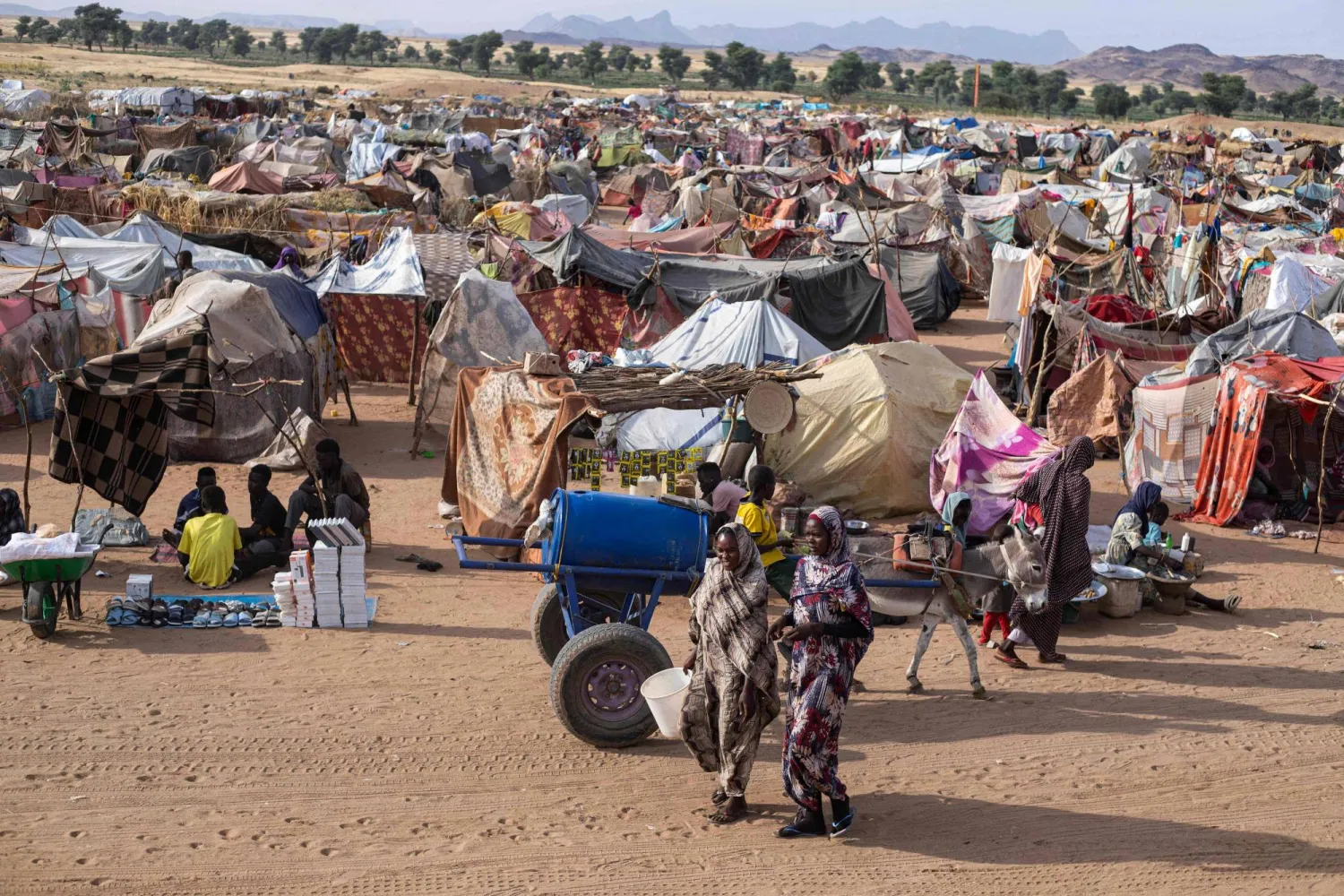
Displaced Sudanese who fled El-Fasher after the city fell to the Rapid Support Forces (RSF), rest in the camp of Um Yanqur, located on the southwestern edge of Tawila, in war-torn Sudan's western Darfur region on November 3, 2025. (Photo by AFP)
TT

Sudan's Worsening Situation Leaves 2 Out of Every 3 People in Need of Aid, UN Official Says

Displaced Sudanese who fled El-Fasher after the city fell to the Rapid Support Forces (RSF), rest in the camp of Um Yanqur, located on the southwestern edge of Tawila, in war-torn Sudan's western Darfur region on November 3, 2025. (Photo by AFP)

Two out of three people in war-torn Sudan are in dire need of aid, a UN official said Wednesday.

The situation is getting “horrific for civilians,” UN humanitarian affairs and relief head Tom Fletcher told The Associated Press, as aid groups struggle to deliver much-needed assistance to communities.

“The access we need is far too limited by the conflict,” he said during a phone interview from Darfur.

The military and the rival paramilitary Rapid Support Forces, or RSF, went to war in 2023, when tensions erupted between them. The army and RSF are former allies that were supposed to oversee a democratic transition after a 2019 uprising.

The fighting has killed at least 40,000 people, according to the World Health Organization, and displaced 12 million others. However, aid groups say the true death toll could be many times higher.

Overcrowded camps

As the war continued to rage on for more than two years, humanitarian resources were significantly depleted across the country, said Amy Pope, director-general of the International Organization for Migration, or IOM.

“People are exhausted and vulnerabilities are extremely high,” Pope told the AP by phone from the capital, Khartoum.

A new influx of displaced people in the Darfur region has further strained already overcrowded camps and depleted limited resources. The Darfur and Kordofan regions have become the epicenter of the fight.

Last month, the RSF seized el-Fasher, the capital city of North Darfur that was besieged for more than 18 months killing more than 450 people, according to WHO, and went house to house, killing civilians and committing sexual assaults.

Mashad Organization, a rights group, said Sunday that hundreds of girls were subject to sexual violence.

The IOM estimates that around 82,000 people had fled the city and surrounding areas as of Nov. 4, heading to safe spots, including Tawila.

Scale of need ‘incredible’ Doctors without Borders, or MSF, said on Wednesday that its teams have seen “staggering” malnutrition rates among those who fled el-Fasher and arrived in Tawila.

Pope also briefed reporters virtually from Khartoum on the gruesome details of the civil war, saying that most people fleeing the areas impacted describe watching civilians be shot on site and walking over dead bodies.

“The scale of the need is absolutely incredible. And of course, it is coinciding at a time when there have been unprecedented humanitarian cuts to humanitarian assistance around the world,” Pope said.

Potential truce

Sudanese Foreign Minister Mohi al-Din Salem said Tuesday that his government doesn't engage in an official capacity with the US-led mediator group known as the Quad, which put forward a humanitarian truce proposal in September.

“The Quad group was not formed by a decision from the Security Council or an international organization,” said Salem, adding that his country engages on a bilateral basis with countries such as Egypt, whose foreign minister, Badr Abdelatty, said Wednesday that his country stands firm against any attempts of dividing Sudan.

The US-led plan would start with a three-month ceasefire followed by a nine-month political process, according to Massad Boulos, a US adviser for African affairs.

The RSF said last week that it agreed to the proposed humanitarian truce, and while the army welcomes the proposal, it said it will only agree to a truce if the RSF withdraws from civilian areas and surrenders its weapons.

Fletcher said on Wednesday that his agency is in contact with warring parties to push for aid delivery.



Led by Al-Khanbashi, National Shield Forces Deploy in Yemen’s Hadhramaut to Retake Camps

Hadhramaut Governor Salem al-Khanbashi (Saba News Agency)
TT

Led by Al-Khanbashi, National Shield Forces Deploy in Yemen’s Hadhramaut to Retake Camps

Hadhramaut Governor Salem al-Khanbashi (Saba News Agency)

Eastern Yemen’s Hadhramaut province entered a critical phase on Friday as government-backed National Shield forces began deploying against an insurgency by the Southern Transitional Council (STC), seeking to regain control of military camps and restore the state’s grip over security and military institutions under the leadership of Governor Salem al-Khanbashi.

Field sources said National Shield forces advanced toward the al-Khasha area in Wadi Seiyun, where units affiliated with the STC are stationed.

The forces encountered ambushes and armed clashes during their advance, prompting direct intervention by aircraft from the Arab Coalition backing Yemen’s internationally recognized government.

The sources said National Shield forces succeeded in the early hours in seizing the headquarters of the 37th Strategic Brigade Camp in al-Khasha, while continuing their advance to tighten control over Seiyun, the largest city in Wadi Hadhramaut and home to the First Military Region command, ahead of moving toward other valley cities still under Transitional Council influence.

As ground operations unfolded, Arab Coalition spokesperson Brig. Gen. Turki al-Maliki stated that Saudi Arabia’s Royal Naval Forces had completed their deployment in the Arabian Sea, a move aimed at conducting inspection operations and combating smuggling.

The developments followed a decision by Yemen’s Presidential Leadership Council Chairman, Rashad al-Alimi, to appoint al-Khanbashi as the overall commander of the National Shield forces in the province, granting him full military, security, and administrative authority to restore security and order.

The decision stated that the mandate would end once its causes cease or upon the issuance of a subsequent presidential decision revoking the authorization. The last clause confirmed the decision would take effect from the date of issuance and publication in the official gazette and military bulletins.

The decision is widely seen as a decisive sovereign step reflecting al-Alimi’s approach to unifying military and security command in Hadhramaut and reinforcing state authority in one of Yemen’s most strategically and economically important provinces.

Observers said the decision provides legal and political cover for the “handover of camps” operation, placing it within a clear institutional framework and away from factional conflict, a point the governor emphasized in his address.

Saudi ambassador blames al-Zubaidi

Leaders of the Southern Transitional Council rejected handing over the camps or avoiding confrontation, with several figures calling for general mobilization. Field assessments indicate their forces’ capabilities have declined and may collapse, potentially forcing their withdrawal from Hadhramaut and al-Mahra by force.

In a clear Saudi stance, Saudi Ambassador to Yemen Mohammed Al-Jaber held the Transitional Council and its leader, Aidrous al-Zubaidi, directly responsible for the escalation, stating that the exploitation of the southern cause for personal gain had harmed it and stripped it of many of its political achievements.

In a series of posts on X, Al-Jaber stated that Saudi Arabia has supported and continues to support the southern cause as a just issue with historical and social dimensions, emphasizing that a genuine solution can only be achieved through political dialogue that meets the aspirations of all southern governorates.

He said al-Zubaidi had taken dangerous unilateral decisions, most notably leading a military attack on Hadhramaut and al-Mahra, resulting in security breakdowns, the intimidation of civilians, and the killing and wounding of Hadhramaut residents.

Al-Jaber stated that the Kingdom had exerted intensive efforts in recent weeks to persuade the STC to end the escalation and hand over the camps to National Shield forces, but faced continued rejection and intransigence.

This included refusing to issue clearance for a Saudi aircraft carrying an official delegation on Jan. 1, 2026, and shutting down air traffic at Aden airport, which he described as irresponsible behavior that harms Yemenis and undermines de-escalation efforts.

A peaceful operation

Al-Khanbashi confirmed the launch of the “camp handover” operation, stating that it is a peaceful and organized process targeting only military sites, without harming any political or social component, and without affecting civilians or their interests.

He stressed that the operation was not a declaration of war or a push for escalation, but a preventive measure aimed at neutralizing weapons and stopping chaos, thereby preventing the use of camps to threaten Hadhramaut’s security and protecting the province from dangerous scenarios.

Al-Khanbashi said Hadhramaut is going through a sensitive phase that requires courageous and responsible decisions.

He noted that local authorities, backed by the state and Saudi Arabia, had made significant efforts to open dialogue channels, but faced deliberate obstruction and systematic preparations to create chaos that could spiral out of control.

He stated that the operation is limited in scope, clear in its objectives, and guided by constitutional and national responsibilities to protect citizens’ lives and preserve civil peace.

Calls for calm and accountability

The governor called on Hadhramaut’s tribal leaders, elders, and social figures to play their national role during this critical phase and help shield society from being drawn into chaos or polarization, stating that Hadhramaut has always been and will remain a land of peace, wisdom, and statehood.

Al-Khanbashi held the United Arab Emirates responsible for what he described as chaos and looting targeting weapons and ammunition facilities at Riyan airport, due to their failure to hand the site over to local authorities upon withdrawal.

He rejected any attempt by forces or entities from outside the province to exploit the developments.

Al-Khanbashi stated that protecting Hadhramaut is a collective responsibility, warning that anyone attempting to undermine security or engage in looting will be held legally and judicially accountable.

He stressed that the state will remain aligned with citizens, peace, and the future.


8 Arab and Islamic Countries Deeply Concerned About Deteriorating Humanitarian Situation in Gaza

Nanaa Abu Jari cooks outside her tent after it was flooded by rainwater in Nuseirat, central Gaza Strip, Friday, Jan. 2, 2026. (AP Photo/Abdel Kareem Hana)
TT

8 Arab and Islamic Countries Deeply Concerned About Deteriorating Humanitarian Situation in Gaza

Nanaa Abu Jari cooks outside her tent after it was flooded by rainwater in Nuseirat, central Gaza Strip, Friday, Jan. 2, 2026. (AP Photo/Abdel Kareem Hana)

The foreign ministers of eight Arab and Islamic countries, including Saudi Arabia, Egypt and Qatar urged on Friday the international community to pressure Israel to lift constraints on the distribution of aid in the Gaza Strip.

In a joint statement the eight countries “expressed their deepest concern regarding the deteriorating humanitarian situation in the Gaza Strip, which has been exacerbated by severe, harsh, and unstable weather conditions, including heavy rainfall and storms, and compounded by the continued lack of sufficient humanitarian access, acute shortages of essential life-saving supplies, and the slow pace of the entry of essential materials required for the rehabilitation of basic services and the establishment of temporary housing.”

They "urged the international community to pressure Israel, as the occupying power, to immediately lift the constraints on the entry and distribution of essential supplies" to Gaza.

The statement also called for the immediate delivery of humanitarian aid in the Palestinian enclave through the UN and its agencies, the rehabilitation of infrastructure and hospitals, and the opening of the Rafah Crossing in both directions as stipulated in US President Donald Trump’s Comprehensive Plan.

The Rafah border crossing was set to be reopened under the ceasefire in effect in Gaza since October, but has so far remained closed.

Friday’s statement “commended the tireless efforts of all United Nations organizations and agencies, especially UNRWA, as well as humanitarian international NGOs, in continuing to assist Palestinian civilians and deliver humanitarian assistance under extremely difficult and complex circumstances.”

The eight countries “demanded that Israel ensure the UN and international NGOs are able to operate in Gaza and the West Bank in a sustained, predictable, and unrestricted manner, given their integral role in the humanitarian response in the Strip.”

“Any attempt to impede their ability to operate is unacceptable,” they added.


MSF Calls Israeli Ban a 'Grave Blow' to Gaza Aid

Nanaa Abu Jari cooks outside her tent after it was flooded by rainwater in Nuseirat, central Gaza Strip, Friday, Jan. 2, 2026. (AP Photo/Abdel Kareem Hana)
TT

MSF Calls Israeli Ban a 'Grave Blow' to Gaza Aid

Nanaa Abu Jari cooks outside her tent after it was flooded by rainwater in Nuseirat, central Gaza Strip, Friday, Jan. 2, 2026. (AP Photo/Abdel Kareem Hana)

International charity Doctors Without Borders Friday condemned a "grave blow to humanitarian aid" after Israel revoked the status it needs to operate in Gaza for refusing to share Palestinian staff lists.

Israel on Thursday confirmed it had banned access to the Gaza Strip to 37 foreign humanitarian organizations for refusing to share lists of their Palestinian employees.

Doctors Without Borders (MSF), which has 1,200 staff members in the Palestinian territories, the majority of them in Gaza, said in a statement that "denying medical assistance to civilians is unacceptable under any circumstances".

The medical organization argued that it had "legitimate concerns" over new Israeli requirements for foreign NGO registration, specifically the disclosing of personal information about Palestinian staff.

According to AFP, it pointed to the fact that 15 MSF staff had been "killed by Israeli forces", and that access to any given territory should not be conditional on staff list disclosure.

"Demanding staff lists as a condition for access to territory is an outrageous overreach," the charity said.

MSF also denounced "the absence of any clarity about how such sensitive data will be used, stored, or shared", charging that Israeli forces "have killed and wounded hundreds of thousands of civilians" in Gaza during the course of the war.

It also charged that Israel had "manufactured shortages of basic necessities by blocking and delaying the entry of essential goods, including medical supplies".

Israel controls and regulates all entry points into Gaza, which is surrounded by a wall that began to be built in 2005.

Felipe Ribero, MSF head of mission in the Palestinian territories, told AFP that all of its operations were still ongoing in Gaza.

"We are supposed to leave under 60 days, but we don't know whether it will be three or 60 days" before Israeli authorities force MSF to leave, he said.

Prominent humanitarian organizations hit by the Israeli ban include the Norwegian Refugee Council (NRC), World Vision International and Oxfam, according to an Israeli ministry list.

The ban, which came into effect on December 31, 2025 at midnight, has triggered widespread international condemnation.

Israel says the new regulation aims to prevent bodies it accuses of supporting terrorism from operating in the Palestinian territories.

MSF says it currently supports one in five hospital beds in Gaza and assists one in three mothers in the territory, and urged the Israeli authorities to meet to discuss the ban.