Sweden Sees Silent Forests as Sanctuaries from a Noisy Worldhttps://english.aawsat.com/varieties/5208662-sweden-sees-silent-forests-sanctuaries-noisy-world
Sweden Sees Silent Forests as Sanctuaries from a Noisy World
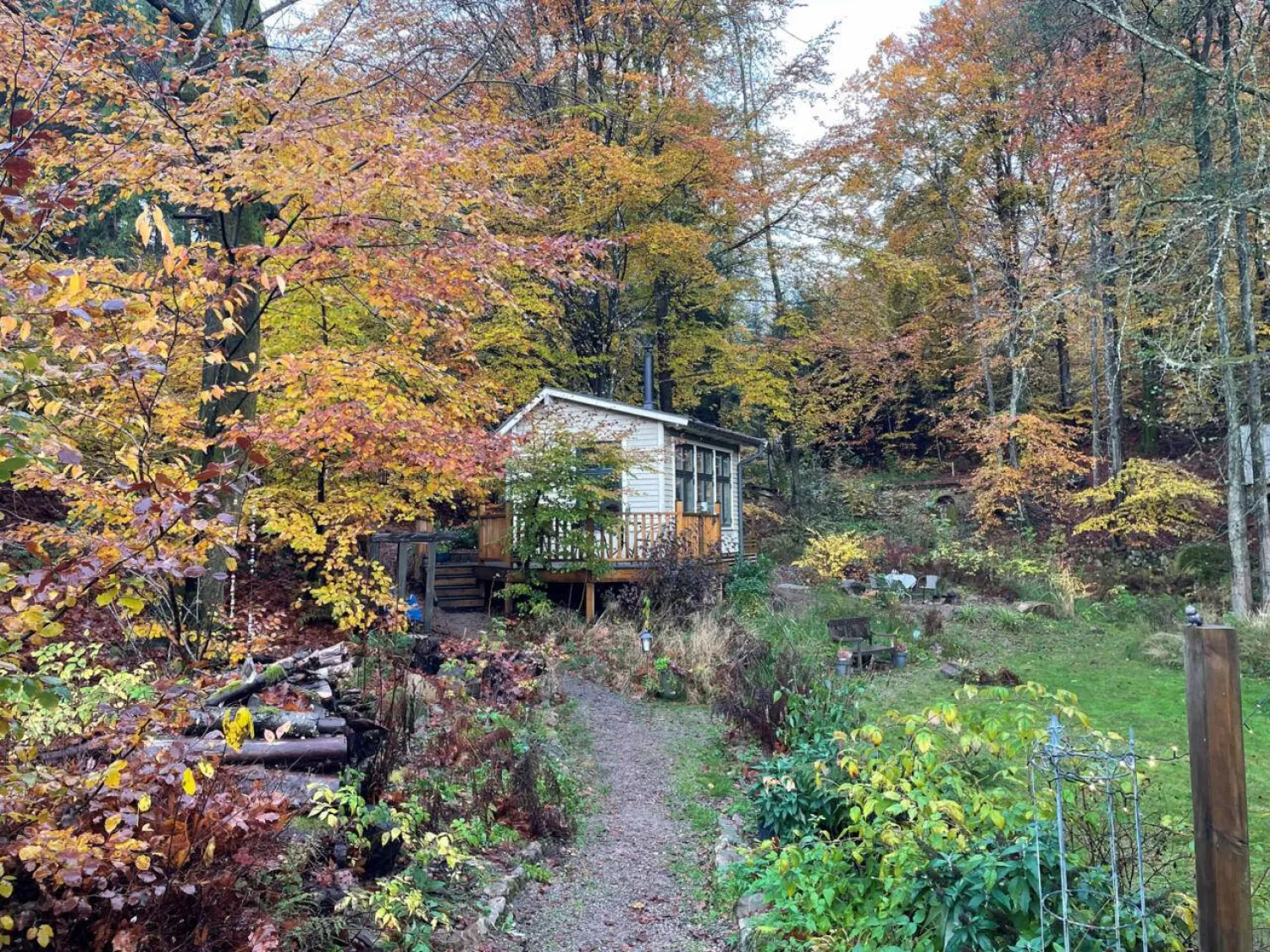
Couples had to spend four days in a cabin and not make noise over 45 decibels. Camille BAS-WOHLERT / AFP
In a cottage nestled deep in a Swedish forest, three couples recently spent four days whispering and without phones as part of a campaign about the dangers of noise pollution and promoting quiet Scandinavia.
The project arose from the observation that for many tourists, Sweden's appeal lies in its tranquility.
"What are their reasons for choosing Sweden as a travel destination? Relaxation, calm, and to unwind, as well as experiences in nature," Josefine Nordgren, one of the organizers of the "Silent Cabin" project by Visit Skane, which promotes tourism in southern Sweden, told AFP.
"Even in Germany, noise pollution is 10 times higher than in Sweden," she said.
Noise is the second-most detrimental environmental factor affecting Europeans' health after air pollution, according to the European Environment Agency (EEA).
This autumn, as the sun began its winter retreat in Sweden, Visit Skane invited three couples to spend four days -- on separate occasions -- in a little green cabin with white trim at the end of a winding forest lane, free of charge on the condition that their conversation remained below 45 decibels.
A normal conversation level is around 60 decibels.
To ensure everybody played by the rules, a sound meter was placed on top of a cupboard.
The unit was connected to the organizers' own system, and if the conversation level remained too high for an extended period, the couple faced eviction.
The couples were all city dwellers charmed by the cosy cabin -- kitted out with a large bed, small table and stove -- tucked in between trees with leaves turning yellow and red near a small brook.
The bathroom and kitchen were located in the owner's main house a short walk away.
The sound meter ensured the visitors stuck to the challenge.
"It's so important that we had this measurement, I think, to take it seriously," Lise Holm, a 26-year-old from Tubingen in Germany who stayed in the cabin with her older sister Johanna, told AFP.
The energetic self-proclaimed chatterboxes spoke in hushed tones when necessary and gesticulated to each other for the four days.
They spent their days taking walks, meditating, painting, making bonfires -- and speaking very little.
"I'm a new person now," Holm said.
"We heard noises (that) you don't hear when everyday life is so loud and everything is fast and rapid," her sister added.
Forcing the guests to stay quiet preserves the tranquility of the site, which in turn improves guests' health, Nordgren from Visit Skane said.
"If you stay quiet and calm, under 45 decibels, it has a positive influence on the body and mind," she said.
Lise Holm said that was her experience.
"My energy level shifted a lot," she said.
"I just felt this deep happiness and deep, energized level to (an) 'I can change the world' feeling," she said.
In the European Union, one in five people are exposed to noise levels harmful to their health, according to the EEA.
Living in an area with transportation noise is linked to a higher risk of developing health problems, including mental health and cardiovascular illnesses.
While brief escapades in the countryside may sound tempting as a remedy, they don't resolve the bigger problems posed by noise pollution.
"This can be an individual solution but it's not a good collective solution," said Eulalia Peris, an EEA expert.
"If everybody moves, let's say, to quiet areas in the countryside but they still need to travel to the city, they may benefit from the quietness of being in the countryside but they are producing noise by taking maybe the car to the city," she said.
"The problem of noise is not going to be solved by only one solution," she said.
She called for measures to reduce noise pollution, including lower speed limits and limits on engine noise, the installation of buffer zones, and promoting walking and cycling as active forms of transport.
An Imaginary Archeological Site Discusses the Fragility of Memory in the Saudi Pavilion at Venicehttps://english.aawsat.com/varieties/5270674-imaginary-archeological-site-discusses-fragility-memory-saudi-pavilion-venice
An Imaginary Archeological Site Discusses the Fragility of Memory in the Saudi Pavilion at Venice
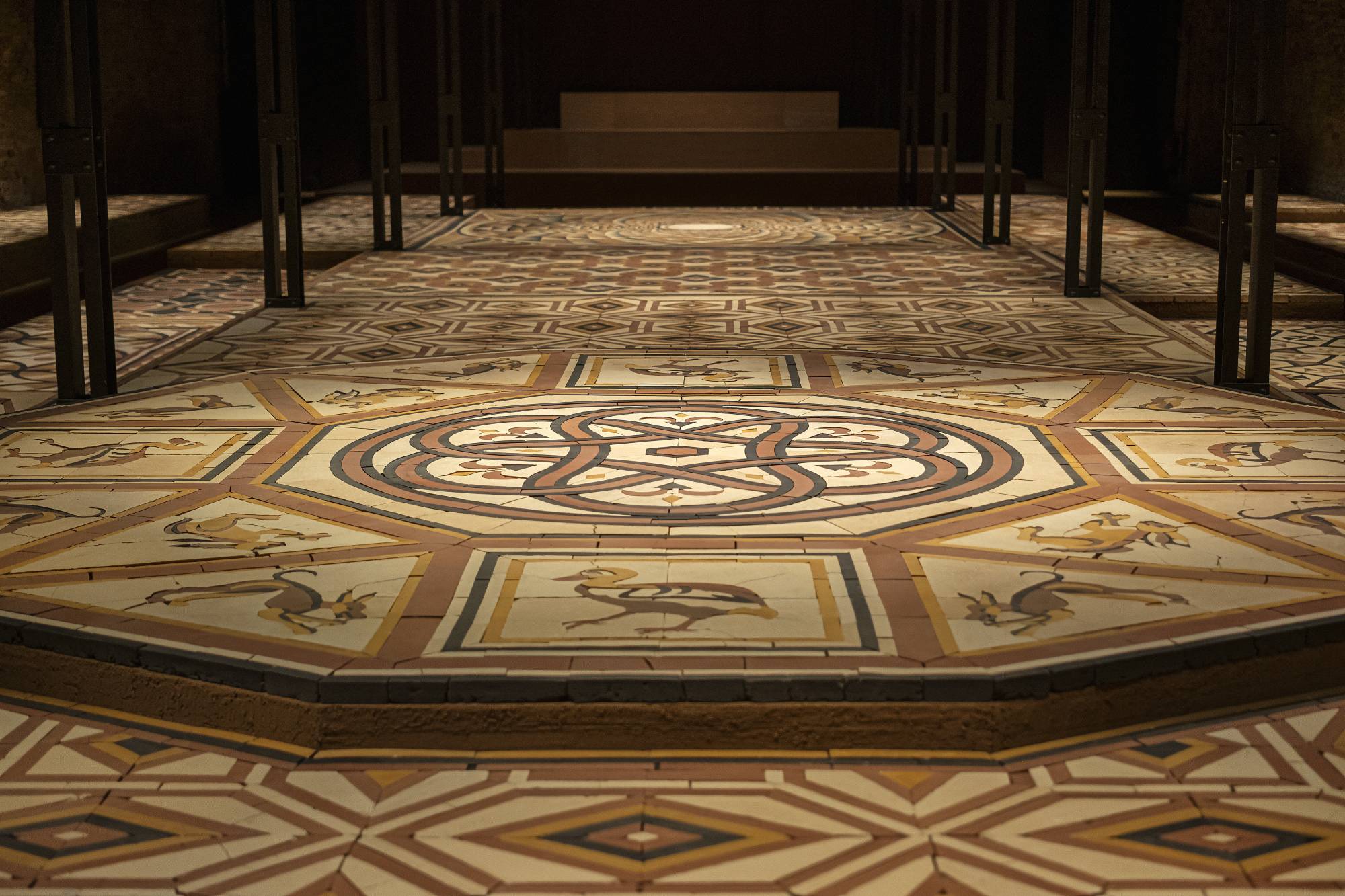
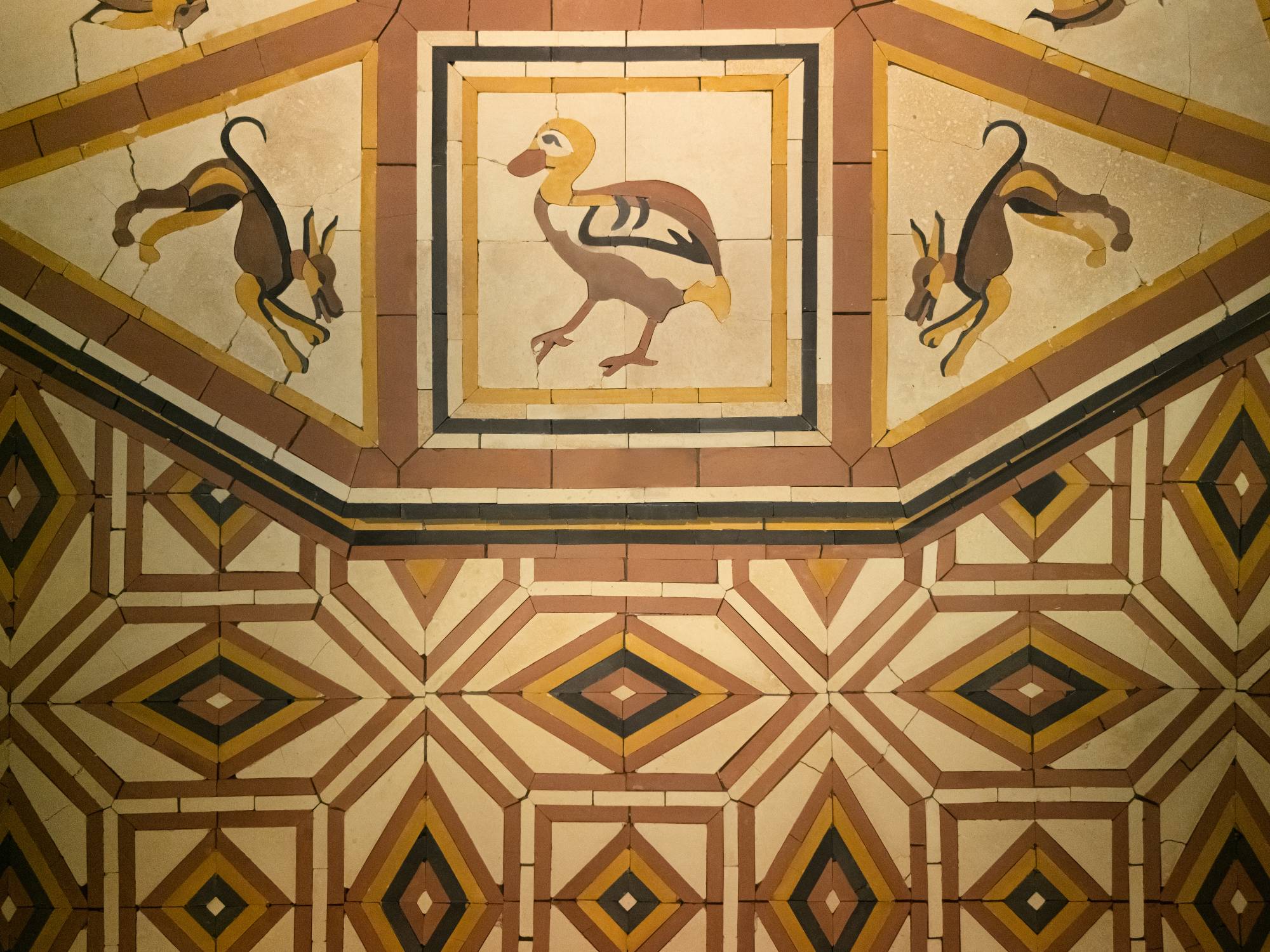
Mosaic carpet reviving the memory of destroyed places (Artist and Visual Arts Commission)
In the Saudi Pavilion at the Venice Biennale, Saudi artist of Palestinian origin, Dana Awartani, takes us on an immersive journey to discover an artistic map of archaeological and historical landmarks destroyed by war. It is not a geographical map, but rather a magnificent mosaic composed of thousands of clay pieces, molded and baked under the Riyadh sun, then colored with natural pigments to form geometric patterns and designs.
These patterns are drawn from historical sites, buildings, and monuments that have stood for centuries in the Arab region, witnessing the rise and fall of states and kingdoms, until they too were destroyed, stripped of their place and significance in the collective Arab heritage.
Artist Dana Awartani (Artist and Visual Arts Commission)
In her work, Awartani has consistently depicted the waves of demolition and destruction that have swept across various Arab countries. Who can forget her monumental piece at the first Riyadh Contemporary Art Biennale, which encapsulated a part of the history of the Great Mosque in Aleppo, Syria, and the tiles of the Hammam al-Samra in Gaza, which she presented at the Bukhara Contemporary Art Biennale last year?
Documentation with Clay and Colors
The theme is expansive, and Awartani's works diligently and patiently record what has been removed and destroyed, imbued with the conviction that we must document what we lose daily because of wars, destruction, and attempts at erasure.
She speaks of her research to learn more about the increasingly demolished buildings and archaeological sites. It's worth noting that her work coincides with escalating violence in the region, as if recording history moment by moment and commenting on the events unfolding before us. Perhaps this element will amplify the impact of the pavilion, as the destruction and demolition are happening now, and Dana's work becomes an immediate commentary on these events.
In Venice, her work evokes twenty-three historical sites of significant historical importance, each possessing immense cultural and material value.
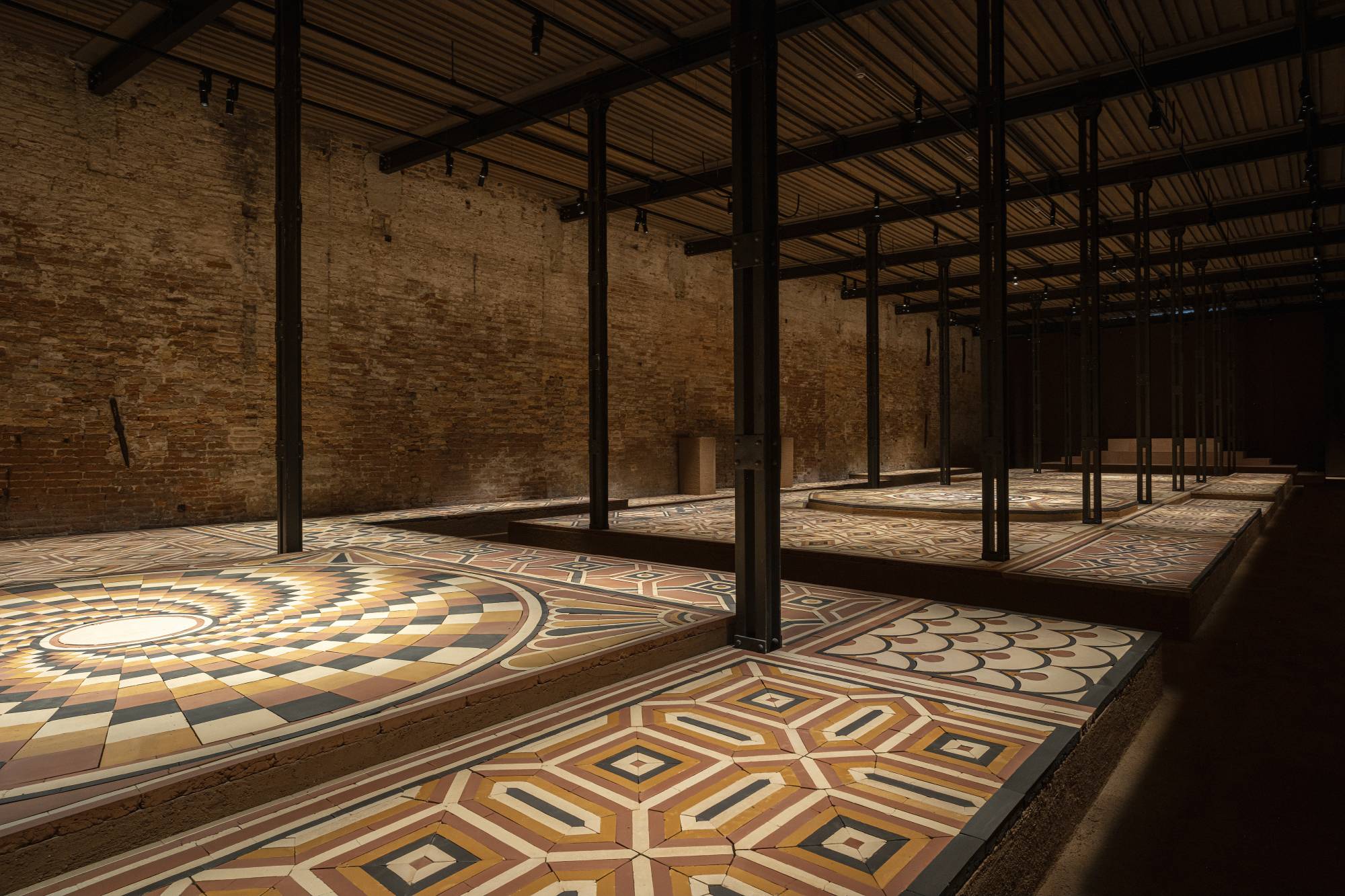
Part of the Saudi pavilion at the Venice Biennale (Artist and the Visual Arts Commission)
The Beginning in Riyadh
In her studio in Riyadh, Dana began working on the monumental artwork representing Saudi Arabia at the Venice Biennale. There, under the scorching sun, workers and craftsmen were engrossed in shaping and arranging clay molds according to a meticulously detailed blueprint that Awartani carried with her. She spoke with the craftsmen, discussing the pieces and their placement.
For her Venice piece, she chose a title inspired by the poetry of Abu Nuwas: "May your tears never dry, you who weep over the ruins." The theme of ruins is a recurring motif in her work. She has addressed numerous Arab monuments that have been destroyed and reduced to ruins, their destruction evoking grief and tears. However, Dana views these ruins with a unique perspective, incorporating them into her art. She continues her research on targeted and destroyed monuments, documenting every new discovery.
During our interview, she spoke about archaeological sites, mosques, churches, and even several synagogues that were reduced to rubble by an aggressive attack that disregarded the past, history, and culture.
Despite choosing a topic addressed by the poet Abu Nuwas, the artist disagrees with his mockery of those who stand on ruins, saying that ruins represent a history that has lived and witnessed cultures and peoples, and some of it will remain after the people are gone: “I believe that these stones carry their history and tell the stories of the people who lived here for hundreds of years. These stones may remain after the living have passed away. Therefore, I did not agree with that poem, but I quoted that particular sentence out of context and used it to illustrate my point of view.”
Her work draws on 23 historically significant sites (Artist and Visual Arts Commission)
The Mosaic Carpet
In Venice, Awartani's work stands out across the entire Saudi pavilion, resembling a mosaic carpet made from colorful bricks. The piece is divided into different visual themes, all inspired by the Middle East, as she explained to Asharq Al-Awsat during a special tour of the studio where the work was created outside Riyadh last January. "All the motifs I used here are taken from different places in the Middle East, and all of them have been destroyed," she said.
In her research, she documented the details of the destroyed sites and what happened to them, then extracted distinctive artistic forms and motifs from each location. She points out that the shapes and decorations vary in origin and history, including Roman and Byzantine styles: "There are many shapes and designs, but I make sure that every design I present includes a reference to a place that has been destroyed."
At the Venice exhibition, all this information is displayed on one of the walls.
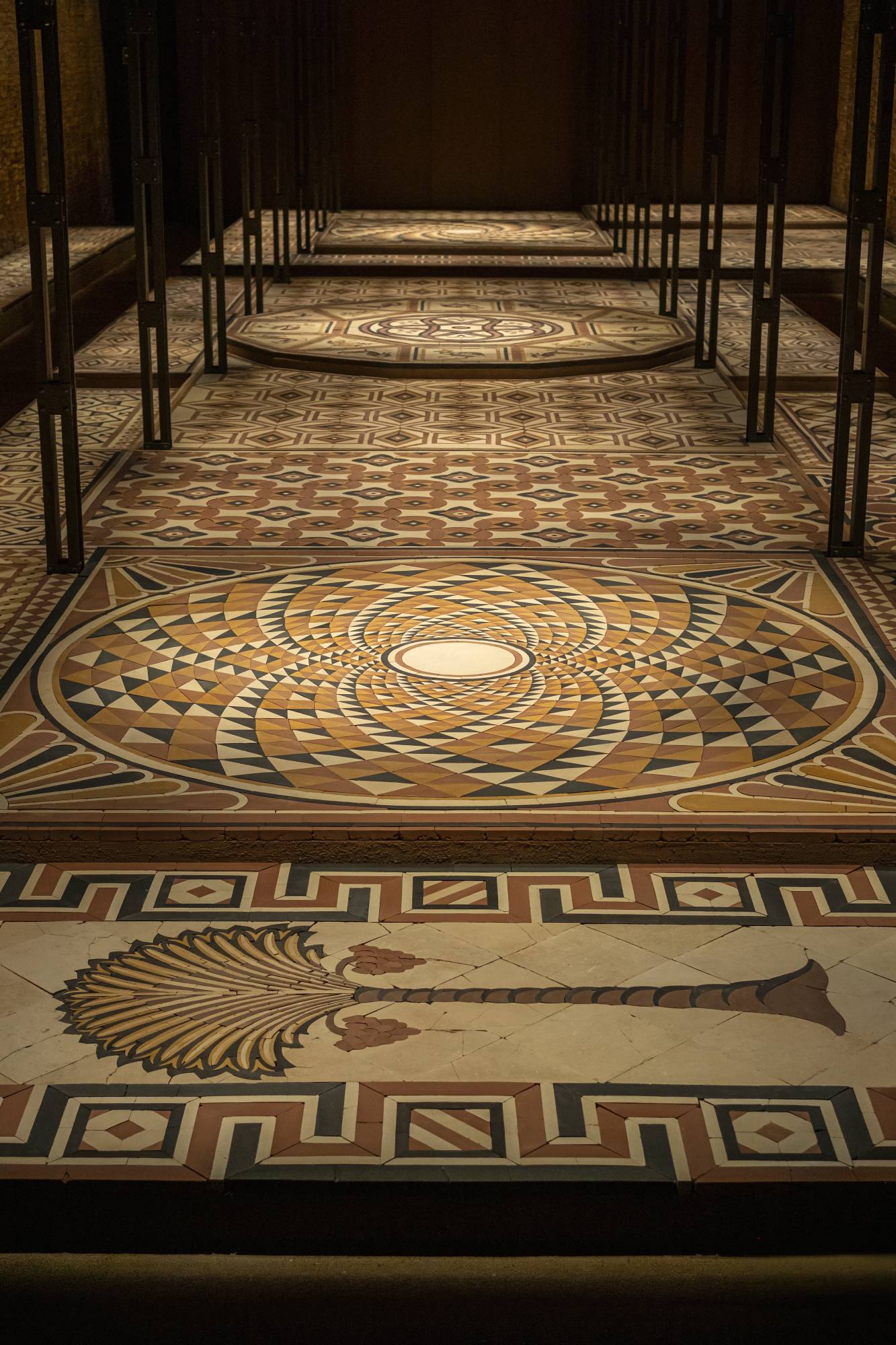
A mosaic carpet revives the memory of destroyed places (Artist and Visual Arts Commission)
An Imagined Archaeological Site
The location of the Saudi pavilion at the Venice Biennale offered the artist a tremendous opportunity to showcase her work. The space was vast and abstract, and Awartani had several ways to present her piece, but she rejected the idea of a traditional display. She explains that the presentation could convey a message of "liberating antiquities from a colonial perspective."
She aimed to create an immersive experience, drawing visitors into the work. Visitors walk through designated pathways between adjacent mosaic tiles, raised on wooden bases without artificial or imposed boundaries. "We wanted the audience to feel like they were part of the work, walking among these elements," she says. "It's like an imagined archaeological site. That's why the entire floor is covered in earth."
She describes the work as an "immersive ground installation" that incorporates a mix of different designs. "I didn't want to create a map showing the origin of each pattern, because many of these patterns exist in multiple locations. It's a shared heritage, and you can't simply say: this is a Palestinian pattern, this is a Syrian pattern, and this is a Lebanese pattern. They are all very similar; our heritage is shared and important to all of us."
She explains the visual patterns and geometric designs used in the work: “There are two patterns from Gaza, one from the Al-Bureij mosaic, and the other from the Monastery of St. Peter. There is also a collection of forms from Beiteddine Palace in Lebanon. There is also a palm tree from a monastery in Syria. Upon entering the building, the visitor will find a wall plaque detailing the main concepts and listing all the sites I mentioned. Most are residential spaces, but many are Christian sites: monasteries, churches, the Church of the Nativity, the Church of All Nations, and Bethlehem and Jerusalem, which have suffered historical damage. This is because mosaics are used extensively in these places.”
Architectural, botanical, and animal-inspired designs drawn from destroyed Arab sites (Artist and Visual Arts Commission)
Fragile Beauty
From the moment we enter the hall, the pieces unfold before us in a serene and fragile beauty. We follow different patterns, noticing that each pattern belongs to a specific place. Some are cracked and appear as if they have just arrived from their actual geographical location, a place of destruction and fragmentation. But this fragile state stems from the artist's desire for the work to reflect the condition of the damaged archaeological sites. In the clay mixture used, she omitted adding straw, which helps bind the pieces together, and left the clay pieces to the effects of nature. She believes that the occurrence of cracks is natural and serves the idea. She did the same when using natural colors to paint the brick pieces and did not try to fix them with artificial materials.
"It won't stay this vibrant because the colors are natural and are absorbed by the clay, but I also didn't want to put a sealant or anything artificial on it."
Architectural designs inspired by destroyed sites (Artist and Visual Arts Commission)
Mosaics.. From East to West and Back
The artist chose to use mosaics for her work, seeing them as an embodiment of the connections between East and West.
"During my research, I discovered that the first mosaics appeared in Mesopotamia, specifically in Iraq. They then spread to the Roman Empire, and mosaic art flourished in Italy, where it was widely used in Christian places of worship. When the Byzantines reached Palestine, Syria, and Lebanon, they brought this art back to the region. Therefore, most of the patterns I use here are inspired by traditional mosaics from that era."
The use of mosaics might not seem out of place in Venice, whose churches boast exquisite examples of them.
A Collaborative Endeavor
The work required over 30,000 hours of labor, involving thirty-two artisans from Riyadh and beyond. The artist has consistently collaborated with artisans specializing in her work, and she has a philosophy behind this.
She speaks of collaborating with artisans as essential to her: “I try to think of it this way: I wouldn’t go to a factory and ask them to carve the stones by machine. I prefer working with people in the traditional way because I also care about preserving the traditional technique. The same applies to this project. It was done using traditional clay, but I modified the technique in a way. Traditional mud bricks contain sand and straw to make them strong and prevent cracking. I deliberately omitted these to make them crack. Mud bricks are usually used in building structures and houses, but I use them as flooring. So, it’s essential to understand the craft we’re working with. I make sure to involve the people involved throughout the process. They will see images of the project, and their names will be credited as my collaborators.”
*The Saudi Pavilion is commissioned by the Visual Arts Commission of the Ministry of Culture, under the supervision of curator Antonia Carver and assistant curator Hafsa Al-Khudairi.
Iraq's Historic Marshes Revive as Water Returns after Years of Droughthttps://english.aawsat.com/varieties/5270585-iraqs-historic-marshes-revive-water-returns-after-years-drought
A drone view shows a boat moving through water channels amid vegetation at the Chibayish marshes in Dhi Qar province, Iraq, May 7, 2026. REUTERS/Thaier Al-Sudani
Iraq's Historic Marshes Revive as Water Returns after Years of Drought
A drone view shows a boat moving through water channels amid vegetation at the Chibayish marshes in Dhi Qar province, Iraq, May 7, 2026. REUTERS/Thaier Al-Sudani
After years of drought that left large swathes of Iraq's historic marshes cracked and empty, rising water levels are beginning to revive the wetlands, drawing buffalo herders and fishermen back to areas once abandoned.
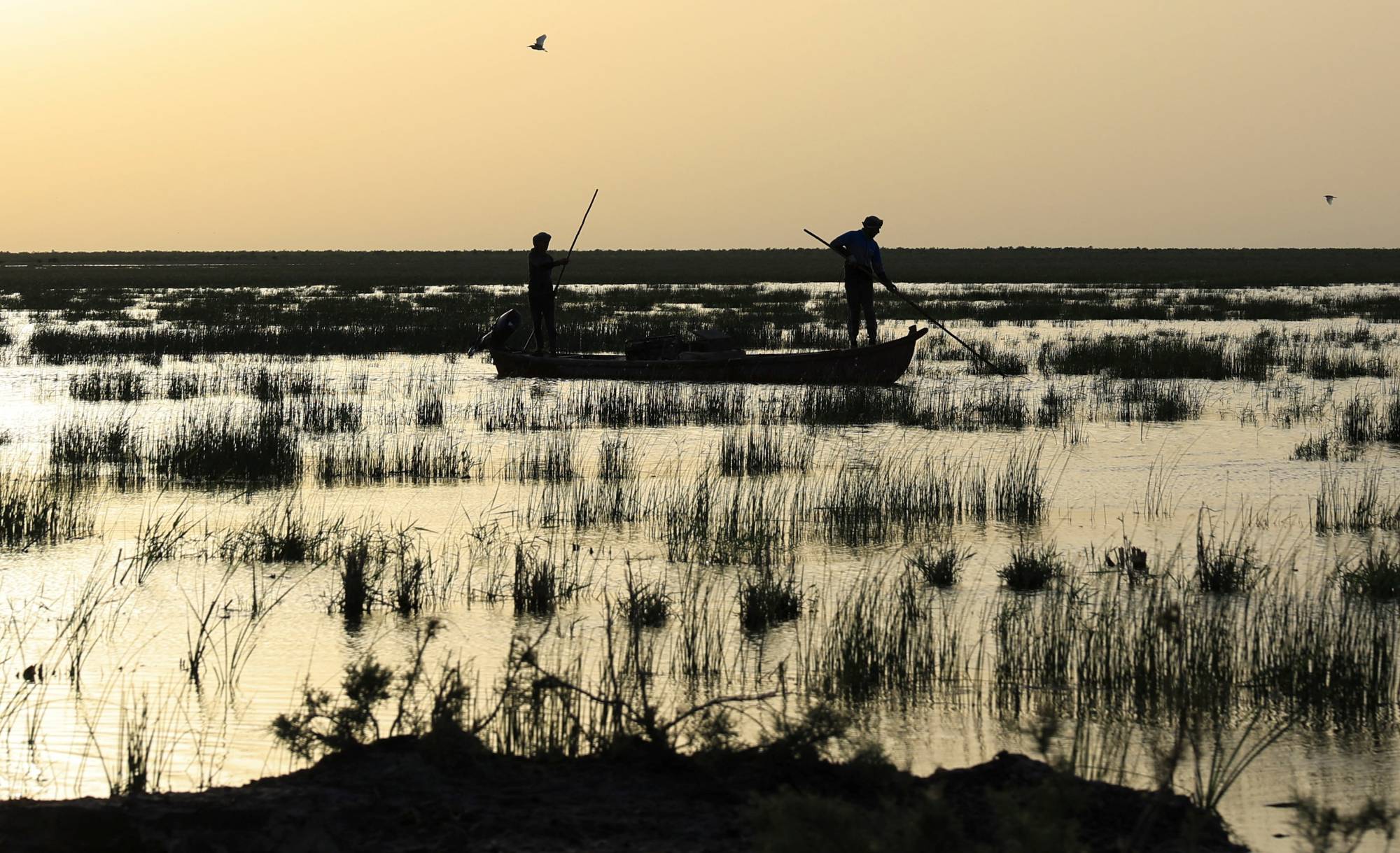
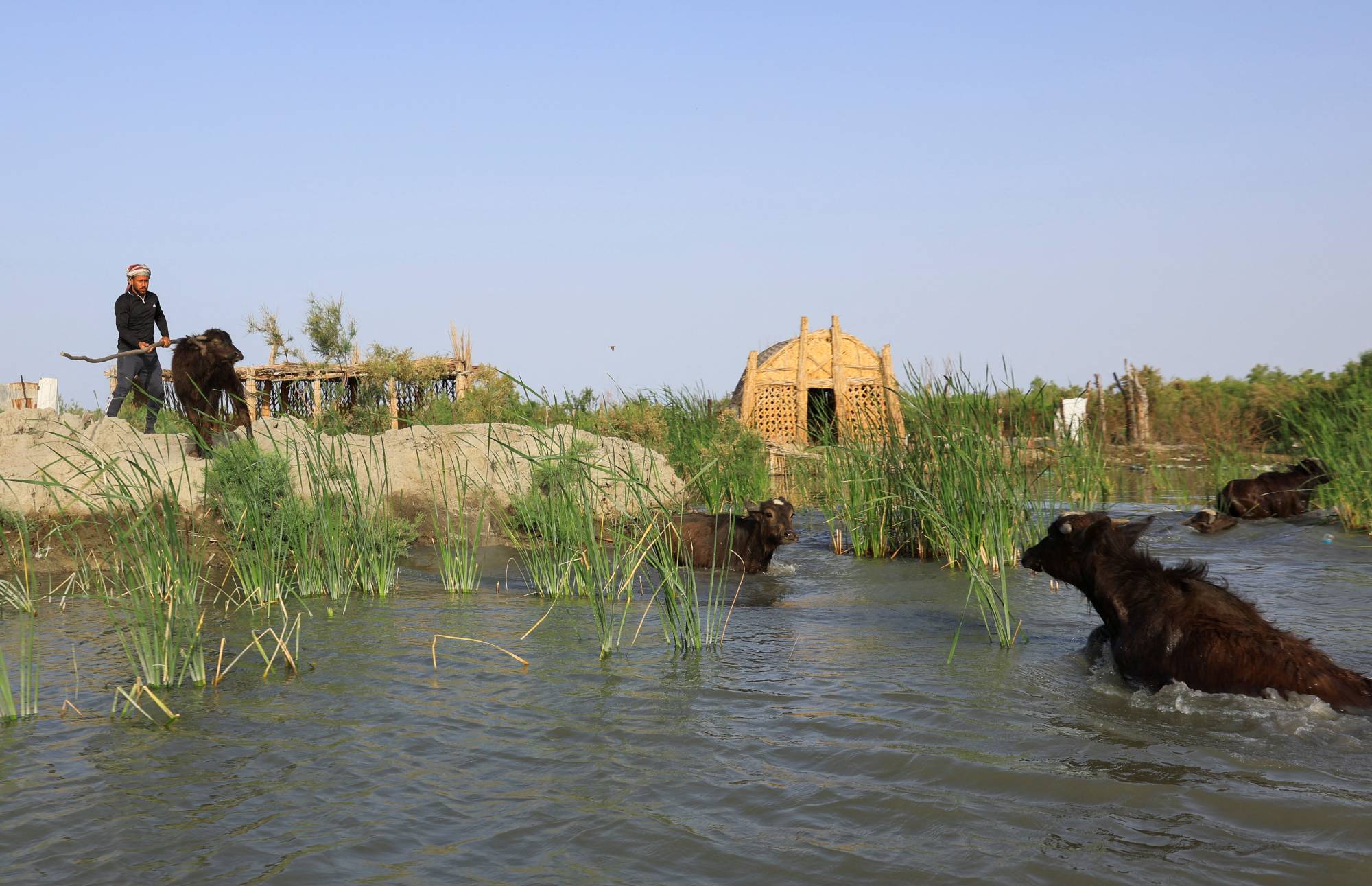
In Chibayish marshes in southern Iraq, canoes once again glide through waterways that had dried up in recent years, while water buffalo wade through restored marshland and patches of green pasture have reappeared.
"Some time ago, all our livestock died and there was no water at all," said Haidar Qassem, a farmer raising water buffalo in the central marsh.
“Many of our people migrated because of the drought,” Qassem said, adding that water had returned this year, livestock numbers were recovering and some families had come back.
The change in the region's fortunes follows heavy winter rainfall that boosted reservoir levels, enabling Iraq’s water resources ministry to release growing volumes into the marshes.
Residents are still hoping for further water releases, Reuters reported.
Fishermen stand in a boat during sunrise at the Chibayish marshes in Dhi Qar province, Iraq, May 7, 2026. REUTERS/Thaier Al-Sudani
Iraqi marshland expert Jassim al-Assadi said the Ishan Hallab area — part of Iraq's marshes, believed by some to be the biblical Garden of Eden and designated a UNESCO World Heritage site in 2016 — had dried up completely between 2021 and 2025, forcing herders to abandon it.
In recent months, the wetter conditions have helped restore the Ishan Hallab area, reviving pastureland and allowing some residents to make their way back to the area.
Al-Assadi said the proportion of submerged marshland had risen to between 32% and 36%, compared with no more than 8% over the past five years, a view Iraqi water resources officials confirmed.
The higher water levels were also supporting a gradual recovery in biodiversity, including fish stocks, vegetation growth and reeds used by residents to build traditional homes.
A buffalo herder guides water buffaloes through marsh waters at the Chibayish marshes in Dhi Qar province, Iraq, May 7, 2026. REUTERS/Thaier Al-Sudani
The marshes have been inhabited for thousands of years by the Marsh Arabs, whose livelihoods and traditions are closely tied to the water.
Mazin Wadai, a water resources official, said larger inflows, improved water management and stronger seasonal rainfall had boosted reserves in dams and increased flows in the Tigris and Euphrates, allowing more water to reach the marshes.
The water resources ministry said Iraq's strategic reserves have increased by about 6 billion cubic meters this year, giving authorities greater flexibility to manage supplies during the summer months.
Iraq's marshes, once stretching across more than 3,600 square miles (9,500 sq km), were heavily drained in the 1990s by Saddam Hussein, who accused the Marsh Arabs of treachery during a 1980–1988 war with Iran, in a bid to root out insurgents.
Many residents fled, but since Saddam's overthrow in 2003 parts of the wetlands have been reflooded by the government, with around 250,000 Marsh Arabs gradually returning.
For residents like buffalo herder Raheem Abdul Zahra, the recent improvements have transformed daily life.
"The land was dry, but now it's alive again," he said.
Separation Surgery of Tanzanian Conjoined Twins Begins in Riyadhhttps://english.aawsat.com/varieties/5270508-separation-surgery-tanzanian-conjoined-twins-begins-riyadh
Separation Surgery of Tanzanian Conjoined Twins Begins in Riyadh
The separation procedure is scheduled to be performed in 10 stages and will take approximately 16 hours. SPA
The medical and surgical teams of the Saudi Conjoined Twins Program (SCTP) began on Thursday the complex procedure of separating 18-month-old Tanzanian twin girls, Nancy and Nice.
The surgery is taking place at King Abdullah Specialized Children’s Hospital (KASCH) at King Abdulaziz Medical City of the Ministry of National Guard in Riyadh in implementation of the directives of Custodian of the Two Holy Mosques King Salman bin Abdulaziz Al Saud, and Prince Mohammed bin Salman bin Abdulaziz Al Saud, Saudi Crown Prince and Prime Minister.
In a statement to the press, Advisor to the Royal Court, Supervisor General of King Salman Humanitarian Aid and Relief Centre (KSrelief) and head of the Surgical and Multidisciplinary Team for the SCTP Dr. Abdullah Al Rabeeah stated that Nancy and Nice arrived in the Kingdom on January 27.
Following the twins’ admission to KASCH, the medical team conducted comprehensive and detailed examinations of the girls, who are conjoined at the lower chest, abdominal, and pelvic areas. Each girl has one leg, and they share a third, deformed lower limb.
Al Rabeeah explained that the medical team conducted a thorough series of examinations and clinical consultations to discuss details about the girls’ case; the twins share one liver, large intestine, anus, urinary and reproductive systems, and also share an external genitalia malformation.
The separation procedure is scheduled to be performed in 10 stages and will take approximately 16 hours.
A team of 35 consultants, specialists, and nursing and technical staff from the fields of anesthesia, pediatric surgery, plastic surgery, pediatric urology, pediatric orthopedics, and other supporting specialties will participate.
Al Rabeeah clarified that while this procedure is delicate, it has a success rate of more than 60%. He stated that Nancy and Nice are the third pair of conjoined twins from Tanzania to be separated by the SCTP since the program began in 1990, and the 71st separation to date.
He added that a total of 157 cases from 28 countries across five continents have been reviewed by the team thus far.
On behalf of himself and his colleagues, Al Rabeeah expressed his appreciation to the Saudi leadership for their ongoing support and follow-up of the program.
لم تشترك بعد
انشئ حساباً خاصاً بك لتحصل على أخبار مخصصة لك ولتتمتع بخاصية حفظ المقالات وتتلقى نشراتنا البريدية المتنوعة