Livestream Giant Twitch to Ban Under-16s in Australia

The eSafety Commission said Friday Twitch met its criteria of platforms to be banned. Martin BUREAU / AFP
TT

Livestream Giant Twitch to Ban Under-16s in Australia

The eSafety Commission said Friday Twitch met its criteria of platforms to be banned. Martin BUREAU / AFP

Livestream giant Twitch will be forced to remove all users under the age of 16 when Australia's strict social media laws take effect next month, Canberra's online regulator said Friday.

From December 10, Australia will force social media platforms including Facebook, Instagram and TikTok to remove users under the age of 16 or face hefty fines.

The eSafety Commissioner said that the US company Twitch -- which started out as a platform for gaming streamers but now hosts live feeds of various genres -- met its criteria to be banned.

The platform includes "features designed to encourage user interaction, including through livestreaming content", the regulator said.

Lifestyle website Pinterest, LegoPlay and WhatsApp will not be banned, but other platforms remain under review.

AFP has reached out to Twitch for comment.

Twitch says that nearly 70 percent of viewers are aged between 18 and 34, but does not disclose how many are younger. It does not allow any users under the age of 13.

Australian authorities have reserved the right to force all platforms to comply with the legislation.

Tech companies have been critical of Australia's ban, describing it as "vague", "problematic" and "rushed".

There is keen interest in whether the sweeping restrictions can work as regulators around the globe wrestle with the potential dangers of social media.

New Zealand's Prime Minister Christopher Luxon will introduce a similar bill to restrict children's social media use.

And the Dutch government advised parents this year to forbid children under 15 from using social media apps like TikTok and Snapchat.

Social media companies caught flouting the laws will face fines of up to $32 million.

On paper, Australia's ban is one of the strictest in the world.

But some experts are concerned that the law will be merely symbolic because of the difficulty in implementing and policing online age verification.


Samsung Electronics Expects Record Quarterly Profit on AI Boom

People visit a Samsung Electronics store gallery in Seoul, South Korea, 07 April 2026. (EPA)
TT

Samsung Electronics Expects Record Quarterly Profit on AI Boom

People visit a Samsung Electronics store gallery in Seoul, South Korea, 07 April 2026. (EPA)

Tech giant Samsung Electronics estimated on Tuesday that its first quarter profit had soared 755 percent annually to a record high of 57.2 trillion won ($37.9 billion), driven by strong sales of chips crucial for artificial intelligence.

The South Korean government has pledged to become one of the world's top three AI powers, alongside the United States and China.

Samsung has emerged as a key player -- along with fellow South Korean firm SK hynix -- in the supply of high-performing chips in demand from companies racing to keep up with the fast-evolving AI industry.

The company also said in a regulatory filing that its sales were expected to reach 133 trillion won ($88 billion) in the three months to the end of March, a 68 percent increase compared to the same period last year.

The strong outlook comes despite the risk posed to the global semiconductor supply chain if the war in the Middle East drags on.

A South Korean ruling party lawmaker told reporters last month that officials from Samsung and other companies had raised concern about potential disruption to chip production if some key supply chain materials, such as helium, cannot be sourced from the Middle East.

"Samsung Electronics achieved its highest-ever results, driven by rising revenue and profits in its memory-focused Device Solutions (DS) division," a Samsung spokesperson said.

He said the firm's competitiveness in home appliances and smartphones has helped to boost earnings.

The operating profit -- more than an eight-fold increase from 6.69 trillion won a year earlier -- was 36.7 percent higher than the average estimate, South Korea's Yonhap news agency reported, citing its own data firm.

- Growing demand -

With growing demand for memory chips, Samsung is expected to see "even better figures" in the months ahead, analyst Ryu Hyung-keun of Daishin Securities told AFP.

"As we are seeing a surge in memory chip prices, its profit margins will improve further for the remainder of the year," he said.

But the company is facing risks, said Kim Dae-jong, a business professor at Sejong University.

"A labor union strike scheduled for next month and the war in Iran are weighing on the outlook," he told AFP.

"The Middle East is Samsung's key market for home appliances, and demand from the region is significant, making it a source of concern."

Meanwhile, LG Electronics, South Korea's second-largest appliance maker after Samsung, also projected record first-quarter revenue of 23.73 trillion won.

"Despite continued macroeconomic uncertainty, the company's core businesses, including home appliances, maintained growth based on strong product competitiveness and solid market positions," the company said in a statement.

- Pushing up prices -

Samsung has seen strong orders from major technology firms for high-bandwidth memory -- a type of chip that is used in data centers and AI "accelerators", which are useful in carrying out demanding tasks and computation.

That is also pushing up the cost of less flashy chips used in consumer electronics -- threatening higher prices for phones, laptops and other devices worldwide.

Riding the AI boom, Samsung's shares have risen more than 240 percent over the past year.

Samsung did not provide earnings breakdowns from its separate divisions, such as the chip and mobile divisions.

Taipei-based research firm TrendForce predicts that memory chip industry revenue will surge to a global peak of more than $840 billion in 2027.

Samsung has already earmarked billions of dollars to expand chip production facilities, pledging to continue spending in "transitioning to advanced manufacturing processes and upgrading existing production lines to meet rising demand".

Experts have said the move would help Samsung seize the moment in the intensifying race for chips critical to AI infrastructure.

Samsung is expected to disclose its final quarterly earnings report at the end of April.

The firm's shares were up 0.73 percent in the afternoon trade in Seoul.


Samsung Is Discontinuing Its Texting App, Tells Impacted Users to Switch to Google Messages

Samsung unveils its latest Galaxy smartphones during a showcase in San Francisco, Feb. 25, 2026. (AP)
TT

Samsung Is Discontinuing Its Texting App, Tells Impacted Users to Switch to Google Messages

Samsung unveils its latest Galaxy smartphones during a showcase in San Francisco, Feb. 25, 2026. (AP)

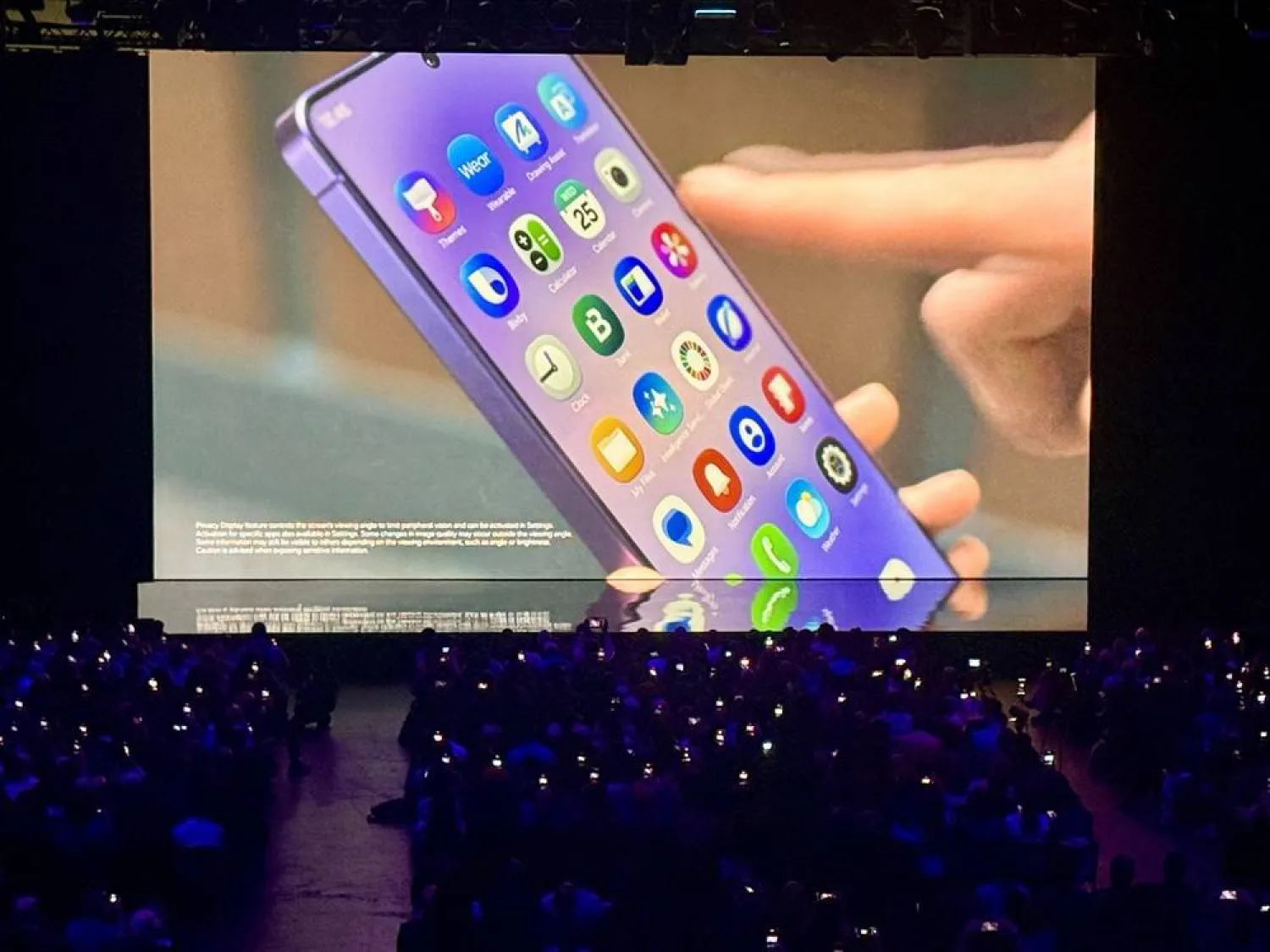
Samsung is saying goodbye its namesake texting app.

According to an end of service announcement published on the tech giant's US support website, Samsung Messages will be discontinued in July. Impacted owners of Samsung smartphones and other gadgets are being asked to switch to Google Messages in the meantime, “to maintain a consistent messaging experience on Android.”

All Samsung Galaxy phones run on Google's Android operating system. To switch to Google Messages, Samsung's website gives users instructions to download the app from the Play Store, if not already on their phone, and set it as the default. Some people may also receive an in-app notification to guide them through the process.

Samsung says switching to Google Messages will give users access to updates like the latest artificial intelligence features from Google's Gemini — which includes an experimental feature called “Remix” to generate images during conversations and AI-powered reply suggestions — and the ability to share higher quality photos between Android and Apple iOS devices through RCS-enabled messages.

Users of older Android operating systems (dating back to Android 11 or older) will not be impacted by the end of Samsung Messages, the company noted. To check what Android OS you have on a Samsung device, open the settings app, click on “software information” and scroll to “Android version.”

Meanwhile, owners of Samsung's latest Galaxy 26 lineup and other newer phones cannot download the Samsung Messages app from the Galaxy Store today.

All devices will no longer be able to download Samsung Messages after it's officially discontinued in July, the company noted. Samsung said users can check their app for the exact date for when service will go offline.

Beyond the US, Samsung did not immediately respond to a request for further information about whether its guidance for Samsung Messages was the same globally.


Microsoft to Invest $10 bn for Japan AI Data Centers

Microsoft's Vice Chair and President Brad Smith (4th L) and (L-R) Sakura Internet Inc President and CEO Kunihiro Tanaka, SoftBank Corp. President and CEO Junichi Miyakawa, Microsoft Japan President Miki Tsusaka, hold a meeitng with Japan's Prime Minister Sanae Takaichi (2nd R) and Vice Minister of Economy, Trade and Industry Toshiro Ino (R) at the Prime Minister's Office in Tokyo on April 3, 2026. Kazuhiro NOGI / POOL/AFP
TT

Microsoft to Invest $10 bn for Japan AI Data Centers

Microsoft's Vice Chair and President Brad Smith (4th L) and (L-R) Sakura Internet Inc President and CEO Kunihiro Tanaka, SoftBank Corp. President and CEO Junichi Miyakawa, Microsoft Japan President Miki Tsusaka, hold a meeitng with Japan's Prime Minister Sanae Takaichi (2nd R) and Vice Minister of Economy, Trade and Industry Toshiro Ino (R) at the Prime Minister's Office in Tokyo on April 3, 2026. Kazuhiro NOGI / POOL/AFP

Microsoft said Friday it will invest $10 billion in Japan over the next four years to build artificial intelligence data centers and related infrastructure.

Power-hungry data centers -- warehouse-like facilities that power AI tools from chatbots to image generators -- are springing up worldwide, and the sector is growing particularly fast in Asia.

Microsoft President Brad Smith met Japanese Prime Minister Sanae Takaichi at her office on Friday to announce the investment, said AFP.

Smith said in a statement that it was a "response to Japan's growing need for cloud and AI services".

Businesses in Japan, the world's fourth-largest economy, are keen to get ahead in the fast-moving AI field.

But data centers expansion there is constrained by limited space and relatively expensive electricity.

The US tech giant will collaborate with Japan's SoftBank Group and Sakura Internet to expand domestic tech infrastructure, it said in a press release.

It follows a $2.9 billion two-year investment Microsoft announced in 2024 to bolster the country's push into AI and strengthen its cyber defenses.

The investment unveiled Friday also includes funds to enhance cybersecurity partnerships with Japanese government agencies, and to train one million engineers in cooperation with telecom and tech giants NTT and NEC.

A rush to build data centers in the Asia-Pacific region, especially in India and Southeast Asia, has sparked concerns over the facilities' environmental impact.

That includes increased demand on electricity grids that are often reliant on fossil fuels, and on local water supplies used to cool the hot servers inside.

Microsoft says it has pledged to become carbon negative, zero-waste and "water positive" by 2030.

On Tuesday, the company announced plans to invest more than $1 billion in cloud and AI data center infrastructure and operations in Thailand over the next two years.