
Beirut on Alert as Talks Aim to Halt Escalation after Tabtabai’s Killing

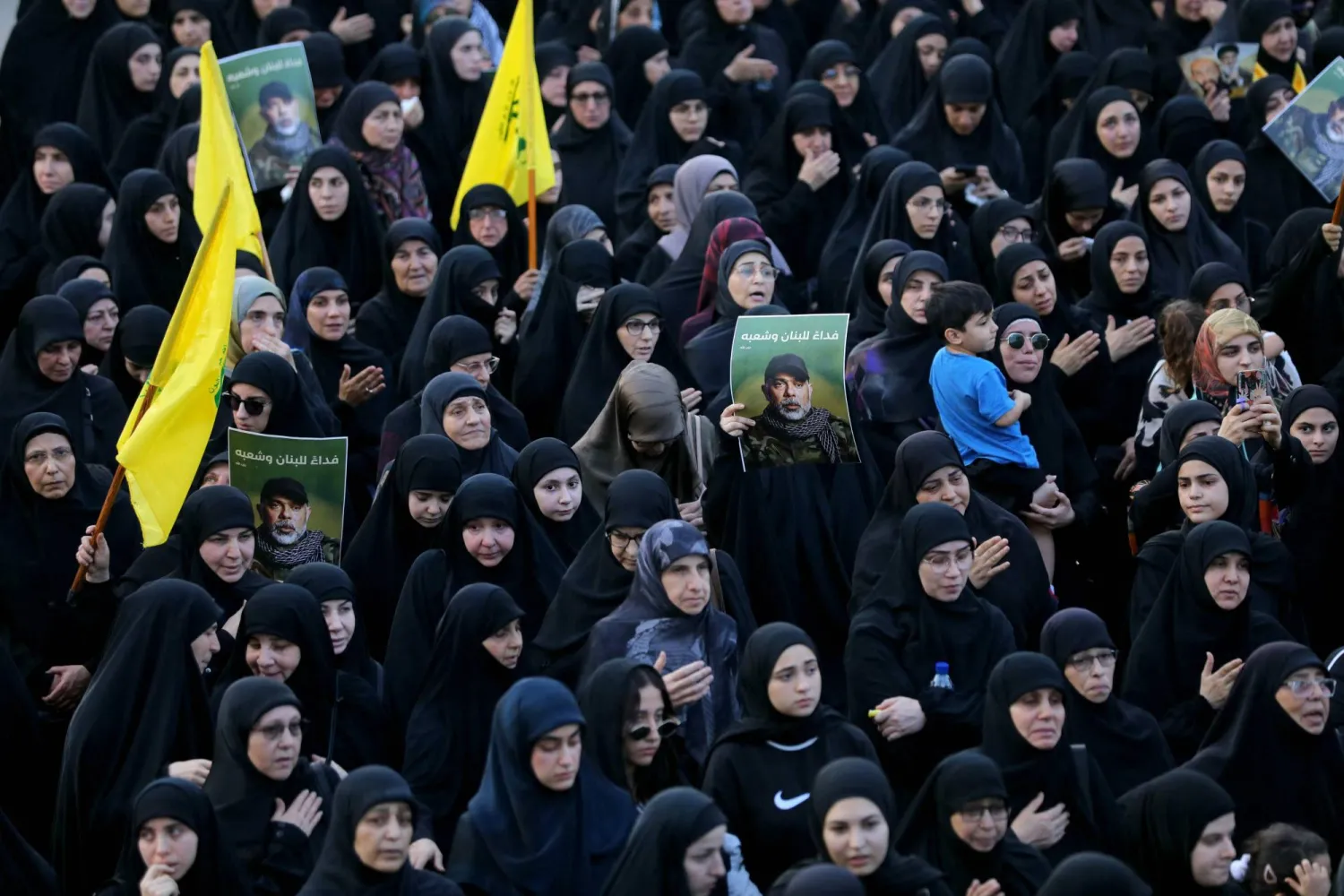
Mourners carry pictures of Haitham Tabtabai, who was killed in an Israeli strike a day earlier, during his funeral in Beirut's southern suburbs on November 24, 2025. (Photo by Ibrahim AMRO / AFP)
TT

Beirut on Alert as Talks Aim to Halt Escalation after Tabtabai’s Killing

Mourners carry pictures of Haitham Tabtabai, who was killed in an Israeli strike a day earlier, during his funeral in Beirut's southern suburbs on November 24, 2025. (Photo by Ibrahim AMRO / AFP)

Concern of further Israeli escalation has grown, following the assassination of Hezbollah’s chief of staff, Haitham al-Tabtabai, in Beirut’s southern suburbs on Sunday.

Lebanese officials view the Israeli strike that killed al-Tabtabai as a political and security message, particularly as it comes on the heels of a new initiative launched by Lebanese President Joseph Aoun. The proposal, like earlier attempts, was met not with dialogue but with fire.

The French Embassy in Beirut on Monday expressed its “deep concern over the Israeli strike that targeted Beirut on Sunday, increasing the risk of escalation in an already highly tense context,” according to a short statement published on its X account.

Diplomatic efforts are expected to continue this week, with Egyptian Foreign Minister Badr Abdelatty scheduled to arrive in Beirut on Tuesday to meet Lebanese officials. His visit follows earlier mediation by Egyptian intelligence chief Maj. Gen. Hassan Rashad, aimed at curbing confrontation and preventing an escalation.

“Weeks ago, when President Aoun proposed a negotiation framework, Israel responded with heavy bombardment of the Bekaa and the South,” ministerial sources told Asharq Al-Awsat. “Two days after he unveiled a new initiative for a sustainable solution and stability, the response came again - this time striking Beirut’s southern suburbs.”

The sources added that the presidency is seeking to garner support for the proposal and is holding both local and international discussions “to calm tensions and avoid escalation.”

They argue that Israel is signaling that “efforts - whether through initiatives or negotiations - are futile, because Israel will do what it decides to do,” pointing to “a series of increasingly hostile statements from officials in Tel Aviv.”

Yet Hezbollah signaled a hardening stance. During the funeral of al-Tabtabai on Monday, the head of its Executive Council, Ali Daamoush, declared: “We are not concerned with any proposal or initiative as long as (Israeli) aggression and violations continue.

He called on Israel to commit to the ceasefire obligations before discussion on any initiative.

Ministerial sources reiterated Aoun’s call for the international community to assume its responsibilities. “Israel refuses every initiative, and we see no clear international action. We are doing our part; let the world do its part,” they remarked.

Israel has meanwhile announced that it has significantly reinforced its northern air-defense readiness and vowed to intensify strikes aimed at weakening Hezbollah and preventing it from rebuilding its capabilities.

Parliamentary sources from the Development and Liberation Bloc, led by Speaker Nabih Berri, said the strike carries “multiple political and security messages,” delivered not only to Hezbollah but also to the Lebanese presidency and its diplomatic efforts.

They warned that the attack, carried out in a densely populated residential district, marks “a dangerous indicator of the escalating strategy Israel has pursued since the November 2024 ceasefire agreement.”

MP Antoine Habchi of the Lebanese Forces bloc argued that Hezbollah’s leadership “still hides among civilians,” claiming this shows the presence of collaborators within the organization.

He called on the state to intervene and “identify where the breach lies."


EU Condemns Israel's West Bank Control Measures

The Israeli settlement of Har Homa, seen from the West Bank city of Bethlehem, Tuesday, Dec. 17, 2024. (AP)
TT

EU Condemns Israel's West Bank Control Measures

The Israeli settlement of Har Homa, seen from the West Bank city of Bethlehem, Tuesday, Dec. 17, 2024. (AP)

The European Union on Monday condemned new Israeli measures to tighten control of the West Bank and pave the way for more settlements in the occupied Palestinian territory, AFP reported.

"The European Union condemns recent decisions by Israel's security cabinet to expand Israeli control in the West Bank. This move is another step in the wrong direction," EU spokesman Anouar El Anouni told journalists.


Atrocities in Sudan's El-Fasher Were 'Preventable Human Rights Catastrophe'

Sudanese displaced people who left El Fasher after its fall, sit in the shade in Tawila at the Rwanda camp reception point on December 17, 2025. (Photo by AFP)
TT

Atrocities in Sudan's El-Fasher Were 'Preventable Human Rights Catastrophe'

Sudanese displaced people who left El Fasher after its fall, sit in the shade in Tawila at the Rwanda camp reception point on December 17, 2025. (Photo by AFP)

The atrocities unleashed on El-Fasher in Sudan's Darfur region last October were a "preventable human rights catastrophe", the United Nations said Monday, warning they now risked being repeated in the neighbouring Kordofan region.


"My office sounded the alarm about the risk of mass atrocities in the besieged city of El-Fasher for more than a year ... but our warnings were ignored," UN rights chief Volker Turk told the Human Rights Council in Geneva.


He added that he was now "extremely concerned that these violations and abuses may be repeated in the Kordofan region".


Arab League Condemns Israel's Decisions to Alter Legal, Administrative Status of West Bank

A general view shows the opening session of the meeting of Arab foreign ministers at the Arab League Headquarters (Reuters)
TT

Arab League Condemns Israel's Decisions to Alter Legal, Administrative Status of West Bank

A general view shows the opening session of the meeting of Arab foreign ministers at the Arab League Headquarters (Reuters)

The General Secretariat of the Arab League strongly condemned decisions by Israeli occupation authorities to impose fundamental changes on the legal and administrative status of the occupied Palestinian territories, particularly in the West Bank, describing them as a dangerous escalation and a flagrant violation of international law, international legitimacy resolutions, and signed agreements, SPA reported.

In a statement, the Arab League said the measures include facilitating the confiscation of private Palestinian property and transferring planning and licensing authorities in the city of Hebron and the area surrounding the Ibrahimi Mosque to occupation authorities.

It warned of the serious repercussions of these actions on the rights of the Palestinian people and on Islamic and Christian holy sites.

The statement reaffirmed the Arab League’s firm support for the legitimate rights of the Palestinian people, foremost among them the establishment of their independent state on the June 4, 1967 borders, with East Jerusalem as its capital.