


Taiwan Plans Extra $40 Billion in Defense Spending to Counter China 

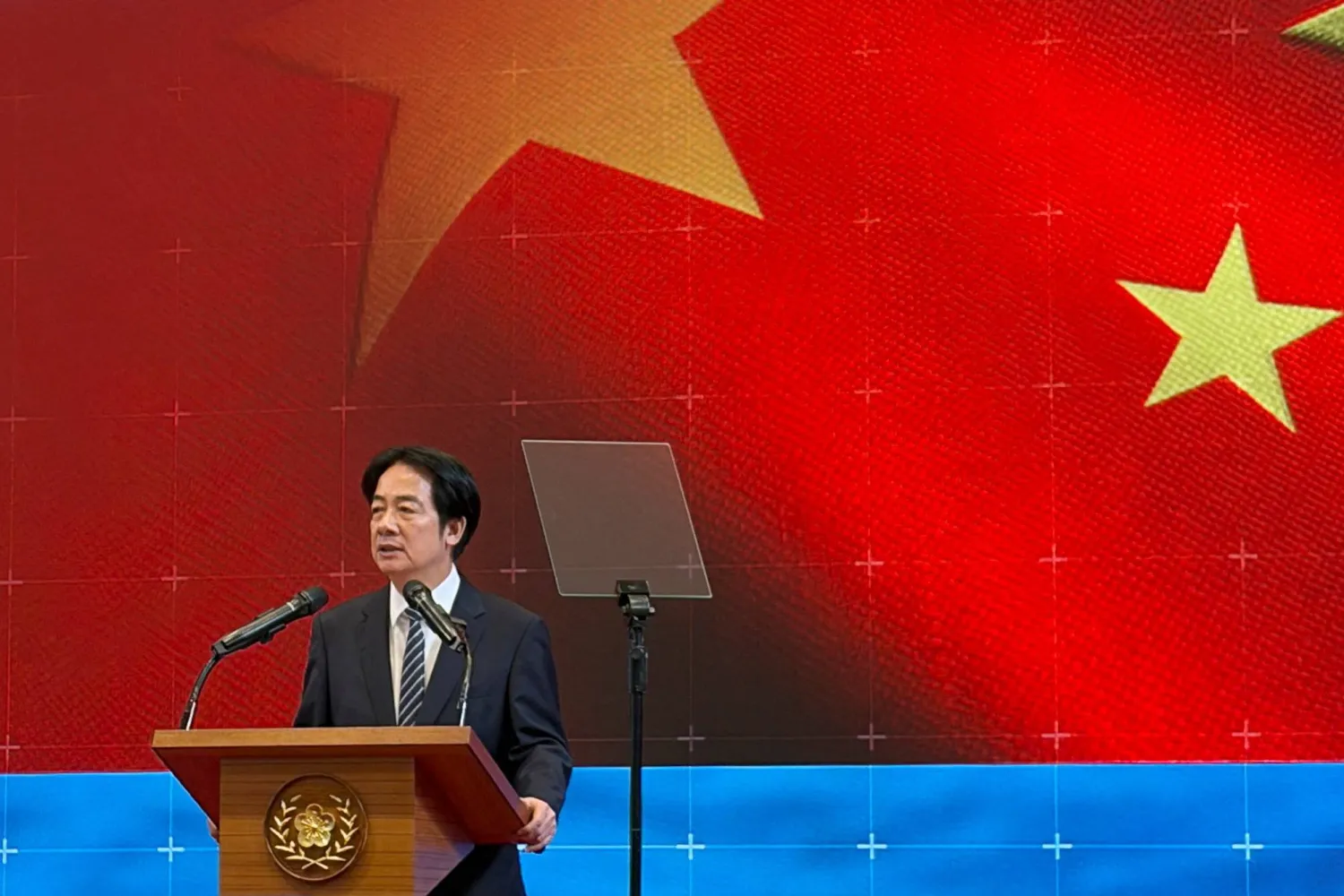
Taiwan President Lai Ching-te speaks at a press conference on defense spending in Taipei, Taiwan November 26, 2025. (Reuters)
TT

Taiwan Plans Extra $40 Billion in Defense Spending to Counter China 

Taiwan President Lai Ching-te speaks at a press conference on defense spending in Taipei, Taiwan November 26, 2025. (Reuters)

Taiwan will introduce a $40-billion supplementary defense budget to underscore its determination to defend itself in the face of a rising threat from China, President Lai Ching-te said on Wednesday.

China, which views democratically-governed Taiwan as its own territory, has ramped up military and political pressure over the past five years to assert its claims, which Taipei strongly rejects.

As Taiwan faces calls from Washington to spend more on its own defense, mirroring US pressure on Europe, Lai said in August he hoped for a boost in defense spending to 5% of gross domestic product by 2030.

Unveiling the T$1.25 trillion ($39.89 billion) package, Lai said history had proven that trying to compromise in the face of aggression brought nothing but "enslavement".

"There is no room for compromise on national security," he said at a press conference in the presidential office.

"National sovereignty and the core values of freedom and democracy are the very foundation of our nation."

Taiwan Defense Minister Wellington Koo said the budget, which will run from 2026-2033, will cover items including missiles and drones as well as the new "T-Dome" air defense system.

DETERMINATION TO DEFEND ITSELF

Lai, who first announced the new spending plan in an op-ed in the Washington Post on Tuesday, said Taiwan was showing its determination to defend itself.

"It is a struggle between defending democratic Taiwan and refusing to submit to becoming 'China's Taiwan'," he added, rather than merely an ideological struggle or a dispute over "unification versus independence".

Lai had previously flagged extra defense spending, but had not given details.

The de facto US ambassador in Taipei, Raymond Greene, wrote on Facebook that the United States supports Taiwan's "rapid acquisition of critical asymmetric capabilities".

"Today's announcement is a major step towards maintaining peace and stability across the Taiwan Strait by strengthening deterrence," he added.

Taiwan has been modernizing its armed forces to push an "asymmetric" approach to warfare to make its forces, which are much smaller than China's, agile and able to pack a greater and more targeted punch.

For 2026, the government plans that such spending will reach T$949.5 billion ($30.3 billion), to stand at 3.32% of GDP, crossing a 3% threshold for the first time since 2009.

The spending will need to be passed by Taiwan's opposition-dominated parliament.

Cheng Li-wun, chairwoman of Taiwan's largest opposition party the Kuomintang, has previously rejected increased defense spending. On Wednesday, she did not directly say the party would vote against the budget, but urged Lai to "step back from the brink".

"I also hope the international community can understand that the people of Taiwan love peace and firmly desire peace. We want to stay far away from the flames of war, we want to avoid war," Cheng told a party meeting.

Lai's announcement comes as China and Japan are embroiled in a bitter dispute about Taiwan, after Japanese Prime Minister Sanae Takaichi said that a hypothetical Chinese attack on Taiwan could trigger Japanese military action.

"Constantly launching multifaceted threats and attacks against neighboring countries at every turn is not the conduct expected of a responsible major power," Lai said, when asked about the issue and referring to China.

Speaking earlier in Beijing, a spokesperson for China's Taiwan Affairs Office said Taiwan was allowing "external forces" to dictate its decisions.

"They squander funds that could be used to improve people's livelihoods and develop the economy on purchasing weapons and currying favor with external powers," the spokesperson, Peng Qingen, told reporters.

"This will only plunge Taiwan into disaster."

The United States is bound by law to provide Taiwan with the means to defend itself, despite a lack of formal diplomatic ties.

US RELATIONS

But since US President Donald Trump took office in January, it approved only one new arms sale to Taiwan, a $330 million package for fighter jets and other aircraft parts announced this month.

The United States plans to ramp up weapons sales to Taipei to a level exceeding Trump's first term, as part of an effort to deter China, two US officials told Reuters in May.

"The international community is safer today because of the Trump administration's pursuit of peace through strength," Lai wrote in the Washington Post.

Lai said Taiwan's ties with the United States were "rock-solid", when asked at the news conference whether he was worried about Trump's visit to China next year, given the improved Washington-Beijing trade relations.

"Recently, before his trip to Asia, President Trump specifically emphasized that 'Taiwan is Taiwan' and President Trump (said he) personally respects Taiwan. These two brief statements say it all," Lai said, referring to comments Trump made while visiting the region last month.

Lai says only Taiwan's people can decide their future. Beijing has rejected his repeated offers of talks, saying he is a "separatist".



UK Sanctions Iran Interior Minister Over Protester Crackdown

 A woman walks past the flag and map of Iran painted on a wall in the Iranian capital Tehran on January 31, 2026, ahead of the 47th anniversary of the 1979 revolution. (AFP)
A woman walks past the flag and map of Iran painted on a wall in the Iranian capital Tehran on January 31, 2026, ahead of the 47th anniversary of the 1979 revolution. (AFP)
TT

UK Sanctions Iran Interior Minister Over Protester Crackdown

 A woman walks past the flag and map of Iran painted on a wall in the Iranian capital Tehran on January 31, 2026, ahead of the 47th anniversary of the 1979 revolution. (AFP)
A woman walks past the flag and map of Iran painted on a wall in the Iranian capital Tehran on January 31, 2026, ahead of the 47th anniversary of the 1979 revolution. (AFP)

The UK on Monday sanctioned 10 individuals, including Iran's interior minister and police chiefs, for their roles in "recent brutality against protesters", the British foreign ministry said.

Those sanctioned include the Law Enforcement Forces of the Islamic Republic of Iran (FARAJA), interior minister Eskandar Momeni, two Iranian Revolutionary Guard (IRGC) officers, an Iranian businessman linked to the IRGC and two judges.

"The Iranian people have shown extreme courage in the face of brutality and repression over recent weeks simply for exercising their right to peaceful protest," said UK foreign minister Yvette Cooper.

"The reports and shocking scenes of violence that have been seen around the world are horrific," Cooper said, adding that this package of sanctions seeks to hold Iran's authorities "to account" for the crackdown.

The measures involve asset freezes and travel bans, the government said.

Iran's authorities have said the protests, which were sparked by economic strain and exploded in size and intensity over several days in early January, were "riots" inflamed by its arch foes the United States and Israel.

Tehran has acknowledged thousands of deaths during the protests, and on Sunday the presidency published the names of 2,986 people out of the 3,117 whom authorities said were killed in the unrest.

Authorities insist most were members of the security forces and innocent bystanders, attributing the violence to "terrorist acts".

The US-based Human Rights Activists News Agency said it has confirmed 6,842 deaths, mostly protesters killed by security forces, though rights groups warn that the figure is likely far higher.


WHO Chief Says Turmoil Creates Chance for Reset

WHO Director-General Tedros Adhanom Ghebreyesus looks on during a press conference with the Association of Accredited Correspondents at the United Nations (ACANU) at the World Health Organization's headquarters in Geneva, on December 10, 2024. (AFP)
TT

WHO Chief Says Turmoil Creates Chance for Reset

WHO Director-General Tedros Adhanom Ghebreyesus looks on during a press conference with the Association of Accredited Correspondents at the United Nations (ACANU) at the World Health Organization's headquarters in Geneva, on December 10, 2024. (AFP)

The head of the World Health Organization said Monday that the dramatic cuts of 2025 as the United States headed for the exit created the chance to build a leaner, re-focused WHO.

Washington, traditionally the UN health agency's biggest donor, has slashed foreign aid spending under President Donald Trump, who on his first day back in office in January 2025 handed the WHO his country's one-year notice of withdrawal.

WHO chief Tedros Adhanom Ghebreyesus told the agency's annual executive board meeting that 2025 was "undeniably one of the most difficult years in our organization's history", with many donors tightening their belts.

"Significant cuts to our funding left us with no choice but to reduce the size of our workforce," he said.

More than a thousand staff have departed but Tedros said such a shock was something the WHO had seen coming, having tried to pivot away from over-reliance on major donors.
And its reorientation was all but finalized, he said.

"We have now largely completed the prioritization and realignment. We have reached a position of stability and we are moving forward," Tedros insisted.

"Although we have faced a significant crisis in the past year, we have also viewed it as an opportunity. It's an opportunity for a leaner WHO to become more focused on its core mission."

He urged member states to keep gradually increasing their membership fees, to reduce the WHO's reliance on voluntary contributions.

The aim is for membership fees to eventually cover 50 percent of the agency's budget, to secure its "long-term stability, sustainability and independence".

"I don't mean independence from member states. Of course, WHO belongs to you and always will," he stressed.

"I mean non-dependence on a handful of donors; I mean non-dependence on inflexible, unpredictable funding; I mean a WHO that's no longer a contractor to the biggest donors.

"I mean an impartial, science-based organization that's free to say what the evidence says, without fear or favor."

The executive board meeting, which opened Monday and runs until Saturday, will discuss the withdrawal notifications of the United States and Argentina.

Unlike any other member state, the United States reserved the right to withdraw when it joined the organization in 1948 -- on condition of one year's notice, and meeting its financial obligations in full for that fiscal year.

While the notice is now up, Washington has not paid its 2024 or 2025 dues, owing around $260 million.


Iran President Orders Talks with US as Trump Hopeful of Deal

 Iranians walk in a street in Tehran, Iran, 02 February 2026. (EPA)
Iranians walk in a street in Tehran, Iran, 02 February 2026. (EPA)
TT

Iran President Orders Talks with US as Trump Hopeful of Deal

 Iranians walk in a street in Tehran, Iran, 02 February 2026. (EPA)
Iranians walk in a street in Tehran, Iran, 02 February 2026. (EPA)

Iranian President Masoud Pezeshkian has ordered the start of nuclear talks with the United States, local media said Monday, after US leader Donald Trump said he was hopeful of a deal to avert military action against the country. 

Following the Iranian authorities' deadly response to anti-government protests that peaked last month, Trump has threatened military action and ordered the dispatch of an aircraft carrier group to the Middle East. 

Trump has maintained he is hopeful of making a deal and Tehran has also insisted it wants diplomacy, while vowing an unbridled response to any aggression. 

"President Pezeshkian has ordered the opening of talks with the United States" on Iran's nuclear program, the Fars news agency reported on Monday, citing an unnamed government source. The report was also carried by the government newspaper Iran and the reformist daily Shargh. 

US news site Axios cited two unnamed sources saying Iranian Foreign Minister Abbas Araghchi was expected to meet with US envoy Steve Witkoff on Friday in Istanbul to discuss a possible deal on the nuclear file. 

Trump had warned "time is running out" for Iran to reach a deal on its nuclear program, which the West believes is aimed at making an atomic bomb, a claim Tehran has repeatedly denied. 

In an interview Sunday with CNN, Araghchi said, "President Trump said no nuclear weapons, and we fully agree. We fully agree with that. That could be a very good deal," adding that, "in return, we expect sanctions lifting". 

Iran foreign ministry spokesman Esmaeil Baqaei said earlier Monday Tehran was working on a method and framework for negotiations that would be ready in the coming days, with messages between the two sides relayed through regional players. 

- 'Police the world' - 

Türkiye has led a diplomatic push to defuse tensions, with Araghchi visiting Istanbul last week and speaking with other regional counterparts, including in Egypt and Jordan. 

Jordan's top diplomat, Ayman Safadi, on Monday assured Araghchi the kingdom would "not be a battleground in any regional conflict or a launching pad for any military action against Iran". 

Iranian authorities, including supreme leader Ali Khamenei, have warned any US attack would trigger a "regional war". 

In Tehran, pensioner Ali Hamidi told AFP he was a veteran and "not afraid of war", but that "America should mind its own business, why does it want to police the world?" 

But, the 68-year-old added, "Iranian officials are also at fault for not providing for the people. The economic troubles are back-breaking... The officials should do something tangible, not just talk." 

The protests were sparked in late December by economic strain and exploded in size and intensity over several days in early January. 

Authorities have said the protests were "riots" inflamed by its arch foes the United States and Israel, with Khamenei likening them to a "coup" attempt. 

- Ambassadors summoned - 

Tehran has acknowledged thousands of deaths during the protests, and on Sunday the presidency published the names of 2,986 people out of the 3,117 whom authorities said were killed in the unrest. 

Authorities insist most were members of the security forces and innocent bystanders, attributing the violence to "terrorist acts". 

US-based Human Rights Activists News Agency said it has confirmed 6,842 deaths, mostly protesters killed by security forces, with rights groups warning the figure is likely far higher. 

Young Iranian Selina, who would not give her full name, travelled to Iraqi Kurdistan seeking some relief from "living in fear". 

"It's not safe for us" in Iran, the 25-year-old told AFP. 

"We don't even dare to go out after 6:00 pm because soldiers are everywhere." 

The crackdown prompted the European Union to list the Iranian Revolutionary Guard Corps (IRGC) as a terrorist organization, with Iranian lawmakers retaliating on Sunday by slapping the same designation on European armies. 

The EU also issued fresh sanctions on Iranian officials, including the interior minister, a move echoed on Monday by Britain, which announced sanctions on 10 individuals over the "brutality against protesters". 

Baqaei said Monday the foreign ministry had summoned all the EU member state ambassadors in Tehran over the designation, and that other responses were to come. 

Iranian state television also announced four foreigners had been arrested in Tehran for "participation in riots", without specifying their nationalities. 

Authorities have continued to announce arrests, with rights groups estimating at least 40,000 people have been detained over the protests.