


Paris's Arthouse Cinemas Adapt to Battle Decline

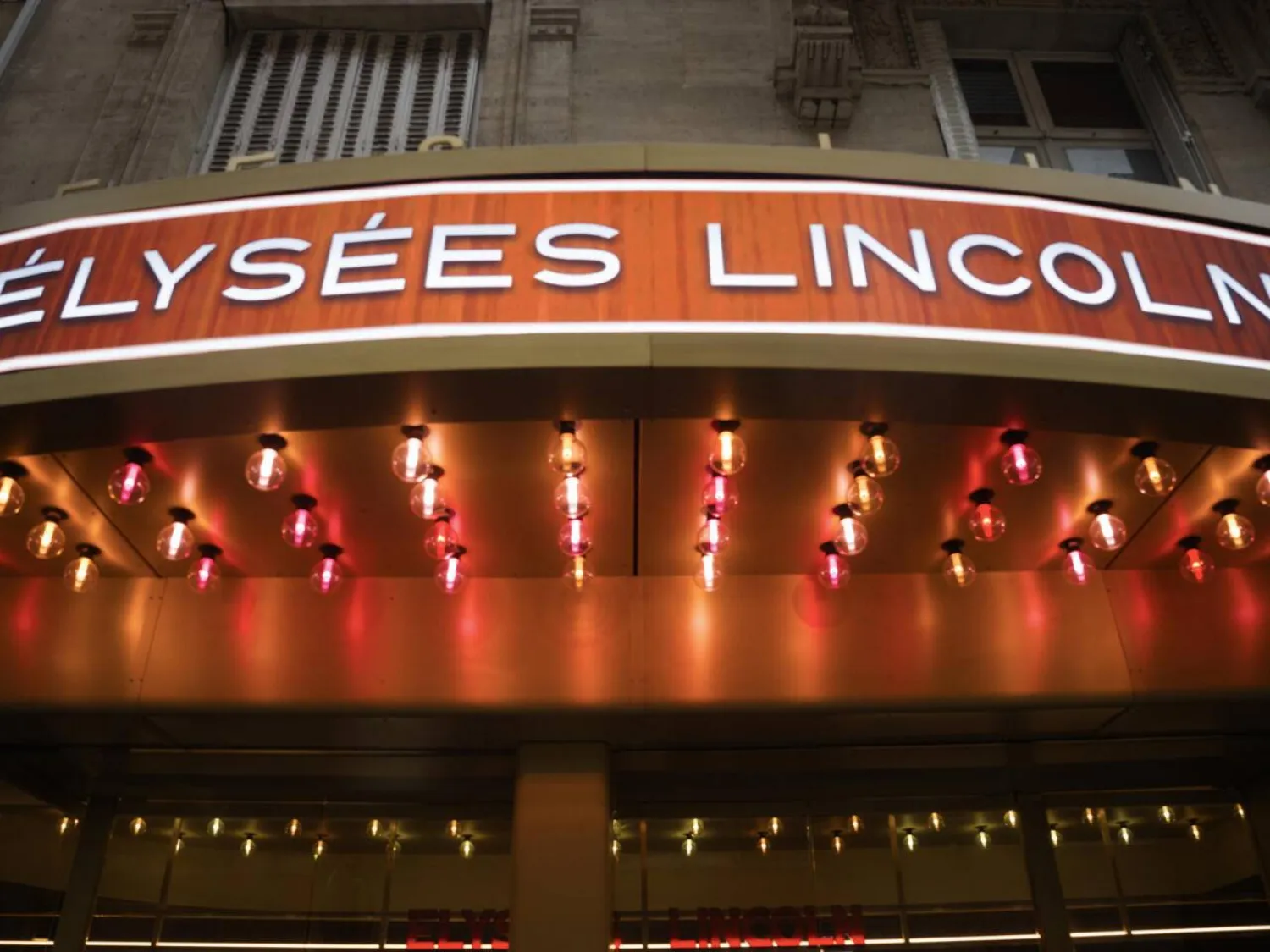
The entrance to the newly renovated Elysees Lincoln cinema. Dimitar DILKOFF / AFP
TT

Paris's Arthouse Cinemas Adapt to Battle Decline

The entrance to the newly renovated Elysees Lincoln cinema. Dimitar DILKOFF / AFP

Paris is one of the world's arthouse cinema hotspots, but falling attendance levels mean beloved independent operators must innovate and invest to survive.

The center of the City of Light has the highest density of silver screens in the world per capita and arguably one of the most cinephile local populations.

That has long supported its dense network of picture houses -- around 80 today -- where film lovers can catch classics and auteur productions in sometimes cramped conditions and with spartan decoration.

But with the rise of streaming, the popularity of high-end home cinema equipment, as well as cut-throat competition from deep-pocketed multiplex chains, the independents are facing an existential crisis.

Nowhere can the transformation of the sector be seen more clearly than the Champs-Elysees area.

In 2014, cinemas on the famous avenue sold 1.9 million tickets.

Ten years later, the figure had dropped to just 133,000, according to data from Paris city hall, which subsidizes the sector.

Today, only a handful of cinemas remain, the others having shut down in favor of luxury boutiques and tourist-oriented shops.

In 2019, the owners of the Elysees-Lincoln, one of the survivors, asked themselves whether they should "close it, transform it or turn it into something other than a cinema", said Louis Merle, who runs the venue with his brother Samuel, along with two other theatres.

"We decided it would remain a cinema because we are passionate, but we had to find a new economic model," he told AFP.

'Unthinkable'

After travelling to several countries, the brothers opted to create a "modular" cinema.

One of the screens can "within an hour" be turned into a reception room able to host up to 200 people.

To suit the upmarket neighborhood, they carried out high-end renovations and created a "luxury cinema" with carefully designed interiors at a cost of nearly 2.3 million euros.

"It was unthinkable to see another cinema close on the Champs-Elysées," he added, saying that maintaining culture on the famous avenue was an "activist" act.

Their project forms part of the current trend of converting cinemas into "premium" venues, offering high comfort and upgraded visual and sound quality.

"The audience is becoming increasingly scarce. You have to win it back by offering exemplary conditions in terms of welcome, comfort and projection quality," said Richard Patry, president of the National Federation of French Cinemas (FNCF).

Cinema attendance has fallen by around 15 percent in 2025 compared with 2024, and experts say the sector may never regain the levels seen before the Covid-19 epidemic in 2020, which closed theatres and changed consumer behavior.

Industry watchers say this year's figures have also suffered from a lack of local French-language hits or buzzy Hollywood blockbusters to drive footfall.

Paris, however, stands out, with an average of 8.03 cinema entries per inhabitant per year, compared with 2.73 nationwide, according to figures from the National Centre for Cinema (CNC).

'Resist'

Other independent cinemas have chosen to reorganize their already limited space to open new screens and increase capacity.

Fabien Houi, who runs the Brady in the 10th arrondissement (district), hopes to almost double annual admissions from 65,000 to 100,000 thanks to the opening of a third screen with 34 seats.

"You have to come up with things within your means and possibilities, even in terms of space, to try to survive," he told AFP, covered in construction dust amid the unfinished worksite.

Opening a new screen when attendance is falling may seem counter-intuitive.

But the experience of the Grand Action, in the heart of the Latin Quarter near Notre-Dame cathedral, also supports the idea.

Since opening a new 27-seat screen in 2022, owner Isabelle Gibbal-Hardy said she has almost doubled the number of releases she can host per year and "attendance has risen far more than expected" -- all while continuing to offer an arthouse program.



Stop-motion 'Wildwood' Showcases 'Human Creativity' in AI Age

(L-R) 'WIldwood' director Travis Knight joins actors Marc Evan Jackson, Awkwafina, Jacob Tremblay, Peyton Elizabeth Lee, Amandla Stenberg, Tantoo Cardinal, Jake Johnson and Angela Bassett at the premiere. VALERIE MACON / AFP/File
TT

Stop-motion 'Wildwood' Showcases 'Human Creativity' in AI Age

(L-R) 'WIldwood' director Travis Knight joins actors Marc Evan Jackson, Awkwafina, Jacob Tremblay, Peyton Elizabeth Lee, Amandla Stenberg, Tantoo Cardinal, Jake Johnson and Angela Bassett at the premiere. VALERIE MACON / AFP/File

After a murder of crows kidnaps her little brother, a young girl ventures into an enchanted forest filled with talking animals and other magical beings, where a looming war will decide everyone's fate.

This is the fanciful tale told in "Wildwood," from the stop-motion animation studio Laika -- an ambitious project that took 16 years to make it to the big screen, and already a frontrunner for next year's Oscars.

"To put that in perspective, 16 years ago, Barack (Obama) was then a fresh-faced president in his very first term. Oh, it was a better time, my friends," director Travis Knight said at the film's premiere in Los Angeles.

"This movie exists because hundreds and hundreds of people poured years of their lives into trying to tell the most beautiful story that they could using their hands, using their imagination," Knight explained in an interview with AFP.

"That is something that computers can't do," added the filmmaker, who is also the CEO of Laika, the US studio behind "Coraline."

In the age of artificial intelligence, Knight extols the virtues of stop-motion, an animation technique in which the movements of tiny physical objects are captured one frame at a time, to create the effect of fluid motion when played back.

"It is a celebration of humanity because what you're seeing in this film is human creativity, human artistry, human effort on a grand scale," he said.

"Computers can try to emulate things that we've gone through, but a computer has never felt loss. It's never felt joy. It hasn't fallen in love. It hasn't had its heart broken."

- 'Universal' -

"Wildwood" is the story of Prue McKeel (Peyton Elizabeth Lee) and her quest to rescue her brother, who has been taken by the crows into the Impassable Wilderness -- or the forests outside Portland, Oregon, which are hidden from mere mortals.

Along with her friend Curtis (Jacob Tremblay), Prue discovers a fantastic world, but one in which ambition and grief are fueling discord that could erupt in conflict.

"It is a big sweeping fantasy story," Knight said. "But it also is an exploration of mature themes and profound emotional things that everyone goes through at various times in their lives."

Lee told AFP that Prue's journey resonated for her, and recalled some of her own challenges in adolescence.

"I didn't go into a magical forest," Lee joked, but said she did understand "that idea of being a young person that feels so mature and so grown up, and feels like they have a really firm grasp on the world and reality, and then it's sort of all put into question."

"And all of a sudden, you have to rethink everything," she added.

Tremblay also said he could identify with Curtis, who tries to emulate the courage he sees in his favorite comic book and game characters.

The actors whose voices are featured in the film also helped shape how their characters move. Their gestures were filmed as they recorded their lines, so that animators could incorporate those mannerisms into the movie.

Angela Bassett, Carey Mulligan, Mahershala Ali and Awkwafina are all part of the cast.

For its technical team, "Wildwood" marks a milestone in terms of the expressions created, and the menagerie of animals featured.

"Every film we've done has been R and D (research and development) for the next one," said animation supervisor Brad Schiff, who explained that the subtleties in facial movement achieved were impossible just a few years ago.

The film, inspired by Colin Meloy's book of the same name, is an ode to Portland, where Laika is based.

"It is a very specific place," said Knight, who lives in the Pacific Northwest city.

"The more specific, the more intimate you make something, ultimately the more universal it becomes."


'Call of Duty' North Korea Invasion Edition Tops Sales Charts in South

Visitors play 'Call Of Duty Modern Warfare 4' at a Paris preview last week. The game envisions a North Korean invasion of its southern neighbor. Simon WOHLFAHRT / AFP
TT

'Call of Duty' North Korea Invasion Edition Tops Sales Charts in South

Visitors play 'Call Of Duty Modern Warfare 4' at a Paris preview last week. The game envisions a North Korean invasion of its southern neighbor. Simon WOHLFAHRT / AFP

The latest instalment of the "Call of Duty" video game franchise, featuring a full-scale North Korean invasion of South Korea, has topped sales charts in the would-be target, even as real-life border tensions are ratcheting higher.

"Call of Duty: Modern Warfare 4", the latest edition of the globally popular franchise is set against a backdrop of tensions between the United States and Russia.

Its Friday release comes on the heels of an explosion inside the heavily fortified Demilitarized Zone (DMZ) that injured three South Korean soldiers, further straining ties on the peninsula, said AFP.

The game follows several parallel storylines: a squad of young American and South Korean soldiers fighting for survival, a former serviceman driven by revenge, and a power struggle surrounding a new North Korean leader -- a character players can also take on.

The new edition has generated considerable interest in South Korea, where able-bodied men are required to serve between 18 and 21 months in the military, depending on the branch.

The title has topped both the global and South Korean sales charts on Steam, one of the world's largest digital distribution platforms for PC games.

The campaign begins with a surprise invasion of South Korea by North Korean forces, who deploy paratroopers and infiltrate through an underground tunnel to catch South Korean and US troops off guard.

In reality, the US stations about 28,000 troops in South Korea to help deter the nuclear-armed North. Seoul and Pyongyang remain technically at war because the 1950-53 Korean War ended in an armistice rather than a peace treaty.

Reactions among South Korean gamers have been largely positive, with some posting hashtags featuring a Korean slogan meaning "exterminate communism" on social media and others saying they were considering upgrading their computers or buying new consoles to play the title.

"I cried so much playing the game to a point I almost got dehydrated. It reminds me so much of my grandfather, who fought in the Korean War," a Threads user with the handle b_yeol_t said.

Another user, posting under the handle ireozima_zebal, described the experience as "horrifying" because of its implications for a potential conflict on the Korean peninsula.

"This is what would unfold if the North launched an invasion, with the border province of Gangwon overwhelmed within an hour and our defense line pushed back right on the edge of Seoul," the user said.

But the game has also drawn criticism for turning the fraught history between North and South Korea into entertainment.

The title raises the "question of whether it is appropriate... to present the tragedy of the Korean War and the current antagonism between South and North as something to be consumed for entertainment", Kim Sung-jae, chairman of the Kim Dae Jung Peace Center, wrote in the Hankyoreh newspaper last month.

On Saturday, North Korean state media said leader Kim Jong Un had urged his military to become the strongest in the world at a two-day meeting of company commanders in Pyongyang last week.


China's First AI Film Hits Cinemas, But Ticket Sales Lag

Nearly 100 people took more than two years to make the film. Hector RETAMAL / AFP
TT

China's First AI Film Hits Cinemas, But Ticket Sales Lag

Nearly 100 people took more than two years to make the film. Hector RETAMAL / AFP

China's first fully AI-generated feature film opens in cinemas on Friday in what promises to be a tough box-office test for the country's booming tech industry as advance ticket sales lag.

More than 10,000 screenings of the sci-fi thriller "Sanxingdui: Future Past" are scheduled for Friday, according to ticketing platform Maoyan.

Public reception, however, has been less than enthusiastic, said AFP.

Presale revenue as of Friday morning stood at 80,000 yuan ($11,980), while total box-office takings were forecast to remain below 150,000 yuan, only a fraction of the reported production cost, according to Maoyan.

Ticket prices range from 20 to 90 yuan, bringing the number sold to a few thousand at most.

Jiang Defu, CEO of the production company Bona Film Group, acknowledged the lukewarm reception in a recent interview but said the film was pushing boundaries.

"We are the first to try it, the first to get a theatrical release permit, and the first to be tested by the audience," he told Chinese film industry outlet Yuli.

"I think that is not easy at all."

Nearly 100 people took more than two years to make the film, which cost more than 10 million yuan ($1.5 million), Bona said, although all the actors, their voices and the backdrops are AI-generated.

The film touches on the theme of humanity in a future shaped by AI.

But that was not enough to convince Iris Yang, who attended a free preview screening of the film on Thursday for acquaintances of the production team and industry workers.

Yang said she would not have paid for a ticket, given the movie's quality.

"If AI generation can match the theatrical experience of 'Avatar', I think I would be willing to pay for it," she said, referring to the US franchise known for the quality of its animation.

AI-generated video has gained popularity in the world's second-largest economy. On Douyin, the Chinese equivalent of TikTok, AI-generated short dramas garnered more than 200 billion views in September alone.

But "the audience won't automatically pay for the tickets just because it's an AI-generated film", independent AI director Zhang Jun told AFP.

Online, Chinese social media users also seemed unconvinced by the launch of AI movies in cinemas.

"If it's free to watch on streaming platforms, it could become legendary. But paying to watch? People are not going to accept it at this stage," one user on Weibo commented.

In Hollywood, the rise of AI has sparked concern among film workers about the prospect of job losses.

An AI-generated sci-fi feature called "Gods Don't Give Gifts" is scheduled for US release on December 4.

And a virtual Hollywood actor called Tilly Norwood, whose interviews have gone viral while fueling job fears, is also set to star in an upcoming movie called "Misaligned".