


'Land Without laws': Israeli Settlers Force Bedouins from West Bank Community

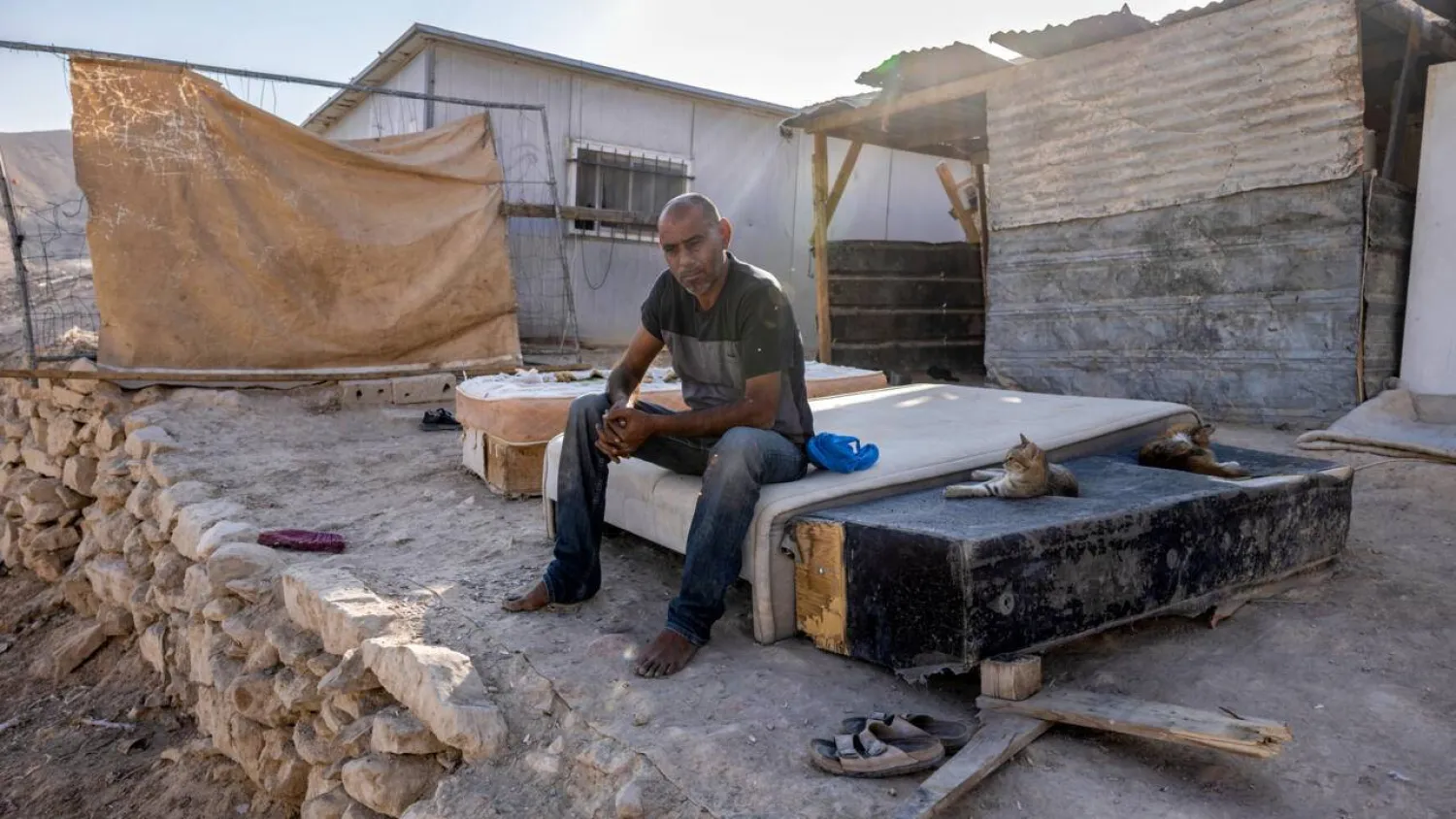
AFP visited Ahmed Kaabneh weeks before he was forced to flee his home in the al-Hathrura area. Menahem Kahana / AFP
TT

'Land Without laws': Israeli Settlers Force Bedouins from West Bank Community

AFP visited Ahmed Kaabneh weeks before he was forced to flee his home in the al-Hathrura area. Menahem Kahana / AFP

As relentless harassment from Israeli settlers drove his brothers from their Bedouin community in the central occupied West Bank, Ahmed Kaabneh remained determined to stay on the land his family had lived on for generations.

But when a handful of young settlers constructed a shack around 100 meters above his home and started intimidating his children, 45-year-old Kaabneh said he had no choice but to flee too.

As with scores of Bedouin communities across the West Bank, the small cluster of wood and metal houses where Kaabneh's father and grandfather had lived now lies empty.

"It is very difficult... because you leave an area where you lived for 45 years. Not a day or two or three, but nearly a lifetime," Kaabneh told AFP at his family's new makeshift house in the rocky hills north of Jericho.

"But what can you do? They are the strong ones and we are the weak, and we have no power."

Israel has occupied the West Bank since 1967, and violence there has soared since the Gaza war erupted in October 2023 following Hamas's attack on Israel.

Some 3,200 Palestinians from dozens of Bedouin and herding communities have been forced from their homes by settler violence and movement restrictions since October 2023, the UN's humanitarian agency OCHA reported in October.

The United Nations said this October was the worst month for settler violence since it began recording incidents in 2006.

Almost none of the perpetrators have been held to account by the Israeli authorities.

'Terrifying'

Kaabneh, four of his brothers and their families, now live together some 13 kilometers (eight miles) northeast of their original homes, which sat in the al-Hathrura area.

Outside his freshly constructed metal house, boys kicked a football while washing hung from the line. But Kaabneh said the area didn't feel like home.

"We are in a place we have never lived in before, and life here is hard," he said.

Alongside surging violence, the number of settler outposts has exploded in the West Bank.

While all Israeli settlements are illegal under international law, outposts are also prohibited under Israeli law. But many end up being legalized by the Israeli authorities.

AFP had visited Kaabneh in the al-Hathrura area weeks before he was forced to flee.

On the dirt road to his family's compound, caravans and an Israeli flag atop a hill marked an outpost established earlier this year -- one of several to have sprung up in the area.

On the other side of the track, in the valley, lay the wreckage of another Bedouin compound whose residents had recently fled.

While in Kaabneh's cluster of homes, AFP witnessed two settlers driving to the top of a hill to surveil the Bedouins below.

"The situation is terrifying," Kaabneh said at the time, with life becoming almost untenable because of daily harassment and shrinking grazing land.

Less than three weeks later, the homes were deserted.

Kaabneh said the settlers "would shout all night, throw stones, and walk through the middle of the houses."

"They didn't allow us to sleep at night, nor move freely during the day."

'Thrive on chaos'

These days, only activists and the odd cat wander the remnants of Kaabneh's former life -- where upturned children's bikes and discarded shoes reveal the chaotic departure.

"We are here to keep an eye on the property... because a lot of places that are abandoned are usually looted by the settlements," said Sahar Kan-Tor, 29, an Israeli activist with the Israeli-Palestinian grassroots group Standing Together.

Meanwhile, settlers with a quadbike and digger were busy dismantling their hilltop shack and replacing it with a sofa and table.

"They thrive on chaos," Kan-Tor explained.

"It is, in a way, a land without laws. There (are) authorities roaming around, but nothing is enforced, or very rarely enforced."

A report by Israeli settlement watchdogs last December said settlers had used shepherding outposts to seize 14 percent of the West Bank in recent years.

NGOs Peace Now and Kerem Navot said settlers were acting "with the backing of the Israeli government and military".

Some members of Israel's right-wing government are settlers themselves, and far-right ministers have called for the West Bank's annexation.

Kan-Tor said he believed settlers were targeting this stretch of the West Bank because of its significance for a contiguous Palestinian state.

But Kaabneh said the threat of attacks loomed even in his new location in the east of the territory.

He said settlers had already driven along the track leading to his family's homes and watched them from the hill above.

"Even this area, which should be considered safe, is not truly safe," Kaabneh lamented.

"They pursue us everywhere."


Rescue Teams Search for Survivors in Building Collapse that Killed at Least 2 in Northern Lebanon

A Lebanese flag is pictured, in the aftermath of a massive explosion, in Beirut's damaged port area, Lebanon August 17, 2020. REUTERS/Hannah McKay
TT

Rescue Teams Search for Survivors in Building Collapse that Killed at Least 2 in Northern Lebanon

A Lebanese flag is pictured, in the aftermath of a massive explosion, in Beirut's damaged port area, Lebanon August 17, 2020. REUTERS/Hannah McKay

At least two people were killed and four rescued from the rubble of a multistory apartment building that collapsed Sunday in the city of Tripoli in northern Lebanon, state media reported.

Rescue teams were continuing to dig through the rubble. It was not immediately clear how many people were in the building when it fell.

The bodies pulled out were of a child and a woman, the state-run National News Agency reported.

Dozens of people crowded around the site of the crater left by the collapsed building, with some shooting in the air.

The building was in the neighborhood of Bab Tabbaneh, one of the poorest areas in Lebanon’s second largest city, where residents have long complained of government neglect and shoddy infrastructure. Building collapses are not uncommon in Tripoli due to poor building standards, according to The AP news.

Lebanon’s Health Ministry announced that those injured in the collapse would receive treatment at the state’s expense.

The national syndicate for property owners in a statement called the collapse the result of “blatant negligence and shortcomings of the Lebanese state toward the safety of citizens and their housing security,” and said it is “not an isolated incident.”

The syndicate called for the government to launch a comprehensive national survey of buildings at risk of collapse.


Israel to Take More West Bank Powers and Relax Settler Land Buys

A view of Israeli settlement of Maale Adumim, in the West Bank, Sunday, June 18, 2023. (AP)
TT

Israel to Take More West Bank Powers and Relax Settler Land Buys

A view of Israeli settlement of Maale Adumim, in the West Bank, Sunday, June 18, 2023. (AP)

Israel's security cabinet approved a series of steps on Sunday that would make it easier for settlers in the occupied West Bank to buy land while granting Israeli authorities more enforcement powers over Palestinians, Israeli media reported.

The West Bank is among the territories that the Palestinians seek for a future independent state. Much of it is under Israeli military control, with limited Palestinian self-rule in some areas run by the Western-backed Palestinian Authority (PA).

Citing statements by Finance Minister Bezalel Smotrich and Defense Minister Israel Katz, Israeli news sites Ynet and Haaretz said the measures included scrapping decades-old regulations that prevent Jewish private citizens buying land in the West Bank, The AP news reported.

They were also reported to include allowing Israeli authorities to administer some religious sites, and expand supervision and enforcement in areas under PA administration in matters of environmental hazards, water offences and damage to archaeological sites.

Palestinian President Mahmoud Abbas said the new measures were dangerous, illegal and tantamount to de-facto annexation.

The Israeli ministers did not immediately respond to requests for comment.

The new measures come three days before Prime Minister Benjamin Netanyahu is scheduled to meet in Washington with US President Donald Trump.

Trump has ruled out Israeli annexation of the West Bank but his administration has not sought to curb Israel's accelerated settlement building, which the Palestinians say denies them a potential state by eating away at its territory.

Netanyahu, who is facing an election later this year, deems the establishment of any Palestinian state a security threat.

His ruling coalition includes many pro-settler members who want Israel to annex the West Bank, land captured in the 1967 Middle East war to which Israel cites biblical and historical ties.

The United Nations' highest court said in a non-binding advisory opinion in 2024 that Israel's occupation of Palestinian territories and settlements there is illegal and should be ended as soon as possible. Israel disputes this view.


Arab League Condemns Attack on Aid Convoys in Sudan

A general view shows the opening session of the meeting of Arab foreign ministers at the Arab League Headquarters (Reuters)
TT

Arab League Condemns Attack on Aid Convoys in Sudan

A general view shows the opening session of the meeting of Arab foreign ministers at the Arab League Headquarters (Reuters)

Arab League Secretary-General Ahmed Aboul Gheit strongly condemned the attack by the Rapid Support Forces on humanitarian aid convoys and relief workers in North Kordofan State, Sudan.

In a statement reported by SPA, secretary-general's spokesperson Jamal Rushdi quoted Aboul Gheit as saying the attack constitutes a war crime under international humanitarian law, which prohibits the deliberate targeting of civilians and depriving them of their means of survival.

Aboul Gheit stressed the need to hold those responsible accountable, end impunity, and ensure the full protection of civilians, humanitarian workers, and relief facilities in Sudan.
