


Aid Flow Into Gaza Falls Short of Ceasefire Terms, Analysis of Israeli Figures Shows

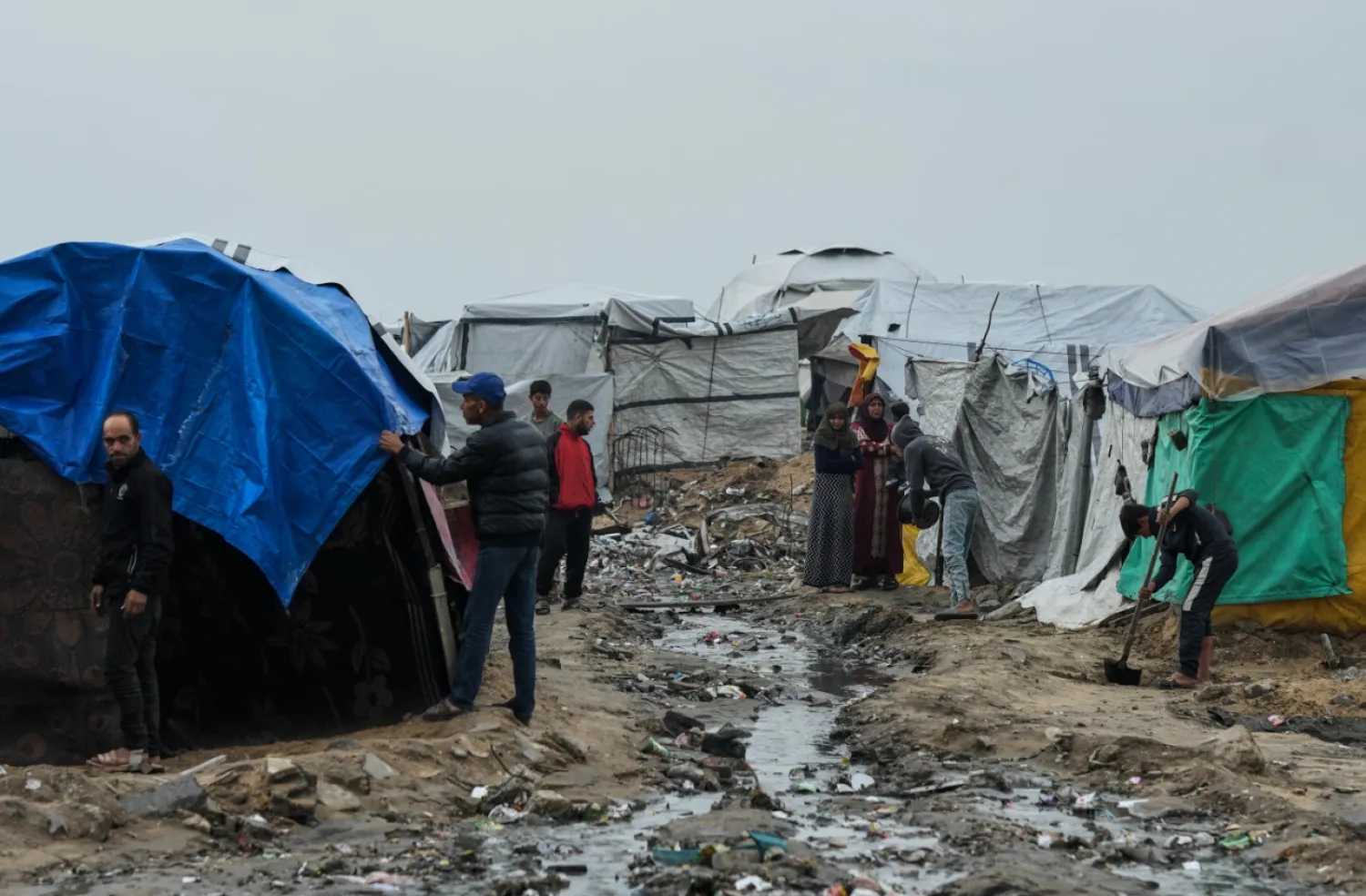
Displaced Palestinians repair their tents at a tent camp on the beach after a stormy weather in Gaza City, Wednesday, Dec. 10, 2025. (AP Photo/Jehad Alshrafi)
TT

Aid Flow Into Gaza Falls Short of Ceasefire Terms, Analysis of Israeli Figures Shows

Displaced Palestinians repair their tents at a tent camp on the beach after a stormy weather in Gaza City, Wednesday, Dec. 10, 2025. (AP Photo/Jehad Alshrafi)

Aid deliveries into Gaza are falling far short of the amount called for under the US-brokered ceasefire, an Associated Press analysis of the Israeli military’s figures showed.

Under the October ceasefire deal between Israel and Hamas, Israel agreed to allow 600 trucks of aid into Gaza each day. But an average of around 459 trucks a day have entered Gaza between Oct. 12, when flow of the aid restarted, and Dec. 7, according to an AP analysis of latest figures by COGAT, the Israeli military body in charge of coordinating aid entry.

By all accounts, aid has fallen short in Gaza COGAT said that roughly 18,000 trucks of food aid had entered Gaza between the ceasefire taking effect and Sunday. It said that figure amounted to 70% of all aid that had entered the territory since the truce.

That means COGAT estimates that a total of just over 25,700 trucks of aid have entered Gaza — well under the 33,600 trucks that should have entered by Sunday, under the terms of the ceasefire.

In response to the AP analysis, COGAT insisted Wednesday that the number of trucks entering Gaza each day was above the 600 mark. But when asked, it refused to elaborate why the figures it gave did not reach that amount or provide raw data on truck entry.

Throughout most of the war, COGAT gave detailed figures of daily trucks entering Gaza but stopped doing so when the ceasefire began. Rights groups say that because it controls the crossings, it is the only entity with the access and visibility necessary to track how much aid and commercial goods are entering Gaza.

The UN and aid groups have often said the amount of aid entering Gaza is far lower than COGAT claims.

The UN says only 6,545 trucks have been offloaded at Gaza crossings between the ceasefire and Dec. 7, amounting to about 113 trucks a day. That's according to its online database. The UN figures do not include aid trucks sent bilaterally by organizations not working through the UN network.

A Hamas document on Saturday provided to the AP put the amount of aid trucks that have entered at 7,333.

This week, United Nations Office for the Coordination of Humanitarian Affairs stressed a “dire” need for more aid to enter Gaza, saying Israeli restrictions on aid have bottlenecked recovery efforts.

Food remains scarce in Gaza, aid groups say Humanitarian groups say lack of aid has had harsh effects on many of Gaza's 2 million residents, most of whom were forcibly displaced by war. Food remains scarce as the Palestinian territory struggles to bounce back from famine, which hit parts of Gaza during the war. Starving mothers in Gaza are giving birth to malnourished babies, some of whom have died in hospital, according to a recent report by UNICEF. As winter rains pick up, displaced families living in tents have been left exposed to the elements and without supplies to cope with floods and the biting cold.

“Needs far outpace the humanitarian community’s ability to respond, given persistent impediments,” the agency wrote in a report on Monday. “These obstacles include insecurity, customs clearance challenges, delays and denials of cargo at the crossings, and limited routes available for transporting humanitarian supplies within Gaza.”

Israel temporarily stopped all aid entry at least once in response to alleged Hamas violations of the truce. Israel said that Hamas has failed to return the bodies of the hostages in the time period established by the ceasefire, while Hamas has said it struggled to find the bodies due to the destruction left by Israel in the Palestinian territory.

Hamas has also accused Israel of violating the ceasefire terms because of the slow flow of aid, continued closure of the Rafah crossing and ongoing deadly strikes on Gaza.

Dispute over remains of final hostage Meanwhile, Israel says it is demanding the return of the final hostage, Ran Gvili.

The Office of Prime Minister Benjamin Netanyahu told the AP on Wednesday that Gvili’s remains must be returned, a condition of the first phase of the ceasefire.

“Once phase one is completed, phase two will begin,” the office said in a statement.

Hamas militants and Red Cross crews continued to comb the ruins of Gaza City for the final body this week, while the militant group Islamic Jihad claimed it had handed over the last hostage body in its possession.

On Tuesday, Hamas called for more international pressure on Israel to open key border crossings, cease deadly strikes on the territory and allow more aid into the strip.

The accusations mark the latest road bump at what regional leaders have described as a critical time for the ceasefire agreement, as mediators seek to push the truce into its second, more complicated phase.



Rescue Teams Search for Survivors in Building Collapse that Killed at Least 2 in Northern Lebanon

A Lebanese flag is pictured, in the aftermath of a massive explosion, in Beirut's damaged port area, Lebanon August 17, 2020. REUTERS/Hannah McKay
TT

Rescue Teams Search for Survivors in Building Collapse that Killed at Least 2 in Northern Lebanon

A Lebanese flag is pictured, in the aftermath of a massive explosion, in Beirut's damaged port area, Lebanon August 17, 2020. REUTERS/Hannah McKay

At least two people were killed and four rescued from the rubble of a multistory apartment building that collapsed Sunday in the city of Tripoli in northern Lebanon, state media reported.

Rescue teams were continuing to dig through the rubble. It was not immediately clear how many people were in the building when it fell.

The bodies pulled out were of a child and a woman, the state-run National News Agency reported.

Dozens of people crowded around the site of the crater left by the collapsed building, with some shooting in the air.

The building was in the neighborhood of Bab Tabbaneh, one of the poorest areas in Lebanon’s second largest city, where residents have long complained of government neglect and shoddy infrastructure. Building collapses are not uncommon in Tripoli due to poor building standards, according to The AP news.

Lebanon’s Health Ministry announced that those injured in the collapse would receive treatment at the state’s expense.

The national syndicate for property owners in a statement called the collapse the result of “blatant negligence and shortcomings of the Lebanese state toward the safety of citizens and their housing security,” and said it is “not an isolated incident.”

The syndicate called for the government to launch a comprehensive national survey of buildings at risk of collapse.


Israel to Take More West Bank Powers and Relax Settler Land Buys

A view of Israeli settlement of Maale Adumim, in the West Bank, Sunday, June 18, 2023. (AP)
TT

Israel to Take More West Bank Powers and Relax Settler Land Buys

A view of Israeli settlement of Maale Adumim, in the West Bank, Sunday, June 18, 2023. (AP)

Israel's security cabinet approved a series of steps on Sunday that would make it easier for settlers in the occupied West Bank to buy land while granting Israeli authorities more enforcement powers over Palestinians, Israeli media reported.

The West Bank is among the territories that the Palestinians seek for a future independent state. Much of it is under Israeli military control, with limited Palestinian self-rule in some areas run by the Western-backed Palestinian Authority (PA).

Citing statements by Finance Minister Bezalel Smotrich and Defense Minister Israel Katz, Israeli news sites Ynet and Haaretz said the measures included scrapping decades-old regulations that prevent Jewish private citizens buying land in the West Bank, The AP news reported.

They were also reported to include allowing Israeli authorities to administer some religious sites, and expand supervision and enforcement in areas under PA administration in matters of environmental hazards, water offences and damage to archaeological sites.

Palestinian President Mahmoud Abbas said the new measures were dangerous, illegal and tantamount to de-facto annexation.

The Israeli ministers did not immediately respond to requests for comment.

The new measures come three days before Prime Minister Benjamin Netanyahu is scheduled to meet in Washington with US President Donald Trump.

Trump has ruled out Israeli annexation of the West Bank but his administration has not sought to curb Israel's accelerated settlement building, which the Palestinians say denies them a potential state by eating away at its territory.

Netanyahu, who is facing an election later this year, deems the establishment of any Palestinian state a security threat.

His ruling coalition includes many pro-settler members who want Israel to annex the West Bank, land captured in the 1967 Middle East war to which Israel cites biblical and historical ties.

The United Nations' highest court said in a non-binding advisory opinion in 2024 that Israel's occupation of Palestinian territories and settlements there is illegal and should be ended as soon as possible. Israel disputes this view.


Arab League Condemns Attack on Aid Convoys in Sudan

A general view shows the opening session of the meeting of Arab foreign ministers at the Arab League Headquarters (Reuters)
TT

Arab League Condemns Attack on Aid Convoys in Sudan

A general view shows the opening session of the meeting of Arab foreign ministers at the Arab League Headquarters (Reuters)

Arab League Secretary-General Ahmed Aboul Gheit strongly condemned the attack by the Rapid Support Forces on humanitarian aid convoys and relief workers in North Kordofan State, Sudan.

In a statement reported by SPA, secretary-general's spokesperson Jamal Rushdi quoted Aboul Gheit as saying the attack constitutes a war crime under international humanitarian law, which prohibits the deliberate targeting of civilians and depriving them of their means of survival.

Aboul Gheit stressed the need to hold those responsible accountable, end impunity, and ensure the full protection of civilians, humanitarian workers, and relief facilities in Sudan.