


Islamic Jihad Denies Withholding Body of Last Israeli Hostage

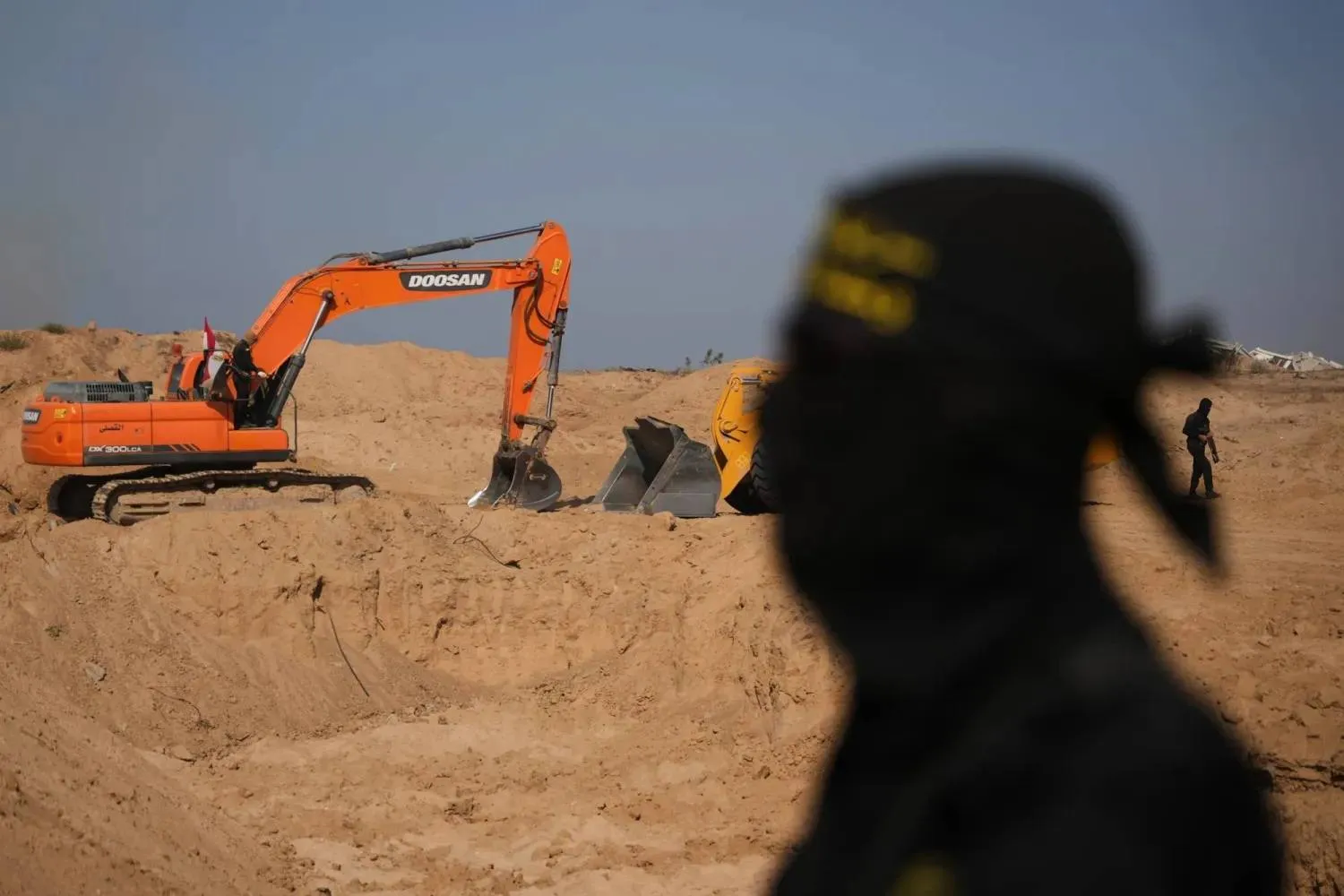
An Islamic Jihad member looks on as workers dig in search of the corpses of hostages in northern Gaza. (AP file)
TT

Islamic Jihad Denies Withholding Body of Last Israeli Hostage

An Islamic Jihad member looks on as workers dig in search of the corpses of hostages in northern Gaza. (AP file)

Palestinian sources dismissed Israeli claims circulating over the past two days that the Islamic Jihad movement is refusing to cooperate with Hamas by handing over what Israel says is the last body of an Israeli hostage in Gaza, a step Israel has linked to moving into the second phase of the ceasefire.

Israel’s Maariv newspaper reported on Friday, citing Israeli security sources, that tensions had emerged between Hamas and Islamic Jihad over the latter’s alleged refusal to hand over the body of the last hostage, Ran Gvili.

Israel believes Islamic Jihad fighters were directly involved in abducting Gvili and holding him in Gaza.

The Al-Quds Brigades, the armed wing of Islamic Jihad, said days ago it had handed over all hostages in its possession and had fully complied with the ceasefire agreement, a claim confirmed by sources in the movement speaking to Asharq Al-Awsat.

According to those sources, Gvili’s body was not among the Israeli hostages held by Islamic Jihad and was instead in Hamas’ custody. They said coordination with Hamas was excellent and denied any disagreements or tensions, dismissing Israeli media reports as unfounded.

Sources from Hamas told Asharq Al-Awsat the body was believed to be located in three or four sites in the Shujaiya and Zeitoun neighborhoods east of Gaza City. Search operations were carried out at those locations but failed to locate it.

They said all field commanders and activists involved in the abduction and in guarding the body had been killed in a series of airstrikes and other operations, making it difficult to determine the exact location with certainty.

They added that the difficulty was compounded by heavy bombardment, widespread destruction and land leveling in those areas during Israeli ground incursions.

According to Israel’s Yedioth Ahronoth newspaper, Israel provided Hamas, via mediators, with information about individuals who might help identify the body’s location, as well as details on potential sites, accompanied by aerial photographs.

Hamas sources said there was ongoing communication with mediators on this issue and others.

New video raises doubts

These developments coincided with the Israeli Hostages and Missing Families Forum publishing video footage of six hostages whose bodies were found inside a tunnel in Rafah in August 2024.

The footage shows them sharing daily life, marking the Jewish holiday of Hanukkah, celebrating the start of 2024, talking among themselves, shaving and moving from one place to another inside the tunnel.

The videos raised questions about the Israeli army’s claim that they were killed two days before being found, allegedly shot by Hamas fighters. Hamas has denied that account, saying they were killed in an Israeli strike that hit the site.

Israeli journalist Miki Levin wrote in a report on Maariv’s website that the six could have returned home alive had an agreement been reached earlier, in April last year, as senior members of the negotiating team had said.

She criticized Israeli Prime Minister Benjamin Netanyahu and ministers Bezalel Smotrich and Itamar Ben-Gvir for insisting on the notion of “total victory,” which she described as empty and unattainable.

She said the six would have been freed under a deal rejected by the Israeli government, which ignored warnings that an incursion into Rafah would lead to the hostages’ deaths.

According to the Israeli Public Broadcasting Corporation, negotiations with mediators days before their deaths were on the verge of collapse due to the Israeli government’s insistence on controlling the Philadelphi corridor. Five of the hostages were due to be released had an agreement been signed at that time.

These circumstances, Hamas sources said, likely prompted Israel to claim they were killed by Hamas gunfire.

The sources again denied that version, saying the hostages were killed in artillery and air strikes that hit the area and also killed several of their captors. They noted that captors had instructions at the time to kill any hostage if Israeli forces approached and posed a direct threat.

The tunnel was located in the Tel al-Sultan neighborhood west of Rafah in southern Gaza. The Israeli army later acknowledged that investigations indicated the hostages were killed as a result of military pressure in the area.

In October 2024, Israel killed Yahya Sinwar, the former head of Hamas’ political bureau, in a house near the tunnel site in Tel al-Sultan, in what Israeli accounts described as a surprise encounter while he was with an armed group spotted moving inside the building.

Asharq Al-Awsat reported in November 2024, citing Hamas sources, that Ibrahim Sinwar, the son of Qassam Brigades commander Mohammed Sinwar, who was later killed in an Israeli strike, had been killed alongside his uncle in one of the Rafah tunnels.

The sources said Ibrahim Mohammed Sinwar was killed in an Israeli strike as he emerged from a tunnel opening to monitor Israeli troop movements, while accompanied by his uncle, in August that year in Rafah.

Assessments cited by Asharq Al-Awsat suggest the tunnel in question was the same one where the six hostages were held. Subsequent Israeli investigations said DNA evidence indicated Sinwar had been present there.

The hostages may in fact have been killed in the same strike that killed Ibrahim Sinwar, who had accompanied his uncle Yahya throughout the war, along with other armed fighters.

Hamas sources stressed that strict instructions had been in place regarding the treatment of Israeli hostages, including providing all necessary means to keep them alive and safeguard their lives.



2 US Service Members and One American Civilian Killed in Ambush in Syria, US Central Command Says

Residents ride a motorcycle along a war-damaged street in Palmyra, Syria. (AP)
TT

2 US Service Members and One American Civilian Killed in Ambush in Syria, US Central Command Says

Residents ride a motorcycle along a war-damaged street in Palmyra, Syria. (AP)

Two US service members and one American civilian were killed and three other people wounded in an ambush on Saturday by a lone member of the ISIS group in central Syria, the US military’s Central Command said. 

The attack on US troops in Syria is the first to inflict casualties since the fall of President Bashar al-Assad a year ago. 

Central Command said in a post on X that as a matter of respect for the families and in accordance with Department of Defense policy, the identities of the service members will be withheld until 24 hours after their next of kin have been notified. 

US Defense Secretary Pete Hegseth posted on X: “Let it be known, if you target Americans — anywhere in the world — you will spend the rest of your brief, anxious life knowing the United States will hunt you, find you, and ruthlessly kill you.” 

The shooting took place near historic Palmyra, according to the state-run SANA news agency, which earlier said two members of Syria’s security force and several US service members had been wounded. The casualties were taken by helicopter to the al-Tanf garrison near the border with Iraq and Jordan. 

SANA said the attacker was killed, without providing further details. 

The US has hundreds of troops deployed in eastern Syria as part of a coalition fighting the ISIS group. 

Last month, Syria joined the international coalition fighting against the ISIS as Damascus improves its relations with Western countries following the ouster of Assad when opposition factions overthrew his regime in Damascus. 

The US had no diplomatic relations with Syria under Assad, but ties have warmed since the fall of the five-decade Assad family rule. The interim president, Ahmed al-Sharaa, made a historic visit to Washington last month where he held talks with President Donald Trump. 

ISIS was defeated on the battlefield in Syria in 2019, but the group’s sleeper cells still carry out deadly attacks in the country. The United Nations says the group still has between 5,000 and 7,000 fighters in Syria and Iraq. 

US troops, which have maintained a presence in different parts of Syria, including al-Tanf garrison in the central province of Homs, to train other forces as part of a broad campaign against ISIS, have been targeted in the past.  

One of the deadliest attacks occurred in 2019 in the northern town of Manbij when a blast killed two US service members and two American civilians, as well as others from Syria while conducting a patrol. 


Israel Suspends Strike on Southern Lebanon Village After Lebanese Army Request

Smoke rises from the site of an Israeli strike that targeted the southern Lebanese, al-Mahmoudiyeh, Lebanon, Nov. 27, 2025. (AFP)
TT

Israel Suspends Strike on Southern Lebanon Village After Lebanese Army Request

Smoke rises from the site of an Israeli strike that targeted the southern Lebanese, al-Mahmoudiyeh, Lebanon, Nov. 27, 2025. (AFP)

Israel put a planned strike on a village in southern Lebanon on hold on Saturday after the Lebanese army requested access to the site to “address a breach” of a ceasefire agreement, an Israeli military spokesperson said.

Earlier in the day, Israel had issued an evacuation warning for the village of Yanouh ahead of what it said was a planned strike against infrastructure of the Hezbollah group.

“After the warning was issued, the Lebanese Army... requested permission to access the specified site again, which had been declared in violation, in order to address the breach of the agreement,” the Israeli military’s Arabic-language spokesperson, Avichay Adraee, said on X.

The Israel army “decided to allow this, and accordingly the airstrike was temporarily frozen.”

Israel and Lebanon agreed to a US-brokered ceasefire in 2024, ending more than a year of fighting between Israel and Hezbollah that had culminated in Israeli strikes that severely weakened the Iran-backed group. Since then, the sides have traded accusations over violations.

On Tuesday, Israel hit what it described as Hezbollah infrastructure in several areas of southern Lebanon.

Israel and Lebanon have both sent civilian envoys to a military committee monitoring their ceasefire, a step toward meeting a months-old US demand that they broaden talks in line with President Donald Trump’s Middle East peace agenda.


Israel Says Killed Top Hamas Weapons Figure in Gaza

Palestinians inspect the site of an Israeli strike on a car in Gaza City, December 13, 2025. (Reuters)
TT

Israel Says Killed Top Hamas Weapons Figure in Gaza

Palestinians inspect the site of an Israeli strike on a car in Gaza City, December 13, 2025. (Reuters)

Israel said it killed the head of weapons production in Hamas's military wing in a strike in the Gaza Strip on Saturday. 

The civil defense agency and medical sources in the Hamas-run Palestinian territory told AFP an Israeli strike killed five people in the Tel al-Hawa district, southwest of Gaza City. 

When contacted by AFP earlier on Saturday, the army did not say whether the strike reported in Tel al-Hawa was the same as the one mentioned in an army statement before the announcement that it had killed Hamas's Raed Saad. 

Israeli Prime Minister Benjamin Netanyahu and Defense Minister Israel Katz said in a joint statement that "in response to the detonation of a Hamas explosive device that wounded our forces today in the Yellow Area of the Gaza Strip... (they) instructed the elimination of the terrorist Raed Saad". 

Under the US-brokered ceasefire between Israel and Hamas in Gaza, Israeli troops have withdrawn to positions behind the so-called Yellow Line, though they are still in control of more than half the territory. 

Netanyahu and Katz described Saad as "one of the architects" of the October 7, 2023 attack on Israel that sparked the war in Gaza. 

The Israeli army said Saad was the head of the weapons production headquarters of Hamas's military wing who led the group's "force build-up". 

Family sources confirmed his death to AFP and said the funeral would be held on Sunday. 

Israel's military earlier on Saturday said two reserve soldiers were lightly injured "as a result of an explosive device that detonated during an operation to clear the area of terrorist infrastructure in southern Gaza". 

The ceasefire that came into effect on October 10 has halted the fighting between Israel and Hamas, but it remains fragile with each side accusing the other of violating its terms. 

- Burnt-out car - 

Mahmud Bassal, a spokesman for Gaza civil defense which operates as a rescue force under Hamas authority, said five people were killed after "a civilian jeep-type vehicle was targeted near the Nabulsi roundabout in Tel al-Hawa". 

Bassal said the "charred" bodies were taken to Al-Shifa hospital after "Israeli warplanes targeted the civilian vehicle with three missiles, causing it to burn and its destruction". 

The hospital's emergency department confirmed to AFP the arrival of the five bodies and said more than 25 people were injured in the strike. 

AFP footage showed a mangled car with vehicle parts scattered around next to other debris. 

"Warplanes fired several missiles at the vehicle, setting it ablaze. Residents rushed to extinguish the fire, and charred body parts were scattered on the ground," a witness, who did not wish to give his name for security reasons, said in the Tel al-Hawa area. 

Another witness, a 34-year-old man living in a tent in the Tel al-Hawa area, said he "saw several Hamas members arrive at the site of the attack", without providing further details. 

Civil defense agency spokesman Bassal also said a 17-year-old boy and an 18-year-old boy were killed by Israeli fire in two separate incidents in Gaza.