

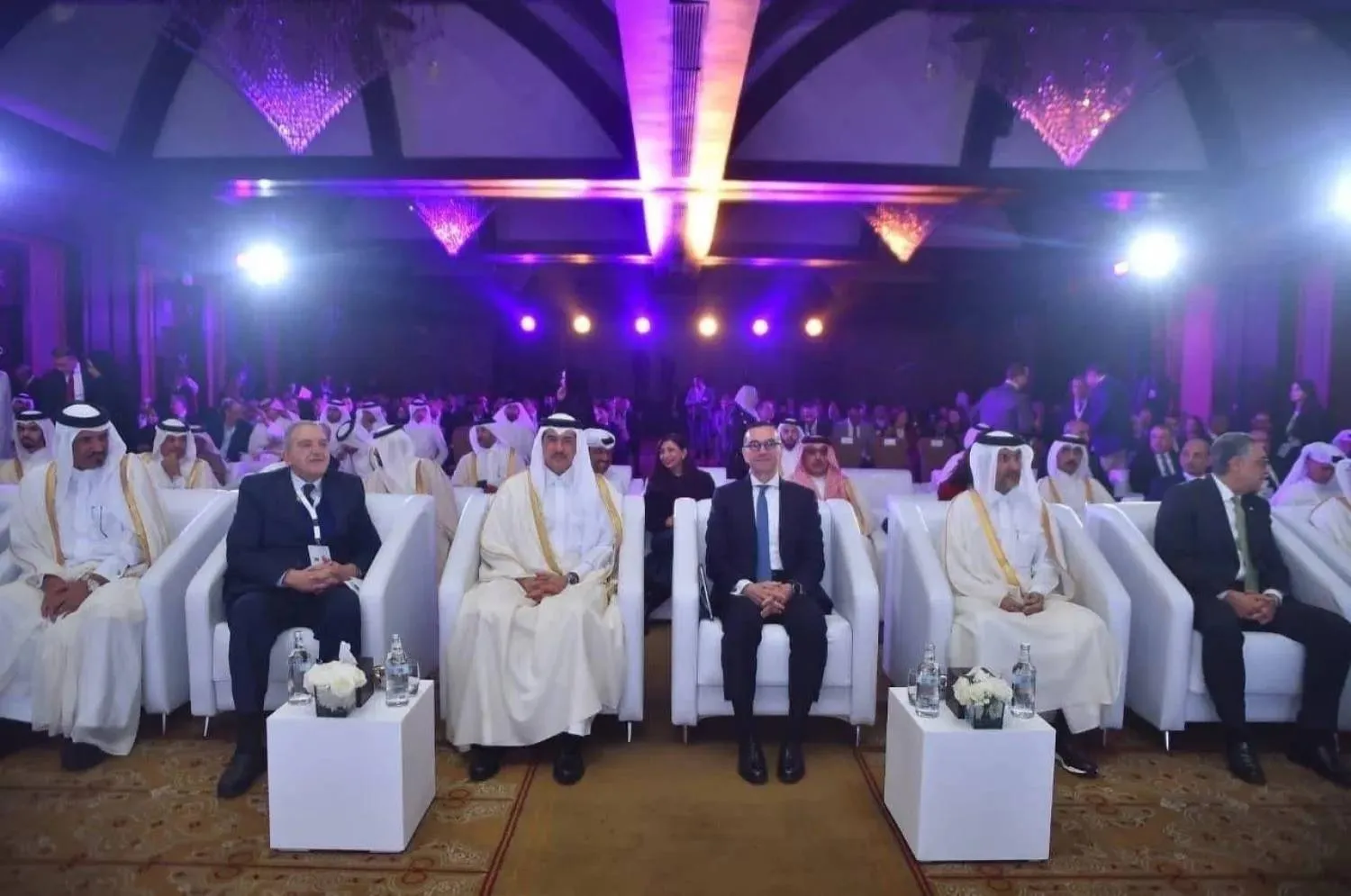

Egypt Pushes for Deeper Economic Ties with Qatar

Photo from  the Egyptian–Qatari Business Forum in Cairo on Sunday (Egyptian Ministry of Investment) 
TT

Egypt Pushes for Deeper Economic Ties with Qatar

Photo from  the Egyptian–Qatari Business Forum in Cairo on Sunday (Egyptian Ministry of Investment) 

Egypt has signaled a new push to deepen economic cooperation with Qatar, announcing a set of investment facilitation measures aimed at boosting bilateral trade and attracting Qatari capital. The announcement came during the Egyptian–Qatari Business Forum held in Cairo on Sunday.

Egypt’s Minister of Investment and Foreign Trade, Hassan ElKhatib, said that a specialized committee would be established to streamline investment and trade procedures between the two countries. Experts view the move as a clear indication of the evolving economic partnership between Cairo and Doha.

ElKhatib inaugurated the forum alongside Ahmad bin Mohammed Al-Sayed, Qatar’s Minister of State for Foreign Trade, with wide participation from business leaders and private-sector representatives from both countries.

Bilateral relations have gained renewed strength following President Abdel Fattah Al-Sisi’s visit to Doha in April, during which Qatar announced a $7.5 billion package of direct investments to support its economic partnership with Egypt.

According to ElKhatib, Qatari investments in Egypt currently stand at around $3.2 billion, distributed across more than 266 companies operating in sectors including finance, industry, and tourism. He added that bilateral trade reached $143 million during the first ten months of the current year, up from $80 million in 2023 — an increase of nearly 80 percent.

The minister said relations with Qatar received a significant boost following Al-Sisi’s visit, which paved the way for new investment projects, led by developments on Egypt’s northwestern Mediterranean coast.

To further support Qatari investors, El-Khatib announced the creation of the specialized facilitation committee to help remove obstacles facing companies and enhance overall economic cooperation, underscoring Egypt’s intent to elevate ties with Qatar to a more strategic level.

Qatar’s Minister of State for Foreign Trade emphasized the importance of strengthening economic partnerships with Cairo, highlighting the private sector’s role in driving growth and creating new investment opportunities. He noted that sustained cooperation between companies in both countries enhances knowledge exchange and enables high-quality investments that support sustainable development.

Former Egyptian Assistant Foreign Minister Ambassador Youssef El-Sharkawy said Egyptian–Qatari relations have entered a new phase of political and economic cooperation. He told Asharq Al-Awsat that economic collaboration has become the main engine of strategic partnership, particularly through investments in the North Coast, the Suez Canal Economic Zone, and key sectors such as tourism, industry, and real estate.

Economist Walid Gaballah, a member of the Egyptian Association for Economy and Legislation, said the forum serves as a practical mechanism for activating Qatar’s investment commitments in Egypt, especially in tourism, agriculture, technology, and industry. He added that improved investment conditions have already contributed to rising trade volumes.

According to Egypt’s Central Agency for Public Mobilization and Statistics, bilateral trade between Egypt and Qatar totaled $128.4 million last year. Observers noted that the deepening economic relationship coincides with closer regional coordination between Cairo and Doha, including joint efforts to promote de-escalation and stability in the region.


US Envoys Urge Netanyahu to Move into Gaza Ceasefire’s Second Phase

Tents housing displaced Palestinians are erected on empty land near buildings destroyed by the Israeli military, in Gaza City on January 24, 2026. (AFP)
TT

US Envoys Urge Netanyahu to Move into Gaza Ceasefire’s Second Phase

Tents housing displaced Palestinians are erected on empty land near buildings destroyed by the Israeli military, in Gaza City on January 24, 2026. (AFP)

Top US envoys met with Israeli Prime Minister Benjamin Netanyahu on Saturday, urging his government to move into the second phase of the ceasefire in Gaza.

Netanyahu met with US President Donald Trump’s envoy Steve Witkoff and Jared Kushner, Trump’s son-in-law and Middle East adviser, according to the prime minister's office, which did not give details. A US official, speaking on condition of anonymity to describe the talks, told reporters the envoys had been working closely with Netanyahu on recovering the remains of the last hostage in Gaza, and on the next steps for demilitarizing the territory.

The US is anxious to keep the Trump-brokered deal moving, but Netanyahu faces pressure to wait until Hamas returns the hostage's remains.

The biggest signal of the second phase would be the reopening of the Rafah border crossing between Gaza and Egypt. Ali Shaath, the head of a future technocratic government in Gaza that is expected to run day-to-day affairs, said Thursday the border crossing will open in both directions this coming week.

There was no confirmation from Israel, which said it would consider the matter this week. The crossing's Gaza side is currently under Israeli military control.

The family of Ran Gvili, whose body is still in Gaza, urged more pressure on Hamas. "President Trump himself stated this week in Davos that Hamas knows exactly where our son is being held," the family said Saturday. "Hamas is deceiving the international community and refusing to return our son, the last remaining hostage, in what constitutes a clear violation of the agreement it signed."

Hamas said Wednesday it has provided "all information" it has on Gvili’s remains to ceasefire mediators and accused Israel of obstructing search efforts in areas it controls in Gaza. The ceasefire took effect on Oct. 10.

Egypt pushes for Rafah crossing to open

Egypt’s top diplomat pressed for an immediate opening of the Rafah crossing with the director of Trump’s new Board of Peace in Gaza, the Egyptian Foreign Ministry said Saturday, including the ability of Palestinians to enter and exit the territory.

Foreign Minister Bader Abdelatty spoke by phone with Bulgarian diplomat Nickolay Mladenov, the high representative for Gaza, the ministry said in a statement. They discussed the implementation of the ceasefire's second phase, including the deployment of an international monitoring force, the opening of the Rafah crossing in both directions and the withdrawal of Israeli forces from the strip, the statement said.

The Egyptian minister said implementing the second phase is a "key entry point" to launch Gaza’s reconstruction. The statement didn’t say when the crossing will open for travelers and the evacuation of sick and wounded.

Israel is expected to discuss opening the Rafah crossing during Sunday's Cabinet meeting.

Hamas in a statement Saturday said a delegation met in Istanbul with the head of Türkiye's National Intelligence Organization about the ceasefire's second phase and "the fulfillment of the requirements of the first phase."

2 teens killed in Gaza

Also on Saturday, an Israeli strike killed two Palestinian teens in Gaza, according to hospital authorities. The boys, cousins aged 13 and 15, were searching for firewood, according to Shifa Hospital in Gaza City, which received the bodies.

The boys were killed in the area that Israel's military has said is safe for Palestinians, about 500 meters (yards) from the Yellow Line, which separates the Israeli-controlled areas in eastern Gaza from the rest of the strip, said a relative, Arafat al-Zawara.

Israel's military said it had targeted several fighters who crossed the Yellow Line and planted explosives, threatening troops. It denied that those killed were children.

Since the ceasefire, more than 480 Palestinians have been killed by Israeli fire, according to Gaza's Health Ministry. The ministry, which is part of the Hamas-led government, maintains detailed casualty records that are seen as generally reliable by UN agencies and independent experts. Israel disputes its figures but has not provided its own.


Syria: Ceasefire Holds as Kurds Withdraw to Kobani

Syrian government forces inspect al-Aqtan prison in Raqqa after the SDF withdrew from the facility on Friday, Jan. 23 (AP). 
TT

Syria: Ceasefire Holds as Kurds Withdraw to Kobani

Syrian government forces inspect al-Aqtan prison in Raqqa after the SDF withdrew from the facility on Friday, Jan. 23 (AP). 

Hundreds of fighters from the Syrian Democratic Forces (SDF) arrived on Friday in the city of Kobani (Ain al-Arab) in eastern Aleppo province, after the Syrian army facilitated their withdrawal from Raqqa to the Kurdish city on the Turkish border.

The development comes amid continued adherence to a ceasefire between the two sides, following the Syrian government’s takeover of large areas previously controlled by the SDF’s autonomous administration in Aleppo, Raqqa, Hasakah and Deir Ezzor provinces in northern and eastern Syria.

Syria’s Interior Ministry announced on Friday that it had taken control of al-Aqtan prison in Raqqa after SDF forces withdrew from the facility.

The state news agency SANA quoted the ministry as saying that specialized units from the counterterrorism department and other relevant authorities had been deployed to secure the prison and maintain order inside it.

The Syrian army’s operations command said its units had begun transferring SDF elements from al-Aqtan prison and its surroundings to Kobani, escorting the withdrawing fighters to the city’s outskirts.

Kurdish news outlets later published images showing hundreds of SDF fighters and their vehicles arriving in snow-covered Kobani, where they were welcomed by large crowds of residents.

Al-Aqtan prison holds detainees linked to the ISIS group and had witnessed clashes in its vicinity between government forces and the SDF days earlier. The number of remaining detainees in the facility remains unclear.

Meanwhile, US Central Command announced on Wednesday the launch of a new mission to transfer up to 7,000 ISIS detainees to Iraq to ensure their continued detention in secure facilities.

It said 150 detainees had already been transferred from a prison in Hasakah to Iraq. Iraqi security officials told AFP that the first group included senior ISIS leaders of various nationalities, including Europeans, Asians and Arabs.

Under a comprehensive integration agreement reached on Sunday between Damascus and the SDF, responsibility for prisons holding ISIS detainees is expected to be transferred to the Syrian government.

Separately, the UN refugee agency said the volatile security situation at al-Hol camp, home to families of ISIS fighters, has hindered access to the site. The camp hosts about 24,000 people, including thousands of Syrians and foreign women and children from dozens of countries.


Southern Yemeni Forces Rally in Riyadh Ahead of Key Saudi-Sponsored Dialogue

Southern leaders received in Riyadh by Abdullah Bawazeer, a member of Yemen’s Presidential Leadership Council (X).
TT

Southern Yemeni Forces Rally in Riyadh Ahead of Key Saudi-Sponsored Dialogue

Southern leaders received in Riyadh by Abdullah Bawazeer, a member of Yemen’s Presidential Leadership Council (X).

Riyadh has witnessed, since the beginning of January, an unprecedented wave of political activity involving southern Yemeni leaders and factions.

These consultations and discussions among key actors and influential figures are aimed at preparing for the convening of the Southern Dialogue Conference, sponsored by Saudi Arabia at the request of Rashad al-Alimi, Chairman of Yemen’s Presidential Leadership Council.

Al-Alimi had formally requested Saudi sponsorship of the conference against the backdrop of military and political developments that followed unilateral military actions by Aidarous al-Zubaidi, head of what was formerly known as the Southern Transitional Council (STC), and the subsequent intervention of the Coalition to Support Legitimacy in Yemen to protect civilians in Hadhramaut and Al-Mahra.

As coalition-backed government forces regained control of Hadhramaut and Al-Mahra and deployed across other southern governorates, the Presidential Leadership Council decided to remove Aidarous al-Zubaidi and Faraj al-Bahsani from its membership.

Al-Zubaidi fled Aden by sea to Somalia and then by air to Abu Dhabi, which Yemeni authorities accuse of committing widespread violations in Hadhramaut before ending its military presence there in recent weeks.

Broad Political Mobilization

Amid this momentum, southern figures held a consultative meeting days ago, during which they agreed to abide by the outcomes of the upcoming dialogue, according to a statement read by Abdulrahman al-Muharrami, a member of the Presidential Leadership Council.

In the statement, participants called on the international community to support the dialogue and respect the aspirations of the southern people, stressing that Saudi Arabia guarantees the inclusion of all southern parties and encourages partnership and responsible representation.

Meanwhile, political and social figures in Hadhramaut are mobilizing to unify their vision at the dialogue conference, under the leadership of Salem al-Khanbashi, a member of the Presidential Leadership Council and Governor of Hadhramaut.

Parallel efforts are being led by Abdullah al-Alimi, another member of the Presidential Leadership Council, who has been holding meetings with various southern groups and figures, including those from Shabwa Governorate, alongside representatives from other governorates such as Al-Mahra, Abyan, and Socotra.

This intensive political activity is taking place under direct Saudi sponsorship, in preparation for the launch of the Comprehensive Southern Dialogue Conference, which is expected to constitute a cornerstone in shaping Yemen’s final transitional phase.

Saudi Arabia’s role is no longer confined to traditional mediation but has evolved into what participants describe as “engineering consensus.” Current meetings aim to bridge differences among the various southern components, particularly leaders of what was formerly known as the Southern Transitional Council prior to its dissolution, in addition to other influential southern figures.

Analysts believe that the upcoming conference will not be a mere symbolic event, but rather a defining moment in the history of the “Southern Cause” and Yemen more broadly.

Emphasis on Partnership

Against this political backdrop, converging positions have emerged from Presidential Leadership Council members Abdullah al-Alimi Bawazeer and Abdulrahman al-Muharrami, who stressed the need to entrench the principle of partnership, reject exclusion, and unify the southern front through an inclusive dialogue under Saudi sponsorship.

These positions were articulated during southern meetings held in Riyadh, with the participation of prominent political and military leaders, as part of ongoing preparations for the upcoming dialogue conference.
