


Louvre Workers Vote to Strike in Another Blow to the Paris Museum 

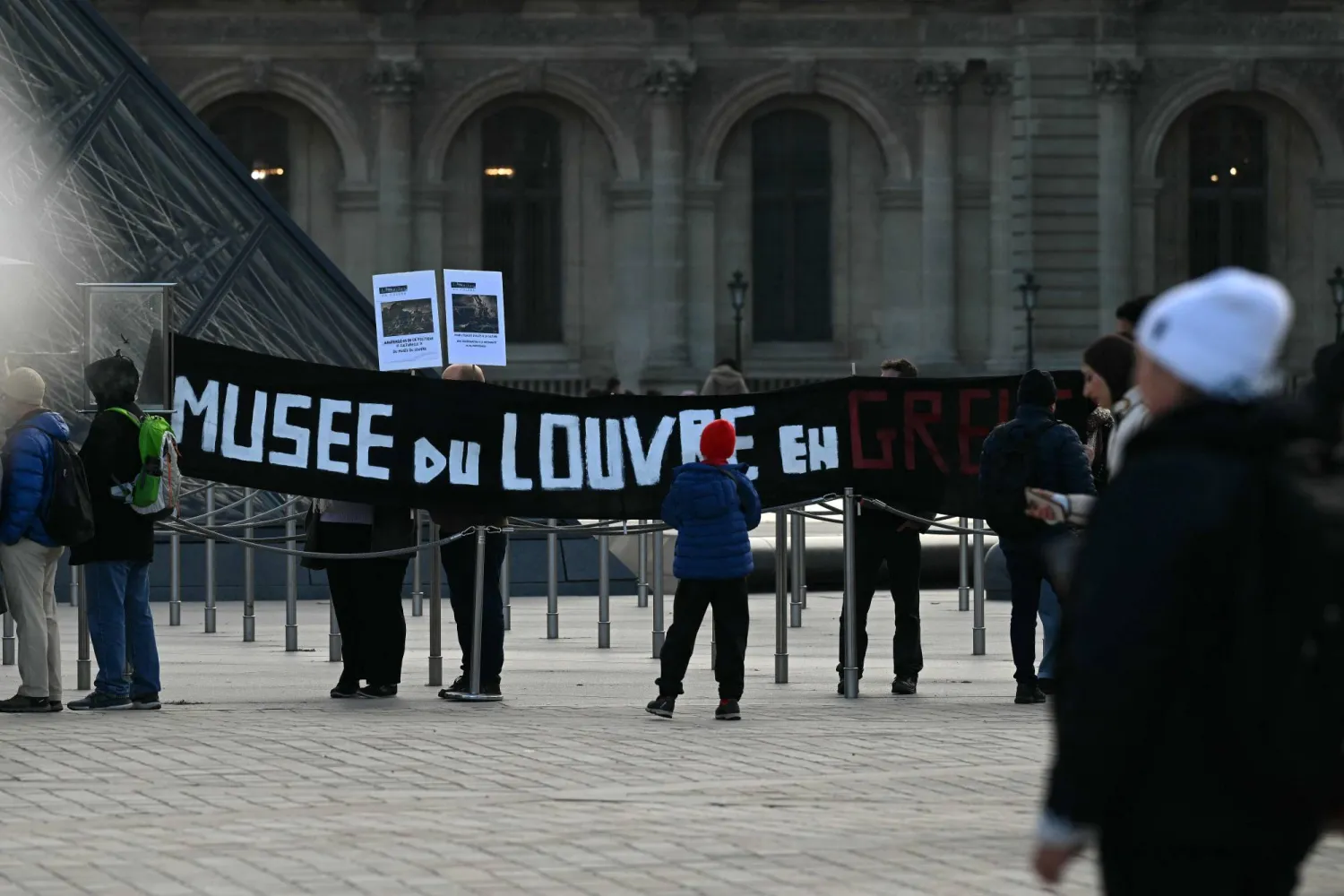
This photograph shows a banner which reads "Louvre Museum on Strike" outside the entrance to the Louvre as museum workers voted to go on strike against increasingly deteriorating working conditions and the declining visitor experience at the world famous museum, in Paris on December 15, 2025. (AFP)
TT

Louvre Workers Vote to Strike in Another Blow to the Paris Museum 

This photograph shows a banner which reads "Louvre Museum on Strike" outside the entrance to the Louvre as museum workers voted to go on strike against increasingly deteriorating working conditions and the declining visitor experience at the world famous museum, in Paris on December 15, 2025. (AFP)

Workers at the Louvre Museum voted Monday to strike over working conditions and other complaints, dealing another blow to the Paris landmark and home of the Mona Lisa after an embarrassing jewelry heist in October.

The CFDT union said the vote was taken at a meeting of 400 workers on Monday morning and that they decided to strike for the day.

The world’s most-visited museum didn’t open as scheduled and turned people away. A notice on the Louvre's website said, “the museum is closed for the moment.”

“It's really sad, because I was really looking forward to this,” said Lindsey Hall, a bitterly disappointed would-be visitor from Sacramento, California. She had been planning to enjoy the museum's huge collection of art and artifacts with a friend, describing it as “one of those life experiences you crave.”

“This is just an epic collection of art and something that every human should see,” she said. “I can see the other side of it, like if you are the person that works in the museum and how that can be, like day after day after day.”

The strike vote followed talks last week between labor unions and government officials, including Culture Minister Rachida Dati. Labor leaders said the talks had not alleviated all of their concerns about staffing and financing for the museum that welcomes millions of visitors each year.

“Visiting the museum has become an obstacle course,” said Alexis Fritche, general secretary of the culture wing of the CFDT union.

For employees, the daylight jewel heist crystallized long-standing concerns that crowding and thin staffing are undermining security and working conditions at the Louvre.

Thieves used a basket lift to reach the Louvre’s facade, forced a window, smashed display cases and fled with pieces of the French crown jewels. A Senate inquiry released last week said the thieves escaped with barely 30 seconds to spare and pointed fingers of blame at broken cameras, outdated equipment, understaffed control rooms and poor coordination that initially sent police to the wrong location.

In a statement, the CFDT said employees wants more staffing for security and to welcome visitors, improved working conditions, stable long-term budgets for the Louvre and leadership that “truly listens to staff.”

Yvan Navarro of the CGT union complained that staff numbers have continually decreased while visitor numbers have increased.

“People come to Paris to visit the museums. So the visitor numbers go up, the tariffs and the prices go up, because everything is becoming more expensive, but the salaries and the numbers of staffers don't go up so obviously you reach a point like today, a day of anger,” he said.

Traditional Arts Festival Reinforces National Identity, Highlights Performance Traditions

The Traditional Arts Festival 2026 is drawing strong crowds of visitors and tourists in Diriyah. (SPA)
TT

Traditional Arts Festival Reinforces National Identity, Highlights Performance Traditions

The Traditional Arts Festival 2026 is drawing strong crowds of visitors and tourists in Diriyah. (SPA)

The Traditional Arts Festival 2026, organized by the Ministry of Culture, is drawing strong crowds of visitors and tourists in Diriyah amid pleasant spring weather.

The festival, held from March 26 to April 8 and from 4 p.m. to 11 p.m., features a range of performing arts from across the Kingdom, the Saudi Press Agency reported on Thursday.

Live shows in a dedicated traditional performance arena allow visitors to explore those traditions and their varied forms, reflecting the depth and diversity of Saudi cultural heritage.

The event is part of the Ministry of Culture’s ongoing efforts to support the national cultural scene and highlight traditional performing arts as a core element of the Kingdom’s cultural identity. It also presents those arts as a form of expression tied to the occasions and events of Saudi society.


Archaeologists Forced by Middle East War to Cut Short Iraq Digs

An Iraqi worker excavates a rock-carving relief recently found at the Mashki Gate, one of the monumental gates to the ancient Assyrian city of Nineveh, on the outskirts of what is today the northern Iraqi city of Mosul on October 19, 2022. (AFP)
TT

Archaeologists Forced by Middle East War to Cut Short Iraq Digs

An Iraqi worker excavates a rock-carving relief recently found at the Mashki Gate, one of the monumental gates to the ancient Assyrian city of Nineveh, on the outskirts of what is today the northern Iraqi city of Mosul on October 19, 2022. (AFP)

Iraq is home to ruins from some of the world's earliest civilizations, but teams led by international archaeologists have been forced by drone and rocket attacks in the Middle East war to cut short their expeditions.

Archaeologists told AFP that some of the projects interrupted by the war had been planned for years, but their teams have had to evacuate ancient sites since the United States and Israel attacked Iraq's neighbor, Iran.

Like other countries around the region, Iraq has become engulfed in the war, bringing to an abrupt end a period of nascent stability.

Iraq's precious archaeological sites, some dating back thousands of years, had for years faced threats ranging from climate change to successive conflicts.

Under normal circumstances, around 60 international teams would have been working on digs, a government official told AFP, but "all of these missions have left Iraq".

- 'Like a musician' -

Adelheid Otto of Germany's Ludwig-Maximilians-University started a long-planned dig at ancient Shuruppak, modern-day Tell Fara, on February 28.

That same day, Israel and the US launched strikes against Iran, sparking a war that has dragged Iraqi armed groups into the fray -- and cutting short Otto's work.

"We are Near Eastern archaeologists. So that is our work. That is like a musician who can no longer play an instrument," she told AFP.

Her team -- 18 German archaeologists, geologists, geophysical experts and students and seven Iraqi archaeologists -- initially stayed, reasoning travelling the 750 kilometers (460 miles) overland to Türkiye was more dangerous.

"After some days we got kind of used to the rockets and drones above our heads," she said.

But Iraqi officials repeatedly urged them to depart, despite their discovery of ancient cuneiform tablets.

"It is impossible" to leave, she told authorities, insisting on staying extra days. "We have to document it. We have to take photos of everything."

"I told the students you have to work on all the small finds that we have," said Otto, 59, who boasts four decades of experience.

"You never know in any of these countries if you will ever return," she said.

- 'Guarantors' -

Many German institutions had just started relaxing travel restrictions to Iraq after a succession of conflicts, including the 2003 US-led invasion and the extremist ISIS group.

Now, said Otto, archaeologists once again face being shut out.

Iraq's State Board of Antiquities and Heritage head Ali Obeid Shalgham told AFP Iraqi security forces were the sites' "true guarantors", especially as many are in remote rural areas.

He said the country is installing so-called protective "blue shields" -- nicknamed "the Red Cross of heritage" -- at archaeological sites.

The presence of foreign teams is "crucial", said Aqeel al-Mansrawi, an Iraqi landscape archaeologist.

"They work to protect heritage through conservation," he said.

He also emphasized the training Iraqi experts receive from foreigners, vital after years of isolation and war.

"We are always training a lot of Iraqi archaeologists and colleagues," said Otto, of the German institute.

"If it would be cut again, it would be terrible," she said.

Foreign digs must work with Iraqi archaeologists, bringing their international expertise.

Shalgham said the arrangement allows Iraqis "to keep up with global advancements in new technologies and state-of-the-art equipment".

- 'Can't catch a break' -

Chicago University professor Augusta McMahon was in southern Iraq, working at the 6,000-year-old Nippur site, when the war began.

Having worked in the Middle East for almost four decades, this was her third evacuation.

In 2024, she had to leave Iraq, while in 2011, she left Syria.

"We had pressure from a lot of different directions in terms of having to leave," she said, with her eight-person team departing under an Iraqi escort on March 10.

"It is quite frustrating, along with everything else, I feel terribly bad for [my] Iraqi colleagues," she said.

The war has also rippled beyond the immediate: an initiative to finally return the preeminent Rencontre Assyriologique Internationale (RAI) conference to Iraq was cancelled by the University of Baghdad.

The city last attempted to host the event in 1990, according to the university, but it was scrapped with the Gulf War.

"Now 36 years later, they finally pulled themselves together... and it's cancelled again," said McMahon, who was due to be presenting.

"It's like they can't catch a break."


Thieves Steal Paintings by Renoir, Cézanne and Matisse from Italian Private Museum

A visitor looks at works by Auguste Renoir during the press review of the exhibition 'Renoir the draughtsman at 'the Orsay museum, Monday, March 16, 2026, in Paris, France. (AP Photo/Emma Da Silva)
TT

Thieves Steal Paintings by Renoir, Cézanne and Matisse from Italian Private Museum

A visitor looks at works by Auguste Renoir during the press review of the exhibition 'Renoir the draughtsman at 'the Orsay museum, Monday, March 16, 2026, in Paris, France. (AP Photo/Emma Da Silva)

Thieves made off with three paintings by Renoir, Cézanne and Matisse worth millions of euros (dollars) from a museum near the city of Parma in northern Italy, police said on Monday.

The heist took place on the night of March 22-23, with thieves forcing open the entrance door, The Associated Press quoted police as saying.

The three stolen paintings are “Fish” by Auguste Renoir, “Still Life with Cherries” by Paul Cézanne, and “Odalisque on the Terrace” by Henri Matisse.

The Magnani Rocca Foundation, a private museum, lies in the heart of the countryside 20 kilometers (12 miles) from Parma.

Local media reported that the thieves were able to nab the paintings in less than three minutes and escape across the museum gardens.

Established in 1977, the foundation hosts the collection of the art historian Luigi Magnani and also includes works by Dürer, Rubens, Van Dyck, Goya and Monet.

The museum believes a structured and organized gang was responsible for the theft, which was interrupted by the alarm, local media reported.

The museum didn't post any statement about the theft on its website and wasn't reachable for a comment, as it is closed on Monday.

The crime in Parma comes after a series of high-profile heists at major European museums, including a major incident in October where thieves stole jewels and other items worth 88 million euros ($101 million) from the Louvre in Paris.