


Turkmenistan's Battle against Desert Sand

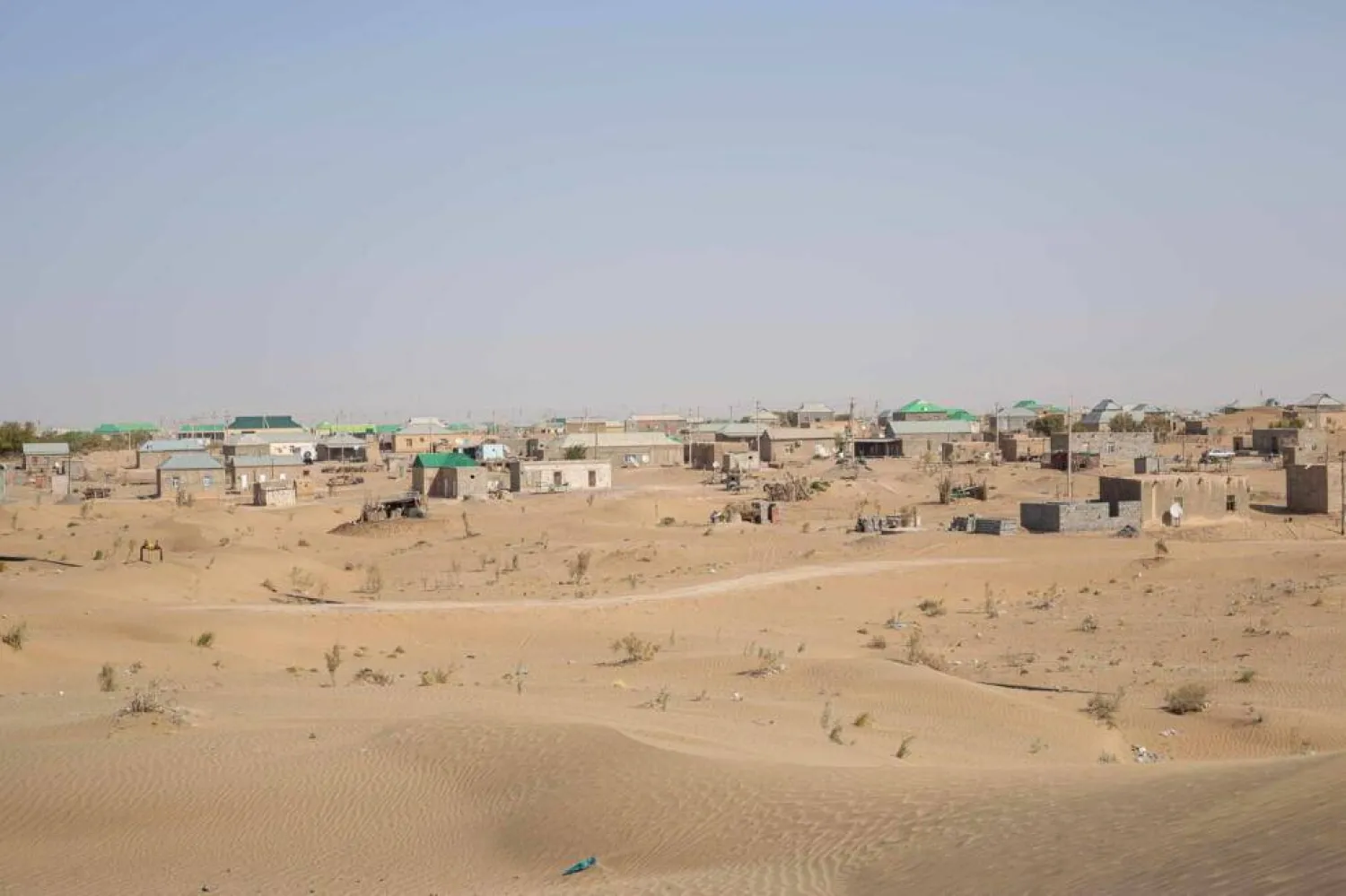
For Bokurdak residents, cultivating every square meter is a constant battle with nature. Nikolay Vavilov / AFP
TT

Turkmenistan's Battle against Desert Sand

For Bokurdak residents, cultivating every square meter is a constant battle with nature. Nikolay Vavilov / AFP

Residents in the remote Turkmen village of Bokurdak have long depended on the Karakum Desert for their livelihoods, cultivating every square meter they can in a constant battle with nature.

It is a battle that some fear they are now losing.

Over recent years, large dunes have started encroaching on the land in the village, while rolling desert sands have forced residents to shift further downhill, local pensioner Kakabai Baimedov told AFP.

For those who live in the desert -- known as "gumli" in Turkmen -- this has been "very difficult", Baimedov said.

"The village of Bokurdak used to be on a hill north of this place. Then, due to the advancing desert, we had to move lower and lower," Baimedov told AFP.

While sand and the steppe have always been part of life in Central Asia, scientists warn climate change and other human activities are accelerating desertification and the degradation of the land.

In addition to being an ecological and social problem, desertification is also an economic burden, costing an estimated six percent of Central Asia's GDP annually, according to the World Bank.

The Karakum Desert covers more than 80 percent of Turkmenistan, a former Soviet republic bordering Iran and Afghanistan.

"If its vegetation and soil cover are not properly managed, the surface is easily subject to erosion, degrading farmland and forming sand dunes," Turkmen scientist Mukhammet Durikov told AFP.

Deforestation is another key culprit, while severe droughts and dry winds fueled by climate change are making the problem worse, he said.

Tree-planting campaign

Central Asia is especially vulnerable to climate change: average temperatures in the region have risen by about twice the global average since 1991, according to UN data.

Authorities in Turkmenistan -- a politically isolated country of seven million people -- have sought to curb desertification through a massive tree-planting campaign.

The government announced in the summer that 162 million trees had been planted over the past 20 years.

"The president himself actively participates in the fight against desertification," an official from the environmental ministry told AFP.

The ministry and regional officials are responsible for planting sites for the trees, overseeing their planting and care, the official said.

AFP was not able to immediately verify the government's claims.

The country bordering the Caspian Sea restricts independent reporting and keeps information about government activities largely secret.

Turkmenistan's two leaders, father-and-son duo Gurbanguly and Serdar Berdymukhamedov, have been keen to show they are taking action in combating desertification.

State media shows Serdar regularly appearing with a shovel in hand planting trees.

"Previously, it was spruces or cedars, but today, we find endemic species better adapted to the climate," Merdan Arazmedov, a member of Turkmenistan's Nature Protection Society, told AFP.

Keeping water in the soil

In Bokurdak, scientists have mainly planted saxauls -- a hardy desert shrub whose roots penetrate as much as 15 meters (49 feet) underground to capture water, Arazmedov said.

The saxaul -- which is also being used in Uzbekistan and Kazakhstan -- helps retain sand, improves soil moisture, and also serves as a natural barrier for homes.

Baimedov, who has become an amateur botanist, tends to about 15,000 saplings, which are aimed at forming a green wall against the sand.

"It takes 15-20 years to grow a tree like this," he said, pointing to an eight-meter- (26-foot-) high saxaul.

The saxaul is also being used to protect the capital Ashgabat, where "environmental activists have planted more than 50 hectares of saxaul on the edge of the desert," Arazmedov said.

"Now, the road to the capital is no longer covered in sand, traffic flows smoothly, and the number of accidents has decreased," he added.

But for Baimedov, whose main weapon against the desert is planting trees, the battle has become all the harder due to climate change.

"In the past, it was enough to water young saxaul daily with up to 10 liters of water," he said.

"Today, due to climate change and rising temperatures, it takes up to 20 liters each day to ensure rooting."

Turkmenistan has employed other methods to beat the sand.

Last year, scientists in the country announced they had launched successful trials spraying the soil with cyanobacteria, also known as "blue-green algae" -- a method that helps retain moisture and facilitate tree rooting.

In September, Turkmenistan's president proposed creating a regional center against desertification in Central Asia.



'Large-scale' Avalanche Kills Two Skiers in French Alps

Members of the CRS Alpes Grenoble mountain rescue team prepare to board a Securite Civile helicopter (emergency management) after after an avalanche emergency response rescue mission in an off-piste area of the Ecrins massif, French Alps on January 29, 2026. (Photo by JEFF PACHOUD / AFP)
TT

'Large-scale' Avalanche Kills Two Skiers in French Alps

Members of the CRS Alpes Grenoble mountain rescue team prepare to board a Securite Civile helicopter (emergency management) after after an avalanche emergency response rescue mission in an off-piste area of the Ecrins massif, French Alps on January 29, 2026. (Photo by JEFF PACHOUD / AFP)

An avalanche has killed two off-piste ski tourers in the French Alps, a local prosecutor said on Sunday.

According to local rescue services, the two men died when an avalanche was triggered on Saturday afternoon near the village of Saint-Veran, known as the highest village in the French Alps.

The two victims-- one born in 1997 and the other in 1991 -- were part of a group of four unguided skiers when a "large-scale" avalanche swept down the north side of the Tete de Longet mountain peak, Gap prosecutor Marion Lozac'hmeur told AFP.

The other two skiers were unharmed, Lozac'hmeur added.

An autopsy has been ordered as part of an investigation into the cause of death, according to the prosecutor.

Avalanches have already claimed the lives of more than 20 skiers across the French, Swiss and Austrian Alps so far this season.


Olympic Tourists in Cortina Can Explore the Dolomites with the New ‘Uber Snowmobile’ Service

 The peaks of the Dolomites are seen from the Cortina Sliding Centre during the Milano Cortina 2026 Winter Olympic Games in Cortina d'Ampezzo on February 5, 2026. (AFP)
The peaks of the Dolomites are seen from the Cortina Sliding Centre during the Milano Cortina 2026 Winter Olympic Games in Cortina d'Ampezzo on February 5, 2026. (AFP)
TT

Olympic Tourists in Cortina Can Explore the Dolomites with the New ‘Uber Snowmobile’ Service

 The peaks of the Dolomites are seen from the Cortina Sliding Centre during the Milano Cortina 2026 Winter Olympic Games in Cortina d'Ampezzo on February 5, 2026. (AFP)
The peaks of the Dolomites are seen from the Cortina Sliding Centre during the Milano Cortina 2026 Winter Olympic Games in Cortina d'Ampezzo on February 5, 2026. (AFP)

The peaks of the Dolomites are seen from the Cortina Sliding Centre during the Milano Cortina 2026 Winter Olympic Games in Cortina d'Ampezzo on February 5, 2026. (AFP)

For one month starting on Saturday, Olympic spectators keen for a side trip to a UNESCO World Heritage Site can use Uber to reserve a ride on a snowmobile along the snow-covered road to the base of the Three Peaks of Lavaredo.

The dramatic, jagged limestone pinnacles stand just 23 kilometers (14.3 miles) from the Cortina venues where athletes are competing in the 2026 Winter Olympics and Paralympics.

One of the Olympic torchbearers, Giulia Baffetti, runs snowmobiling tours through Cortina-based winter activities outfit Snowdreamers. The company partnered with Uber, the official ride-hailing sponsor for the Games, to offer free tours on the weekends in February to people in town.

"Uber Snowmobile" tours, which can only be booked through Uber, include a ride in an Uber transfer bus for up to eight people from Cortina to the spot where riders mount their snowmobiles for departure. Tourgoers then follow the instructor, who leads the line of snowmobiles.

The first slots offered went fast, but Uber spokesperson Caspar Nixon said Friday that it planned to add more.

The three peaks are a magical place, Baffetti said, and this is a way for more people to experience it. Hikers and climbers flock there in the warmer months. In the winter, it’s a prime spot for cross-country skiing, snowshoeing and sledding. Snowmobiling is allowed in a limited area in order to protect the environment.

"We want to give an experience to the tourists, so they can feel the mountains in a different way," she said.

The Associated Press took the one-hour tour on Thursday, ahead of the Saturday launch, along with one other person. Helmets are essential, while heated handgrips are a most welcome feature. And that red button? Passengers can push it to stop the snowmobile if it veers off course or they feel unsafe.

The adrenaline-filled ride reaches speeds up to 40 kph (25 mph) when zooming past snow-covered trees, and drivers are instructed to slow when coming upon cross-country skiers and sledders. Deer and wolves are sometimes seen along the 7-kilometer (4.3-mile) route up to the base of the peaks.

Also visible on Thursday was the southernmost of the three Lavaredo peaks, rising sharply out of the fog. While the Dolomites are breathtaking from Cortina — and on Friday, the sun shone and the view was clear from town — they are even more impressive up close.

The route back includes a short loop around Lake Antorno. Before traversing all the ups and downs, the snowmobile instructor leading the tour offers a reminder about that red button.

Saher Deeb, an Israeli tourist, was along for the ride Thursday, one day after his 29th birthday. It was his first time on a snowmobile, and he was all smiles as he climbed off at the end.

"It was perfect," he said.


French Duo Finish Walking from France to Shanghai After 1.5 Years

 Performers throw molten iron to create sparks during a performance on the Bund promenade along the Huangpu river, ahead of the upcoming Lunar New Year of the Horse in Shanghai on February 2, 2026. (AFP)
Performers throw molten iron to create sparks during a performance on the Bund promenade along the Huangpu river, ahead of the upcoming Lunar New Year of the Horse in Shanghai on February 2, 2026. (AFP)
TT

French Duo Finish Walking from France to Shanghai After 1.5 Years

 Performers throw molten iron to create sparks during a performance on the Bund promenade along the Huangpu river, ahead of the upcoming Lunar New Year of the Horse in Shanghai on February 2, 2026. (AFP)
Performers throw molten iron to create sparks during a performance on the Bund promenade along the Huangpu river, ahead of the upcoming Lunar New Year of the Horse in Shanghai on February 2, 2026. (AFP)

Two French adventurers reached the end of an epic walk from France to Shanghai on Saturday, after nearly a year and a half crossing 16 countries almost entirely on foot.

Loic Voisot and Benjamin Humblot embraced as they stood by the river on the Bund promenade, the financial hub's distinctive skyline glittering in the background.

Voisot and Humblot set off from Annecy in September 2024.

"We were thinking about this moment almost every day for more than a year now, so it's a really strong feeling," Humblot said of reaching their destination.

Hanging out after work one day, the two friends realized they both yearned for a "great adventure".

They wanted to visit China -- but without flying, which they believe is too harmful to the environment.

A plan to set out on foot was hatched, and except for a stretch in Russia which was done by bus for safety reasons, 518 days and around 12,850 kilometers (7,980 miles) later they took the last steps to completing it.

Around 50 people gathered at the start point for the last 10km stretch of their odyssey, many local people who have been following them on social media.

Along the way their numbers swelled, as media, French residents of Shanghai and others joined.

"If your dreams are crazy, just take it step by step and sometimes you will not succeed, but sometimes you will," said Voisot.

Asked what he would do first now the walk was over, he joked: "Sleep a lot!"