
What Egypt’s Red Lines Mean for Sudan’s War

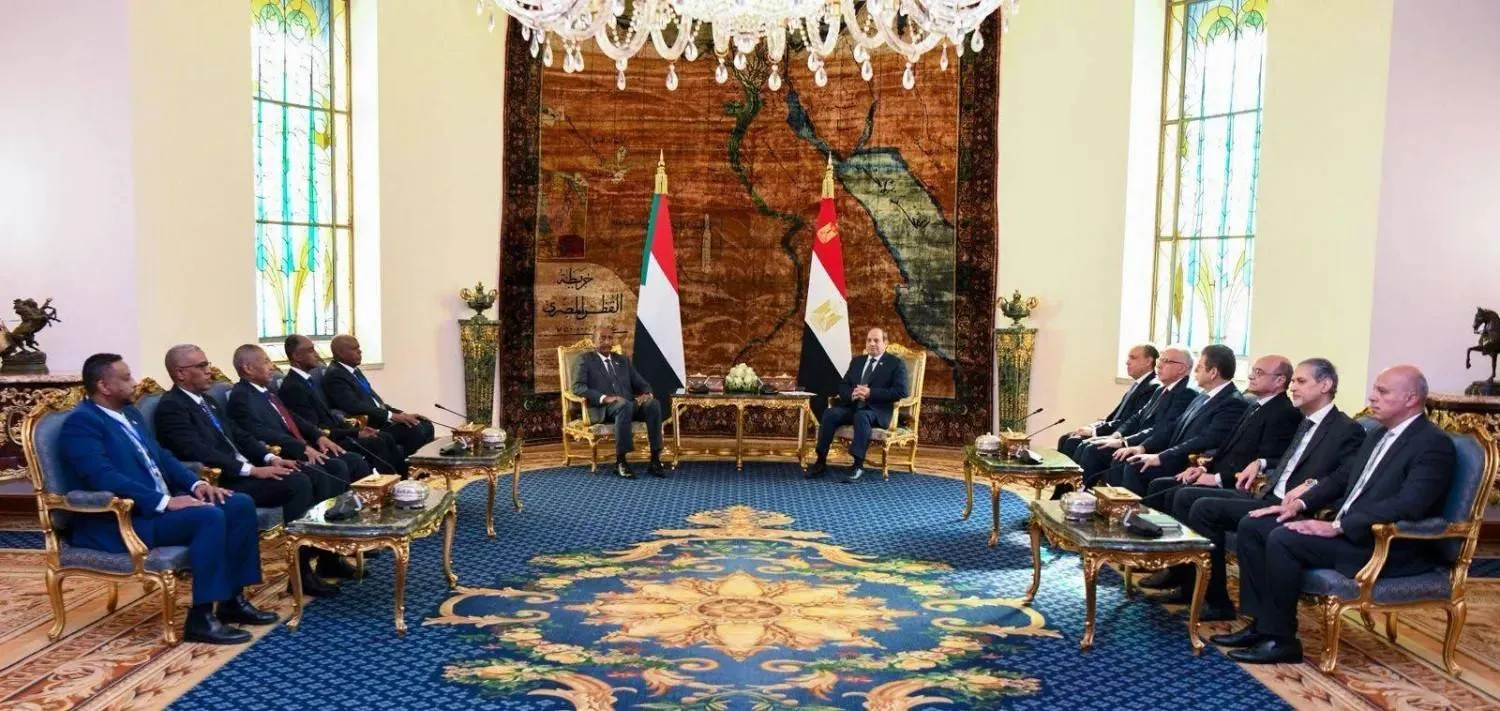
Egyptian President Abdel Fattah al-Sisi holds talks with Sudan’s army chief Abdel Fattah al-Burhan in Cairo on Thursday (Egyptian Presidency)
TT

What Egypt’s Red Lines Mean for Sudan’s War

Egyptian President Abdel Fattah al-Sisi holds talks with Sudan’s army chief Abdel Fattah al-Burhan in Cairo on Thursday (Egyptian Presidency)

In unusually blunt language, and following a visit by Sudan’s Sovereignty Council Chairman and army chief Abdel Fattah al-Burhan to Cairo, the Egyptian presidency issued a statement on the war in Sudan outlining three points it described as red lines.

It said Egypt would not allow any of them to be crossed or compromised, as they directly affect Egypt’s national security, which it said is inseparable from Sudan’s national security.

The reference to activating the joint defense agreement between the two countries was seen as a signal that Egypt could bring its military, political, and diplomatic weight to bear in support of the Sudanese army.

Joint defense agreement

In March 2021, Egypt signed a military cooperation agreement with Sudan that covers training, border security, and the confrontation of shared threats. That agreement followed a joint defense pact signed in 1976 during the presidencies of Sudan’s Gaafar Nimeiry and Egypt’s Anwar Sadat.

Articles One and Two of the pact stipulate that any attack on one party is considered an attack on the other, and require immediate consultation, including the use of armed force to repel aggression. The agreement also commits both sides to coordinating their defense and military policies on matters related to their national security.

After the fall of Nimeiry’s regime in the 1985 popular uprising, then Prime Minister Sadiq al-Mahdi informed the Egyptian leadership of his desire to cancel the joint defense agreement. Instead, the two sides signed what became known as the Brotherhood Charter in 1987. While it did not explicitly cancel the 1976 agreement, its mechanisms have not been discussed or activated since then.

Regional and international messages

Sudanese journalist Osman Mirghani, editor-in-chief of Al-Tayar newspaper, said the Egyptian statements amounted to regional and international messages linked to recent developments and what he described as serious security threats facing Sudan.

He pointed to the expansion of the Rapid Support Forces in the Darfur and Kordofan regions in a way that threatens shared Sudanese and Egyptian national security, warning of risks of geographic fragmentation that could endanger Sudan’s unity.

Speaking to Asharq Al-Awsat, Mirghani said Egypt was, for the first time, using direct and tough language and signaling the possibility of intervention under international law in Sudan’s conflict. He said this reflected the level of Egyptian concern over the situation in Sudan.

Mirghani added that the reference to red lines was a message directed at all parties, noting that there are many influential players in Sudan.

The red lines

The first red line cited by Cairo was the preservation of Sudan’s unity and territorial integrity, preventing any tampering with its resources or those of the Sudanese people, and rejecting the secession of any part of the country. Egypt reiterated its categorical refusal to the establishment or recognition of any parallel entities, saying such moves would undermine Sudan’s unity and territorial integrity.

The statement also stressed the need to preserve Sudanese state institutions and prevent any harm to them. Egypt affirmed its full right to take all necessary measures permitted under international law, including activating the joint defense agreement between the two brotherly countries, to ensure these red lines are not crossed.

Timing of the visit

Former Sudanese Foreign Minister Ali Youssef noted the timing of Burhan’s visit to Cairo, stating that it occurred after his trip to Saudi Arabia earlier this week and following a visit by Saudi Crown Prince Mohammed bin Salman to the United States.

Youssef said the trip was part of efforts to end the war in Sudan through the Quartet mechanism, which includes Saudi Arabia, the United Arab Emirates, Egypt, and the United States.

Speaking to Asharq Al-Awsat, Youssef said Burhan briefed Egyptian President Abdel Fattah al-Sisi on the outcomes of his Saudi visit and the latest developments in Sudan.

He stated that the visit did not follow the usual ceremonial protocol and was a result of developments in the war, noting that Egypt’s security is linked to Sudan’s security. He added that Egypt is part of the Quartet, which seeks to end a war that is approaching its third year.

Military implications

Sudanese military expert Al-Muatasim Abdel Qader said activating the joint agreement would imply Egyptian intervention in various forms, including supplying weapons and ammunition or direct military involvement.

He said the provisions of the agreement obligate each army to defend the other, adding that the red lines outlined by the Egyptian presidency represented a significant step and carried major implications for the Sudanese state.

In remarks to Asharq Al-Awsat, Abdel Qader described mutual protection between the two countries as a historically rooted matter, dating back to wars Egypt fought in the last century in which Sudanese armed forces took part.

Rapid Support Forces response

Basha Tabiq, an adviser to the commander of the Rapid Support Forces, said in posts on X that Egypt’s position amounted to blatant interference, bias toward one party, and a colonial mindset that views Sudan as a backyard.

Another source aligned with the RSF said accusations against Egypt of backing the Sudanese army have persisted since the early days of the war. The source pointed to the presence of Egyptian forces at Merowe air base in northern Sudan at the start of the conflict, when several Egyptian soldiers and officers were captured before later being handed over to Cairo.

The source also cited accusations by RSF leader Mohamed Hamdan Dagalo, known as Hemedti, who said in October 2024 that the Egyptian army had carried out air strikes against his forces and supplied the Sudanese army with drones and training.

He said Hemedti renewed those accusations last June, alleging that Cairo supported the Sudanese army with aircraft flown by Egyptian pilots that bombed areas under his forces’ control, and supplied weapons and aviation fuel. Hemedti described this as a blatant aggression against the Sudanese people.

The source, who requested anonymity, said Egypt has been intervening in the war from the outset and that activating the joint defense agreement would merely formalize an existing reality.

No time to spare

Sudanese ambassador Al-Sadiq al-Maqli said Egypt is working with Saudi Arabia and the international Quartet, in coordination with the United States, to give fresh momentum to efforts on Sudan.

He said Washington is currently using soft power rather than force, which he described as an option deferred until shuttle diplomacy by US President’s senior adviser Massad Boulos is exhausted.

Speaking to Asharq Al-Awsat, Maqli said the United States fully understands the influence of Saudi Arabia and Egypt and their ability to persuade and soften the stance of Sudan’s government, which has rejected the latest US initiative.

He said Burhan currently has no time to spare, as what is unfolding in Sudan represents the world’s worst humanitarian disaster, according to the international community.

Maqli noted that Egypt, represented by Foreign Minister Badr Abdelatty, has been almost fully dedicated to making the Quartet mechanism succeed, given that the continuation of the current situation in Sudan poses a threat to Egypt’s national security.

He described Burhan’s visits to Riyadh and Cairo as short but necessary steps toward accepting the Quartet initiative, saying the Saudi visit marked a qualitative shift in the Sudanese government’s official position.

He added that Sudan’s foreign ministry later expressed Port Sudan’s readiness to cooperate with President Donald Trump, his secretary of state, and Boulos in efforts to achieve peace in Sudan, predicting imminent developments that could lead to a major breakthrough in the crisis.


From UNIFIL to Verification Committees... Will Int’l Force in Lebanon Have Expanded Powers?

UN peacekeepers (UNIFIL) vehicles drive in the Lebanese village of Wazzani near the border with Israel, southern Lebanon, July 6, 2023. (Reuters)
TT

From UNIFIL to Verification Committees... Will Int’l Force in Lebanon Have Expanded Powers?

UN peacekeepers (UNIFIL) vehicles drive in the Lebanese village of Wazzani near the border with Israel, southern Lebanon, July 6, 2023. (Reuters)

With UNIFIL’s departure now all but certain, the question is no longer whether the UN force will remain in southern Lebanon, but who will replace it, and with what powers.

A European-led force and verification committees are under discussion, potentially expanding the international role from monitoring UN Security Council resolution 1701 to verifying exclusive state control over weapons south of the Litani River.

European-led force

Abbas Daher, director of the Center for Media Foresight, told Asharq Al-Awsat that a decision not to renew the UN Interim Force in Lebanon’s (UNIFIL) mandate was now “virtually certain,” despite recent attempts involving Italy to revive efforts for an extension.

“However, President Joseph Aoun’s visit to Italy and the current visit by Lebanese army Commander Gen. Rodolphe Haykal to continue discussions on implementation have effectively opened debate over the force that could succeed UNIFIL, whether in the form of verification committees or a force with a predominantly European composition,” Daher said.

“Discussions are now underway, and European countries, led by Italy, France and Spain, and perhaps Germany, are considering establishing a primarily European force to continue the mission,” he added.

“Efforts are also being made to gain international support for this arrangement.”

As for the verification committees, Daher said there was a proposal for the United States to play a role, particularly in verifying that weapons were under the state’s exclusive control and monitoring implementation. Discussions with Washington remain open, he added.

Italian proposal

Separately, local media reported having reviewed a four-page Italian proposal for the post-UNIFIL phase. The plan calls for a smaller, but more effective international presence focused on supporting the Lebanese army, protecting civilians and backing the mechanism monitoring the ceasefire.

The force could play a role in the disarmament measures, conditional on political approval.

Force’s mission

The debate over the force’s composition is closely tied to questions about its jurisdiction, mission and powers.

Asked how the new force would differ from UNIFIL, Daher said: “UNIFIL’s duties were defined by an international mandate and resolution 1701.”

“Lebanon will insist on replicating the experience or substance of the resolution in defining the nature of its work. The question, however, is whether that will succeed or whether amendments will be imposed, because Washington, under Israeli pressure, wants any committee to have greater executive powers.”

Retired Brig. Gen. Fadi Daoud agreed that the most important issue in the next phase was not limited to which party would replace UNIFIL. Rather, he said, it concerned a change in the nature of the international mission itself and the potential redefinition of the relationship between the new force and the Lebanese army.

“The process of ending UNIFIL’s mission has effectively become a reality, despite Lebanese efforts to secure an extension,” Daoud told Asharq Al-Awsat.

“The central question has therefore become: Who will replace it? The alternative arrangement will be the one that receives US approval,” he added.

“We are moving from peacekeeping forces to verification committees — from a mission linked to resolution 1701 to a different mechanism suited to a post-1701 phase, at least in the form in which we have known it over the past years.”

“Lebanon has no problem with any mechanism for verifying exclusive state control over weapons south of the Litani because it is committed to this issue,” Daher said.

“But the fundamental question is whether Israel will withdraw or remain an occupying force. If verification committees carry out their work, the army reaches certain areas and confirms that they are free of weapons, will Israel uphold its end of the arrangement and withdraw?”

“There must be a clear framework for an Israeli withdrawal, just as there is a clear framework for ensuring exclusive state control over weapons in the south.”

Powers of the verification committees

From a military perspective, Daoud said the scope of the committees’ powers lay at the heart of the debate. The distinction between verifying that the army had completed its mission and helping oversee its implementation could determine whether any new arrangement was viable.

“Will the verification committees’ role be limited to confirming that the Lebanese army has completed the task required of it, or will they take part in overseeing how it is carried out? There is a very significant difference between the two,” he stressed.

“For example, if information is received about a weapons depot at a particular location and the Lebanese army raids the site, will the committee merely receive a report confirming that the mission was completed and verify its outcome? Or will it accompany the military force and monitor the search on the ground using personnel, cameras and communications equipment?” he added.

“This is not a technical detail. It could be the most dangerous issue in any new arrangement because the Lebanese army cannot easily accept a foreign party or an entity outside its military chain of command exercising such close oversight over how it performs its duties or directing it during search operations,” he continued.

“An international body can verify that a mission has been carried out and confirm its results. But moving toward direct supervision of its implementation could create serious and sensitive problems,” Daoud said.


Gaza’s Diabetes Patients Face a War Without Respite

Palestinian child Al-Baraa Abdel Aal, who has diabetes, was forced to use expired medication in Gaza (Asharq Al-Awsat)
TT

Gaza’s Diabetes Patients Face a War Without Respite

Palestinian child Al-Baraa Abdel Aal, who has diabetes, was forced to use expired medication in Gaza (Asharq Al-Awsat)

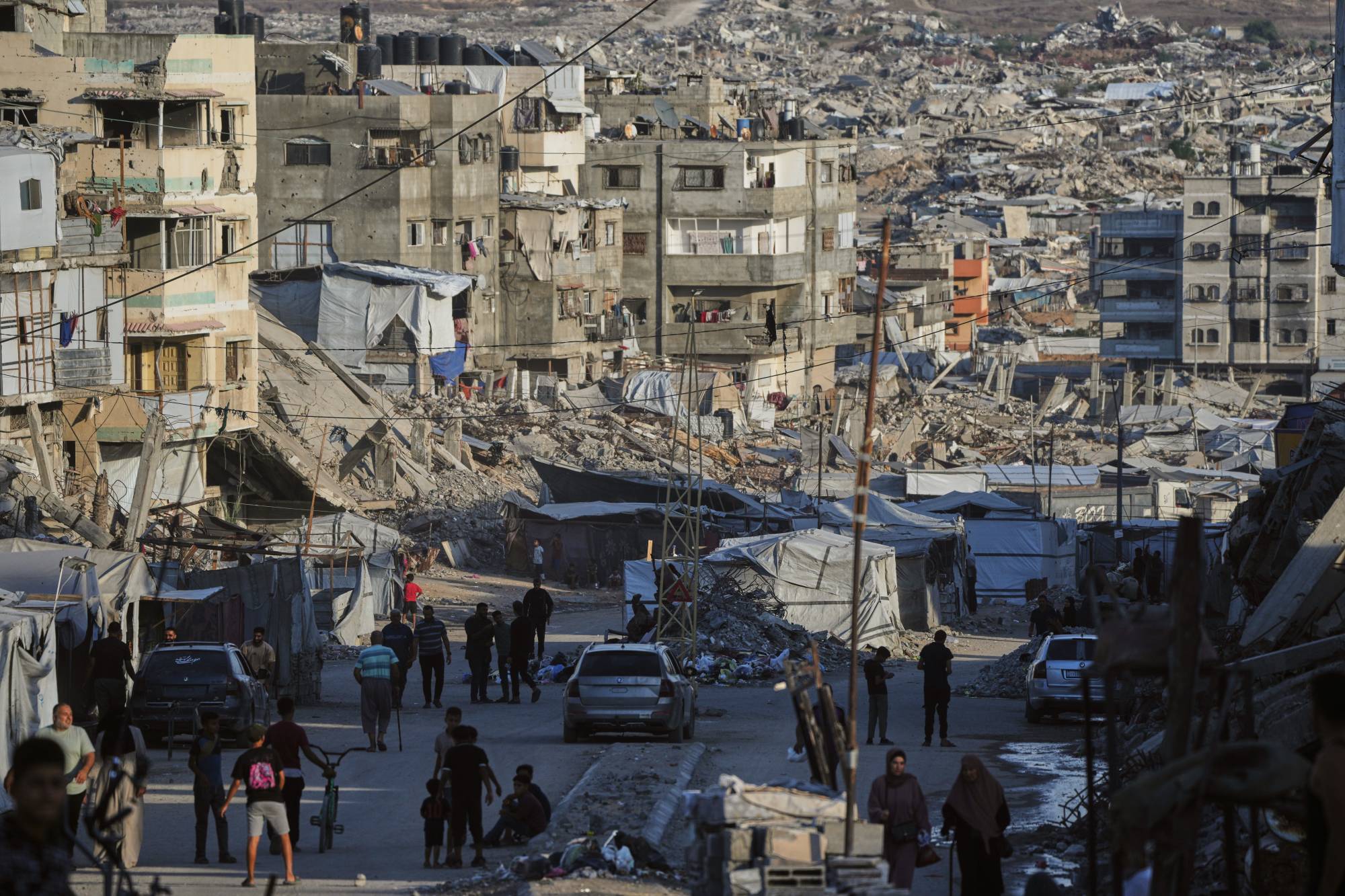
Diabetes patients in the Gaza Strip are fighting two battles without respite - the fallout from an Israeli offensive that began nearly three years ago despite a ceasefire announced almost a year ago, and a daily struggle to secure medication as Israel tightens restrictions on the entry of drugs and other medical supplies, despite appeals from UN and health organizations.

The war has forced people with chronic illnesses to use expired medication as access to safe treatment has dwindled.

Habib Abu Daqqa, 11, who was diagnosed with diabetes a year before the war, has spent more than three months at Nasser Medical Complex after falling into a coma following an injection of expired diabetes medication.

His mother, Maysaa Abu Daqqa, who also has diabetes, told Asharq Al-Awsat that her son has become severely distressed and needs regular, safe treatment before he can leave the hospital.

She resorted to the expired injection because of his condition, despite warnings from some doctors, while others had told her it could still be used. He subsequently developed diabetic ketoacidosis and was admitted to intensive care.

Before the war, she recalled, both had reliable access to medication and appropriate food and followed regular treatment and dietary plans. She attributed their deteriorating health partly to the period of famine in Gaza.

In 2024, the Palestinian Health Ministry estimated that around 350,000 people with chronic illnesses in Gaza lacked necessary healthcare, including about 71,000 diabetes patients, 225,000 people with hypertension and 45,000 with cardiovascular disease.

Al-Baraa Abdel Aal, 14, who has Type 1 diabetes, also required intensive care after medication shortages forced him to take expired drugs.

“Before the war, I had access to all kinds of medication, especially insulin,” Abdel Aal told Asharq Al-Awsat. Suitable food was also readily available.

“I spent eight days in intensive care. I saw death,” he recalled, adding that expired medication and substitutes left him severely fatigued.

Wafaa Washah, 36, a Jabalia refugee camp resident displaced to Khan Younis who has had diabetes for 13 years, explained that economic hardship and her husband’s unemployment had deprived her of suitable food and even clean drinking water.

She recounted that she nearly slipped into a coma several times after using expired medication because no alternatives were available. During the famine, shortages of food, particularly flour, left her suffering frequent dizziness and fever.

Farah Lafi, 19, noted that the crisis extends beyond insulin to glucose test strips needed for frequent blood-sugar monitoring. She estimated that expired medications retain only about 30% of their effectiveness, undermining patients’ daily activity and ability to function.

Ibrahim Dhair, a diabetes consultant at hospitals in southern Gaza, described diabetes patients as among those hardest hit by severe drug shortages. Much of the available medication is expired and can lead to complications including diabetic ketoacidosis and admission to intensive care.

Even when insulin is available, proper refrigeration poses another problem, he explained. Many residents live in tents without basic services, while extreme heat can spoil medicines that must be stored at specific temperatures.

Dhair added that doctors sometimes issue guidance on how to manage available medicines, but with stocks continuing to run out, he described the current situation as a crisis beyond the healthcare system’s capacity to handle.


From Wells to Budget: Where Does Libya’s Oil Money Go?

Tugboat Al-Hani begins operations at Zueitina port (National Oil Corporation)
TT

From Wells to Budget: Where Does Libya’s Oil Money Go?

Tugboat Al-Hani begins operations at Zueitina port (National Oil Corporation)

Libya depends on oil for nearly 98% of its income. Yet a central question persists: How are those revenues collected and spent in a country divided between rival governments? And why do Libyans complain of poverty when their country holds Africa’s largest oil reserves and produces and exports about 1.4 million barrels a day?

The process starts with the National Oil Corporation, which collects proceeds from crude oil and gas sales in US dollars and deposits them in accounts at the Libyan Foreign Bank. The money is then transferred to the Central Bank of Libya's accounts in Tripoli, recorded as state budget sovereign revenue, and converted into Libyan dinars.

The dollar trades at 6.36 dinars at the official rate, compared with 9.12 on the parallel market.

The Finance Ministry in Tripoli then issues spending authorizations under approved financial arrangements, after which the central bank releases funds to ministries and other state bodies through the main budget chapters.

Libya’s oil export revenues have swung sharply in recent years, ranging between $18 billion and $22 billion. They rose to about $18 billion in the first half of this year, nearly double the level in the same period last year, according to the Economy Ministry in the interim Government of National Unity.

Libyan oil expert Mohamed al-Shahati attributed the increase during that period to the war involving Iran.

Where is the breakdown?

Economists say Libya’s dependence on oil as its near-exclusive source of income lies at the heart of the crisis.

Ayoub al-Farsi, an economics professor at the University of Benghazi, said Libya showed how excessive reliance on natural resources could turn into a complex financial crisis when combined with political fragmentation and a lack of economic diversification.

“The Libyan economy is a clear example of how excessive dependence on natural resources can become a complex financial crisis,” he said, adding that political fragmentation and the absence of diversification had created conditions that directly affected people’s lives.

Al-Farsi, a member of the Central Bank of Libya’s Monetary Policy Committee, said the economy was built around a rentier-state model that depended almost entirely on oil exports to fund the treasury and provide foreign currency.

That dependence, he told Asharq Al-Awsat, had created deep structural distortions.

Agriculture and industry had been marginalized, the state bureaucracy had expanded to absorb workers into unproductive public-sector jobs, and the country had grown heavily dependent on imports for most consumer goods, he said.

Industrial activity remains limited, largely confined to the private sector and small-scale production. Critics also point to a market dominated by a small number of traders and importers, helping imported goods crowd out local production.

At protests across Libyan cities, the question is often the same: Where is the oil money going? Why are people struggling in an energy-producing country?

Al-Shahati said part of the answer lies in the difference between the value of the oil Libya produces and the amount that actually reaches the state treasury.

“Not every barrel produced in Libya is converted directly into a dollar entering the public treasury, because foreign partners have a share,” he told Asharq Al-Awsat.

Foreign companies have become production partners under various contractual arrangements, he said.

He also pointed to a stark contradiction: Libya produces oil, yet depends heavily on imports of gasoline, diesel, and other petroleum products to meet domestic demand.

That means a growing share of the country’s resources is converted into foreign currency to pay for fuel imports.

Al-Shahati said another problem was the lack of a regularly published, unified, and easy-to-read account that answers basic questions, such as: What was the total value of the oil produced? How much went to foreign partners? How much was exported for the state? How much went to the domestic market? And how much net revenue was actually available for public spending?

“The figures in circulation provide parts of the picture,” he said, “but they do not always show the full flow of revenues from the wellhead to the state’s public accounts.”

Libya’s oil fields are concentrated mainly in the eastern Sirte Basin, which holds about 82% of its oil reserves, as well as in the Murzuq Basin in the southwest and offshore areas along the coast.

Fuel and power crises

Those weaknesses in the oil revenue chain are unfolding as Libya grapples with a severe electricity crisis.

The country has suffered several “blackouts” in recent days, with some areas going without electricity for more than 17 hours a day.

Researcher Ezzedine Mokhtar sees the power cuts as one part of a wider pattern of recurring financial failures, including fuel shortages.

He blamed the hardship facing many Libyans on “corruption” and “unlimited spending” by two rival governments competing for power in the country’s east and west.

He also cited “oil smuggling through Arkenu, whose revenues go to specific individuals rather than the state treasury.”

Mokhtar said Libya’s subsidy system was another core problem, with more than 60% of the country’s budget going to fuel subsidies.

He called on the Tripoli government to phase out those subsidies gradually and to draw up a national plan to develop the workforce.

“We have no industrial skills in anything,” he said. “We import everything — yogurt, dairy products, fruit, vegetables, frozen fish, and even underwear. Everything comes from abroad.”

Libya ranks 10th globally in proven oil reserves, with about 48.3 billion barrels, according to Worldometer.

The UN Panel of Experts said in its latest report on Libya, covering October 2024 to February 2026, that Arkenu had moved at least $3 billion in oil revenues to bank accounts outside Libya between January 2024 and November 2025.

According to the report, Arkenu was established in 2023 as a private company and is indirectly controlled by Saddam Haftar, deputy commander-in-chief of the Libyan National Army. It faces accusations of “oil smuggling.”

Reuters previously investigated the company and concluded, based on shipping documents, London Stock Exchange Group data, and information from Kpler, that some oil revenues were being diverted away from the Central Bank of Libya.

How are revenues distributed?

Oil revenues are distributed across the four main chapters of the state budget, according to experts and economists.

Chapter One, salaries and wages, takes the largest share. It covers public-sector employees across eastern, western, and southern Libya through the unified national identification number system.

Chapter Two covers operating expenses for ministries and public institutions.

Chapter Three covers subsidies, including fuel, water, and electricity.

Chapter Four covers development and projects, including infrastructure, as well as allocations to the National Oil Corporation to sustain and increase production.

Al-Shahati said 26% of oil revenues went toward importing fuel products, equivalent to about $7 billion if crude traded at $70 a barrel.

This year, he said, the figure could rise to between $8 billion and $9 billion because oil prices had climbed above $85 a barrel and the gap between crude prices and diesel and gasoline prices had widened amid shortages.

He also pointed to higher domestic consumption driven by economic growth and a rise in smuggling.

A second problem, al-Shahati said, is the absence of an approved national budget, which would make it possible to determine how spending should be allocated among population groups and regions.

“What is clear is that the main cities control most spending,” he said.

He also pointed to “a large and obvious imbalance” in salaries across Libya’s three regions, job grades, and types of employment.

Those gaps, he said, risk widening financial divisions between social groups.

Even an agreement to unify development spending did not appear to be properly implemented because there were no clear standards and no comprehensive budget.

“There are no criteria for distributing oil revenues,” al-Shahati said. “The distribution process is random and unsustainable.”

Libya fell to 177th out of 182 countries in the 2025 Corruption Perceptions Index, from 173rd out of 180 countries in 2024, reflecting worsening corruption and no tangible improvement over the past two years.

Pressure on the local economy

A report by UN Secretary-General Antonio Guterres on Libya highlighted deep structural strains in the economy, driven by high public spending, near-total dependence on oil and gas revenues, and mounting pressure from food, fuel, and electricity prices.

The report, submitted to the UN Security Council on Aug. 17, covers the period from April 1 to July 28.

Citing the International Monetary Fund, it said Libya’s fiscal deficit reached 30% of gross domestic product last year, while public debt climbed to 146% of GDP.

Inflation also rose into double digits, eroding purchasing power.

The UN report noted unjustified increases in fuel consumption by military and security agencies and the energy sector, as well as repeated double purchasing.

The cost of institutional division

Libya’s political and institutional split and the presence of multiple authorities have made the economic crisis worse, al-Farsi said.

The distortions, he said, were no longer merely structural.

They had created parallel public finances and pushed consumer spending higher to meet the demands of rival authorities, sending salaries and subsidies to unprecedented levels.

Repeated shutdowns of oil fields in previous years, combined with lower actual revenues, pushed financial authorities toward deficit financing and higher public debt, al-Farsi said.

That flooded the market with money without a corresponding rise in domestic production.

Oil revenues reached $21.9 billion in 2025, according to the National Oil Corporation, up from $18.6 billion in 2024, an increase of 15%.

Al-Farsi said the deterioration in public finances had left monetary authorities in a difficult position and forced them into emergency measures to protect reserves and contain the deficit.

The result, he said, was a weaker national currency, liquidity shortages and a collapse in confidence.

Development tools had also been paralyzed.

“Monetary policy shifted from an instrument for stimulating growth and investment into a tool for managing daily crises,” he said.

Why has the crisis not been solved?

Economists point to several reasons.

Al-Shahati put “corruption spreading on an unprecedented scale” near the top of the list.

“Corruption is no longer confined to the margins,” he said. “It has come to dominate the core of public finances in key sectors, obstructing any attempt at reform.”

He also blamed the absence of an institutional vision following the breakdown of middle management, which had once linked fiscal and monetary policy to economic realities and provided unified political backing.

Policies, he said, had become detached from the economy and lost their ability to restore balance.

Conventional reforms that had worked elsewhere would not work in Libya, al-Shahati said, because the country lacked a central political authority capable of building an institutional vision and curbing corruption that had spread through both the state and private sector.

Al-Farsi said Libya could not escape its fiscal and monetary crisis without addressing the roots of the problem.

That meant unifying the management of public finances, curbing government spending, and launching genuine structural reforms that would gradually shift Libya from consuming oil rents to building a diversified economy.

Mokhtar also called on the Tripoli government to develop a strategic plan to make better use of human resources and support small and medium-sized industries.

For him, breaking Libya’s dependence on oil revenues is part of the way out.

Masoud Suleiman, chairman of Libya’s National Oil Corporation, said in media remarks last week that the country needed between $30 billion and $40 billion in investment to develop untapped oil and gas resources.

The corporation, he said, aims to raise production to 2 million barrels a day by 2030.