


Israel Confirms Ban on 37 NGOs in Gaza

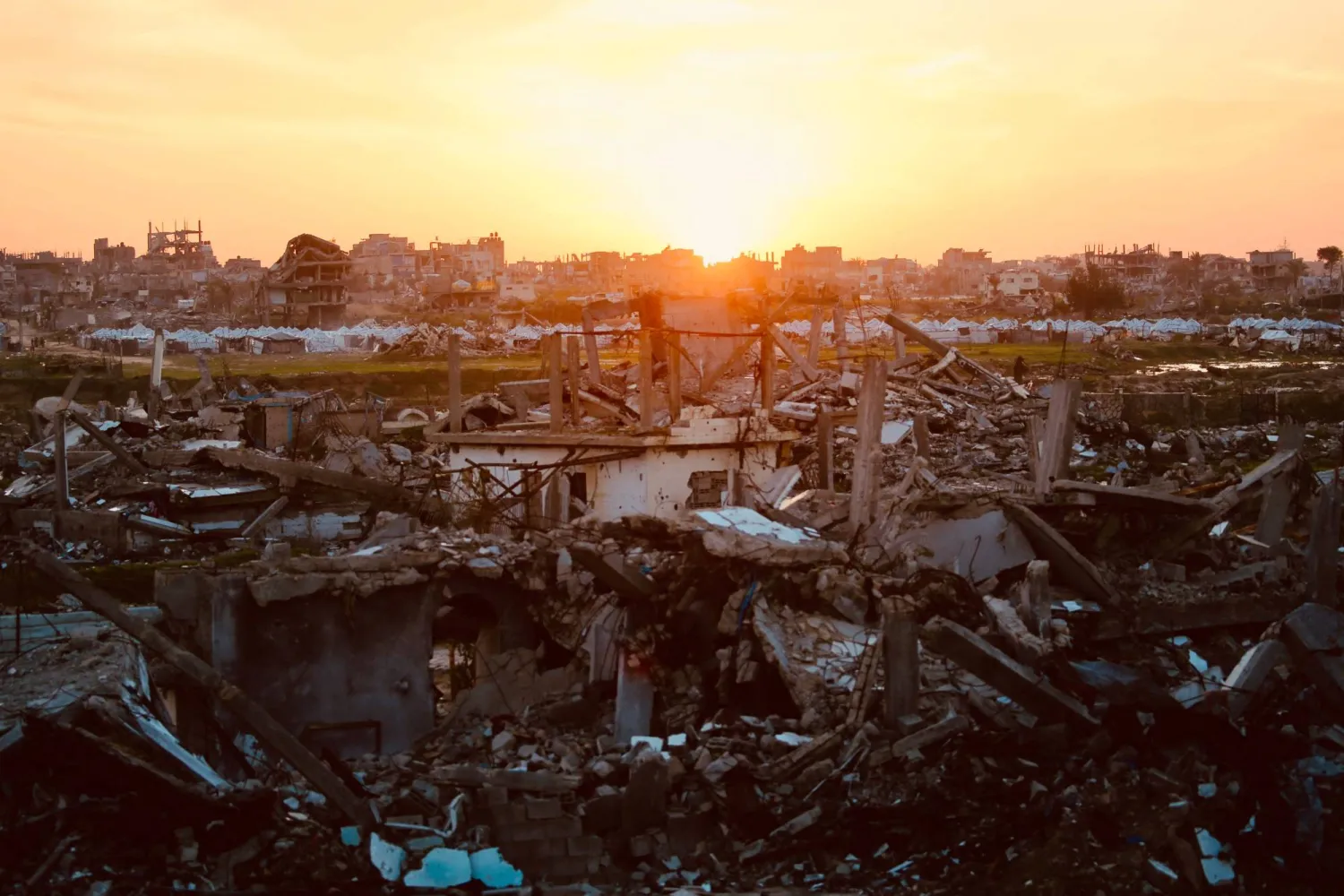
The sun sets behind the ruins of destroyed buildings in the Nuseirat refugee camp in the central Gaza Strip on December 31, 2025. (AFP)
TT

Israel Confirms Ban on 37 NGOs in Gaza

The sun sets behind the ruins of destroyed buildings in the Nuseirat refugee camp in the central Gaza Strip on December 31, 2025. (AFP)

Israel on Thursday said 37 humanitarian agencies supplying aid in Gaza had not met a deadline to meet "security and transparency standards", and would be banned from the territory, despite an international outcry. 

The international NGOs, which had been ordered to disclose detailed information on their Palestinian staff, will now be required to cease operations by March 1. 

The United Nations has warned that this will exacerbate the humanitarian crisis in the war-ravaged Palestinian territory. 

"Organizations that have failed to meet required security and transparency standards will have their licenses suspended," Israel's Ministry of Diaspora Affairs and Combating Antisemitism said in a statement. 

Several NGOS have said the requirements contravene international humanitarian law or endanger their independence. 

Israel says the new regulation aims to prevent bodies it accuses of supporting terrorism from operating in the Palestinian territories. 

Prominent humanitarian organizations hit by the ban include Doctors Without Borders (MSF), the Norwegian Refugee Council (NRC), World Vision International and Oxfam, according to a ministry list. 

In MSF's case, Israel accused it of having two employees who were members of Palestinian groups Islamic Jihad and Hamas. 

MSF said this week the request to share a list of its staff "may be in violation of Israel's obligations under international humanitarian law" and said it "would never knowingly employ people engaging in military activity". 

- 'Critical requirement' - 

NRC spokesperson Shaina Low told AFP its local staff are "exhausted" and international staff "bring them an extra layer of help and security. Their presence is a protection." 

Submitting the names of local staff is "not negotiable", she said. "We offered alternatives, they refused," she said, of the Israeli regulators. 

The ministry said Thursday: "The primary failure identified was the refusal to provide complete and verifiable information regarding their employees, a critical requirement designed to prevent the infiltration of terrorist operatives into humanitarian structures." 

In March, Israel gave NGOs 10 months to comply with the new rules, which demand the "full disclosure of personnel, funding sources, and operational structures". 

The deadline expired on Wednesday. 

The 37 NGOs "were formally notified that their licenses would be revoked as of January 1, 2026, and that they must complete the cessation of their activities by March 1, 2026," the ministry said Thursday. 

A ministry spokesperson told AFP that following the revocation of their licenses, aid groups could no longer bring assistance into Gaza from Thursday. 

However, they could have their licenses reinstated if they submitted the required documents before March 1. 

Minister of Diaspora Affairs and Combating Antisemitism Amichai Chikli said "the message is clear: humanitarian assistance is welcome -- the exploitation of humanitarian frameworks for terrorism is not". 

- 'Weaponization of bureaucracy' - 

On Thursday, 18 Israel-based left-wing NGOs denounced the decision to ban their international peers, saying "the new registration framework violates core humanitarian principles of independence and neutrality". 

"This weaponization of bureaucracy institutionalizes barriers to aid and forces vital organizations to suspend operations," they said. 

UN Palestinian refugee agency chief Philippe Lazzarini had said the move sets a "dangerous precedent". 

"Failing to push back against attempts to control the work of aid organizations will further undermine the basic humanitarian principles of neutrality, independence, impartiality and humanity underpinning aid work across the world," he said on X. 

On Tuesday, the foreign ministers of 10 countries, including France and Britain, urged Israel to "guarantee access" to aid in the Gaza Strip, where they said the humanitarian situation remains "catastrophic". 

A fragile ceasefire has been in place since October, following a deadly war waged by Israel in response to Hamas's unprecedented October 7, 2023 attack on Israel. 

Nearly 80 percent of buildings in Gaza have been destroyed or damaged by the war, according to UN data. 

About 1.5 million of Gaza's more than two million residents have lost their homes, said Amjad Al-Shawa, director of the Palestinian NGO Network in Gaza. 


Al-Alimi Names New Yemeni Govt

Chairman of Yemen’s Presidential Leadership Council Dr. Rashad al-Alimi chairs a council meeting on Friday. (Saba)
TT

Al-Alimi Names New Yemeni Govt

Chairman of Yemen’s Presidential Leadership Council Dr. Rashad al-Alimi chairs a council meeting on Friday. (Saba)

Chairman of Yemen’s Presidential Leadership Council Dr. Rashad al-Alimi announced on Friday the formation of a new government.

The lineup was presented by Prime Minister Shaie Mohsen Al-Zindani and approved by al-Alimi.

Al-Zinadani retained his position of PM, as did Muammar Al-Iryani as Minister of Information.

The government is formed of Nayef Saleh Abdulqader Al-Bakri as Minister of Youth and Sports; Salem Abdullah Issa Al-Saqtari as Minister of Agriculture, Irrigation and Fisheries; Major General Ibrahim Ali Ahmed Haidan as Minister of Interior; Tawfiq Abdulwahid Ali Al-Sharjabi as Minister of Water and Environment; Mohammed Mohammed Hizam Al-Ashwal as Minister of Industry and Trade; and Dr. Qasim Mohammed Qasim Baheebah as Minister of Public Health and Population.

Judge Badr Abdo Ahmed Al-Aradha was named Minister of Justice; Major General (Staff) Taher Ali Aydha Al-Auqeeli as Minister of Defense; Engineer Badr Mohammed Mubarak Basalmah as Minister of Local Administration; Muti’a Ahmed Qasim Dammaj as Minister of Culture and Tourism; and Dr. Anwar Mohammed Ali Kalshat Al-Mahri as Minister of Technical Education and Vocational Training.

Engineer Adnan Mohammed Omar Al-Kaf was named Minister of Electricity and Energy; Marwan Faraj Saeed bin Ghanem as Minister of Finance; Dr. Afrah Abdulaziz Al-Zouba as Minister of Planning and International Cooperation; Salem Abu Bakr Mohammed Thabet Al-Awlaki as Minister of Civil Service and Insurance; Judge Ishraq Fadl Al-Maqtari as Minister of Legal Affairs; Dr. Adel Abdulmajid Alawi Al-Abbadi as Minister of Education; and Dr. Ameen Noman Mohammed Al-Qadsi as Minister of Higher Education and Scientific Research.

Dr. Shadi Saleh Basarah was appointed Minister of Communications and Information Technology; Dr. Mohammed Abdullah Ali Bamqa’a as Minister of Oil and Minerals; Mohsen Ali Haidarah Qasim Al-Omari as Minister of Transport; Engineer Hussein Awad Saeed Al-Aqrabi as Minister of Public Works and Roads; Mukhtar Omar Saleh Al-Yafei as Minister of Social Affairs and Labor; Mashdal Mohammed Omar Ahmed as Minister of Human Rights; Sheikh Turki Abdullah Ali Al-Wadei as Minister of Endowments and Guidance; Dr. Abdullah Ali Hussein Abu Hurriya as Minister of State for Parliamentary and Shura Council Affairs; Abdulghani Hefzullah Jameel as Minister of State and Secretary of the Capital Sanaa; Dr. Ahd Mohammed Salem Ja’sous as Minister of State for Women’s Affairs; and Abdulrahman Sheikh Al-Yafei as Minister of State and Governor of Aden Governorate.

Ahmed Saleh Ahmed Al-Awlaki, Judge Akram Naseeb Ahmed Al-Ameri, Walid Mohammed Mohammed Al-Qudaimi and Walid Ali Ismail Al-Abarah were named Ministers of State.


Yemen’s Presidential Leadership Council Praises Saudi Arabia’s Continued Support

Yemeni Presidential Leadership Council meeting in Riyadh (Asharq Al-Awsat)
TT

Yemen’s Presidential Leadership Council Praises Saudi Arabia’s Continued Support

Yemeni Presidential Leadership Council meeting in Riyadh (Asharq Al-Awsat)

Yemen’s Presidential Leadership Council renewed its appreciation to the Kingdom of Saudi Arabia for its continued support of the Yemeni people, the Saudi Press Agency said on Saturday.

The council praised the Kingdom’s leadership under Custodian of the Two Holy Mosques King Salman bin Abdulaziz Al Saud and Prince Mohammed bin Salman bin Abdulaziz Al Saud, Crown Prince and Prime Minister, for their sincere and steadfast positions in backing Yemen. It also commended Saudi Arabia’s dedicated efforts to enhance security and stability, strengthen state institutions, and provide generous humanitarian and development assistance.

The remarks were made during a meeting of the Presidential Leadership Council held on Friday in Riyadh.

The meeting reviewed local developments across various levels, including progress toward restoring recovery and normalizing conditions in the temporary capital, Aden, and in the liberated governorates.

Discussions also focused on the ongoing efforts of local authorities, as well as security and military agencies, to stabilize the situation and advance institutional performance.


Lebanese Army Chief Faces Labeling Dispute During Washington Visit

Lebanese Army Commander General Rodolphe Haykal during his visit to Washington (Lebanese Army Command)
TT

Lebanese Army Chief Faces Labeling Dispute During Washington Visit

Lebanese Army Commander General Rodolphe Haykal during his visit to Washington (Lebanese Army Command)

What was meant to be a routine visit by Lebanese Army Commander General Rodolphe Haykal to Washington to discuss military support and aid coordination turned into a political flashpoint, after a brief meeting with US Senator Lindsey Graham ignited a dispute over whether the army chief would describe Hezbollah as a “terrorist organization.”

The controversy was sparked by a brief meeting with hardline Republican Senator Lindsey Graham, who publicly said he cut the meeting short after Haykal declined to use the designation in what he called the “context of Lebanon.”

What happened in the Graham meeting

In a post on X, Graham said: “I just had a very brief meeting with the Lebanese Chief of Defense General Rodolphe Haykal. I asked him point blank if he believes Hezbollah is a terrorist organization. He said, “No, not in the context of Lebanon.” With that, I ended the meeting.”

“They are clearly a terrorist organization. Hezbollah has American blood on its hands. Just ask the US Marines,” he added.

“They have been designated as a foreign terrorist organization by both Republican and Democrat administrations since 1997 – for good reason.”

“As long as this attitude exists from the Lebanese Armed Forces, I don’t think we have a reliable partner in them.”

“I am tired of the double speak in the Middle East. Too much is at stake,” Graham concluded.

The reaction went beyond expressions of displeasure. Some US coverage suggested Graham effectively raised questions about the “usefulness” of continuing support for the Lebanese army if such a gap persists between the US position and Lebanon’s official language.

Haykal’s answer raises its cost in Washington

Inside Lebanon, the issue is not limited to the stance on Hezbollah. Still, it extends to the army’s role as a unifying institution in a country whose political balance rests on sectarian arrangements and deep sensitivities.

Adopting an external designation, even a US one, in official language by the head of the military could be interpreted domestically as a move that risks triggering political and sectarian division or drawing the army into confrontation with a component that has organized political and popular representation.

That explains why Lebanese voices, including some critics of Hezbollah, defended the logic that “the state does not adopt this classification.” Therefore, the army commander cannot formally do so.

In other words, Haykal sought to avoid two conflicting languages: Washington’s legal and political framing of Hezbollah, and the Lebanese state’s language, which walks a fine line between the demand for exclusive state control over arms and the avoidance of reproducing internal fractures.

US State Department position

Amid the controversy surrounding the Graham meeting, an official US position emerged on Tuesday through the US Embassy in Beirut, welcoming the visit and focusing on the core US message.

The statement said that “the Lebanese Armed Forces’ ongoing work to disarm non-state actors and reinforce national sovereignty as Lebanon’s security guarantor is more important than ever.”

The wording was notable because it separated two levels: continued US reliance on the army as a state institution, and, in practice, linking that reliance to the issue of disarming non-state actors.

The phrase avoids direct naming but, in the Lebanese context, is widely understood to refer primarily to Hezbollah.

The visit’s broader track

Despite the political awkwardness, Haykal’s visit was not reduced to a single meeting. He held senior-level military talks, including meetings with US Central Command chief Admiral Brad Cooper and Chairman of the Joint Chiefs of Staff General Dan Caine.

According to a statement from a Joint Chiefs spokesperson, the meeting “reaffirmed the importance of enduring US defense relationships in the Middle East.”

The visit coincided with broader discussions in Washington on support for the Lebanese army and plans to extend state authority, as international reports spoke of Lebanon entering new phases of a plan to dismantle illegal weapons structures in the south and north.

The army commander’s visit had initially been delayed for reasons that add another layer to understanding Washington’s sensitivity to the military’s language.

In November 2025, sources quoted the US State Department as saying Washington canceled scheduled meetings with the Lebanese army commander after objecting to an army statement on border tensions with Israel, prompting the visit to be postponed to avoid a pre-emptive political failure.
