


Yemen Minister Says Efforts Underway to Bring Capital Back to Hadhramaut

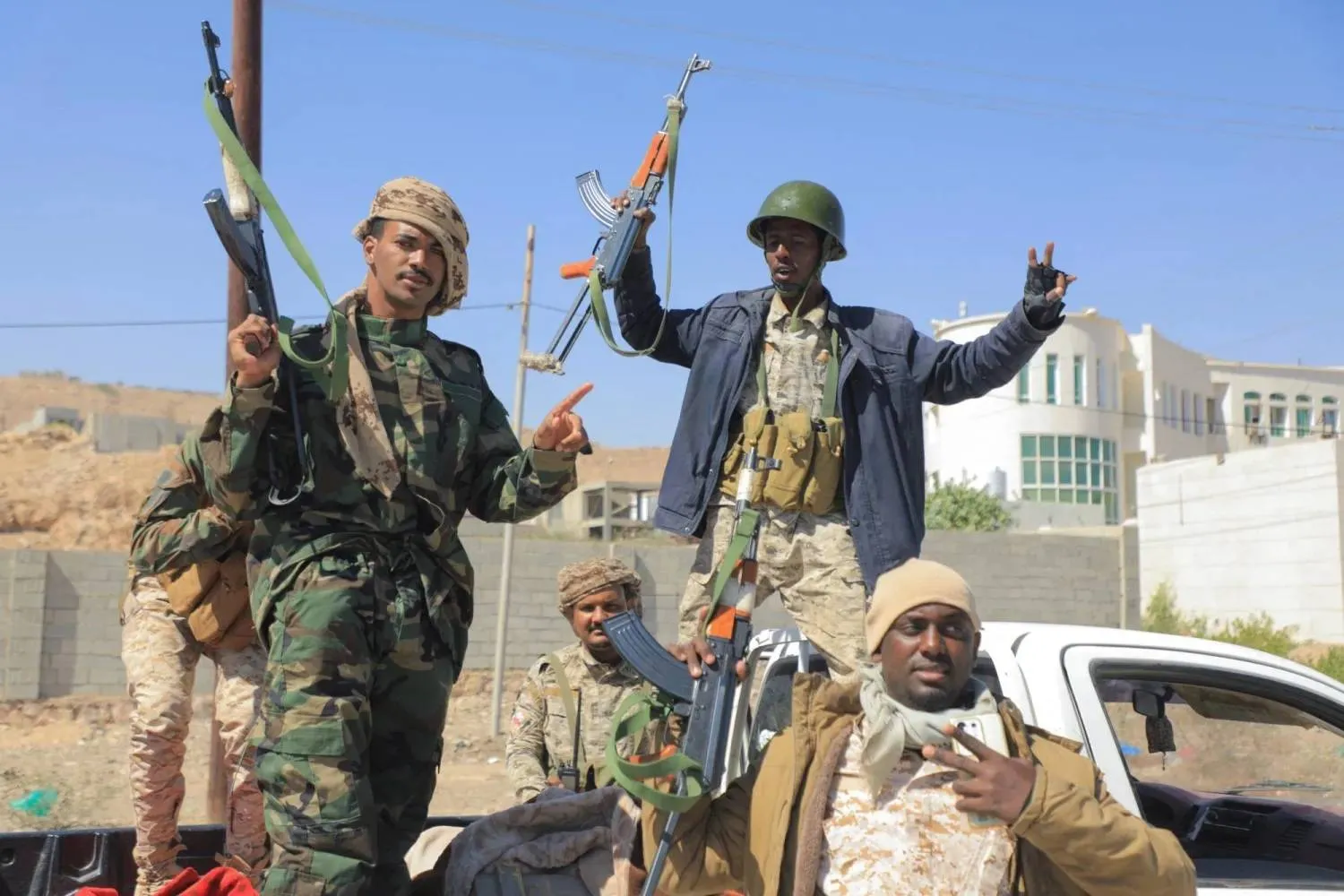
 Yemeni National Shield forces during the recapture of military camps in Hadhramaut and Al-Mahrah (Reuters)
Yemeni National Shield forces during the recapture of military camps in Hadhramaut and Al-Mahrah (Reuters)
TT

Yemen Minister Says Efforts Underway to Bring Capital Back to Hadhramaut

 Yemeni National Shield forces during the recapture of military camps in Hadhramaut and Al-Mahrah (Reuters)
Yemeni National Shield forces during the recapture of military camps in Hadhramaut and Al-Mahrah (Reuters)

At a critical moment when the Yemeni government is seeking to rebuild confidence in the national economy, official indicators suggest a tangible improvement in the investment climate, particularly in provinces where the internationally recognized government has regained control, most notably Hadhramaut and Socotra.

These moves come as part of a broader government effort to reassure traders and investors and to create a safe and stable environment for the return of capital that left the country in recent years, amid improving security conditions, the spread of state institutions, and growing interest among local and regional business leaders in resuming investment activity in liberated areas.

Monitoring stocks and price stability

Yemen’s Minister of Industry and Trade Mohammed al-Ashwal told Asharq Al-Awsat that the ministry issued official instructions the day before yesterday aimed at reassuring southern communities about the availability of essential commodities and price stability.

He stated that three separate memoranda were sent to the heads of the ministry’s offices in Mukalla, Seiyun, and al-Mahrah, containing clear directives to closely monitor commodity stocks and continuously track market activity on a daily basis.

Al-Ashwal said the instructions emphasized the importance of ensuring that Saudi aid reaches its intended beneficiaries and is not diverted or sold in markets, underscoring that the ministry gives this issue top priority due to its direct impact on market stability and food security.

Reassurances in three provinces

On security, the minister said conditions were reassuring and that security was stable in Hadhramaut, Seiyun, and Al Mahrah. He said the measures taken had helped boost confidence among citizens and traders alike, creating a sense of stability in market activity.

He pointed to ongoing communication with the Yemeni Saudi Business Council, noting that a meeting in Mecca resulted in a set of joint projects that reflect the strength of economic ties between the two countries and open new horizons for investment and cooperation across several vital sectors.

Normalizing the situation in Aden

Regarding the situation in Aden, the minister stated that the government is currently working to fully normalize conditions until security is firmly established, particularly in the temporary capital.

He added that the deployment of the National Shield forces would lead to the unification of the security authority in charge, which would have a positive impact on security and administrative stability and provide investors and traders with a clear counterpart to deal with.

Capital between flight and resilience

Regarding investors and business leaders in the south, al-Ashwal stated that following the Houthi coup, significant capital left the southern areas; however, some local businessmen remained resilient despite the volatility and challenges, continuing their commercial activities under extremely difficult conditions and helping to preserve a minimum level of economic activity.

He said local business leaders demonstrated honorable positions in the darkest circumstances and played a positive role in maintaining the economic cycle.

He called on traders who had left the country after the Houthi coup to return, especially to Hadhramaut, stating that the province would not be the same as it was before, given the expansion of state institutions and the consolidation of security through the army, security agencies, and local authorities.

Al-Ashwal said the country is witnessing notable economic momentum during a period in which conditions have stabilized in many southern provinces.

He said there is clear interest among business leaders who left Yemen about a decade ago and who now show a desire and readiness to return and invest again, amid improved security and economic conditions and an expanding area of stability.

Progress in Hadhramaut

He added that in recent hours, he had been in contact with the heads of chambers of commerce in Aden, Mukalla, and Taiz, reassuring them about security and stability.

He said he met with the governor of Hadhramaut on Monday, who confirmed that several practical steps had been taken to ensure the smooth functioning of commercial activity in the province.

Al-Ashwal said the impact of these steps is now clearly visible in Hadhramaut, where social and economic life has returned at a good pace, reflecting an improved business environment and a gradual revival of commercial activity.

Confidence signals to investors

Regarding government efforts to strengthen the local economy, al-Ashwal stated that the government, through the Ministry of Industry and Trade, is preparing to launch an industrial zone in Aden as a clear indicator of economic stability, alongside three other industrial zones in Hadhramaut and two in Socotra.

He said signing the contract for the Aden industrial zone would send a practical message that the economic situation is stable and developing dynamically.

Saudi role

In this context, al-Ashwal spoke at length about the importance of Saudi Arabia’s role, thanking the kingdom for its efforts to support stability in Yemen.

He said this support is ongoing and has directly contributed to strengthening economic stability and supporting state institutions.



Lebanon FM Urges Iran to Find ‘New Approach’ on Hezbollah Arms

Iranian Foreign Minister Abbas Araghchi (L) shakes hands with Lebanese Minister of Foreign Affairs and Emigrants Youssef Raggi (R) at the Foreign Ministry in downtown Beirut, Lebanon, 09 January 2026. (EPA)
TT

Lebanon FM Urges Iran to Find ‘New Approach’ on Hezbollah Arms

Iranian Foreign Minister Abbas Araghchi (L) shakes hands with Lebanese Minister of Foreign Affairs and Emigrants Youssef Raggi (R) at the Foreign Ministry in downtown Beirut, Lebanon, 09 January 2026. (EPA)

Lebanese Foreign Minister Youssef Raggi on Friday urged his visiting Iranian counterpart to find a "new approach" to the thorny issue of disarming the Iran-backed Hezbollah group.

Lebanon is under heavy US pressure to disarm Hezbollah, which was heavily weakened in more than a year of hostilities with Israel that largely ended with a November 2024 ceasefire, but Iran and the group have expressed opposition to the move.

Iran has long wielded substantial influence in Lebanon by funding and arming Hezbollah, but as the balance of power shifted since the recent conflict, officials have been more critical towards Tehran.

"The defense of Lebanon is the sole responsibility of the Lebanese state", which must have a monopoly on weapons, Raggi told Iranian Foreign Minister Abbas Araghchi, a Lebanese foreign ministry statement said.

Raggi called on Iran to engage in talks with Lebanon to find "a new approach to the issue of Hezbollah's weapons, drawing on Iran's relationship with the party, so that these weapons do not become a pretext for weakening Lebanon".

He asked Araghchi "whether Tehran would accept the presence of an illegal armed organization on its own territory".

Last month, Raggi declined an invitation to visit Iran and proposed meeting in a neutral third country.

Lebanon's army said Thursday that it had completed the first phase of disarming Hezbollah, doing so in the south Lebanon area near the border with Israel, which called the efforts "far from sufficient".

Araghchi also met President Joseph Aoun on Friday and was set to hold talks with several other senior officials.

After arriving on Thursday, he visited the mausoleum of former Hezbollah leader Hassan Nasrallah, who was killed in a massive Israeli air strike on south Beirut in September 2024.

Last August, Lebanese leaders firmly rejected any efforts at foreign interference during a visit by Iran's security chief Ali Larijani, with the prime minister saying Beirut would "tolerate neither tutelage nor diktat" after Tehran voiced opposition to plans to disarm Hezbollah.


Hamas Says Israeli Strikes on Gaza ‘Cannot Happen without American Cover’

 Palestinians inspect damaged tents at a displacement camp following an Israeli strike in Gaza City, Friday, Jan. 9, 2026. (AP)
Palestinians inspect damaged tents at a displacement camp following an Israeli strike in Gaza City, Friday, Jan. 9, 2026. (AP)
TT

Hamas Says Israeli Strikes on Gaza ‘Cannot Happen without American Cover’

 Palestinians inspect damaged tents at a displacement camp following an Israeli strike in Gaza City, Friday, Jan. 9, 2026. (AP)
Palestinians inspect damaged tents at a displacement camp following an Israeli strike in Gaza City, Friday, Jan. 9, 2026. (AP)

A Hamas official said Friday that Israeli strikes on Gaza "cannot happen without American cover", the day after Israeli attacks killed at least 13 people according to the Palestinian territory's civil defense agency.

Since October 10, a fragile US-sponsored truce in Gaza has largely halted the fighting between Israeli forces and Hamas, but both sides have alleged frequent violations.

Gaza's civil defense agency -- which operates as a rescue force under Hamas authority -- said Israeli attacks across the territory on Thursday killed at least 13 people, including five children.

In a statement on Friday morning, the Israeli military said it "precisely struck Hamas terrorists and terror infrastructure" in response to a "failed projectile" launch.

"Just yesterday, 13 people were killed in different areas of the Strip on fabricated pretexts, in addition to the hundreds of killed and wounded who preceded them after the ceasefire," Hamas political bureau member, Bassem Naim, wrote on Telegram.

"This cannot happen without American cover or a green light."

Israeli forces have killed at least 439 Palestinians in Gaza since the ceasefire took effect, according to the health ministry in the Hamas-run territory.

The Israeli military said gunmen have killed three of its soldiers during the same period.

Media restrictions in Gaza and difficulties in accessing many areas mean AFP is unable to independently verify the tolls and details provided by both sides.

Naim also accused Israeli Prime Minister Benjamin Netanyahu of "evading his commitments and escalating in order to sabotage the agreement and return to war".

He said the Palestinian movement had "complied with all its obligations under the agreement" and was "ready to engage positively and constructively with the next steps of the plan".

Israel has previously said it is awaiting the return of the last hostage body held in Gaza before beginning talks on the second phase of the ceasefire and has insisted that Hamas disarm.

Hamas officials told AFP that search operations for the remains of deceased hostage Ran Gvili resumed on Wednesday after a two-week pause due to bad weather.


Germany Calls on Israel to Halt E1 Settlement Plan

A view of Israeli settlement of Maale Adumim, in the West Bank, Sunday, June 18, 2023. (AP)
TT

Germany Calls on Israel to Halt E1 Settlement Plan

A view of Israeli settlement of Maale Adumim, in the West Bank, Sunday, June 18, 2023. (AP)

Germany calls on Israel to halt its controversial ​E1 settlement project, said a foreign ministry spokesperson in Berlin on Friday, warning that construction carries the risk of ‌creating more ‌instability in the ‌West ⁠Bank ​and ‌the region.

"The plans for the E1 settlement project, it must be said, are part of a comprehensive ⁠intensification of settlement policy in ‌the West Bank, ‍which ‍we have recently ‍observed," said the spokesperson at a regular government press conference.

"It carries the ​risk of creating even more instability, as it ⁠would further restrict the mobility of the Palestinian population in the West Bank," as well as jeopardize the prospects of a two-state solution, the spokesperson added.