


Mauritania to Saudi Investors: We Are Your Atlantic Gateway to Securing Minerals of the Future

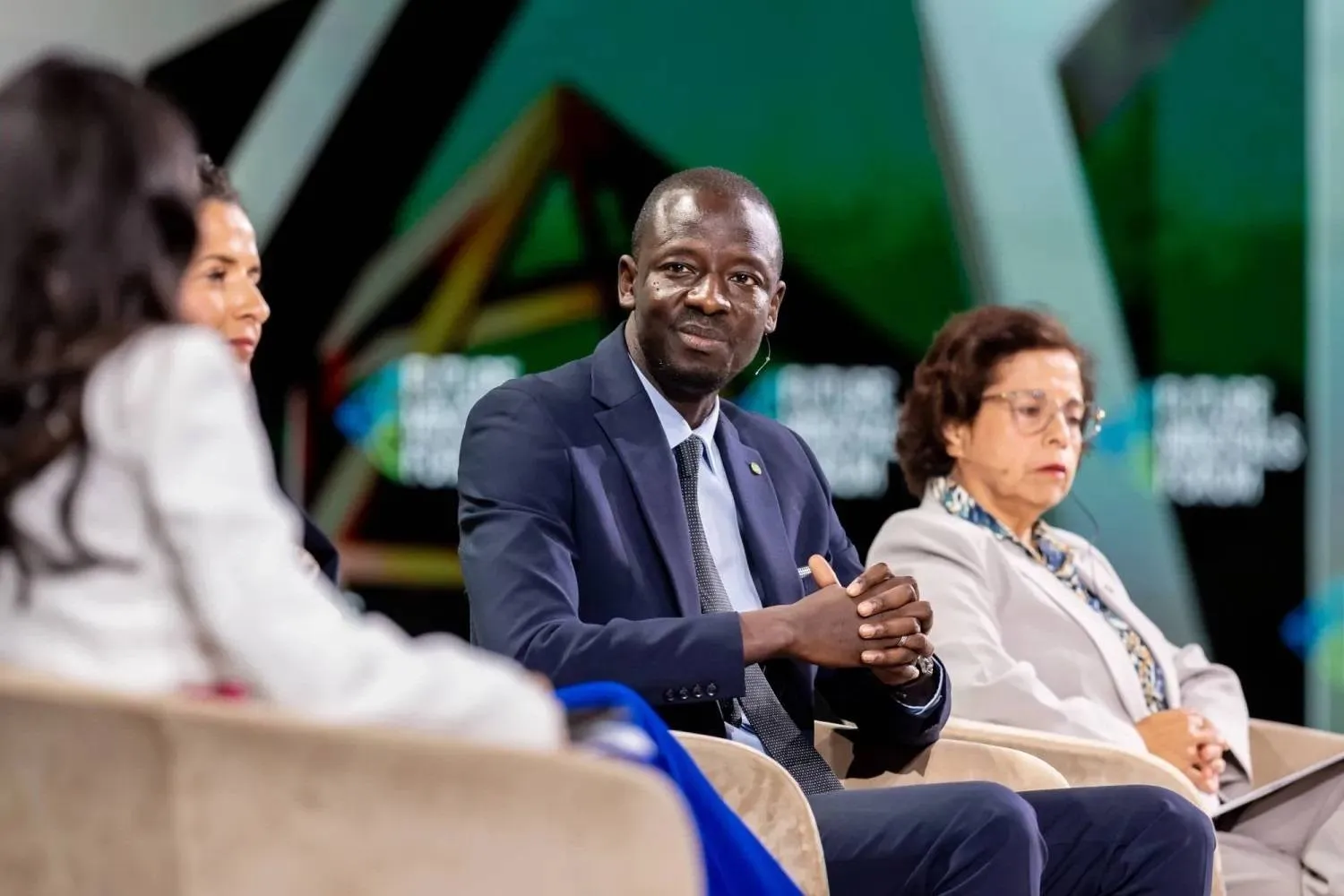
Mauritania’s Minister of Mines and Industry, Thiam Tijani (Asharq Al-Awsat) 
TT

Mauritania to Saudi Investors: We Are Your Atlantic Gateway to Securing Minerals of the Future

Mauritania’s Minister of Mines and Industry, Thiam Tijani (Asharq Al-Awsat) 

Mauritania is positioning its mining weight and strategic Atlantic Ocean location as an “African mining gateway” for Saudi investments, extending a clear invitation to move immediately into partnerships that go beyond traditional extraction and open new horizons in downstream and value-added industries.

This message was conveyed by Mauritania’s Minister of Mines and Industry, Thiam Tijani, in an interview with Asharq Al-Awsat on the sidelines of the International Mining Conference held in Riyadh.

He stressed that the message was not merely an economic call, but a reaffirmation that Saudi investment in Mauritania is an “investment in the future” and a “unique development partnership in which the Saudi investor is not viewed as a stranger, but as a genuine partner welcomed through the open doors of Nouakchott to translate historical ties into major projects that benefit both brotherly countries.”

Today, Mauritania’s mining sector represents the backbone of the national economy, contributing more than 24 percent of GDP. The sector is undergoing a profound transformation aimed at moving it from a purely extractive activity into a comprehensive development sector.

While Mauritania has historically relied on iron ore and gold, recent discoveries and the country’s push toward green hydrogen are placing it on the threshold of an unprecedented industrial transformation on the African continent.

The minister said Mauritania is redrawing its mining map to make it broader and richer, setting ambitious targets for the next five years. Nouakchott aims to raise iron ore production to more than 20 million tons annually and increase gold output to over 1.5 million ounces per year.

He emphasized that the next phase will prioritize not only production volumes, but also the sector’s ability to generate local added value that supports sustainable economic growth.

Saudi Arabia... The Strategic Partner and the Awaited Expertise

Addressing bilateral relations, Tijani described Saudi Arabia as a “strategic partner,” noting that these ties are grounded in the forward-looking vision of the two countries’ leaderships. He praised the historic role of the Saudi Fund for Development, as well as investments by Saudi companies such as SABIC.

He expressed Mauritania’s aspiration for broader participation by major industrial players, including Maaden, stressing that the country is aligning its laws and regulations to be attractive to Saudi investors, whom he described as “partners in development, not strangers to the home,” particularly in downstream industries where the Kingdom has long-standing expertise.

Leadership in Hydrogen and the Production of “Green Steel”

On the energy front, Tijani revealed Mauritania’s ambition to become Africa’s “capital of green hydrogen,” capitalizing on its abundant wind and solar resources. The strategic plan, he said, is to use clean energy to process iron ore locally into “green steel,” a project he believes has the potential to “change the rules of the game globally.”

He extended an open invitation to leading Saudi companies in renewable energy and heavy industries to take part in this transformation, ensuring that Mauritanian mining products become among the most in demand in global markets in the future.

Fuel of Technology... Lithium and Rare Minerals

Turning to the minerals of the future, Tijani said recent geological surveys have revealed promising potential for lithium, cobalt, nickel, and chromium. Describing these minerals as the “fuel of the technological revolution” and electric vehicles, he noted that Mauritania has designated new concession areas and prepared technical files to present to Saudi partners.

He stressed that Saudi Arabia has a valuable opportunity to secure its supply chains for these strategic materials through direct investment in Mauritanian mines.

To ensure smooth investment flows, Tijani announced a major leap in facilitating procedures through the digitization of the mining land registry and making it available online, ensuring full transparency and allowing investors in Riyadh to access maps and data remotely. He added that a dedicated one-stop shop has been established to reduce bureaucracy and accelerate the processing of applications.

He concluded with a message of reassurance to leaders in Saudi Arabia’s mining sector, emphasizing that “Mauritania is the safest and most viable destination, thanks to its political and security stability and a legal framework that protects rights,” inviting them to invest in “the future” through Mauritania’s Atlantic gateway.


Gold Bounces Back on Softer Dollar, US-Iran Concerns; Silver Rebounds

Gold and silver bars are stacked in the safe deposit boxes room of the Pro Aurum gold house in Munich, Germany, January 10, 2025. REUTERS/Angelika Warmuth
TT

Gold Bounces Back on Softer Dollar, US-Iran Concerns; Silver Rebounds

Gold and silver bars are stacked in the safe deposit boxes room of the Pro Aurum gold house in Munich, Germany, January 10, 2025. REUTERS/Angelika Warmuth

Gold rebounded on Friday and was set for a weekly gain, helped by bargain hunting, a slightly weaker dollar and lingering concerns over US-Iran talks in Oman, while silver recovered from a 1-1/2-month low.

Spot gold rose 3.1% to $4,916.98 per ounce by 09:31 a.m. ET (1431 GMT), recouping losses posted during a volatile Asia session that followed a fall of 3.9% on Thursday. Bullion was headed for a weekly gain of about 1.3%.

US gold futures for April delivery gained 1% to $4,939.70 per ounce.

The US dollar index fell 0.3%, making greenback-priced bullion cheaper for the overseas buyers.

"The gold market is seeing perceived bargain hunting from bullish traders," said Jim Wyckoff, senior analyst at Kitco Metals.

Iran and the US started high-stakes negotiations via Omani mediation on Friday to try to overcome sharp differences over Tehran's nuclear program.

Wyckoff said gold's rebound lacks momentum and the metal is unlikely to break records without a major geopolitical trigger.

Gold, a traditional safe haven, does well in times of geopolitical and economic uncertainty.

Spot silver rose 5.3% to $74.98 an ounce after dipping below $65 earlier, but was still headed for its biggest weekly drop since 2011, down over 10.6%, following steep losses last week as well.

"What we're seeing in silver is huge speculation on the long side," said Wyckoff, adding that after years in a boom cycle, gold and silver now appear to be entering a typical commodity bust phase.

CME Group raised margin requirements for gold and silver futures for a third time in two weeks on Thursday to curb risks from heightened market volatility.

Spot platinum added 3.2% to $2,052 per ounce, while palladium gained 4.9% to $1,695.18. Both were down for the week.


Europe, Türkiye Agree to Work Toward Updating Customs Union

European Union (R) and Turkish flags fly at the business and financial district of Levent in Istanbul, Türkiye September 4, 2017. REUTERS/Osman Orsal
TT

Europe, Türkiye Agree to Work Toward Updating Customs Union

European Union (R) and Turkish flags fly at the business and financial district of Levent in Istanbul, Türkiye September 4, 2017. REUTERS/Osman Orsal

The European enlargement chief and the Turkish foreign minister said on Friday they had agreed to continue work toward modernizing the EU-Türkiye customs union and to improve its implementation, Reuters reported.

European Commissioner for Enlargement Marta Kos met Turkish Foreign Minister Hakan Fidan in the capital Ankara on Friday.

"They shared a willingness to work for paving the way for the modernization of the Customs Union and to achieve its full potential in order to support competitiveness, and economic security and resilience for both sides," they said in a joint statement afterward.

The sides also welcomed the gradual resumption of European Investment Bank (EIB) operations in Türkiye and said they intended to support projects across the country and neighbouring regions in cooperation with the bank.


Bitcoin Falls 8% and Asian Shares Mostly Slip after Wall Street is Hit by Tech Stock Losses

FILE PHOTO: Representation of Bitcoin cryptocurrency in this illustration taken September 10, 2025. REUTERS/Dado Ruvic/Illustration/File Photo
TT

Bitcoin Falls 8% and Asian Shares Mostly Slip after Wall Street is Hit by Tech Stock Losses

FILE PHOTO: Representation of Bitcoin cryptocurrency in this illustration taken September 10, 2025. REUTERS/Dado Ruvic/Illustration/File Photo

US futures and Asian shares traded mostly lower on Friday, tracking Wall Street’s losses as technology stocks again dragged on markets.

Bitcoin sank to roughly half its record price, giving back all it gained since US President Donald Trump won the White House for his second term.

Tokyo’s Nikkei 225 was up 0.8% to 54,253.68, recovering from losses earlier this week, with technology-related stocks leading gains. SoftBank Group rose 2.2% and chipmaker Tokyo Electron rose 2.6%. Japan will also be holding its general election on Sunday, in which Prime Minister Sanae Takaichi expects to win a stronger public mandate for her policies.

Shares of Toyota Motor were up 2%. The carmaker said Friday its CEO Koji Sato will be stepping down in April, and is to be replaced by Chief Financial Officer Kenta Kon, The Associated Press said.

South Korea’s Kospi lost 1.4% to 5,089.14, weighed down by tech shares. Samsung Electronics, the country’s biggest listed company, fell 0.4%. Chipmaker SK Hynix was also down 0.4%.

Hong Kong’s Hang Seng fell 1.4% to 26,519.60. The Shanghai Composite index was down 0.3% to 4,065.58.

In Australia, the S&P/ASX 200 shed 2% to 8,708.80.

Taiwan’s Taiex was mostly flat. India's Sensex traded 0.1% lower.

Against the backdrop of the technology sell-off this week, bitcoin, the world’s largest cryptocurrency, saw dimming enthusiasm and was trading about 8% lower at just under $65,000 early Friday, after it briefly sank over 12% to below $64,000 on Thursday. That’s down from a record of above $124,000 in October.

The future for the S&P 500 was 0.2% lower, while that for the Dow Jones Industrial Average fell 0.1%.

On Thursday, the S&P 500 fell 1.2% to 6,798.40, its sixth loss in the seven days. The Dow Jones Industrial Average fell 1.2% to 48,908.72. The Nasdaq composite dropped 1.6% to 22,540.59.

Technology stocks were among the worst hit as concerns persist over whether massive AI investments by many of the Big Tech firms will pay off.

Chipmaker Qualcomm sank 8.5% despite better-than-expected quarterly revenues. Alphabet lost 0.5% as investors were focused on its huge spendings on AI.

Amazon fell 11% in after hours trading Thursday after it announced plans to boost capital spending by more than 50% to $200 billion in AI and other areas.

American artificial intelligence startup Anthropic ’s new AI tools also fueled the sell-off of software stocks on Wall Street this week, as its sophistication means many traditional software development services and products could be disrupted or replaced.

Gold and silver prices have been volatile this week following a monthslong rally as investors moved into safe haven assets prompted by factors including elevated geopolitical tensions. Gold prices fell 0.6% on Friday to $4,858.60 per ounce, after nearing $5,600 last week.

Silver prices dropped 5.5% to $72.52 per ounce after rising earlier this week. It lost more than 31% last Friday.

In other dealings early Friday, US benchmark crude oil gained 35 cents to $63.64 a barrel. Brent crude, the international standard, rose 36 cents to $67.91 a barrel.

The US dollar fell to 156.74 Japanese yen from 157.03 yen. The euro was trading at $1.1789, up from $1.1777.
