


With Saudi Backing, Yemen Moves to Forge Southern Consensus and Restore State Authority in the North

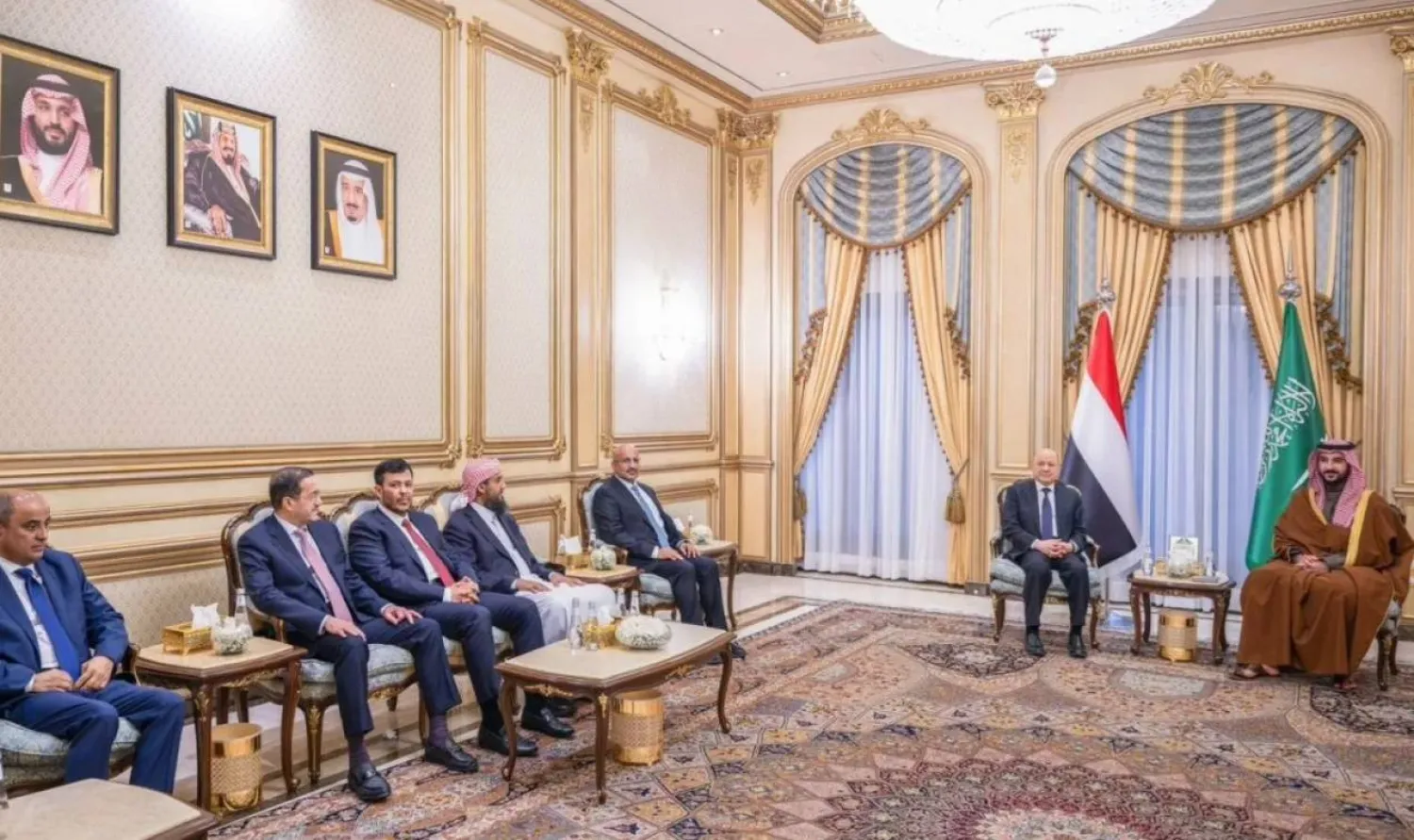
Members of Yemen’s Presidential Leadership Council meet with the Saudi Defense Minister. Saba
TT

With Saudi Backing, Yemen Moves to Forge Southern Consensus and Restore State Authority in the North

Members of Yemen’s Presidential Leadership Council meet with the Saudi Defense Minister. Saba

Yemen’s Presidential Leadership Council took a series of far-reaching decisions on Thursday, including changes to its membership and the appointment of a new prime minister tasked with forming a new government, in a move aimed at reshaping power dynamics within the anti-Houthi camp and strengthening unified sovereign decision-making under declared Saudi support.

In a rapid sequence of decisions, the council revoked Faraj Al-Buhsani's membership, filled the resulting vacancies by appointing Lieutenant General Mahmoud Al-Subaihi and Dr. Salem Al-Khanbashi, accepted the resignation of Prime Minister Salem bin Braik’s government, and named Shaea Mohsen Al-Zandani to form a new cabinet.

The steps, which officials said were taken with Saudi Arabia playing a “decisive” role, are intended to normalize conditions in southern provinces, particularly Hadhramaut, and pave the way for a comprehensive south-to-south dialogue to be hosted in Riyadh.

The decision to strip Al-Buhsani of his membership in the Presidential Leadership Council was not merely a change in personnel, according to the legal reasoning published by official media, but a firm political and legal message.

The decision accused him of “breaching the principle of collective responsibility” and “challenging sovereign decisions.”

It said Al-Buhsani had “exploited his constitutional position to provide political and legal cover for illegal military movements” carried out by what it described as the dissolved Southern Transitional Council, including justifying the mobilization of forces from outside Hadhramaut to attack the province.

He was also accused of endorsing “unilateral measures” led by Aidarous al-Zubaidi, who has been referred to the public prosecutor on charges of high treason, actions that the decision said had contributed to undermining national unity.

The language of the ruling framed those actions as an “armed rebellion outside the framework of the state,” shifting the southern dispute from a political disagreement into a question of allegiance to state institutions and legitimacy.

The move was seen as a heavy blow to the dissolved Transitional Council and its supporters, reaffirming that southern demands must be pursued through constitutional and legal channels and through negotiations under Saudi sponsorship, rather than unilateral military action.

Rebalancing power

The appointment of Dr. Salem Al-Khanbashi, the governor of Hadhramaut, as a member of the Presidential Leadership Council while retaining his local post underscored the priority placed on stability in the oil-rich province.

In a previous interview with Asharq Al-Awsat, Al-Khanbashi said the Saudi position had been “decisive” in the rapid withdrawal of Southern Transitional Council forces from Hadhramaut.

His elevation to the council is seen as recognition of his recent efforts and is expected to strengthen the government camp’s ability to manage political and security conditions in Hadhramaut and across southern Yemen.

The appointment of Lt. Gen. Mahmoud Al-Subaihi, a veteran military commander, was viewed as bolstering the representation of the professional military establishment within the council and sending a reassuring message to forces fighting on the front lines against the Houthis.

Officials said it could also be a step toward unifying military formations under the Ministry of Defense, a key Saudi and international demand.

Accepting the government's resignation and appointing Al-Zandani to form a new cabinet was aimed at renewing government performance to meet the demands of a new phase, shifting from crisis management to rebuilding institutions and improving services.

The move coincided with Saudi Arabia’s announcement of $90 million in financial support to pay salaries, in addition to covering military wages starting Sunday.

Broader context

The latest Yemeni moves cannot be separated from Saudi Arabia’s regional role. Alongside the internal decisions, Riyadh announced a new development package for Yemen worth 1.9 billion Saudi riyals, or about $500 million, and preparations to host a south-to-south dialogue conference, while continuing efforts to reunify military forces.

The Saudi strategy, according to officials, centers on supporting Yemen’s legitimate authority to impose control, unify armed forces, end armed activity outside the state, and facilitate inclusive southern dialogue under its sponsorship to reach a unified vision addressing the southern issue.

Saudi Arabia has also continued its development and humanitarian efforts, linking political stability in Yemen to improved services and living conditions to restore public confidence in state institutions.

These developments come as UN envoy Hans Grundberg has warned of the truce's fragility, stressing that the future of the south cannot be imposed by force.

The changes appear aimed at forging a more cohesive and unified southern leadership capable of entering decisive negotiations over the shape of Yemen’s future state, before turning to the long-delayed settlement in the north, where the Houthis continue to obstruct regional and international efforts to end the conflict and re-enter a peace process to restore stability across Yemen.



World Defense Show Opens in Riyadh with Expanded Int’l Participation

The exhibition includes a fully integrated airport with a 2,700-meter runway, four aircraft taxiways, and extensive display areas (Asharq Al-Awsat)
TT

World Defense Show Opens in Riyadh with Expanded Int’l Participation

The exhibition includes a fully integrated airport with a 2,700-meter runway, four aircraft taxiways, and extensive display areas (Asharq Al-Awsat)

The World Defense Show opened in Riyadh on Sunday, bringing together defense and military companies from around the globe to showcase advanced technologies, as Saudi Arabia accelerates efforts to localize its military industries and strengthen domestic supply chains.

The third edition of the exhibition is being held under the patronage of King Salman bin Abdulaziz Al Saud and organized by the General Authority for Military Industries from Feb. 8 to Feb. 12.

It features official delegations, government entities, and international firms operating in the defense and security sectors.

The event comes as part of Saudi Vision 2030, which aims to build a comprehensive national defense industry and localize more than 50 percent of military spending, while boosting operational readiness and strategic autonomy.

Ahmad Al-Ohali, governor of the General Authority for Military Industries and chairman of the exhibition’s supervisory committee, said the show reflects the Kingdom’s commitment to innovation, localization, and the development of an integrated defense ecosystem.

He said the exhibition includes live air and ground demonstrations, static displays, and newly introduced zones designed to enhance cooperation between government bodies and major national and international defense companies.

Andrew Pearcey, chief executive of the World Defense Show, said the event would feature a comprehensive program starting with an official delegations initiative linking senior officials with investors and industry leaders to support international industrial and technological cooperation.

Pearcey said the “Defense Industry Lab” would highlight emerging technologies and applied research, while dedicated zones would focus on naval systems and Saudi supply chains, connecting local manufacturers and small and medium-sized enterprises with global firms.

The program also includes meetings between Saudi government entities and industry representatives to discuss operational requirements and investment opportunities.

He added that the venue includes a fully integrated airport with a 2,700-meter runway, four aircraft taxiways, and large display areas, allowing the exhibition to host integrated air, land, and maritime demonstrations.

Participation in the 2026 edition is expected to exceed previous shows, reflecting growing international interest in Saudi Arabia’s defense market.

South Korea’s air force aerobatic team, the Black Eagles, will take part in the exhibition for the first time in the Middle East. The South Korean Air Force said it would deploy 9 T-50 fighter jets, including 1 reserve aircraft, 4 C-130 transport planes, and about 120 personnel.


Saudi Arabia Condemns RSF Attacks on Civilians and Aid Convoys in Sudan

 An elderly man picks up his food aid ration at the Umdulu Camp, in Engpung County, Sudan, January 30, 2026. (Karl Schembri/Norweigan Refugee Council/Handout via Reuters)
An elderly man picks up his food aid ration at the Umdulu Camp, in Engpung County, Sudan, January 30, 2026. (Karl Schembri/Norweigan Refugee Council/Handout via Reuters)
TT

Saudi Arabia Condemns RSF Attacks on Civilians and Aid Convoys in Sudan

 An elderly man picks up his food aid ration at the Umdulu Camp, in Engpung County, Sudan, January 30, 2026. (Karl Schembri/Norweigan Refugee Council/Handout via Reuters)
An elderly man picks up his food aid ration at the Umdulu Camp, in Engpung County, Sudan, January 30, 2026. (Karl Schembri/Norweigan Refugee Council/Handout via Reuters)

Saudi Arabia strongly condemned on Saturday the Rapid Support Forces’ attack against a humanitarian aid convoy in Sudan’s Kordofan.

A Foreign Ministry statement said the Kingdom expressed its strong condemnation of the attack against Al-Kuweik Military Hospital, a humanitarian aid convoy affiliated with the World Food Program, and a vehicle transporting displaced civilians.

“These acts are unjustifiable under any circumstances and are flagrant violations of all humanitarian norms and relevant international agreements,” it stressed.

“The Kingdom called on the RSF to immediately cease these violations and to fulfill their moral and humanitarian obligations by ensuring the safe and unhindered delivery of humanitarian assistance to those in need, in accordance with international humanitarian law and the Jeddah Declaration signed on May 11, 2023,” it added.

The Kingdom reiterated its firm position in support of Sudan’s unity, security, and stability, the need to preserve its legitimate institutions.

It voiced its rejection of “foreign interference and the continued actions of certain parties in supplying illicit weapons, mercenaries, and foreign fighters, despite their stated support for a political solution,” saying such “conduct is a primary factor in prolonging the conflict and exacerbating the suffering of the Sudanese people.”

A drone attack by the RSF hit a vehicle carrying displaced families in central Sudan Saturday, killing at least 24 people, including eight children, a doctors’ group said, a day after a World Food Program aid convoy was targeted.

The attack occurred close to the city of Rahad in North Kordofan province, said the Sudan Doctors Network, which tracks the country’s ongoing war. The vehicle was transporting displaced people who fled fighting in the Dubeiker area, the group said in a statement. Among the dead children were two infants.


OIC Condemns Terrorist Bombing of Mosque in Islamabad

A Pakistani man reacts as people attend a protest against the suicide bomb blast that killed dozens of people, in Peshawar, Pakistan, 07 February 2026. (EPA)
TT

OIC Condemns Terrorist Bombing of Mosque in Islamabad

A Pakistani man reacts as people attend a protest against the suicide bomb blast that killed dozens of people, in Peshawar, Pakistan, 07 February 2026. (EPA)

The Organization of Islamic Cooperation (OIC) General Secretariat strongly condemned on Saturday the terrorist bombing that targeted a mosque in Islamabad.

The secretariat stressed its categorical rejection of terrorism in all its forms, especially those targeting places of worship.

It underlined its firm stance in condemning these criminal acts, which are contrary to human values and religious principles.

The OIC offered its sincere condolences to the government and people of Pakistan and to the families of the victims.

It also reiterated its full solidarity with Pakistan in its efforts to combat terrorism and boost its security and stability.

At least 30 people killed in a suicide bombing at a Muslim mosque during Friday prayers.