

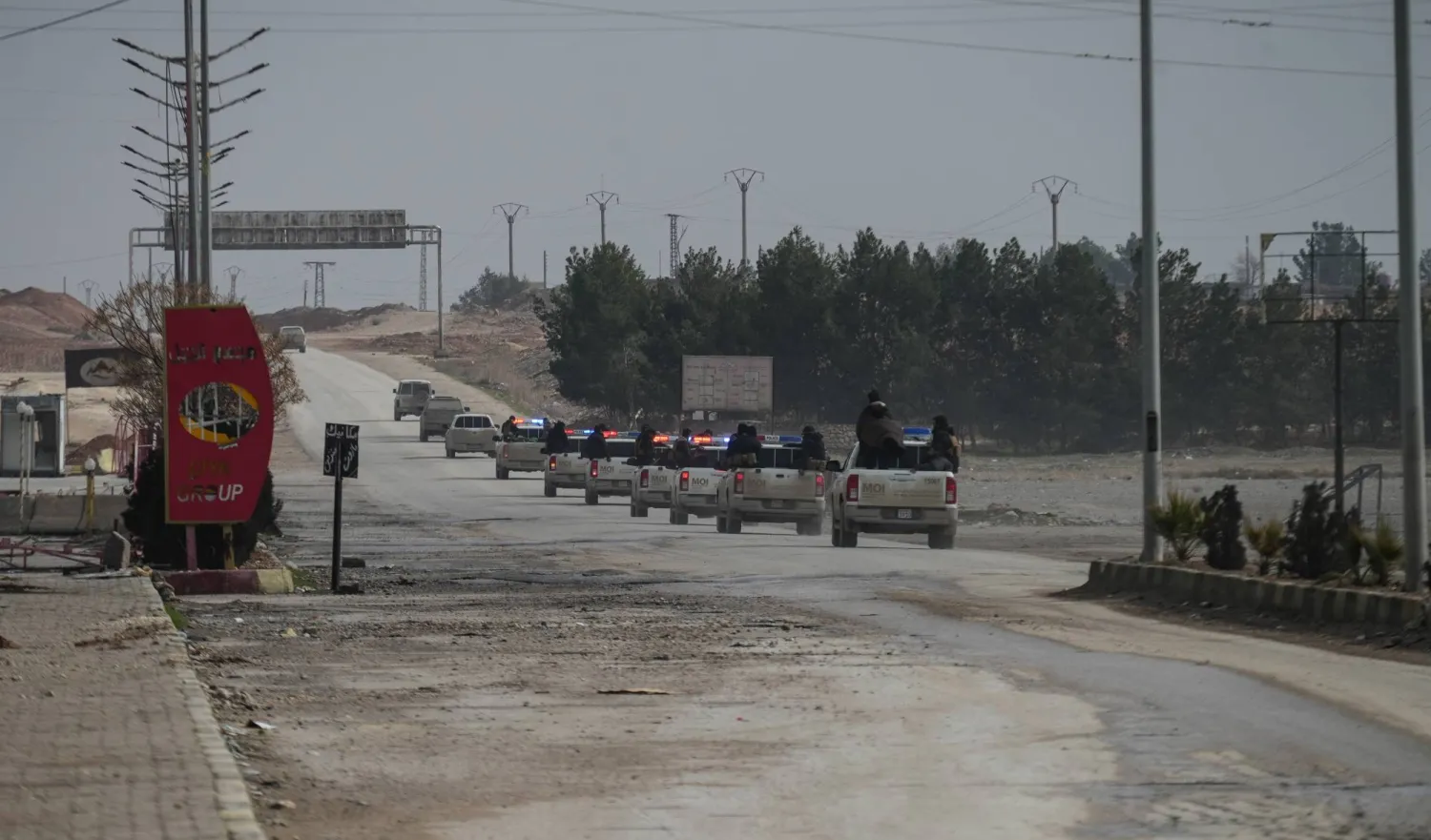

Syria Govt Forces Enter Qamishli Under Agreement with Kurds

02 February 2026, Syria, Saran: Syrian internal security forces are preparing near the village of Saran to enter the Kobane region northeast of Aleppo, following an agreement between the SDF and the Syrian government stipulating the entry of a number of Syrian security forces into the cities of Hasakeh, Qamishli, and Kobane to take over government institutions. (dpa)
TT

Syria Govt Forces Enter Qamishli Under Agreement with Kurds

02 February 2026, Syria, Saran: Syrian internal security forces are preparing near the village of Saran to enter the Kobane region northeast of Aleppo, following an agreement between the SDF and the Syrian government stipulating the entry of a number of Syrian security forces into the cities of Hasakeh, Qamishli, and Kobane to take over government institutions. (dpa)

Syrian government forces entered the Kurdish-majority city of Qamishli on Tuesday as part of a deal agreed last week to gradually integrate the Kurds' forces and institutions into the state. 

The arrival came after government security personnel entered the mixed Kurdish-Arab city of Hasakeh and the countryside around the Kurdish town of Kobane the day before. 

Kurdish forces have ceded swathes of territory to advancing government troops in recent weeks following months of tension and sporadic clashes as Syria's new authorities have sought to impose their authority across the country. 

"A convoy of internal security forces began entering the city of Qamishli," the official SANA news agency said. 

An AFP correspondent saw a convoy of vehicles, including armored personnel, carriers enter the city, which has been the main stronghold of the Kurds' de facto autonomous administration, while forces set up checkpoints at its entrances. 

Another correspondent reported few people on the streets inside the city amid a curfew in place until Wednesday morning, with Kurdish security forces also lightly deployed and Kurdish flags and banners raised. 

At the city's entrance, interior ministry spokesman Noureddine al-Baba said work would be undertaken to integrate the Kurds' domestic security forces, known as the Asayish, "into the ranks and payroll" of the ministry. 

He welcomed Syria's diversity and "all Syrian national personnel" wishing to serve the country. 

State television reported that Baba and Marwan al-Ali, the new head of internal security in Hasakeh province, inspected the Asayish security headquarters in Qamishli ahead of its handover. 

- 'Gradual integration' - 

Friday's deal "seeks to unify Syrian territory", including Kurdish areas, while also maintaining an ongoing ceasefire and introducing the "gradual integration" of Kurdish forces and administrative institutions, according to the text of the agreement. 

It was a blow to the Kurds, who had sought to preserve the de facto autonomy they exercised after seizing vast areas of north and northeast Syria in battles against the IS extremist group during the civil war. 

Mazloum Abdi, head of the Kurdish-led Syrian Democratic Forces (SDF), had previously said the deal would be implemented on the ground from Monday, with both sides to pull forces back from frontline positions in parts of the northeast, and from Kobane in the north. 

He added that a "limited internal security force" would enter parts of Hasakeh and Qamishli, but that "no military forces will enter any Kurdish city or town". 

On Monday, government security personnel also deployed to the countryside around Kobane, more than 200 kilometers (125 miles) from Hasakeh. 

Hemmed in by the Turkish border and Syrian government forces, the town has long been seen as a symbol of Kurdish fighters' victory against ISIS. 

The United States, which leads a military coalition that had backed the Kurds' campaign against ISIS, has drawn close to Syria's new authorities and recently said the purpose of its alliance with the Kurdish forces was largely over. 


Salam to Asharq Al-Awsat: We Refuse to Tie Lebanon’s Fate to Iran’s Interests

Lebanese Prime Minister Nawaf Salam speaks to reporters at the Grand Serail in Beirut, December 3, 2025. (Reuters)
TT

Salam to Asharq Al-Awsat: We Refuse to Tie Lebanon’s Fate to Iran’s Interests

Lebanese Prime Minister Nawaf Salam speaks to reporters at the Grand Serail in Beirut, December 3, 2025. (Reuters)

Lebanese Prime Minister Nawaf Salam stressed on Saturday that the state was doing everything possible on the political and diplomatic levels to end Israel’s war on Lebanon and ease its catastrophic impact on the people, especially the displaced.

He told Asharq Al-Awsat that diplomatic efforts have not reached their desired results because the situation in Lebanon is being tied to the crises and war in the region.

“We could have avoided being impacted by the conflict were it not for the strategic error committed by Hezbollah by being dragged us into it,” he added.

This been a catastrophe for Lebanon and “the environment that the party claims it wants to protect,” Salam went on to say.

The war has been imposed on all the Lebanese people, he reiterated. “It is not in their interest,” he declared, underscoring the need to end the war.

Moreover, the PM revealed that foreign efforts to end the war are being met with “an extreme hardline position by Israel” and the United States’ preoccupation with the ongoing war.

He said the war was having dangerous repercussions on the security of the Arab Gulf, condemning and questioning Iran’s attacks against countries that have extended their hands in friendship towards it and repeatedly expressed their opposition to war before it erupted.

Salam underlined his government’s determination to implement its latest decisions related to banning Hezbollah’s military and security operations.

The state’s armed forces and judiciary are carrying out their duties to that end, but the war is making implementation more difficult, he said.

On Lebanon’s decision to impose visas on visiting Iranians, the PM explained it was due to intelligence about Iranian Revolutionary Guards operations that could harm Lebanon’s national security.

Lebanon wants the best relations with Iran, state to state, Salam added, while categorically rejecting tying the Lebanese people’s interests to that of another country as has already happened.

On the displacement of the people of the South and Beirut’s southern suburbs, the PM said the government was sparing no effort to ease their suffering and meet their essential needs, such as food and medicine.

This is a major challenge given the state’s limited means, he acknowledged. He added that he was personally overseeing aid efforts.

Meanwhile, France has continued to exert efforts to resolve the crisis. President Emmanuel Macron held telephone talks with President Joseph Aoun for the third time in two days.

His efforts have yet to make any breakthrough, ministerial sources told Asharq Al-Awsat.

The situation needs more time, they revealed, expecting that mid-next week should witness renewed efforts.

Aoun also received a telephone call from Spain’s King Felipe, who expressed Madrid’s solidarity with Beirut.

Earlier on Saturday, Israel's Defense Minister Israel Katz warned the Lebanese government to disarm Hezbollah or "pay ‌a very ‌heavy price." 

"We (ISRAEL) ‌have ⁠no territorial claims ⁠against Lebanon, but we will not accept a situation ⁠where what ‌existed ‌for many ‌years — firing ‌from Lebanese territory toward the State of ‌Israel — is renewed," Katz said in ⁠a ⁠statement.  

"Therefore, we are turning and warning: act and take action before we act even more." 

The United Nations special coordinator for Lebanon urged Lebanon and Israel to enter talks to negotiate an end hostilities after the outbreak of a renewed Israel-Hezbollah war.  

"As bad as things are today, they are set to get even worse," Jeanine Hennis-Plasschaert said.  

"Talks between Lebanon and Israel can be the game changer needed to save future generations from going, time and again, through the same nightmare".  

In December, Lebanese and Israeli civilian representatives engaged in their first direct talks in decades as part of a meeting of a committee monitoring the November 2024 ceasefire between Israel and Hezbollah.  

Lebanon was engulfed by the expanding Middle East war on Monday, after Hezbollah fired missiles at Israel to avenge the death of Iranian supreme leader Ali Khamenei in US-Israeli attacks on Iran. 


Israeli Army Warns Remaining Residents of Beirut’s Southern Suburbs to Evacuate

A destroyed building following an Israeli air strike in the Chiyah neighborhood of Beirut, Lebanon, 07 March 2026. (EPA)
TT

Israeli Army Warns Remaining Residents of Beirut’s Southern Suburbs to Evacuate

A destroyed building following an Israeli air strike in the Chiyah neighborhood of Beirut, Lebanon, 07 March 2026. (EPA)

The Israeli military on Saturday warned the remaining residents of Beirut's southern suburbs, where Hezbollah holds sway, to evacuate immediately.

"Urgent warning to residents of Beirut's southern suburbs, especially those who have not yet evacuated the area. We reiterate -- save your lives and evacuate your homes immediately," Arabic-language spokesman for the military Avichay Adraee said on X.

Tens of thousands of residents have fled the suburbs, known as Dahieh in Arabic, since Israel first issued an evacuation warning on Thursday ahead of its strikes.

Lebanon's social affairs minister said on Saturday that 454,000 people had been registered as displaced since the outbreak of the new war between Israel and Hezbollah.

In a press briefing, Haneen Sayed said that the total number of people who registered their names on a website affiliated with the ministry reached 454,000, including 112,525 people registered in government shelters.

Sayed urged remaining displaced people to register their names with the authorities, with Israel this week having warned residents of Beirut's densely populated southern suburbs and hundreds of square kilometers of southern Lebanon to evacuate.


Strike Hits Iraqi PMF Base Near Mosul

A photograph shows the remains of a drone that was reportedly aimed at Erbil International Airport and crashed outside Erbil, the capital of the semiautonomous Kurdish region of northern Iraq, on March 3, 2026. (AFP)
TT

Strike Hits Iraqi PMF Base Near Mosul

A photograph shows the remains of a drone that was reportedly aimed at Erbil International Airport and crashed outside Erbil, the capital of the semiautonomous Kurdish region of northern Iraq, on March 3, 2026. (AFP)

A strike targeted a military base belonging to the former paramilitary coalition Popular Mobilization Forces (PMF) in northern Iraq on Saturday, two PMF sources told AFP.

"An airstrike, likely American, hit a PMF base south of the city of Mosul," an official said. Another source confirmed the strike took place.

The PMF is an alliance of factions now integrated into the regular army.

Bases belonging to the PMF have been hit several times since the start of the war in the Middle East, with strikes hitting Tehran-backed armed groups.

Pro-Iran factions have brigades that operate within the PMF, but have a reputation for acting on their own.

They are also part of the loose alliance of the “Islamic Resistance” in Iraq that has vowed not to stay neutral in the war and has been claiming attacks against US bases in Iraq and the region.

Iraq, long a proxy battleground between the US and Iran, had said it did not want to be dragged into the conflict engulfing the Middle East, but it has not been spared.

It was drawn into the war from the outset, with strikes blamed on the United States and Israel targeting Iran-backed groups.
