

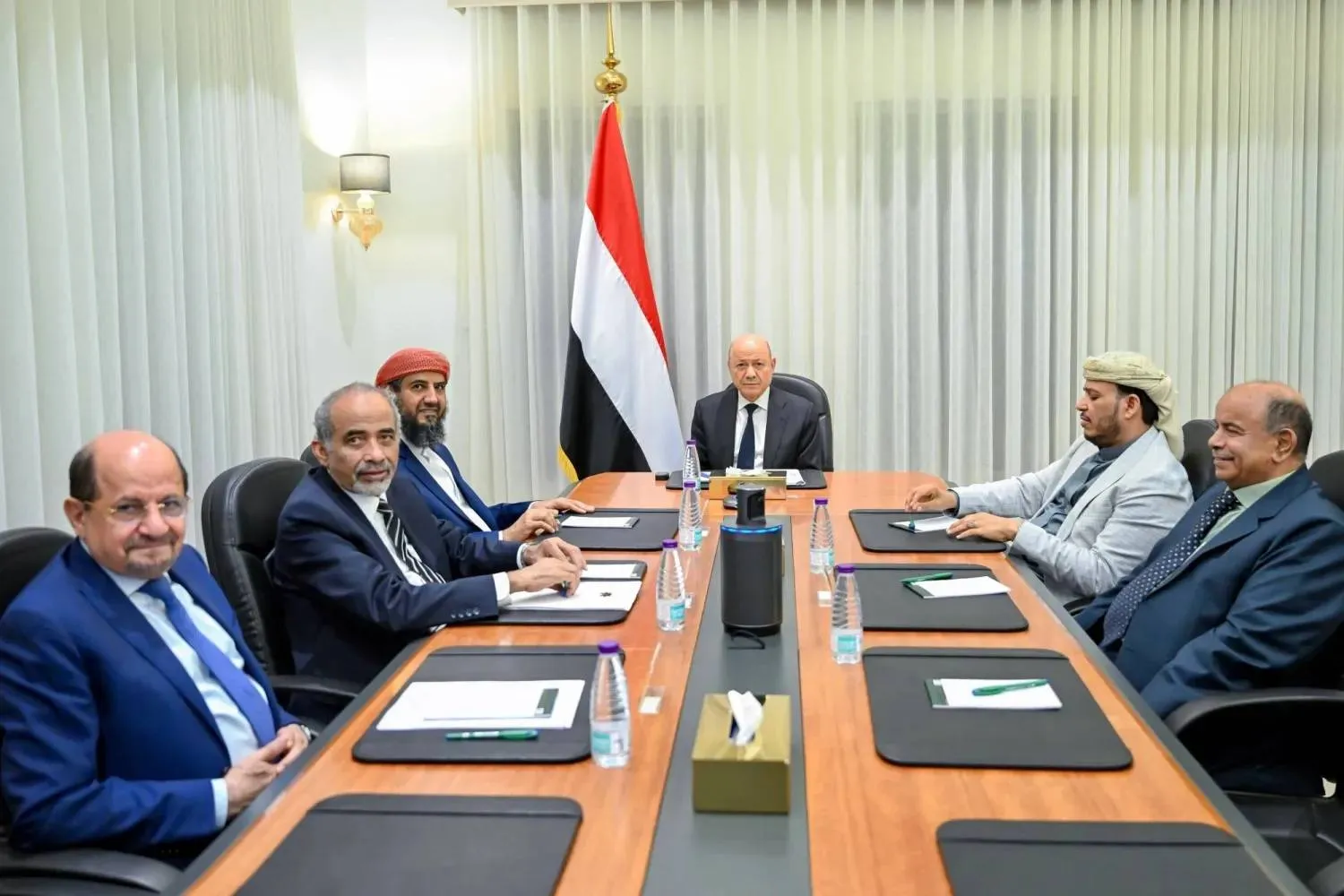

Al-Alimi Names New Yemeni Govt

Chairman of Yemen’s Presidential Leadership Council Dr. Rashad al-Alimi chairs a council meeting on Friday. (Saba)
TT

Al-Alimi Names New Yemeni Govt

Chairman of Yemen’s Presidential Leadership Council Dr. Rashad al-Alimi chairs a council meeting on Friday. (Saba)

Chairman of Yemen’s Presidential Leadership Council Dr. Rashad al-Alimi announced on Friday the formation of a new government.

The lineup was presented by Prime Minister Shaie Mohsen Al-Zindani and approved by al-Alimi.

Al-Zinadani retained his position of PM, as did Muammar Al-Iryani as Minister of Information.

The government is formed of Nayef Saleh Abdulqader Al-Bakri as Minister of Youth and Sports; Salem Abdullah Issa Al-Saqtari as Minister of Agriculture, Irrigation and Fisheries; Major General Ibrahim Ali Ahmed Haidan as Minister of Interior; Tawfiq Abdulwahid Ali Al-Sharjabi as Minister of Water and Environment; Mohammed Mohammed Hizam Al-Ashwal as Minister of Industry and Trade; and Dr. Qasim Mohammed Qasim Baheebah as Minister of Public Health and Population.

Judge Badr Abdo Ahmed Al-Aradha was named Minister of Justice; Major General (Staff) Taher Ali Aydha Al-Auqeeli as Minister of Defense; Engineer Badr Mohammed Mubarak Basalmah as Minister of Local Administration; Muti’a Ahmed Qasim Dammaj as Minister of Culture and Tourism; and Dr. Anwar Mohammed Ali Kalshat Al-Mahri as Minister of Technical Education and Vocational Training.

Engineer Adnan Mohammed Omar Al-Kaf was named Minister of Electricity and Energy; Marwan Faraj Saeed bin Ghanem as Minister of Finance; Dr. Afrah Abdulaziz Al-Zouba as Minister of Planning and International Cooperation; Salem Abu Bakr Mohammed Thabet Al-Awlaki as Minister of Civil Service and Insurance; Judge Ishraq Fadl Al-Maqtari as Minister of Legal Affairs; Dr. Adel Abdulmajid Alawi Al-Abbadi as Minister of Education; and Dr. Ameen Noman Mohammed Al-Qadsi as Minister of Higher Education and Scientific Research.

Dr. Shadi Saleh Basarah was appointed Minister of Communications and Information Technology; Dr. Mohammed Abdullah Ali Bamqa’a as Minister of Oil and Minerals; Mohsen Ali Haidarah Qasim Al-Omari as Minister of Transport; Engineer Hussein Awad Saeed Al-Aqrabi as Minister of Public Works and Roads; Mukhtar Omar Saleh Al-Yafei as Minister of Social Affairs and Labor; Mashdal Mohammed Omar Ahmed as Minister of Human Rights; Sheikh Turki Abdullah Ali Al-Wadei as Minister of Endowments and Guidance; Dr. Abdullah Ali Hussein Abu Hurriya as Minister of State for Parliamentary and Shura Council Affairs; Abdulghani Hefzullah Jameel as Minister of State and Secretary of the Capital Sanaa; Dr. Ahd Mohammed Salem Ja’sous as Minister of State for Women’s Affairs; and Abdulrahman Sheikh Al-Yafei as Minister of State and Governor of Aden Governorate.

Ahmed Saleh Ahmed Al-Awlaki, Judge Akram Naseeb Ahmed Al-Ameri, Walid Mohammed Mohammed Al-Qudaimi and Walid Ali Ismail Al-Abarah were named Ministers of State.



Israel Puts Military on Alert for Oct 7 Anniversary, Warns Gazans

Residents gather on a hill on October 1, 2026, in Sderot, one of the areas in southern Israel attacked by Hamas three years prior. Oded Balilty, AP
TT

Israel Puts Military on Alert for Oct 7 Anniversary, Warns Gazans

Residents gather on a hill on October 1, 2026, in Sderot, one of the areas in southern Israel attacked by Hamas three years prior. Oded Balilty, AP

Israel's defense minister on Tuesday said he had put the military on high alert before the anniversary of Hamas's October 7, 2023 attack, warning Gazans would pay a "heavy price" if forces were harmed.

The office of Defense Minister Israel Katz said the instruction came "in light of intelligence regarding Hamas's intentions to attempt to carry out attacks and terror operations against our forces in Gaza on that day".

"If, heaven forbid, our forces are harmed, the ones who will pay the heavy price will be Hamas and the population of Gaza -- beyond all proportion," the statement added.

Hamas's October 7, 2023 attack was the deadliest day in Israel's history, resulting in the deaths of 1,221 people, according to an AFP tally based on official Israeli figures.

Militants also dragged 251 hostages into Gaza, 44 of them already dead.

In response, Israel launched a military offensive that has left most of Gaza in ruins and killed more than 74,200 people, according to Gaza's health ministry, which is under Hamas authority and whose figures are considered reliable by the United Nations.

Since a ceasefire was declared last October, Israeli forces have killed more than 1,440 people in Gaza, according to the ministry.

On Monday, during a state ceremony to mark three years since the attack, Israeli Prime Minister Benjamin Netanyahu said there would be "no Hamas rule in Gaza" and vowed to continue targeting anyone who was involved in the attack or who held hostages.


Berri Reins In Hezbollah Campaign against Lebanese Prime Minister

Lebanese Prime Minister Nawaf Salam inspects the Nabatieh Gendarmerie unit last Friday (National News Agency) 
TT

Berri Reins In Hezbollah Campaign against Lebanese Prime Minister

Lebanese Prime Minister Nawaf Salam inspects the Nabatieh Gendarmerie unit last Friday (National News Agency) 

Lebanese Parliament Speaker Nabih Berri has moved to rein in political attacks by his ally Hezbollah against Prime Minister Nawaf Salam, with sources close to Berri telling Asharq Al-Awsat that he pushed for a de-escalation between Salam and a large segment of residents in southern Lebanon.

The shift was reflected in Salam’s visit to Nabatieh on Friday and reinforced in a Sunday interview on NBN, a channel affiliated with Berri’s Amal Movement. Salam reiterated the government’s position on Israel’s withdrawal from southern Lebanon and its commitment to restoring the state’s role and activating its institutions there.

Salam’s meetings Monday offered further signs of a drive to strengthen the state’s presence in the south. He met Berri to discuss political and field developments, pressing social and economic conditions, the outcome of his US visits and his Nabatieh tour and projects launched there, the speaker’s office said.

At the Grand Serail, Salam met Head of Council for the South Hashem Haidar, who briefed him on the council’s work and projects announced during the Nabatieh visit and steps taken to begin them.

Positive signs

Friday’s trip was Salam’s third visit to the south in three months. It was notably coordinated, with Amal MP Hani Qobeissi welcoming him alongside Finance Minister Yassin Jaber, himself from Nabatieh, and Interior Minister Ahmad al-Hajjar. Municipal leaders from Nabatieh-area villages aligned with Hezbollah also joined the reception.

Although Hezbollah’s political representatives were absent, the group issued no statement criticizing the visit or Salam, unlike on previous occasions — a sign of the de-escalation promoted by Berri.

Sources following the visit noted that the tour and meetings “repaired a large part of the relationship between Salam and the people of the region.” They said Hezbollah MP Mohammad Raad, the party’s representative in Nabatieh, was absent because he does not attend social occasions for security reasons. Hezbollah-aligned municipalities took part, while opposition to the visit appeared marginal.

In another sign of de-escalation, Hezbollah MP Hassan Fadlallah said Monday the group supported strengthening the state’s role in the south and having it assume full responsibility, “but that begins with expelling the occupation, stopping the aggression and ending this bulldozing operations and destruction in our villages.”

He urged the state to match words with actions, backed development initiatives in the south and called for the disbursement of a $250 million World Bank loan, part of which is allocated to the region, as well as increased government spending there in the 2027 budget.

Berri consistent with his demands

Unlike Hezbollah, which has attacked Salam in recent months, communication between the prime minister and Berri has continued. Berri has pressed for activating state institutions in the south, securing stability and the ceasefire, enabling residents to return to their villages and providing services to bolster their steadfastness, despite opposing direct negotiations with Israel and having earlier declared the “framework agreement” defunct.

Amal sources told Asharq Al-Awsat that Berri was consistent with his demand for state institutions to be present in the south. Salam’s visit, they said, confirmed the executive authority’s intention to strengthen that presence, making it natural for Amal and its Development and Liberation bloc to “meet it halfway.”

The sources underlined that the visit “soothed the wounds of southerners” and opened the door to a stronger state presence. They also pointed to Salam’s acknowledgment that resources were limited and reconstruction required international support because Lebanon could not undertake it alone.

‘No punishment of any community’

In Sunday’s NBN interview, Salam said: “The state cannot remain in a state of waiting. We must go to the south and to all regions and assume our responsibilities.”

He reiterated the need to stop Israeli attacks, consolidate the ceasefire, secure Israel’s withdrawal from occupied Lebanese territory and work for the release of prisoners.

“When I return for a fourth time to Nabatieh and Tyre, I want to see with my own eyes that water and electricity have been restored, that the contracts we launched are actually being implemented, that schools are being repaired, and that our people are returning and feel safe,” Salam added.

“If I wanted to punish a particular community, I would not personally be following these operations and the response to demands every day.”

Salam stressed that dialogue with all sides remained open, adding that agreed measures now had to be implemented and each side must honor its commitments.

Addressing residents of the south, he said: “You are not alone. The state is with you, beside you and at your service,” citing the presence of security agencies, institutions and services in Nabatieh.


Lebanon, Britain to Hold Joint Military Exercise Starting Tuesday

A Lebanese flag flies as buildings lie in ruins in Mansouri, as seen from Henniye, Lebanon, September 29, 2026. (Reuters)
TT

Lebanon, Britain to Hold Joint Military Exercise Starting Tuesday

A Lebanese flag flies as buildings lie in ruins in Mansouri, as seen from Henniye, Lebanon, September 29, 2026. (Reuters)

Lebanon's army will hold exercises with the British military this month, both sides said on Monday, with the drills also to involve personnel and representatives from countries including the United States and France.

Britain has been a key supporter of the cash-strapped Lebanese army and has provided millions of dollars in assistance over the years, including helping train Lebanese soldiers to secure the country's land borders.

The Lebanese army said that the joint "Pegasus Cedar 2026" exercise would begin on Tuesday and aimed to "bolster the capabilities of military units and raise the level of coordination between the Lebanese army and friendly armies".

It said the exercise would include "training on reconnaissance, raids and combat in built-up areas", among other activities.

A British embassy statement said British soldiers based in Cyprus would "join their Lebanese counterparts in the Air Assault Regiment in a landmark military exercise aimed at strengthening bilateral defense ties and enhancing operational readiness".

"Personnel from the armies of the United States and Italy will also take part, with representatives from the armies of France, Cyprus, Qatar, and Jordan joining as observers," it added.

The exercise, to be held over three weeks, builds on a previous UK-Lebanon military training exercise held in September 2023, the embassy statement added.

Lebanese authorities have called for increased support for the country's under-resourced army, which counts some 80,000 personnel and depends heavily on foreign aid.

The military faces enormous challenges in completing its deployment to south Lebanon under a framework agreement reached in June between Israel and Lebanon that involves the disarmament of the Hezbollah group and the gradual withdrawal of Israeli forces.

Hezbollah drew the country into the Middle East war in March by attacking Israel, which responded with massive airstrikes and a ground invasion.

While violence has dropped since June, Israel still carries out attacks and demolitions, and its troops are occupying a self-declared "security zone" running around 10 kilometers (six miles) inside Lebanon along the border.

The fighting followed another conflict that erupted in 2023 that led to an all-out war the following year.

Last month in Paris, Lebanese President Joseph Aoun met his French counterpart Emmanuel Macron and Jordan's King Abdullah II, and discussed international support for the country's military.