
Al-Alimi Calls from Munich for a New Regional Security Framework

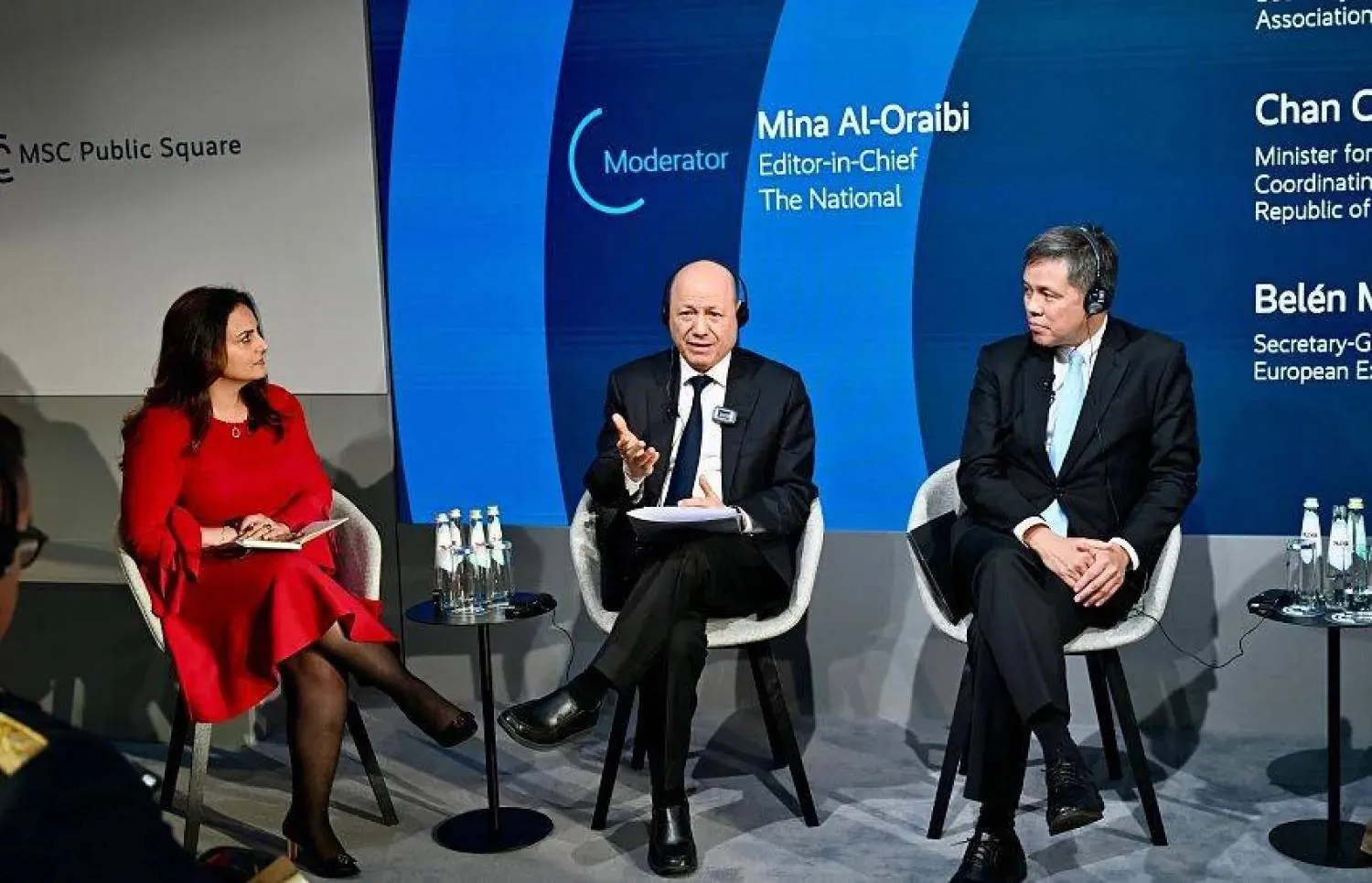
Al-Alimi presents Yemen’s vision for maritime security during a panel discussion in Munich (SABA).
TT

Al-Alimi Calls from Munich for a New Regional Security Framework

Al-Alimi presents Yemen’s vision for maritime security during a panel discussion in Munich (SABA).

Yemen’s Presidential Leadership Council Chairman Rashad Al-Alimi has called for a fundamental rethinking of the international approach to regional security, warning that escalating threats in the Red Sea and the Bab el-Mandeb represent a geopolitical shift rather than a series of isolated incidents.

Speaking at the Munich Security Conference during a panel on maritime security, Al-Alimi said that safeguarding international shipping requires addressing the root causes of Yemen’s conflict, not relying on short-term containment measures.

He argued that sustainable maritime security begins with supporting Yemen’s state institutions and strengthening their capacity to restore stability and combat terrorism.

Al-Alimi criticized previous international responses to attacks on shipping in the Red Sea as largely tactical and reactive, focused on immediate protection rather than long-term solutions.

He said that while international naval operations have helped reduce direct risks to commercial vessels, they have also contributed to further militarization without resolving the underlying sources of instability.

He stressed that maritime security cannot be achieved through military presence alone. Instead, it depends on building a capable Yemeni state with effective political, military and economic deterrence, preventing armed groups from using Yemen’s geography as a platform to threaten global trade.

Temporary pauses in attacks, he warned, do not eliminate the risk, as Houthi militias will remain a persistent threat unless addressed through a comprehensive deterrence strategy.

Al-Alimi called for a proactive international counterterrorism approach that treats such groups as long-term geopolitical threats rather than challenges that can be managed through de-escalation or political incentives.

He also urged stronger coordination through existing regional mechanisms, including Red Sea coastal frameworks and joint task forces, within broader international partnerships aimed at achieving lasting security.

Turning to regional cooperation, Al-Alimi renewed his call for deeper Yemeni-Gulf integration, advocating Yemen’s gradual inclusion in the Gulf Cooperation Council as a strategic pathway to economic and political stability.

Speaking at a session organized by the Gulf Research Center in cooperation with the International Crisis Group, he proposed a “Gulf Marshall Plan” for Yemen’s reconstruction, inspired by the Saudi Development and Reconstruction Program for Yemen and aligned with Saudi Vision 2030.

He concluded by stressing that any future peace process must include dismantling armed militias and ending external interference. He noted that Yemen’s long-term stability depends on internal reconciliation, stronger ties with Gulf neighbors and a shift away from sectarianism and uncontrolled weapons.


UN Says Al-Hol Camp Population Has Dropped Sharply as Syria Moves to Relocate Remaining Families

US military vehicles escort buses transporting ISIS detainees from Syria to Iraq, according to a security source from the Syrian Democratic Forces, in Qamishli, Syria, February 8, 2026. (Reuters)
TT

UN Says Al-Hol Camp Population Has Dropped Sharply as Syria Moves to Relocate Remaining Families

US military vehicles escort buses transporting ISIS detainees from Syria to Iraq, according to a security source from the Syrian Democratic Forces, in Qamishli, Syria, February 8, 2026. (Reuters)

The UN refugee agency said Sunday that a large number of residents of a camp housing family members of suspected ISIS group militants have left and the Syrian government plans to relocate those who remain.

Gonzalo Vargas Llosa, UNHCR's representative in Syria, said in a statement that the agency “has observed a significant decrease in the number of residents in al-Hol camp in recent weeks."

“Syrian authorities have informed UNHCR of their plan to relocate the remaining families to Akhtarin camp in Aleppo Governorate (province) and have requested UNHCR’s support to assist the population in the new camp, which we stand ready to provide,” he said.

He added that UNHCR “will continue to support the return and reintegration of Syrians who have departed al-Hol, as well as those who remain.”

The statement did not say how residents had left the camp or how many remain. Many families are believed to have escaped either during the chaos when government forces captured the camp from the Kurdish-led Syrian Democratic Forces last month or afterward.

There was no immediate statement from the Syrian government and a government spokesperson did not respond to a request for comment.

At its peak after the defeat of ISIS in Syria in 2019, around 73,000 people were living at al-Hol. Since then, the number has declined with some countries repatriating their citizens. The camp’s residents are mostly children and women, including many wives or widows of ISIS members.

The camp’s residents are not technically prisoners and most have not been accused of crimes, but they have been held in de facto detention at the heavily guarded facility.

Forces of Syria’s central government captured the al-Hol camp on Jan. 21 during a weekslong offensive against the SDF, which had been running the camp near the border with Iraq for a decade. A ceasefire deal has since ended the fighting.

Separately, thousands of accused ISIS militants who were held in detention centers in northeastern Syria have been transferred to Iraq to stand trial under an agreement with the US.

The US military said Friday that it had completed the transfer of more than 5,700 adult male ISIS suspects from detention facilities in Syria to Iraqi custody.

Iraq’s National Center for International Judicial Cooperation said a total of 5,704 suspects from 61 countries who were affiliated with ISIS — most of them Syrian and Iraqi — were transferred from prisons in Syria. They are now being interrogated in Iraq.


Rubio: US Satisfied with Overall ‘Trajectory’ in Syria

US Secretary of State Marco Rubio gives a thumbs-up as he boards a plane while departing Bratislava Airport in Bratislava, Slovakia, Sunday, Feb. 15, 2026. (Reuters)
TT

Rubio: US Satisfied with Overall ‘Trajectory’ in Syria

US Secretary of State Marco Rubio gives a thumbs-up as he boards a plane while departing Bratislava Airport in Bratislava, Slovakia, Sunday, Feb. 15, 2026. (Reuters)

US Secretary of State Marco Rubio said on Sunday that Washington is pleased with the "trajectory" in Syria, which has launched talks with Kurdish minority groups, despite troubles.

"There's been some days that have been very concerning, but we like the trajectory," Rubio said on a brief visit to Bratislava. "We have to keep it on that trajectory. We've got good agreements in place."

Rubio added, however, that a deal between Syrian authorities and the Kurdish minority must now be implemented.

"That's not going to be easy and there other such agreements that they need to reach with the Druze, with the Bedouins, with the Alawites -- with all the elements of a very diverse society in Syria," Rubio said.

Syrian leaders in Damascus and Kurdish officials announced in January, after months of deadlock and armed clashes, that they had reached an agreement to integrate Kurdish forces and autonomous areas of Syria into the Syrian state.

A de facto separate Kurdish state was established in northeast of the country during Syria's civil war (2011-2024).

The United States had supported Kurdish forces in their fight against the ISIS group starting in 2014.

But after the overthrow of Bashar al-Assad at the end of 2024, the President Donald Trump's administration backed Syrian leader Ahmed al-Sharaa -- whose opposition forces drove Assad from power -- in his bid to impose authority over the entire country.

Rubio on Sunday defended the administration's embrace of Sharaa -- even against the former Kurdish allies -- by arguing that Washington faced a difficult decision in Syria.

The process, "as difficult as it's been, is far better than a Syria that would've been broken up into eight pieces with all kinds of fighting going on, all kinds of mass migration," Rubio said. "So we were very positive about that."


Indonesia Says 8,000 Troops Ready for Possible Peacekeeping Mission in Gaza by June

Women walk down a hill overlooking a camp for displaced Palestinians in Khan Younis, in the southern Gaza Strip, on February 14, 2026. (AFP)
TT

Indonesia Says 8,000 Troops Ready for Possible Peacekeeping Mission in Gaza by June

Women walk down a hill overlooking a camp for displaced Palestinians in Khan Younis, in the southern Gaza Strip, on February 14, 2026. (AFP)

Indonesia's military said Sunday that up to 8,000 troops are expected to be ready by the end of June for a potential deployment to Gaza as part of a humanitarian and peace mission, the first firm commitment to a critical element of US President Donald Trump’s postwar reconstruction plan.

The Indonesian National Armed Forces, known as TNI, has finalized its proposed troop structure and a timeline for their movement to Gaza, even as the government has yet to decide when the deployment will take place, army spokesperson Brig. Gen. Donny Pramono said.

“In principle, we are ready to be assigned anywhere,” Pramono told The Associated Press, “Our troops are fully prepared and can be dispatched at short notice once the government gives formal approval.”

Pramono said the military prepared a composite brigade of 8,000 personnel, based on decisions made during a Feb. 12 meeting for the mission.

Under the schedule, troops will undergo health checks and paperwork throughout February, followed by a force readiness review at the end of the month, Pramono said. He also revealed that about 1,000 personnel are expected to be ready to deploy as an advance team by April, followed with the rest by June.

Pramono said that being ready does not mean the troops will depart. The deployment still requires a political decision and depends on international mechanisms, he said.

Indonesia's Foreign Ministry has repeatedly said any Indonesian role in Gaza will be strictly humanitarian. Indonesia’s contribution would focus on civilian protection, medical services, reconstruction, and its troops would not take part in any combat operations or actions that could lead to direct confrontation with armed groups.

Indonesia would be the first country to formally commit troops to the security mission created under Trump’s Board of Peace initiative for Gaza, where a fragile ceasefire agreement between Israel and Hamas has held since Oct. 10 following two years of devastating war.

Indonesia, the world’s most populous Muslim majority nation, does not have formal diplomatic relations with Israel and has long been a strong supporter of a two-state solution. It has been deeply involved in providing humanitarian aid to Gaza, including funding a hospital.

Indonesian officials have justified joining the Board of Peace by saying it was necessary to defend Palestinian interests from within, since Israel is included on the board but there is no Palestinian representation.

The Southeast Asian country has experience in peacekeeping operations as one of the top 10 contributors to United Nations missions, including in Lebanon.