


Yemen PM Announces Comprehensive Reform Plan with Saudi Support

Zindani government holds first meeting after ministers return to Aden (Saba News Agency)
TT

Yemen PM Announces Comprehensive Reform Plan with Saudi Support

Zindani government holds first meeting after ministers return to Aden (Saba News Agency)

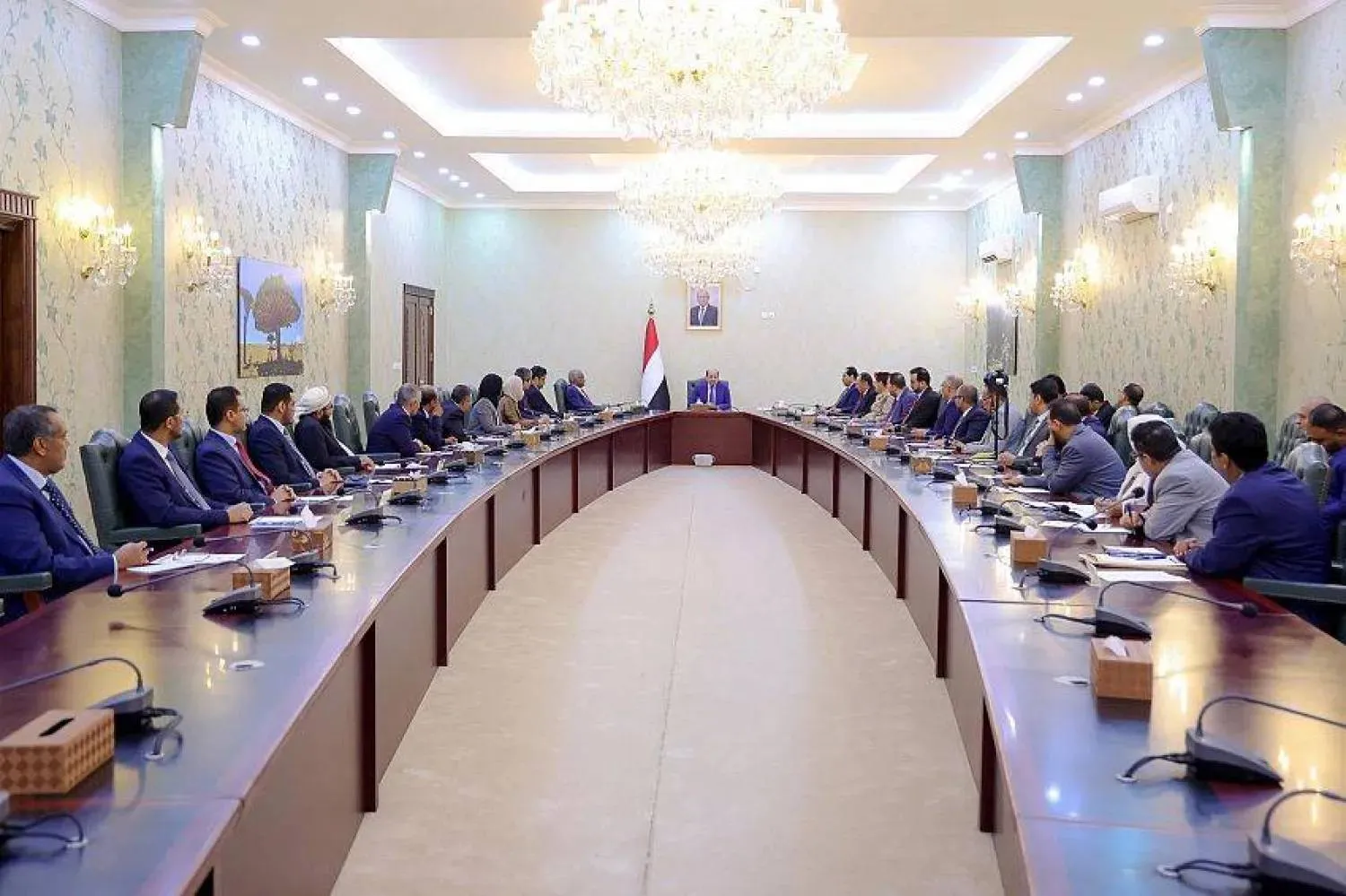
Yemen’s new government convened its first cabinet meeting on Thursday in the temporary capital Aden, with Prime Minister Shayea al-Zindani presiding after ministers completed their return to the country to resume duties, in what officials cast as the start of a hands-on push to stabilize security, revive services and shore up a battered economy with broad Saudi backing.

The meeting coincided with remarks by Presidential Leadership Council member Abdulrahman al-Mahrami, who warned against unrest in Aden, in an apparent reference to attempts led by elements of the dissolved Southern Transitional Council. “We will not allow any attempts to destabilize public order or drag our city into chaos or futile conflicts,” he said.

At the cabinet’s first meeting following its return to Aden, Zindani stressed that “there is no room for any government member to remain outside the country,” affirming that the government would be present on the ground, living among the population and addressing their daily needs, in a move aimed at restoring public trust and strengthening direct government performance.

The Yemeni prime minister, who also retains the foreign affairs portfolio, said his government would enter a new phase of field-based work from Aden, emphasizing that the next stage would rely on direct engagement with citizens, enhancing the effectiveness of state institutions and achieving tangible improvements in services and economic and security stability.

He said improvements in some basic services in recent weeks were not temporary, but the result of disciplined measures and practical reforms, alongside significant Saudi support, which he said had once again proven to be a pillar of the Yemeni state and a key partner in achieving peace and ensuring stability. He added that Saudi moves in support of the Yemeni people were consistent with international law.

Zindani said the government was working to ensure the sustainability of service delivery so that citizens feel a real and lasting difference, not a fleeting improvement, noting that the coming phase would include serious steps to combat corruption, enhance transparency and enforce the law as key pillars for building effective state institutions.

Reforms on all fronts

On the economic front, Zindani announced that the government would present a realistic 2026 budget for the first time in years, giving top priority to the regular payment of public-sector salaries as a legal and moral obligation.

Measures would also be taken to curb inflation and contain the erosion of citizens’ purchasing power, thereby easing living burdens.

On the security and military fronts, he said the government was committed to removing all military camps from Aden and other cities and to unifying military and security decision-making under the state’s authority, to strengthen stability and prevent multiple centers of influence.

He stressed the importance of respecting rights and equality for all citizens, and of not allowing calls that promote chaos or threaten public order.

Regarding the southern issue, the prime minister expressed confidence that south-south dialogue would open a genuine window to address it, calling on southerners to abandon the rhetoric of treason and avoid fueling strife and grudges, and to entrench a culture of tolerance and move beyond past conflicts.

He said southerners are the ones concerned with determining their present and future through dialogue, away from the imposition of individual or factional will, stressing there was no room to politicize or diminish the southern issue, which he described as a national cause concerning all Yemenis.

On the peace track, Zindani said the state retained all options to restore its institutions if the Houthis remained intransigent, while affirming that the internationally recognized government continues to extend its hand for peace and to end the Houthi coup, alongside efforts to launch a broad process of reconstruction, development and modernization.

Gradual work

Upon his arrival at Aden International Airport, Zindani said the government’s return to the country represents a practical commitment to shoulder national responsibilities and directly address accumulated challenges facing citizens, particularly amid difficult economic conditions and the repercussions of the ongoing war.

In his first interview after being sworn in as prime minister, Zindani said his government would soon relocate to Aden, noting that being inside the country was not a symbolic step but a prerequisite for effective decision-making and restoring the regular functioning of state institutions.

Speaking to Asharq Al-Awsat, he said the current phase “does not tolerate broad rhetoric,” but requires gradual work to rebuild trust and restore institutional rhythm, stressing that improving living conditions, services, and economic recovery are urgent priorities.

He justified retaining the foreign affairs portfolio as necessary to complete organizational and diplomatic reforms he had previously begun.

Zindani said his cabinet was formed based on professional criteria, away from quota-based arrangements, with a focus on competence, specialization and national balance.

Economically, he adopted what he described as a realistic tone, avoiding quick promises, and said recovery requires restructuring financial administration, controlling resources, enhancing transparency and activating oversight.

He said unifying political and military decision-making would enable state institutions to enforce the law, make accountability possible and give the government a more cohesive negotiating position in any upcoming peace process with the Houthis.

No tolerance for unrest

In support of Zindani’s government, Presidential Leadership Council member Abdulrahman al-Mahrami said security and stability in Aden would remain a non-negotiable priority.

He stressed that no attempts would be allowed to undermine public order or drag Aden into chaos and futile conflicts.

In a statement on his official X account, he reaffirmed that Aden’s security and stability will remain a priority and the government will accept no compromise or negligence.

"We will not allow any attempts to destabilize public order or drag our city into chaos or futile conflicts, without detracting from the political path of the south and its cause," he said.

He added: “We look forward to a South-South dialogue sponsored by Riyadh. It is a historic opportunity that we value and hold on to, and we thank the Kingdom’s leadership for it. We also affirm our full support for the government headed by Dr. Shayea al-Zindani, urging all its members to provide services and improve living conditions in a way that citizens can feel.”

Al-Mahrami pledged to follow up on performance “with care, transparency and responsibility,” calling on “everyone to unite, reject rumors, strengthen the spirit of national responsibility and stand together to protect the capital and safeguard state institutions.”

He added: “We trust that all understand the importance of preserving security and stability as the foundation for government and institutional work and the provision of services, away from political direction or exploitation by any party to harm people’s lives and increase their suffering, without detracting from our just cause.”



French Boats Set Sail to Join Gaza Aid Flotilla

Activists gather in l'Estaque, part of Marseille's harbor, southern France, on April 4, 2026, during a rally in support of a flotilla carrying activists from “Thousand Madleens to Gaza” movement as they prepare to set sail. (AFP)
TT

French Boats Set Sail to Join Gaza Aid Flotilla

Activists gather in l'Estaque, part of Marseille's harbor, southern France, on April 4, 2026, during a rally in support of a flotilla carrying activists from “Thousand Madleens to Gaza” movement as they prepare to set sail. (AFP)

Some 20 French boats set sail from Marseille on Saturday to join up with an international flotilla making a renewed effort to break an Israeli blockade and deliver aid to Gaza, AFP reporters saw.

"Gaza, Marseille is with you" shouted around a thousand people who had come to the docks to support the initiative.

The ships, mostly sailboats, set off to a round of applause and songs shortly after 5:00 pm (1500 GMT) to join the "Global Sumud Flotilla", named after a Gazan fisherman.

The international flotilla of some 100 boats, mostly setting sail from Barcelona on April 12, will head towards Gaza around April 20, according to the organizers. A week-long stopover is planned in southern Italy for "non-violence training."

"The goal is to give Palestine more visibility. We're not talking about it much right now, because of the international context," said Manon, a crew member who declined to give her full name.

In late 2025, an initial flotilla of about 50 boats, composed of political figures and activists such as Sweden's Greta Thunberg, was boarded by the Israeli navy -- illegally according to the organizers and Amnesty International.

The crew members were arrested and expelled by Israel.

The Gaza Strip, governed by Hamas, has been under an Israeli blockade since 2007. Israel and the Palestinian movement accuse each other of violating a ceasefire that came into effect on October 10, 2025, after two years of war.


Tens of Thousands of Sadr Supporters Rally in Baghdad Against War

Followers of Iraq's Moqtada al-Sadr wave Iraqi national flags during a protest against the joint US-Israeli strikes on Iran, as they gather in Tahrir Square, Baghdad, Iraq, 04 April 2026. (EPA)
TT

Tens of Thousands of Sadr Supporters Rally in Baghdad Against War

Followers of Iraq's Moqtada al-Sadr wave Iraqi national flags during a protest against the joint US-Israeli strikes on Iran, as they gather in Tahrir Square, Baghdad, Iraq, 04 April 2026. (EPA)

Tens of thousands of supporters of Iraqi Shiite cleric Moqtada al-Sadr rallied in Baghdad and across the country on Saturday, condemning Israel and the United States and demanding an end to the war.

The massive crowds came as the Middle East war was due to enter its sixth week after strikes launched by the US and Israel against Iran on February 28.

Iraq has been unwillingly drawn into the conflict, with strikes targeting US interests on its soil as well as attacks against pro-Iran groups in the country.

Tens of thousands of men and some women packed into the streets around Baghdad's central Tahrir Square on Saturday, waving the national flag and chanting: "No, no to Israel" and "No, no to America".

"What America and Israel are doing in their aggression against the countries of the region is not a war of a military nature, but a senseless war," Dhirgham Samir, attending the rally, told AFP.

"Today's demonstration is an expression of rejection of aggression, arrogance, and injustice throughout the world, not just in Iraq," he said.

Samir, who was in his forties, added that "this is a senseless war, targeting civilians".

Across the region since the onset of war thousands have been killed.

In a statement, Sadr called for peaceful demonstrations "to condemn the Zionist-American aggression and to establish peace in the region".

Under the giant Freedom Monument, commemorating Iraq's declaration of independence, demonstrators also railed against what they said was US and Israeli meddling in the region.

"They violate the rights of all the peoples of the region first, and then the world," cleric Ali Al-Fartousi told AFP.

"Humanity must speak out against these people and stop them," he said, adding: "The time has come for the entire world to stand united against global Zionist-American arrogance."

Sadr retains a devoted following of millions among Iraq's majority Shiite population, and has previously mobilized huge crowds.

As well as popular support, Sadr also has representatives among Iraqi ministries and official institutions, despite opposing several governments over the years.


Israeli Forces Destroy 17 UN Peacekeeper Cameras in South Lebanon

A dog lies an empty road outside a Lebanese army outpost in the area of Naqoura in southern Lebanon on March 27, 2026. (AFP)
TT

Israeli Forces Destroy 17 UN Peacekeeper Cameras in South Lebanon

A dog lies an empty road outside a Lebanese army outpost in the area of Naqoura in southern Lebanon on March 27, 2026. (AFP)

Israeli forces destroyed 17 surveillance cameras linked to the United Nations peacekeepers' main headquarters in southern Lebanon in 24 hours, a UN security official told AFP on Saturday.

Since the start of the Israel-Hezbollah war on March 2, the UN force in Lebanon (UNIFIL) has been caught in the crossfire in the country's south, with Hezbollah launching attacks on Israel and its troops, and Israeli forces pushing into border towns.

The official, who requested anonymity, said "17 of our headquarters' cameras have been destroyed by the Israeli army" in the coastal town of Naqoura.

On Thursday, UNIFIL spokeswoman Kandice Ardiel told AFP peacekeepers had seen "Israeli soldiers conducting demolitions of large parts" of Naqoura since the start of the week.

"Not only have these demolitions destroyed civilian homes and businesses, but the strength of the blasts have caused damage to UNIFIL's headquarters," she added.

Three Indonesian peacekeepers from the UN force have been killed in two separate incidents over the past week.

UNIFIL also reported Friday an "explosion" in one of its bases near Adaisseh in south Lebanon that wounded three personnel, adding that they "do not yet know the origin of the explosion".

The Israeli army accused Hezbollah of firing " a rocket that landed in a UNIFIL outpost".

The UN office in Jakarta said on Saturday the wounded were Indonesian.

Indonesia condemned the incident as "unacceptable", saying "these events underscore the urgent need to strengthen protection for UN peacekeeping forces amid an increasingly dangerous conflict situation".

According to the UN, 97 force members have been killed in violence since its establishment in 1978 to monitor the withdrawal of Israeli forces after they invaded Lebanon.

"This has been a difficult week for peacekeepers working near the central part of UNIFIL's area of operations," Ardiel said in her statement.

She added that UNIFIL "reminds all actors of their obligations to ensure the safety and security of peacekeepers, including by avoiding combat activities nearby that could put them in danger".