

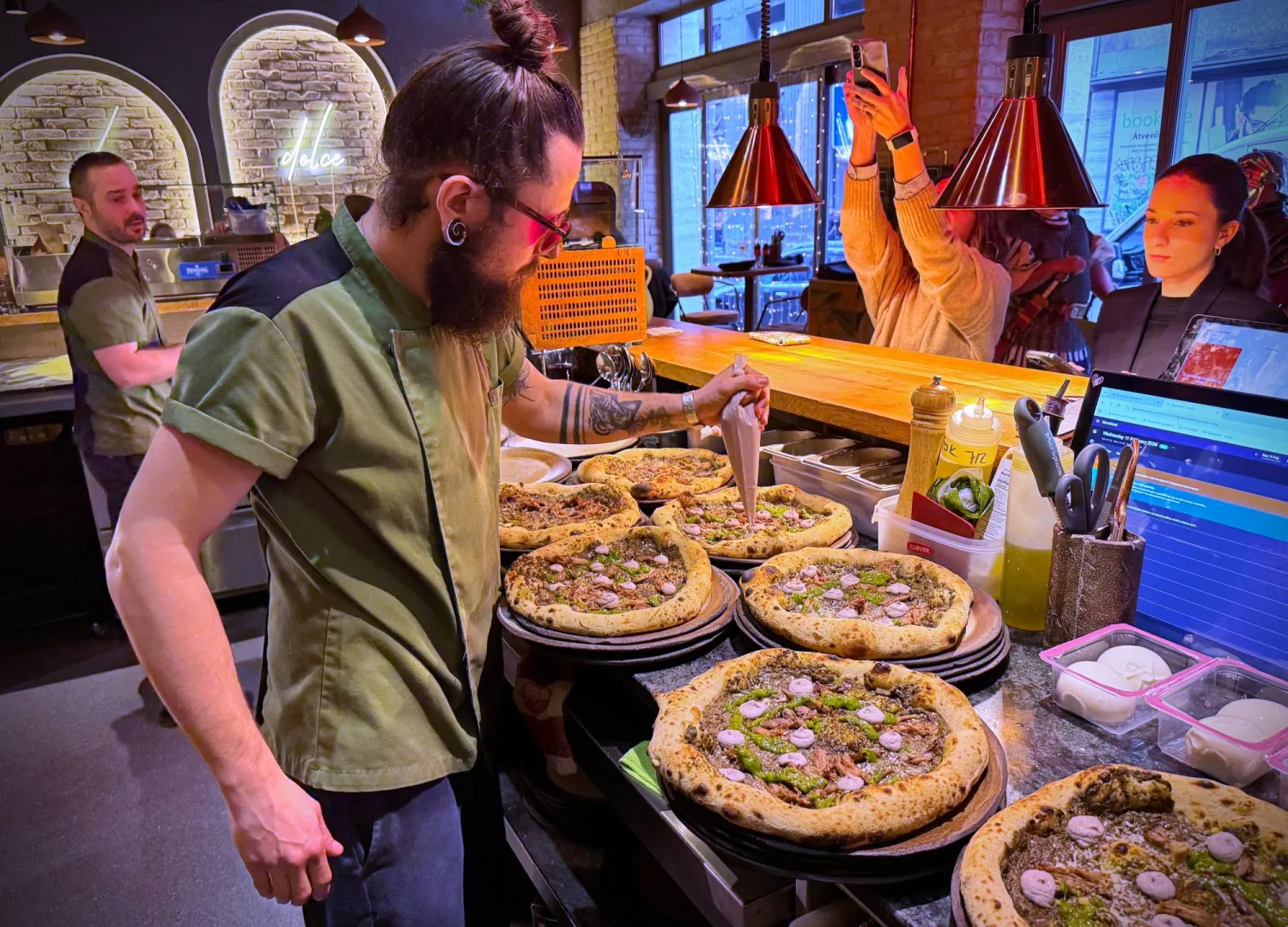

When in Rome: Budapest Pizzeria Offers Time-Travel Twist with Ancient Rome-Inspired Pie

László Bárdossy, head chef of the Neverland Pizzeria adds topping on the restaurant's Roman-era pizza in Budapest, Hungary, on Feb. 11, 2026. (AP)
TT

When in Rome: Budapest Pizzeria Offers Time-Travel Twist with Ancient Rome-Inspired Pie

László Bárdossy, head chef of the Neverland Pizzeria adds topping on the restaurant's Roman-era pizza in Budapest, Hungary, on Feb. 11, 2026. (AP)

In Hungary’s capital, a city best known for its goulash, a pizzeria is inviting diners to travel back two millennia to a time before tomatoes, mozzarella or even the word “pizza” were known in Europe.

At Neverland Pizzeria in central Budapest, founder Josep Zara and his team have created a limited-edition pie using only ingredients that would have been available in ancient Rome, long before what we know today as pizza ever existed.

“Curiosity drove us to ask what pizza might have been like long ago,” Zara said. “We went all the way back to the Roman Empire and wondered whether they even ate pizza at the time.”

Strictly speaking, they did not. Tomatoes arrived in Europe centuries later from the Americas, and mozzarella was as yet unknown. Some histories have it that the discovery of mozzarella led directly to the invention of pizza in Naples in the 1700s.

But Romans did eat oven-baked flatbreads topped with herbs, cheeses and sauces, the direct ancestors of modern pizza, which were often sold in ancient Roman snack bars called thermopolia.

In 2023, archaeologists uncovered a fresco in Pompeii depicting a focaccia-like flatbread topped with what appear to be pomegranate seeds, dates, spices and a pesto-like spread. The image made headlines around the world, and sparked Zara’s imagination.

“That made me very curious about what kind of flavor this food might have had,” he said. “That’s where we got the idea to create a pizza that people might have eaten in the Roman Empire, using only ingredients that were in wide use at the time.”

Zara began researching Roman culinary history, consulting a historian in Germany as well as the ancient cookbook De re coquinaria, thought to have been authored around the 5th century. Following his research, he compiled a list of historically documented ingredients to present to the pizzeria's head chef.

“We sat down to imagine what we might be able to make using these ingredients, and without using things like tomatoes and mozzarella,” Zara said. “We had to exclude all ingredients that originated from America.”

Head chef László Bárdossy said the constraints forced the team into months of experimentation, and a few false starts.

“We had to discard a couple ideas,” Bárdossy said. “The fact that there wasn’t infrastructure like a water system at the time of the Romans made things difficult for us, since more than 80% of pizza dough is water. We had to come up with something that would have worked before running water.”

The solution: helping the dough rise using fermented spinach juice. Ancient grains such as einkorn and spelt, widely cultivated in Roman times, formed the base, and the dough ended up slightly more dense than that of most modern pizzas.

The finished pie is topped with ingredients associated with Roman aristocratic cuisine, including epityrum, an olive paste, garum, a fermented fish sauce ubiquitous in Roman cooking, confit duck leg, toasted pine nuts, ricotta and a grape reduction.

“Our creation can be called a modern pizza from the perspective that we tried to make it comprehensible for everyone,” Bárdossy said. “Although we wouldn’t use all its ingredients for everyday dishes. There is a narrow niche that thinks this is delicious and is curious about it, while most people want more conventional pizza, so it’s not for everyday eating. It’s something special.”

For Zara, the project reflects Neverland Pizzeria’s broader philosophy.

“We’ve always liked coming up with new and interesting things, but tradition is also very important for us, and we thought that these two things together suit us,” he said.

However, he added, there is a modern boundary the restaurant will not cross.

“We do a lot of experimentation with our pizzas. But of course, we definitely do not use pineapple,” he said.



Saudi Arabia: King Abdulaziz Library to Launch 26th Free Reading Festival

The King Abdulaziz Public Library. SPA
TT

Saudi Arabia: King Abdulaziz Library to Launch 26th Free Reading Festival

The King Abdulaziz Public Library. SPA

The King Abdulaziz Public Library, in cooperation with the Riyadh Education Department, will launch its 26th annual Free Reading Festival for public school students on Sunday.

Running from May 10 to 14 in Riyadh, the festival will bring together more than 100 schools, over 1,550 students, and a number of educators and teachers.

It aims to foster a love of reading and learning, expand students’ literary, scientific, and cultural horizons, and encourage teachers to promote independent reading. It will also provide a platform to showcase student talents and strengthen Arabic language skills.

Through initiatives like this festival, the King Abdulaziz Public Library promotes reading through diverse programs and a wide range of books that foster pride in the Kingdom’s heritage.


Qassim's Monday Market Retains Heritage Role as Economic and Cultural Hub

The Monday market in the governorate of Uyun Al-Jiwa. (SPA)
TT

Qassim's Monday Market Retains Heritage Role as Economic and Cultural Hub

The Monday market in the governorate of Uyun Al-Jiwa. (SPA)

The Monday market in the governorate of Uyun Al-Jiwa, north of Qassim Region, stands as one of the oldest traditional weekly markets, enduring through changing times while maintaining its role as a vibrant economic and cultural hub.

The market draws a growing number of visitors from across Qassim and beyond, supported by the governorate’s strategic location.

During a field tour, the Saudi Press Agency observed lively activity throughout the market, with stalls displaying a diverse range of products. These include agricultural goods such as almonds and dried figs; animal products like ghee and milk, for which the region is renowned; as well as handicrafts and natural items such as henna and sidr.

Visitors noted that the market has retained its authentic character, continuing to serve as a vital source of income for small vendors and families working in the cottage industry, reinforcing its role as a key platform for preserving traditional culture while supporting the local rural economy.


Heritage Commission Revives Al-Nasb Heritage District as Abha Cultural Tourism Destination

The district’s significance lies in its unique architectural composition - SPA
TT

Heritage Commission Revives Al-Nasb Heritage District as Abha Cultural Tourism Destination

The district’s significance lies in its unique architectural composition - SPA

Al-Nasb Heritage District in Abha is one of the most prominent living examples of traditional architecture in Aseer Region, preserving its long history and architectural details that embody people’s connection to their local environment and document the social and cultural patterns that have shaped the identity of the place across generations.

The district’s significance lies in its unique architectural composition, where mud and stone buildings stand side by side in visual harmony. They were built using local materials such as stone, clay, and juniper trunks, while the narrow alleyways and closely set buildings give the district a cohesive social character that reflects the spirit of past communities in the region and the close relationship between people and place.

The Heritage Commission has revived the district through an integrated restoration and rehabilitation project aimed at preserving its original elements and enhancing its sustainability, as part of national efforts to protect urban heritage and highlight it as a cultural and tourism asset, SPA reported.

The site is also distinguished by its natural setting, as the district overlooks the banks of Abha Valley and surrounding farms, giving it a distinctive visual and aesthetic dimension. Its narrow passageways and closely set buildings illustrate a traditional urban pattern that strengthens ties among residents and captures the nature of social life in that era.

The district is now a growing destination for culture and tourism in Abha, attracting visitors and heritage enthusiasts who come to explore the details of authentic architecture and learn about the traditional ways of life that have shaped Aseer Region’s identity across generations. The project helps raise awareness of the importance of preserving archaeological sites as a key pillar in forming national memory.

The project is part of the Kingdom’s efforts to protect and effectively manage cultural heritage, in line with the targets of Saudi Vision 2030, which gives special attention to the cultural sector. It seeks to turn heritage sites into vibrant spaces that support cultural tourism and sustainable development while reconnecting society with its historical roots.