


Crews Recover Bodies of 9 Backcountry Skiers Days after California Avalanche

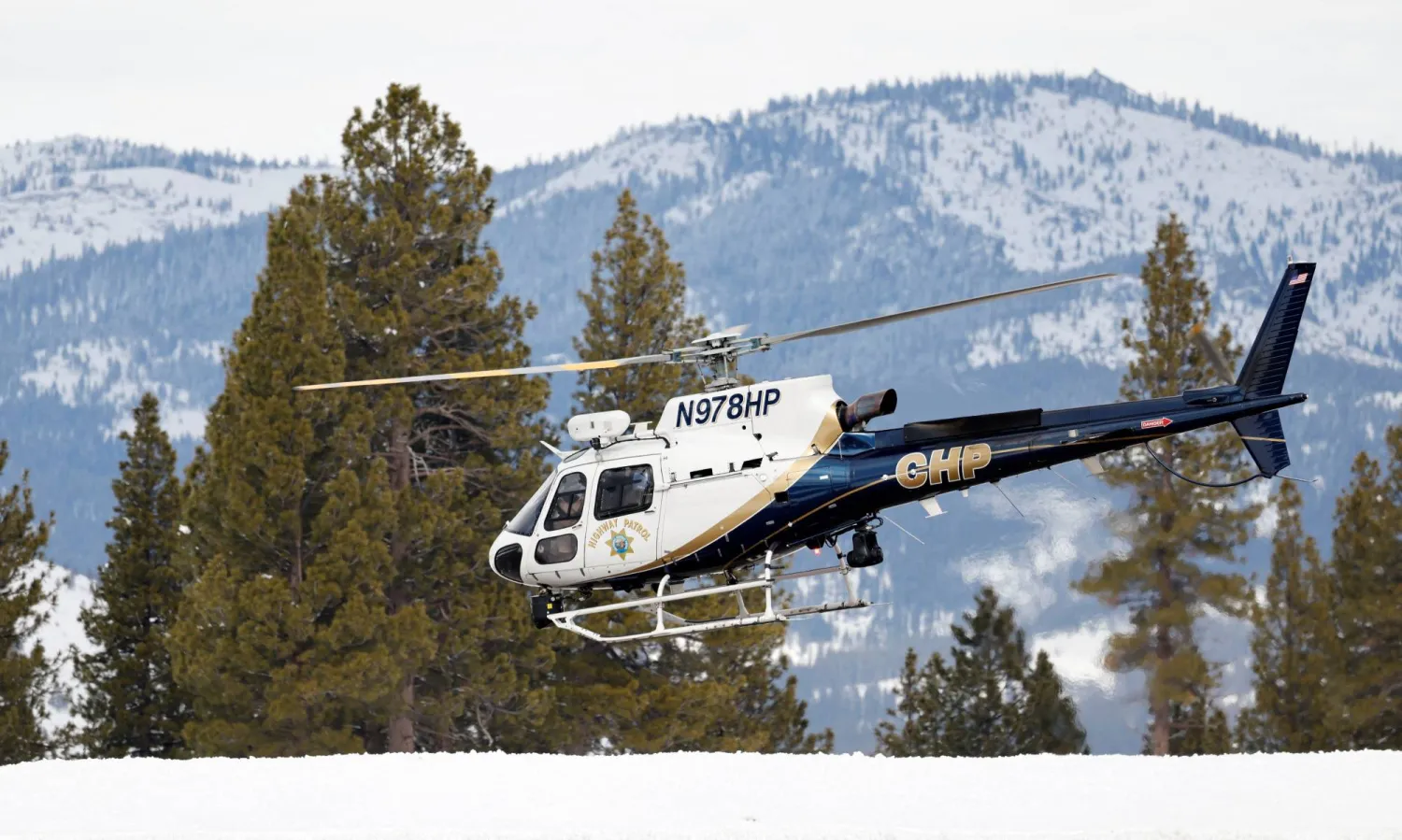
A California Highway Patrol helicopter lifts off from Truckee Tahoe Airport while taking part in recovery efforts for the skiers that died in an avalanche in the Sierra Nevada mountains, in Truckee, California, US February 21, 2026.  REUTERS/Fred Greaves
A California Highway Patrol helicopter lifts off from Truckee Tahoe Airport while taking part in recovery efforts for the skiers that died in an avalanche in the Sierra Nevada mountains, in Truckee, California, US February 21, 2026. REUTERS/Fred Greaves
TT

Crews Recover Bodies of 9 Backcountry Skiers Days after California Avalanche

A California Highway Patrol helicopter lifts off from Truckee Tahoe Airport while taking part in recovery efforts for the skiers that died in an avalanche in the Sierra Nevada mountains, in Truckee, California, US February 21, 2026.  REUTERS/Fred Greaves
A California Highway Patrol helicopter lifts off from Truckee Tahoe Airport while taking part in recovery efforts for the skiers that died in an avalanche in the Sierra Nevada mountains, in Truckee, California, US February 21, 2026. REUTERS/Fred Greaves

Crews recovered the bodies of nine backcountry skiers who were killed by an avalanche in California's Sierra Nevada, authorities said Saturday, concluding a harrowing operation that was hindered by intense snowfall.

A search team reached the bodies of eight victims and found one other who had been missing and presumed dead since Tuesday’s avalanche on Castle Peak near Lake Tahoe. The ninth person who was missing was found “relatively close” to the other victims, according to Nevada County Sheriff’s Lt. Dennis Hack, but was impossible to see due to whiteout conditions at that time.

At a news conference, Sheriff Shannon Moon praised the collective efforts of the numerous agencies that helped recover the bodies — from the California Highway Patrol to the National Guard to the Pacific Gas & Electric utility company — and 42 volunteers who helped on the last day of the operation.

“We are fortunate in this mountain community that we are very tight-knit, and our community shows up in times of tragedy,” The Associated Press quoted Moon as saying.

The sheriff named for the first time the three guides from Blackbird Mountain Company who died: Andrew Alissandratos, 34, Nicole Choo, 42, and Michael Henry, 30.

According to biographies on the company's website, Alissandratos was originally from Tampa, Florida, and moved to Tahoe roughly a decade ago. He enjoyed a wide array of adventure activities, from backcountry exploration to rock climbing.

Henry moved to Colorado in 2016 and then to Truckee three years later. He was described as “laid back” and devoted to sharing his knowledge and love of the mountains with others.

There was no bio for Choo on the website.

“This was an enormous tragedy, and the saddest event our team has ever experienced,” Blackbird Mountain founder Zeb Blais said Wednesday in a statement.

“We are doing what we can to support the families who lost so much,” he said, “and the members of our team who lost treasured friends and colleagues.”

The six other fatal victims were women who were part of a close-knit group of friends who were experienced backcountry skiers and knew how to navigate the Sierra Nevada wilderness, their families said this week.

They were identified as Carrie Atkin, Liz Clabaugh, Danielle Keatley, Kate Morse, Caroline Sekar and Kate Vitt, all in their 40s. They lived in the San Francisco Bay Area, Idaho and the Lake Tahoe area.

“We are devastated beyond words,” the families said in a statement. “Our focus right now is supporting our children through this incredible tragedy and honoring the lives of these extraordinary women. They were all mothers, wives and friends, all of whom connected through the love of the outdoors.”

The families asked for privacy while they grieve and added that they “have many unanswered questions.”

Two of the friends got out alive and were rescued along with four others, including one guide, after Tuesday’s avalanche. Their names have not been released.

The avalanche struck on the last day of the 15 skiers’ three-day tour, when the group decided to end the trip early to avoid the impending snowstorm.

Officials have said the path they took is a “normally traveled route” but declined to specify what that meant.

At around 11:30 a.m. Tuesday, the six survivors called for help, describing a sudden and terrifying slide that was approximately the length of a football field. In the aftermath they discovered the bodies of three fellow skiers, according to Hack.

Rescuers were not able to reach them until roughly six hours after the initial call for help, Hack said, and took two separate paths to arrive. They found five other bodies, leaving only one person unaccounted for.

But it was immediately clear to rescuers that it was too dangerous to extract the bodies at that time due to the heavy snowfall and threat of more avalanches.

Those conditions persisted on Wednesday and Thursday.

A breakthrough on Friday Authorities used two California Highway Patrol helicopters, with the help of Pacific Gas & Electric Company, to break up the snow and intentionally release unstable snowpack to reduce the avalanche risk.

Crews were then able to recover five victims that evening before it got too dark to access the last three.

Rescuers used helicopters and ropes to hoist the last four bodies from the mountain the following morning, fighting through severe winds that forced them to make multiple trips. The bodies were then taken to snowcats — trucks that are outfitted to drive on snow — for further transport.

“We cannot say enough how tremendously sorry we are for the families that have been affected by this avalanche,” Moon said.

Initial reports indicated that at least two of the surviving skiers were not swept away by the avalanche, Hack said. The others were standing separately and relatively close together and were hit.

Hack declined to offer information about what might have set off the avalanche.

Authorities close the area The terrain will be off-limits to visitors until mid-March, said Chris Feutrier, forest supervisor for the Tahoe National Forest. Officials intended to restore public access once the investigation is complete.

“This is the public’s land, and they love to recreate on it,” Feutrier said. “The Forest Service doesn’t close public land for every hazard or every obstacle. We trust the American people to use their best judgment when recreating.”



Sweet Dreams: Seoul Holds ‘Power Nap Contest’ in Sleep-Deprived South Korea

 Participants take a nap during the 2026 Hangang Nap Competition at Yeouido Hangang Park in Seoul, South Korea, Saturday, May 2, 2026. (AP)
Participants take a nap during the 2026 Hangang Nap Competition at Yeouido Hangang Park in Seoul, South Korea, Saturday, May 2, 2026. (AP)
TT

Sweet Dreams: Seoul Holds ‘Power Nap Contest’ in Sleep-Deprived South Korea

 Participants take a nap during the 2026 Hangang Nap Competition at Yeouido Hangang Park in Seoul, South Korea, Saturday, May 2, 2026. (AP)
Participants take a nap during the 2026 Hangang Nap Competition at Yeouido Hangang Park in Seoul, South Korea, Saturday, May 2, 2026. (AP)

Under hazy spring ‌sunshine on Saturday, hundreds of young Seoulites turned up at a park by the Han River at the invitation of the city government to try to do something many overworked South Koreans never get enough of - sleep.

The Seoul Metropolitan Government staged its third annual spring event, dubbed a power nap contest, from 3 p.m. (0600 GMT), under a refreshed set of admission requirements for would-be participants: wear outfits befitting either a sleeping beauty or prince, come tired, with a full belly.

For a metropolis that famously runs on 24-hour shopping malls, competitive hustle ‌and iced Americanos, ‌the underlying exhaustion on the lawn was palpable.

"Between ‌exam ⁠prep and part-time ⁠jobs, I survive on three or four hours of sleep a night, patching it up with desk naps during the day," said Park Jun-seok, who showed up draped in the silken, crimson robes of a Joseon Dynasty monarch.

"I'm here to show off my napping skills, and to demonstrate exactly how a king sleeps," said Park, a ⁠20-year-old university student.

Nearby, Yoo Mi-yeon, 24, an English ‌teacher from Ilsan north of Seoul, stood ‌out in a plush, oversized koala-themed onesie.

"I've always suffered from insomnia, ‌I struggle to fall asleep, and wake up easily," she said. "Koalas ‌are famous for their deep slumber. I came dressed as one hoping to borrow a little of their magic."

Now in its third consecutive year, the sleep competition underscores a chronic issue for South Koreans. Data show South Korea ‌is one of the most overworked and sleep-deprived nations among Organization for Economic Cooperation and Development members, ⁠and, as ⁠a consequence, people have some of the fewest sleep hours.

As the clock struck three and eye masks descended across the park, officials went around to measure participants' heart rate to make sure they had a stable reading - an indicator of deep, peaceful sleep.

The winner of the contest was a man in his 80s.

Hwang Du-seong, a 37-year-old office worker, was a runner-up.

"I was completely drained, having done night shifts often on top of going to work everyday plus I also drive a lot for work. So when I saw the contest I was determined to sleep to fully recharge amid river breeze, and I'm very happy to be placed second place, luckily."


Humpback Whale Stranded in Germany Released into North Sea

01 May 2026, Denmark, Skagen: An aerial view of the the humpback whale towed in its barge by the tugboat Fortuna B along the Danish coast, just south of Skagen in the Skagerrak, through the Baltic Sea. (dpa)
TT

Humpback Whale Stranded in Germany Released into North Sea

01 May 2026, Denmark, Skagen: An aerial view of the the humpback whale towed in its barge by the tugboat Fortuna B along the Danish coast, just south of Skagen in the Skagerrak, through the Baltic Sea. (dpa)

A humpback whale that had been struggling to survive after beaching near the German coast was Saturday released into the North Sea off Denmark after being transported in a barge, a member of a rescue mission said.

Dubbed "Timmy" by the German media, the whale was first spotted stuck on a sandbank on March 23 near the city of Luebeck before freeing itself and then becoming stuck again several times.

The whale left the barge it had been towed on from Wismar Bay on the Baltic coast at around 8:45 am (0645 GMT), said Karin Walter-Mommert from the rescue initiative.

It is now swimming on its own and freely, and at least for the time being, in the right direction, she said.

At the start of April, German officials gave up on trying to rescue the animal, saying they believed it could not be saved.

But this triggered an outcry and authorities were persuaded to approve a privately financed rescue plan proposed by two wealthy entrepreneurs.

The barge idea was hatched after their initial attempt to save the whale with inflatable cushions and pontoons was unsuccessful.

The rescue effort was seen as a long shot and criticized by experts who said it would only cause the animal more distress.

The whale's ordeal has sparked a media frenzy -- with non-stop coverage from TV channels, online outlets and social media influencers -- but has also led to angry spats and conspiracy theories.


US Border Wall Construction Threatens Endangered Wolves, Conservationists Say

Mexican gray wolf cubs, an endangered native species, are seen in their enclosure at the Museo del Desierto in Saltillo, Mexico July 2, 2020. (Reuters)
TT

US Border Wall Construction Threatens Endangered Wolves, Conservationists Say

Mexican gray wolf cubs, an endangered native species, are seen in their enclosure at the Museo del Desierto in Saltillo, Mexico July 2, 2020. (Reuters)

For the first time in decades, a radio-collared endangered Mexican wolf crossed from the US into Mexico last week in New Mexico, a federal official said on Friday, but environmental groups warn the animal may never return due to US border wall construction.

The male wolf crossed into Chihuahua, Mexico, from a remote area of the New Mexico Bootheel, according to Aislinn Maestas, a spokesperson for the US Fish and Wildlife Service, which tracks members of the smallest and rarest subspecies of North American gray wolf, also known by its Spanish name "lobo."

Once common in the Southwestern US and Mexico, the wolf came ‌close to extinction ‌in the 1970s, exterminated by government agencies and ranchers who claimed ‌targeting ⁠the species would protect ⁠livestock.

The wolves have for millennia roamed the Bootheel's grasslands, desert and wooded mountains, traversing the migration corridor in search of prey and mates in what is now Mexico and the US

The administrations of President Donald Trump and former President Joe Biden have built a steel border wall westward across New Mexico to stem the trafficking of migrants and drugs.

Current construction of the 18- to 30-foot-high barrier in the area means last week's wolf border-crossing may be the last ever by ⁠the species, conservationist Michael Robinson said on Friday.

That would exacerbate the ‌wolf's chronic inbreeding, which has led to lower survival ‌rates for pups, as well as cancers and birth defects.

“Sealing off the Bootheel would isolate wolves and ‌other rare mammals like jaguars and ultimately make them all less likely to survive,” Robinson, ‌a senior conservation advocate at the Center for Biological Diversity, said in an interview.

The Department of Homeland Security and its US Customs and Border Protection agency, which are responsible for border wall construction, did not immediately respond to a request for comment.

DIVERSITY PROBLEM

Conservation groups and some US wildlife officials have said expansion ‌of the border wall will fragment habitats and disrupt migration routes in regions such as the Big Bend area of Texas, the ⁠San Rafael Valley ⁠of Arizona and the Otay Wilderness in California.

The Department of Homeland Security has used legal authority to override environmental laws, leading to lawsuits against barriers.

US administrations from both parties have acknowledged environmental risks but argue the barrier is necessary for national security. Officials have incorporated mitigation features like ground-level wildlife openings for small animals such as reptiles and rodents.

In the case of the Mexican wolf, mating between animals from the US and Mexico could increase critically low genetic diversity, said Cyndi Tuell, Arizona and New Mexico director at Western Watersheds Project, a conservation group.

All modern Mexican wolves are descended from just seven wolves that were successfully bred after being captured as part of a binational breeding program started in the late 1970s.

As of this year there are at least 319 wild Mexican wolves in the US, around 36 in Mexico and about 380 in captive breeding programs, according to USFWS and conservation groups.