

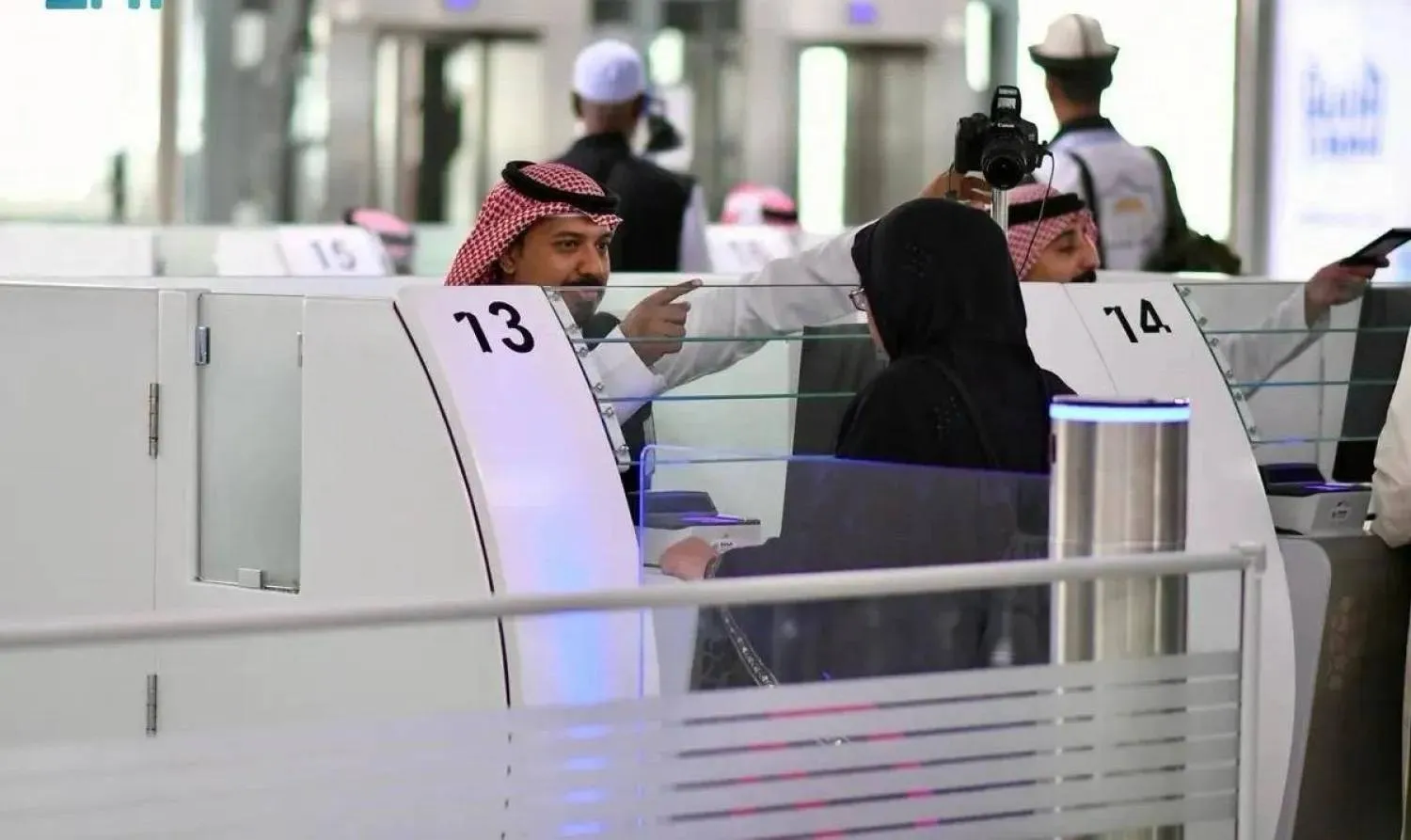

Saudi Passports Boost Readiness for Ramadan Umrah

Professional conduct and swift processing are among the most prominent traits of passport personnel (SPA)
TT

Saudi Passports Boost Readiness for Ramadan Umrah

Professional conduct and swift processing are among the most prominent traits of passport personnel (SPA)

Saudi Arabia’s General Directorate of Passports is leading frontline operations to receive visitors and Umrah performers from around the world during the holy month of Ramadan, serving as the first point of contact in their journeys.

Backed by an integrated operational system combining trained personnel and advanced technology, the directorate is working to ensure smooth transit through international entry points, reflecting the level of institutional transformation underway across the Kingdom’s service and security sectors.

The use of technology and intensive training has helped reduce processing times.

With an expected rise in the number of Umrah performers during the holy month, the Passports Directorate has intensified operational readiness at air, land and sea ports under a plan aimed at cutting processing times, improving service quality and enhancing the pilgrim experience from arrival to departure.

Major Nasser Al-Otaibi, official spokesperson for the General Directorate of Passports, told Asharq Al-Awsat that the directorate is focused on facilitating entry and exit procedures for Umrah performers across all international ports through comprehensive operational plans.

These include deploying trained personnel, providing the latest technical equipment and using advanced electronic systems to speed up travel procedures, with the goal of completing processes smoothly and reducing congestion and waiting times.

Al-Otaibi said the directorate has deployed the latest technologies and smart systems as part of its operational plan for the season, contributing to faster entry and exit procedures and ensuring smooth movement at all ports.

Modern technologies enable travelers to complete procedures independently in record time.

He added that these technologies and systems help shorten processing times and raise service quality. The integrated technical system aims to achieve the highest levels of operational efficiency and enhance the experience of pilgrims, reflecting the development of passport services.

On coordination with other entities, Al-Otaibi said integration between the General Directorate of Passports and other security and service bodies is a key element in improving field performance, especially during high-density seasons such as Ramadan.

He said the directorate operates within an integrated security and service system that includes relevant security and other authorities.

This integration relies on direct technical linkage, facilitating rapid verification of information, accuracy of procedures and timely decision-making.

Advance coordination also helps unify operational plans, distribute human resources and manage passenger flows inside travel halls to ensure smooth movement and reduce waiting times without compromising security.

Al-Otaibi said the joint work reflects the concept of a “single system,” with roles integrated across sectors to achieve a unified goal of efficiently serving pilgrims while enhancing the security and safety of entry points.

On training and reducing processing times, the spokesperson said continuous qualification and training plans for passport personnel have had a direct and tangible impact on the quality of service provided to Umrah performers, particularly during peak periods that require high readiness and swift performance.

He stressed that the directorate is implementing specialized training programs covering regulatory and technical aspects, as well as skills in dealing with a multilingual and multicultural public, in addition to crowd management and working under pressure.

This training enhances personnel’s ability to complete procedures accurately and quickly while maintaining a humane approach in dealing with pilgrims.

Al-Otaibi said the training has yielded measurable results, including shorter processing times, higher pilgrim satisfaction and an effective balance between speed and security requirements, reflecting the professionalism of national cadres serving pilgrims.

Saudi Arabia is currently experiencing a large influx of Umrah performers from abroad, which typically peaks in the final days of Ramadan, along with domestic pilgrims. The current season is expected to record higher numbers compared with the same period in previous seasons, particularly given the strong figures announced in the first days of the month.

On Saturday, 4 Ramadan, the Grand Mosque recorded the highest number of Umrah performers since the start of the month at around 904,000.

Previously, Saudi Arabia announced that the number of visitors to the Two Holy Mosques during Ramadan 2025 reached about 122,286,712 Umrah performers and worshippers.

Of those, more than 16 million were Umrah performers, compared with 75,573,928 worshippers at the Grand Mosque and 30,154,543 worshippers at the Prophet’s Mosque, all of whom were provided services from arrival until departure.



Kuwait Power, Water Desalination Plants Damaged by Iranian Attack

A drone view shows Kuwait City, in the aftermath of strikes by Israel and the US on Iran, in Kuwait, February 28, 2026. (Reuters)
TT

Kuwait Power, Water Desalination Plants Damaged by Iranian Attack

A drone view shows Kuwait City, in the aftermath of strikes by Israel and the US on Iran, in Kuwait, February 28, 2026. (Reuters)

Two Kuwaiti power and water desalination plants were damaged by a drone attack from Iran, the electricity and water ministry said Sunday.

The attack resulted in "significant material damage and the shutdown of two electricity generating units", the ministry said in a post on X, adding there were no deaths or injuries.

Earlier, the Kuwait Petroleum Corporation said a fire broke out in its Shuwaikh oil sector complex, which houses the oil ministry and KPC headquarters, after a drone attack, the Kuwaiti state news agency ‌reported early ‌on Sunday.

Kuwaiti state ‌media, ⁠citing the finance ⁠ministry, said an Iranian drone hit an office complex for government ministries, causing significant material damage but no casualties.

No injuries were ‌reported.

An Iranian drone attack had also caused "significant" damage to a government building in Kuwait City on Saturday evening, a finance ministry statement said, adding there were no reports of deaths or injuries. 

Staff from the several ministries housed in the complex would work remotely on Sunday and visits would be suspended, the statement said. 

The latest attacks come as the US-Israeli war on Iran, how in its sixth week, broadens, with Tehran striking Israel and Gulf Arab states hosting US military installations.

There was no official comment from Iran.


UAE Condemns ‘Acts of Vandalism’ at Its Embassy in Damascus

The UAE Foreign Ministry building in Abu Dhabi. (WAM)
TT

UAE Condemns ‘Acts of Vandalism’ at Its Embassy in Damascus

The UAE Foreign Ministry building in Abu Dhabi. (WAM)

The United Arab Emirates on Saturday condemned what it described as "riots, acts of vandalism, and assaults" outside its embassy and the residence of its head of mission in Damascus.

In a statement, the UAE's foreign ministry called on Syria to uphold its obligations to secure the embassy and its staff, investigate the incident ‌and hold ‌the perpetrators to account.

Syria's foreign ministry said ‌in a statement on Friday evening that it took a "firm and unwavering ⁠stance" ⁠against any attack on or attempt to approach embassies and diplomatic missions.


Iranian Attacks Target Energy Facilities in Kuwait, UAE

Mina al-Ahmadi refinery in Kuwait (KUNA) 
TT

Iranian Attacks Target Energy Facilities in Kuwait, UAE

Mina al-Ahmadi refinery in Kuwait (KUNA) 

Iranian attacks struck key energy infrastructure in Kuwait and the United Arab Emirates on Friday, prompting air defense responses across the Gulf and causing casualties and material damage, authorities said.

In Kuwait, drones targeted the Mina al-Ahmadi refinery as well as a power generation and water desalination plant. In Abu Dhabi, operations were suspended at the Habshan gas facilities after debris fell following a successful interception, officials said. The incident killed an Egyptian resident and injured four others from Egypt and Pakistan, and sparked two fires.

Emirates Global Aluminium said it shut down its Al Taweelah site — one of the world’s largest aluminum production complexes — after it sustained severe damage in what it described as Iranian missile and drone attacks.

The incidents come amid Gulf efforts to repel Iranian strikes targeting energy installations and vital infrastructure, which have caused injuries and limited material damage.

Saudi air defenses intercepted and destroyed 14 drones on Friday, according to defense ministry spokesman Major General Turki al-Maliki.

Kuwait

Kuwait’s defense ministry spokesman Colonel Saud al-Atwan said seven ballistic missiles, two cruise missiles and 26 hostile drones were detected in the country’s airspace over a 24-hour period.

Interior ministry spokesman Brigadier Nasser Bousleib said nine reports of falling debris were recorded in the same period, bringing the total since the start of the Iranian attacks to 649. Warning sirens were activated five times in 24 hours, for a total of 164 activations since the attacks began.

Kuwait Petroleum Corporation said the Mina al-Ahmadi refinery was hit by drones early Friday, causing fires in several operational units. Emergency and firefighting teams were deployed immediately and were working to contain the blaze and prevent it from spreading. No casualties were reported, the company underlined.

It added that precautionary measures were taken to ensure worker safety and protect facilities, and that coordination was ongoing with environmental authorities to monitor air quality. No negative environmental impact had been recorded so far.

The electricity and water ministry said one of its power generation and water desalination plants sustained material damage, according to spokeswoman Fatima Hayat, adding that technical teams were working to maintain operations.

Meanwhile, National Guard spokesman Brigadier Jadaan Fadhel denied reports circulating on social media of a possible radiation leak, saying readings in the country’s airspace and territorial waters remained within normal levels. He told state news agency KUNA that monitoring systems were operating around the clock.

United Arab Emirates

The UAE said its air defenses intercepted 18 ballistic missiles, four cruise missiles and 47 drones launched from Iran on Friday, bringing the totals since the start of the attacks to 475 ballistic missiles, 23 cruise missiles and 2,085 drones.

The defense ministry said the attacks had killed two members of the armed forces and a Moroccan civilian contractor, as well as eight others of various nationalities.

A total of 203 people have been injured since the attacks began, with injuries ranging from minor to severe.

The Abu Dhabi Media Office said authorities dealt with debris falling at the Habshan gas facilities after a successful interception, prompting a temporary suspension of operations and a fire at the site.

It later said an Egyptian resident was killed during the evacuation, while four others — two Egyptians and two Pakistanis — were injured. Two fires broke out but were brought under control by emergency response teams. The office said the incident caused significant damage to facilities, with assessments ongoing.

In a separate incident, debris fell in the Ajban area, injuring six Nepalese residents and five Indians, with one Nepalese sustaining serious injuries.

Emirates Global Aluminium said its Al Taweelah complex in Khalifa Economic Zone Abu Dhabi (KEZAD) suffered severe damage, triggering a full emergency shutdown of operations, including the aluminum smelter, casting facilities, power plant, alumina refinery and recycling plant.

The company said restoring full primary aluminum production could take up to 12 months, depending on damage assessments, while some operations at the alumina refinery and recycling plant may resume earlier.

Bahrain

Bahrain’s National Communication Center said 16 drones targeting the country were intercepted and destroyed over 24 hours, bringing the total since the start of Iranian attacks to 188 missiles and 445 drones.

The Bahrain Defense Force said targeting civilian sites and private property with ballistic missiles and drones constituted a flagrant violation of international humanitarian law and the UN Charter, warning the attacks posed a direct threat to regional peace and security.

Authorities urged residents to remain indoors except when necessary, avoid damaged areas and suspicious objects, refrain from filming military operations or debris sites, and rely on official sources for information.

The interior ministry said four Bahraini citizens sustained minor injuries and homes were damaged in the Sitra area due to falling debris from an intercepted Iranian drone. Civil defense and ambulance services were responding at the scene.

Qatar

Qatar’s defense ministry said the country was targeted by several Iranian drones, all of which were successfully intercepted.

The environment and climate change ministry said air quality remained within normal and safe limits and was being continuously monitored through a nationwide network.

In a post on platform X, the ministry advised precautionary measures during periods of increased fine particulate matter, including staying indoors — especially for vulnerable groups — keeping windows closed, wearing masks when outside and avoiding outdoor activities.