



'Sinners' Wins Top Prize at Screen Actors Guild Awards

Delroy Lindo (L) speaks for the cast of 'Sinners' as they won the top Actor Award for best cast in a motion picture from the Screen Actors Guild. VALERIE MACON / AFP
TT

'Sinners' Wins Top Prize at Screen Actors Guild Awards

Delroy Lindo (L) speaks for the cast of 'Sinners' as they won the top Actor Award for best cast in a motion picture from the Screen Actors Guild. VALERIE MACON / AFP

"Sinners" scooped the top prize at the Screen Actors Guild gala in Los Angeles on Sunday, tightening the race to the Oscars with two weeks to go before Hollywood's awards season finale.

The honor at the newly rebranded Actor Awards recognizes the ensemble cast of a film -- a decision that sometimes, but not always, presages Academy Award best picture glory, AFP said.

Ryan Coogler's vampire fable about America's difficult racial history, has stormed through awards season, garnering a record 16 Oscar nominations.

"We brought our hearts, we brought our souls, we brought our spirits to this endeavor," said Delroy Lindo, who plays blues musician player Delta Slim, as he accepted the award on behalf of the cast.

"This project is anointed. And from that standpoint, we are all anointed to be a part of this incredible journey created by the genius Ryan Coogler."

It was the first time "Sinners" seized a top prize at a pre-Oscars gala, which have so far been largely swept by "One Battle After Another," including at the Producers Guild Awards on Saturday.

Paul Thomas Anderson's "One Battle" is a political thriller starring Leonardo DiCaprio as a pot-addled former revolutionary forced back into the game when his teenage daughter goes missing.

"Sinners" may have had the upper hand with SAG-AFTRA, which represents more than 160,000 members -- but that may not hold true in two weeks' time for the Academy Awards.

"I'm not as confident that it's going to win the best picture Oscar," Scott Feinberg, awards columnist for The Hollywood Reporter, told AFP ahead of the gala, after predicting the SAG award win.

"Those two awards have gone to different films just about as often as they have gone to the same film."

- Jordan bests Chalamet -

Voting for the Academy Awards does not close until Thursday, meaning Sunday's results could be influential.

For best leading male actor, Michael B. Jordan pulled off a surprise win in a category that Timothee Chalamet ("Marty Supreme") has dominated all season.

"I'm so honored and privileged to be nominated in categories with people and actors and humans that I love," he said.

"This ride has been unbelievable."

For best leading female actor, there were no surprises when Jessie Buckley's name was announced.

The Irish actress, who plays the grief-stricken wife of William Shakespeare mourning their son in "Hamnet" has so far won nearly every prize on offer.

"I have been categorically changed by so many people in this room and beyond," an emotional Buckley said.

"To get to work with my heart in my hand and stand beside my brilliant, daring friends who show me their heart -- I mean, what a way to spend a life."

- Unpredictable -

The race for the Oscar for best supporting performers became even cloudier after Sunday's gala.

Amy Madigan took home the statuette for best supporting actress for her role as the sinister aunt in horror flick "Weapons," following her success at the Critics Choice Awards.

"I wasn't expecting this, but it does really mean a lot to me from my peers," she said.

The major awards in this category this season have gone to different people -- the Golden Globe to Teyana Taylor in "One Battle After Another," and the BAFTA to Wunmi Mosaku for "Sinners."

For the men, Sean Penn -- who was not at the ceremony -- won for his wild turn as Colonel Lockjaw in "One Battle After Another," following on from his BAFTA win.

The Critics Choice Awards recognized Jacob Elordi for "Frankenstein," and the Golden Globe went to Stellan Skarsgard in "Sentimental Value," who did not even get a SAG nod.

The television side of the awards was dominated by Apple TV's Hollywood satire "The Studio" which won three statuettes, including a posthumous award for Catherine O'Hara, who died in January.

Series co-creator Seth Rogen, who accepted the award on her behalf, said he felt fortunate to have spent time with the actress -- a Hollywood stalwart known for her work in "Home Alone" and "Schitt's Creek."

"Something that I've just been marveling at over the last few weeks was really her ability to be generous and kind and gracious, while never ever minimizing her own talents," he said.

The evening also honored veteran Harrison Ford with a life achievement award for memorable roles that have included Han Solo in the "Star Wars" franchise and Indiana Jones.

"I feel incredibly grateful for this kind attention. But to be clear, I also am quite humbled," said Ford, whose big break came in George Lucas's "American Graffiti" in 1973.

"I'm in a room of actors, many of whom are here because they've been nominated to receive a prize for their amazing work, while I'm here to receive a prize for being alive," the 83-year-old said to laughs.
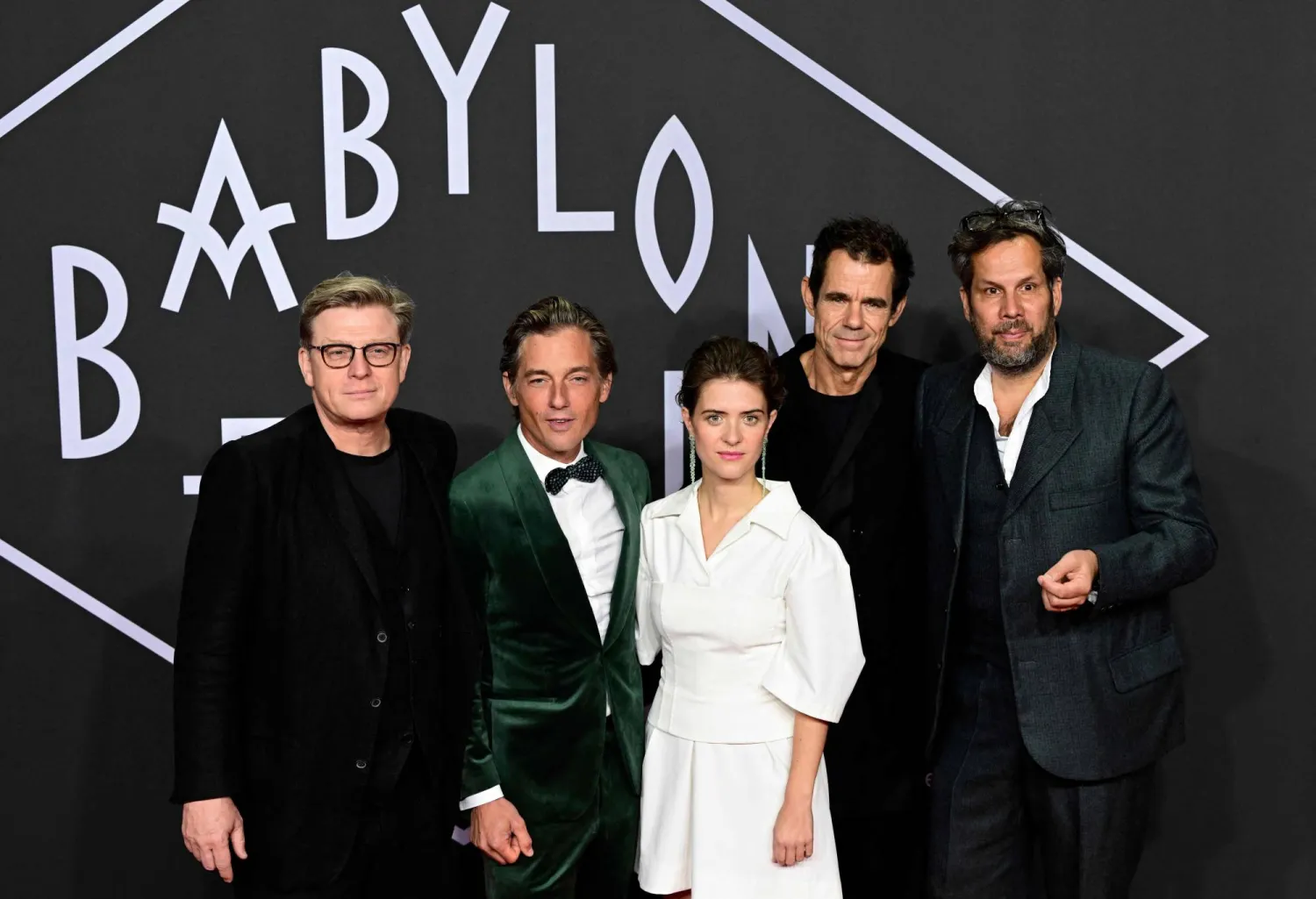


Series Finale of ‘Babylon Berlin’ Offers Dark Mirror for Today’s Germany

German directors and screenwriters Henk Handloegten (L), Tom Tykwer (2ndR) and Achim von Borries (R) and German actor Volker Bruch (2ndL) and German actress Liv Lisa Fries pose on the red carpet upon arrival for the premiere of the "Babylon Berlin" TV series' fourth season, at the Delphi Filmpalast in Berlin on September 20, 2022. (AFP)
TT

Series Finale of ‘Babylon Berlin’ Offers Dark Mirror for Today’s Germany

German directors and screenwriters Henk Handloegten (L), Tom Tykwer (2ndR) and Achim von Borries (R) and German actor Volker Bruch (2ndL) and German actress Liv Lisa Fries pose on the red carpet upon arrival for the premiere of the "Babylon Berlin" TV series' fourth season, at the Delphi Filmpalast in Berlin on September 20, 2022. (AFP)

The hit TV series "Babylon Berlin" has captivated audiences by portraying the chaos and excitement of Weimar-era Germany, but the dark shadow of Adolf Hitler's rise to power will bring down the curtain on the show's upcoming final season.

Season 5 will debut online in Germany at a time when many are fretting about the rise of the far-right Alternative for Germany (AfD) party, which scored a breakthrough victory in a state election last Sunday.

The timing is "pure coincidence," insisted the directors behind the program, Tom Tykwer, Achim von Borries and Henk Handloegten.

But viewers and critics are still certain to draw uncomfortable parallels and resonances in the gritty hit drama from public broadcaster ARD.

Inspired by crime novels from German author Volker Kutscher, the big-budget series is set against the backdrop of the final years of the Weimar Republic, Germany's 14-year experiment in democracy.

The era, sandwiched between the end of World War I and Hitler's ascent, was a period of liberal social attitudes, rapid technological progress and cultural achievement.

But it was also a time of economic hardship, inflation and deep political polarization worsened by the humiliation of military defeat and the Great Depression.

Broadcast in 140 countries, the show chronicles the investigations and romances in Berlin of Gereon Rath -- a young police inspector from Cologne traumatized by World War I -- and his partner Charlotte Ritter, a young Berliner from a modest background who dreams of a career in law enforcement.

- Rise of extremes -

The final run of "Babylon Berlin", which will premiere on Thursday at a red-carpet event in Berlin's famed Zoo Palast cinema, does not yet have an international release date.

Since the show first aired in 2017, the directors have focused the narrative on the final four years of the Weimar Republic, from the global crash of 1929 to Hitler's seizure of power in 1933.

Tykwer, also known for films such as "Run Lola Run" (1998) and "Cloud Atlas" (2012), said the show's creators did not necessarily set out to create a parable of our own times.

"We were drawn to these themes even before the major upheavals in Europe and globally," said Tykwer.

The director said they were surprised when the historical drama began resonating as democracy in Germany and around the world faced a crisis of rising nationalism and mounting voter distrust.

When work on the project began in 2013, the far right had no presence in the German parliament and the AfD had only just been founded as an anti-euro party.

It has since transformed into an anti-immigration party and radicalized, with opponents regularly accusing it of racism, collusion with neo-Nazi extremists and ties with Vladimir Putin's Russia.

The AfD has also steadily grown in popularity, entering parliament in 2017 and finishing second in the most recent national election in February 2025.

The party now routinely leads national opinion polls, well ahead of Chancellor Friedrich Merz's center-right CDU/CSU bloc.

- 'Vulnerability' of democracies -

Tykwer, in an interview with AFP, said "Babylon Berlin" reflects the "vulnerability" of democracies "and how quickly they can be brought to collapse by radical aggression, despite having been built up with such care over such a long period".

"We were drawn to these themes because they touch on something deeper and universal: the struggle between peaceful, empathy-based systems and the forces capable of destroying them."

But Tykwer and von Borries said the show is not intended to deliver any kind of clear message to voters ahead of further regional elections later this month.

But Handloegten expressed pride in having "struck a chord that truly resonates" with viewers around the world who also find themselves -- and their countries -- at a political inflection point.

"I think we took a clear political stance, especially in this final season, and that seems very necessary to me," he said.

For Handloegten, the pressures facing democracy in many countries where the series airs "were truly a source of motivation" during the show's lengthy run.

"I felt there was a contemporary relevance to it, so for me, the work we've been doing here for 13 years is, in a strange way, political."


‘Wallace & Gromit’ Creators Turn 50 with Spook-Tacular Shaun Yarn

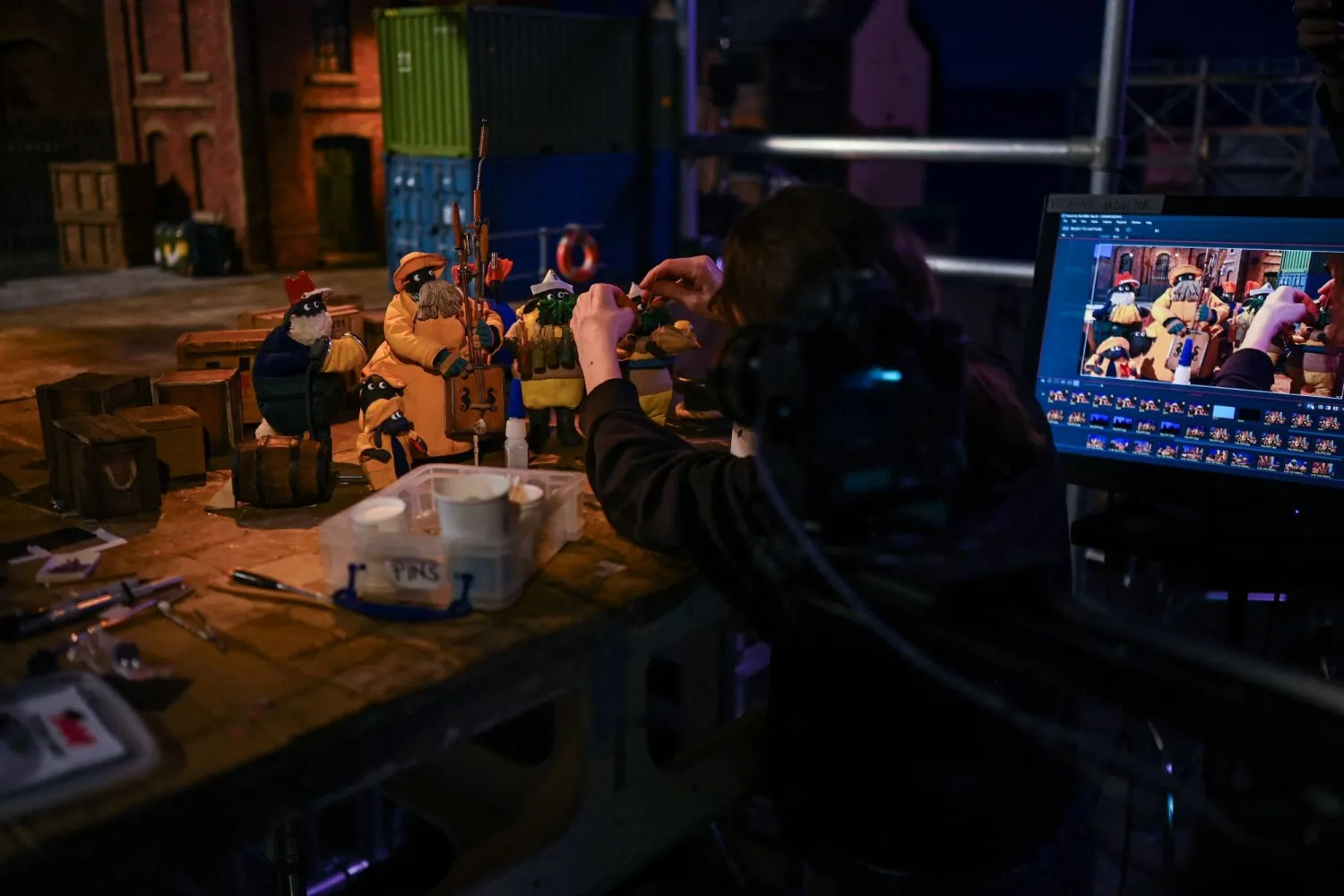
This photo taken on March 4, 2026 shows an employee working on models for "Shaun the Sheep: The Beast of Mossy Bottom" at Aardman Animations studios in Bristol, western England. (AFP)
TT

‘Wallace & Gromit’ Creators Turn 50 with Spook-Tacular Shaun Yarn

This photo taken on March 4, 2026 shows an employee working on models for "Shaun the Sheep: The Beast of Mossy Bottom" at Aardman Animations studios in Bristol, western England. (AFP)

Crochet hook in hand, the animator slightly raises the eyelid of a clay model sheep in a filmmaking technique as old as cinema, perfected over five decades by Aardman Animations.

In the basement of the Bristol-based company -- whose beloved characters such as Wallace and Gromit have won them four Oscars -- designers have been working for the past three-and-a-half years on the latest adventure in their "Shaun the Sheep" series.

"Shaun the Sheep: The Beast of Mossy Bottom" is the third full-length film starring the mischievous, savvy sheep, due to be released on September 18 in UK cinemas.

This time Shaun and his flock have to work together to save Halloween from a fur-raising creature terrorizing their farm's pumpkin patch.

The film marks the 50th anniversary of Aardman, founded in Bristol in 1976 by Peter Lord and David Sproxton who went to school together and used to make models on a kitchen table.

In the dim light of Aardman's basement, about 40 small rooms with a blue background have been set up, with curtains concealing puppet-sized scenes from the film.

One curtain opens to reveal Mossy Bottom farm and its autumnal colors, another a mad science lab, while behind yet another is a black and red fishing boat.

In the world of sophisticated digitalized animations and computer graphics, Aardman stands out for its painstaking handcrafted "stop-motion" technique, which dates back to the late 19th century.

"Our aim as animators is to make people think these puppets are alive," said animation director Claire Rolls.

"Nowadays, there's not a lot of places in the world doing stop-motion animation."

- 'Spare arms and ears' -

In a docklands scene, Rolls, who joined the company in 1998, was working with team member Ed Jackson setting up camera shots.

The sheep, wearing yellow rain jackets, are trying to attract the attention of a crew of sailors, Rolls explained.

The animator gets down to work, eyes fixed on a screen that alternates between the shot he's preparing and the previous frame.

To create the illusion of movement, he raises one sheep's head, lowers another's legs, and clicks the camera once the shot is ready.

After two days of this patient, exacting work, he will have filmed about two seconds of footage, each second made up of 24 frames.

The complete film is made up of more than 100,000 of these painstakingly created stop-motion frames.

The creatures that populate the studio's productions are created upstairs, in the puppet department.

After first appearing in 1995 in "Wallace & Gromit: A Close Shave", Shaun has become one of the studio's icons.

He is now the hero of a television series, shown in 170 countries, and two previous films, and has attracted a huge social media following.

Amid a jumble of drawings and materials, Kate Anderson, the head of the puppet department, pulls out a box filled with interchangeable parts -- a mouth closed, a jaw dropped, or rounded in an "O" of surprise.

Such parts help animators to illustrate different "sounds and expressions" for Bitzer, the long-suffering sheepdog.

The puppet makers "stick with clay for really expressive areas of the puppet, like the face," said Anderson, even if sometimes silicon is used to make the characters' bodies.

That material is more resistant when applied to a metal frame, she said, with the figures nailed in place to avoid any continuity errors.

"Because animators are touching puppets all day long, they do break quite easily," she said.

"We always know that we need to have a big stock of spare sheep arms and ears."

- 'Quirky, fun' -

"The animation is like a live performance," said co-director Steve Cox.

It is different to computer-generated images and two dimensional or 2D ones as "you can't really go back and change things once you've done it".

Filming is done in silence and sound added later, but that doesn't stop its "very British" humor, kind of "quirky and fun", from shining through.

"We do use digital effects in our films, but they're an embellishment to... the hand-crafted work," said producer Richard Beek.

Artificial intelligence has not been used for this latest Shaun movie, he said.

Aardman's playful, imaginative clay figures are instantly recognizable, from the pumpkins to Shaun's mad-scientist glasses.

The release of Disney's "Toy Story" in 1995 caused concern, as with AI, that "we're going to make films now on computers" and there would no longer be any place for stop-motion.

"But what's happened is we've continued to make films," Beek said.

"The whole world changes around us, but there's lots of things that stay the same at Aardman, and maybe that's partly what people like... there's a familiarity to it."


For Sandra Bullock and Nicole Kidman, ‘Practical Magic 2’ Heals Old Wounds

 US-Australian actress Nicole Kidman attends the US premiere of "Practical Magic 2" at Directors Village theater in Los Angeles, on August 31, 2026. (AFP)
US-Australian actress Nicole Kidman attends the US premiere of "Practical Magic 2" at Directors Village theater in Los Angeles, on August 31, 2026. (AFP)
TT

For Sandra Bullock and Nicole Kidman, ‘Practical Magic 2’ Heals Old Wounds

 US-Australian actress Nicole Kidman attends the US premiere of "Practical Magic 2" at Directors Village theater in Los Angeles, on August 31, 2026. (AFP)
US-Australian actress Nicole Kidman attends the US premiere of "Practical Magic 2" at Directors Village theater in Los Angeles, on August 31, 2026. (AFP)

Sandra Bullock and Nicole Kidman view “Practical Magic” very differently today than they did when they made it 28 years ago.

In 1998, the film received mixed reviews and had a modest box office performance. It has since become a cult favorite, embraced by a new generation who found the romantic comedy through social media clips.

The two Oscar winners are returning to their roles of witchy sisters Sally and Gillian Owens in “Practical Magic 2,” in theaters on Sept. 10, giving them a chance to reckon with the original’s rocky reception and its unlikely second life.

Both films trace their roots to Alice Hoffman’s novels: “Practical Magic,” published in 1995, inspired the original film, while her 2021 novel “The Book of Magic” expands the Owens family’s story and provides inspiration for the sequel.

Bullock recalls a promotional push for the original film that became memorable for the wrong reasons.

“I had so much trauma from the press junket from the first one because it was brutal,” Bullock recalls. “We were not well-received because we were ‘too much,’ ‘too witchy,’ ‘too many women,’ ‘too many tones.’ I’m like, ‘Have you lived a day in a life as a woman?’”

“We didn’t stumble, but it stumbled, but it didn’t really stumble. Maybe it needed to marinate a little bit. We were marinating,” said Bullock. “But here we are, and how lucky are we that we’re still here to be able to go reap the benefits and the rewards of our work?”

The movie eventually found the audience it had missed in theaters, and Bullock said she realized there had been a reappraisal about six years ago.

“I was still harboring so much shame,” she said. “I was like, ‘the things that were said, I’m sorry, we thought we were doing something nice.’ And turns out we did. It was just 28 and change years too early.”

For Kidman, the film’s resurgence became personal.

“People started just coming into my life who would go, 'You want to know what my favorite film of yours is? ‘Practical Magic.’ And suddenly I was like, ‘What? Wow, OK,’” she said.

When it came time to make the sequel, Bullock sat down with her children and their friends to watch the original.

“I wanted fresh eyes,” she said. “Because we were embarking on the new chapter, the new baby witches coming in. I wanted to understand it from a point of view I didn’t have. I wanted to see what they had to say.”

As producers, Bullock and Kidman also faced the practical realities of mounting a legacy sequel on a budget. Among the challenges was recreating one of the original film’s most recognizable elements: the Owens house.

The production rebuilt the house on a London back lot as a full structure, rather than the temporary exterior shell used for the original film.

“It was an incredibly tough fiscal time. We were hedging the dollar,” Bullock said. “We’re not a big superhero film, so you don’t get the luxury of a big price tag.”

Kidman added: “And we also knew the responsibility of bringing it in on a certain price because then you go, 'OK, we can breathe a bit,'” she said. “I think when a budget blows out, you’re like, ‘Oh my gosh, the stress.’ And we don’t need any more stress in our lives. It’s stressful enough.”

The sequel continues the story of the younger generation of Owens women, with Joey King and Maisie Williams playing Kylie and Antonia Owens, the daughters of Sally.

“I really appreciate that it’s like a passing of the baton. I think it’s beautiful,” King said. “It just felt like we were stepping into their world and doing this with them, and it’s a real gift and honor to be considered the people who are taking the batons.”

Producer Denise Di Novi, who also produced the original and cast King in her first leading role in 2010's “Ramona and Beezus,” said the new characters could carry the story forward.

“We would love to make a third one, and I think there’s so much more to do with Kylie and Antonia,” she said. “At the end of the movie, spoiler alert, but you kind of feel like the Sally and Gillian characters are kind of the elder aunts, you know, and Kylie and Antonia are the ones launching off into the world as witches.”

Williams is also hoping to expand on the younger Owens women’s story: “We’re so there for it. There’s so much more of ‘Book of Magic’ that we didn’t get to explore,” she said.