


Trump Says He Ordered Iran Strikes to Thwart Tehran’s Nuclear, Missile Programs

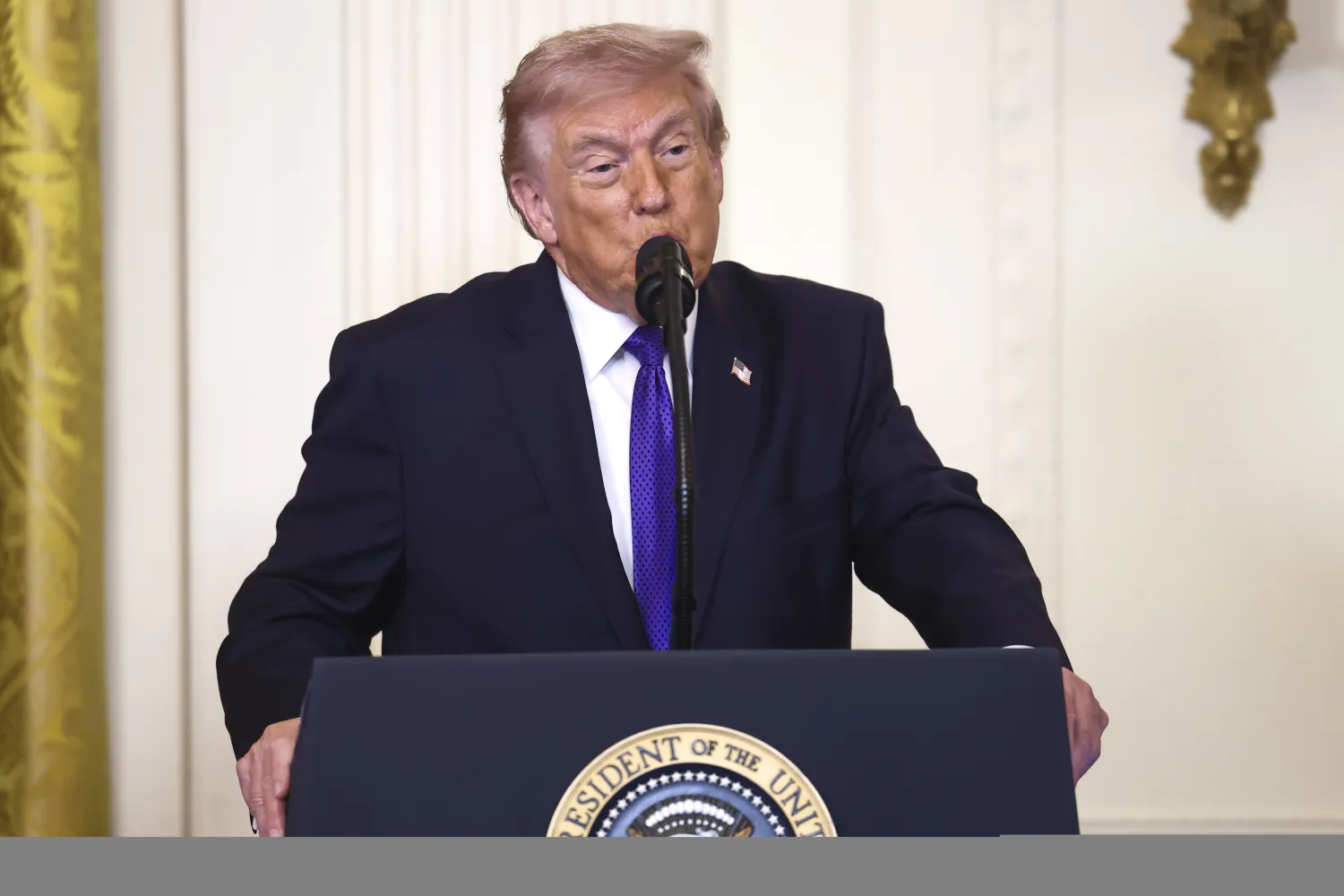
US President Donald Trump delivers remarks during a ceremony to award the medal of honor to Master Sgt. Roderick "Roddie" W. Edmonds, Staff Sgt. Michael H. Ollis, and retired Command Sgt. Maj. Terry P. Richardson in the East Room of the White House in Washington, DC, USA, 02 March 2026. (EPA)
TT

Trump Says He Ordered Iran Strikes to Thwart Tehran’s Nuclear, Missile Programs

US President Donald Trump delivers remarks during a ceremony to award the medal of honor to Master Sgt. Roderick "Roddie" W. Edmonds, Staff Sgt. Michael H. Ollis, and retired Command Sgt. Maj. Terry P. Richardson in the East Room of the White House in Washington, DC, USA, 02 March 2026. (EPA)

US President Donald Trump said on Monday he had ordered the attack on Iran to thwart Tehran's nuclear development and a ballistic missile program that he said was growing rapidly. 

Trump offered his most extensive comments about the war beyond two video messages and a series of brief phone interviews with reporters over the weekend that offered sometimes conflicting objectives in the conflict. 

He said, without providing evidence, that the threat from Iran had been imminent. 

"This was our last best ‌chance to strike ... ‌and eliminate the intolerable threats posed by ‌this ⁠sick and sinister ⁠regime," he said at an event in the White House East Room. 

Trump said military operations were ahead of schedule, without providing details. He said he had projected the US campaign would last four to five weeks but that it could go longer. 

A central premise of the fight was to ⁠prevent Iran from developing a nuclear weapon, which ‌Tehran has denied doing, and thwart ‌its long-range ballistic missile program, Trump said. 

"An Iranian regime armed ‌with long-range missiles and nuclear weapons would be an intolerable ‌threat to the Middle East, but also to the American people," Trump said. 

Trump said US forces had knocked out 10 Iranian ships - "they're at the bottom of the sea" - and expressed ‌confidence about how the campaign was going. 

"Today, the United States military continues to carry out large-scale, ⁠combat operations ⁠in Iran to eliminate the grave threats posed to America by this terrible, terrorist regime," Trump said. 

He said the objectives of the war included destroying Iran's missile capabilities, annihilating their navy and stopping from them from having a nuclear weapon. 

Trump said a third objective was a long-standing US goal, to prevent Iran from supporting militant groups elsewhere in the region. 

Trump noted the loss of four American service personnel in the fight so far, adding: "In their memory, we continue this mission with ferocious, unyielding resolve to crush the threat this terrorist regime poses to the American people." 

- Ground troops -  

Earlier, Trump said he is not ruling out sending US troops into Iran, while threatening a new, "big wave" of attacks.  

The 79-year-old Republican has long campaigned against decades of US military entanglements in the Middle East, but ordered a large-scale war against Iran starting Saturday.  

While so far the assault has focused entirely on aerial attacks by missiles and bombs, Trump refused to rule out sending ground troops -- something generally considered to be far riskier in terms of possible casualties.  

"I don't have the yips with respect to boots on the ground -- like every president says, 'There will be no boots on the ground.' I don't say it," Trump told the New York Post in one of numerous brief interviews he has given since launching the Iran operation.  

"I say 'probably don't need them,' [or] 'if they were necessary,'" he said.  

Trump also spoke to CNN on Monday, flagging what he said would be an escalation in the assault on Iran.  

"We haven't even started hitting them hard. The big wave hasn't even happened," he told CNN, without elaborating. "The big one is coming soon."  

US and Israeli forces have so far struck hundreds of targets across Iran, including the country’s missiles, navy and command-and-control sites.  

Four US military members have been announced killed and three fighter jets have been shot down -- officially in friendly fire.  

Iran has fired missiles at Israel, at US bases around the region and also at targets in regional Arab countries -- Bahrain, Jordan, Kuwait, Qatar and the United Arab Emirates -- something that Trump called "the biggest surprise." 

Trump's comments came shortly after Defense Secretary Pete Hegseth also signaled that deploying troops inside Iran had not been ruled out.  

Asked if there were already boots on the ground, Hegseth told a news conference: "No, but we're not going to go into the exercise of what we will or will not do."  

"We'll go as far as we need to go," he said.  

As for how long the war will last, Hegseth said: "Four weeks, two weeks, six weeks, it could move up. It could move back."  

He sought to differentiate the Iran operation from past long-running US wars in Iraq and Afghanistan, saying the war is not an effort to build democracy in Iran.  

"No stupid rules of engagement, no nation building quagmire, no democracy-building exercise. No politically correct wars. We fight to win and we don't waste time or lives," the Pentagon chief said.  

"This is not Iraq. This is not endless," Hegseth said. "Our generation knows better and so does this president. He called the last 20 years of nation building wars 'dumb' and he's right."  

General Dan Caine, the top US military officer, spoke alongside Hegseth, saying that air superiority had been achieved over Iran.  

Strikes by American forces "resulted in the establishment of local air superiority. This air superiority will not only enhance the protection of our forces, but also allow them to continue the work over Iran," Caine said. 


Russia Evacuates 198 Workers from Iran Nuclear Plant Amid Airstrike

Rosatom State Atomic Energy Corporation Director General Alexey Likhachev arrives to attend the talks between Russian President Vladimir Putin and Armenian Prime Minister Nikol Pashinyan at the Kremlin in Moscow, Russia, 01 April 2026. (EPA/Pavel Bednyakov/AP Pool)
TT

Russia Evacuates 198 Workers from Iran Nuclear Plant Amid Airstrike

Rosatom State Atomic Energy Corporation Director General Alexey Likhachev arrives to attend the talks between Russian President Vladimir Putin and Armenian Prime Minister Nikol Pashinyan at the Kremlin in Moscow, Russia, 01 April 2026. (EPA/Pavel Bednyakov/AP Pool)

Russia started a planned evacuation of 198 workers from Iran's Bushehr atomic plant shortly after a US-Israeli projectile hit near the facility, Russian state media said on Saturday.

This was a third evacuation from the facility in southern Iran on the Gulf coast, which was built with Moscow's help, with about 100 Russian staff remaining there by now.

The area around Bushehr has been struck four times during this war. The latest attack on Saturday saw one person -- a guard at the facility -- killed, but did not damage the plant itself, according to Iranian state media.

"As planned, we began the main phase of the evacuation today," Russia's nuclear agency Rosatom head Alexey Likhachev was quoted as saying by Russia's TASS news agency.

"About 20 minutes after that ill-fated strike, buses set off from Bushehr station towards the Iranian-Armenian border (with) 198 people, to be precise -- this is the largest evacuation," he added.

Likhachev also said that Russia informed the US and Israel about the evacuation.

"The likelihood of a risk of damage or a potential nuclear incident is, unfortunately, only increasing, as has been confirmed by this morning's events," the Rosatom CEO said.

The agency plans to keep only a skeleton staff at Bushehr amid the threat of further strikes.

The Russian foreign ministry slammed the "evil" US-Israeli attack and urged a cessation of hostilities on Iranian nuclear facilities immediately.


Erdogan Says Middle East War Has Caused ‘Geostrategic Impasse’

This handout photograph taken and released by the Turkish presidential press service on April 4, 2026, shows Türkiye's President Recep Tayyip Erdogan (R) welcoming and shaking hands Ukraine's President Volodymyr Zelensky (L) upon arrival for a bilateral meeting on security at Dolmabahce Presidential Office, in Istanbul. (Turkish Presidential Press Service / AFP)
TT

Erdogan Says Middle East War Has Caused ‘Geostrategic Impasse’

This handout photograph taken and released by the Turkish presidential press service on April 4, 2026, shows Türkiye's President Recep Tayyip Erdogan (R) welcoming and shaking hands Ukraine's President Volodymyr Zelensky (L) upon arrival for a bilateral meeting on security at Dolmabahce Presidential Office, in Istanbul. (Turkish Presidential Press Service / AFP)

Türkiye's President Recep Tayyip Erdogan said the war in the Middle East had led to a "geostrategic impasse", during a telephone conversation with NATO chief Mark Rutte, his office said Saturday.

"President Erdogan said the process started by the intervention against Iran had led to a geostrategic impasse and that the international community had to redouble its efforts to bring an end to this war," said the statement.

Türkiye has attempted to mediate an end to the hostilities, notably through negotiations conducted with Pakistan and Egypt.

Erdogan said his country was also continuing efforts "to reach a peaceful outcome" to the conflict between Russia and Ukraine.

Ukrainian President Volodymyr Zelensky arrived in Istanbul Saturday for talks with Erdogan.

A senior Ukrainian official told AFP that the talks would not only be about drone interceptors but also about security cooperation in general.

The Turkish presidency said on X that the talks would focus "efforts towards a ceasefire and a lasting solution."


Several Injured in Israel by Iran Missile Fire

A picture shows the damage at a factory that got hit by a missile in Petah Tikva, east of Tel Aviv, on April 3, 2026. (AFP)
TT

Several Injured in Israel by Iran Missile Fire

A picture shows the damage at a factory that got hit by a missile in Petah Tikva, east of Tel Aviv, on April 3, 2026. (AFP)

Israeli emergency services said its crew treated five people who were injured Saturday in Tel Aviv and surrounding areas after Iran fired several rounds of missiles toward Israel.

Since midnight, seven waves of Iranian missiles have been launched towards Israel, according to the Israeli military.

Israel's Magen David Adom emergency services said a 45-year-old man was treated for minor injuries from glass shrapnel in the central city of Bnei Brak and taken to hospital.

As the day progressed, rescue teams said they had treated three additional casualties -- two men in their 20s hit by glass fragments and one injured by blast.

A 52-year-old man "lightly injured by the blast wave" was also transferred to a hospital in Ramat Gan, in central Israel, the emergency service said.

In a residential neighborhood of Ramat Gan, AFP images showed the top floor of a house completely blown out, exposing its gutted interior, with a crushed bookcase and an exercise bike amid the debris.

Numerous impact marks were visible on the walls.

Nearby, another home was largely destroyed, stripped of its outer walls, according to AFP photographs.

"All this is from shrapnel," Joy Frankel, a social worker told AFP near one of the impacted sites.

According to several local media outlets, including The Times of Israel, a cluster munition missile fired from Iran on Saturday morning landed near the Kirya military base in Tel Aviv, not far from the defense ministry.

The military said its air defenses were working to down missiles fired from Iran, each a time it announced incoming projectiles.

Since February 28, the United States and Israel have conducted joint strikes against Iran, prompting the Tehran to retaliate with daily missile barrages targeting Israel and several neighboring countries across the region.
