


Trump Says US-UK Relationship ‘Not Like It Used to Be’

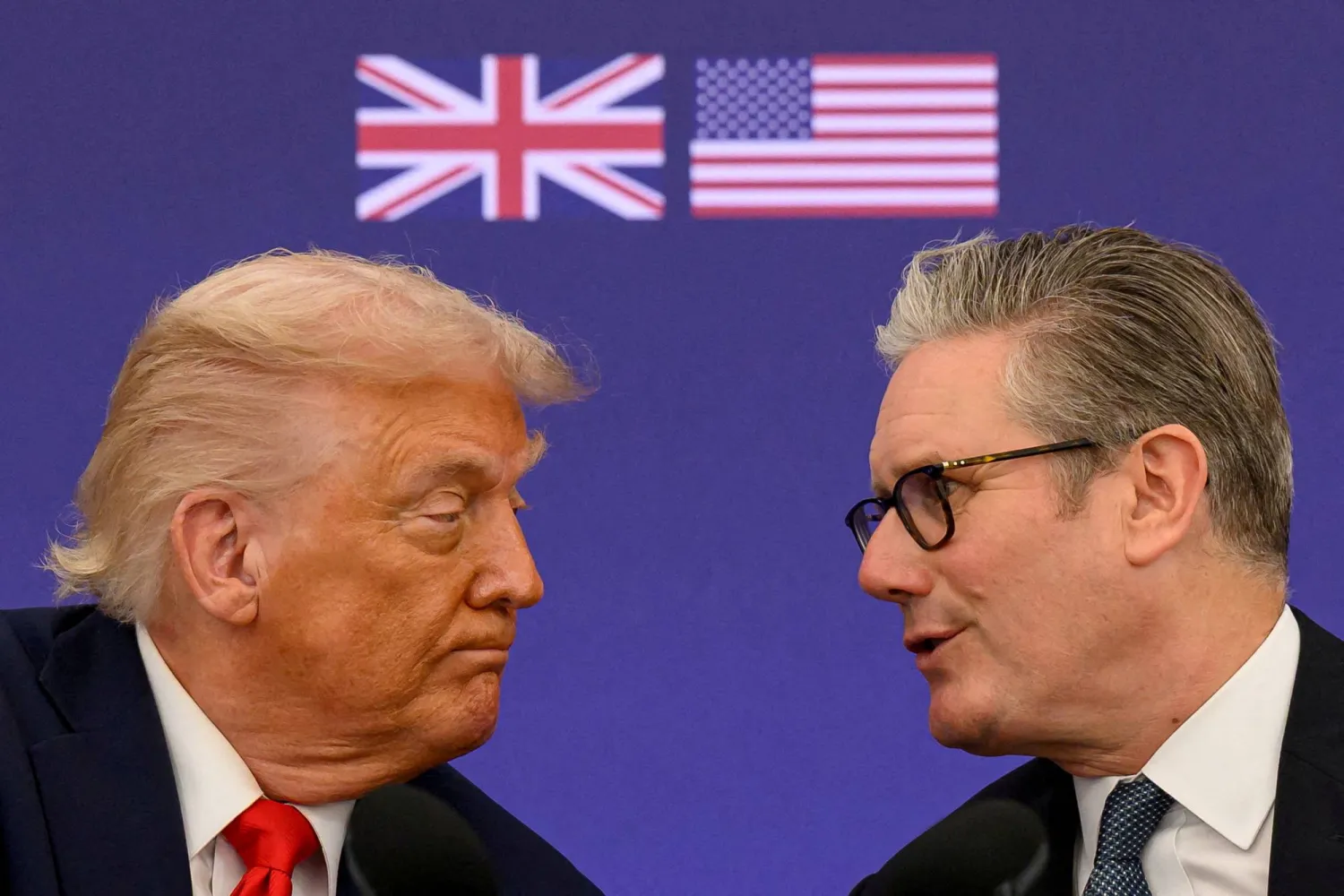
US President Donald Trump and British Prime Minister Keir Starmer announce an agreement between the two countries as they hold a press conference at Chequers at the conclusion of a state visit on September 18, 2025, in Aylesbury, Britain. (Reuters)
TT

Trump Says US-UK Relationship ‘Not Like It Used to Be’

US President Donald Trump and British Prime Minister Keir Starmer announce an agreement between the two countries as they hold a press conference at Chequers at the conclusion of a state visit on September 18, 2025, in Aylesbury, Britain. (Reuters)

US President Donald Trump said the historical relationship between his country and Britain was "not like it used to be", in an interview to British daily newspaper The Sun, amid a major transatlantic fall out over US-Israeli strikes against Iran.

"This was the most solid relationship of all. And now we have very strong relationships with other countries in Europe," he said, singling out France and Germany, after UK Prime Minister Keir Starmer's initial refusal to allow the United States to use British military bases in its war with Iran.

Trump said Starmer "has not been helpful", adding: "I never thought I'd see that. I never thought I'd see that from the UK. We love the UK."

In a telephone interview from the White House on Monday evening, Trump said: "This was the most solid relationship of all. And now we have very strong relationships with other countries in Europe."

"It's a different world, actually. It's just a much different kind of relationship that we've had with your country before.

"It's very sad to see that the relationship is obviously not what it was," he added.

The scathing comments come a day after Trump described Starmer's reaction as "very disappointing" in an interview with The Daily Telegraph.

He added that Starmer's later decision to allow the use of UK bases on specific grounds as "useful" but said it "took far too much time".

Any potential military action in the Middle East is politically sensitive in the UK following former prime minister Tony Blair's disastrous support for the US-led invasion of Iraq.

- 'National interest' -

Starmer defended his position to parliament on Monday.

"President Trump has expressed his disagreement with our decision not to get involved in the initial strikes, but it is my duty to judge what is in Britain's national interest," he told lawmakers.

"That is what I have done and I stand by it," he added.

After initially refusing to have any role in the strikes, Starmer on Sunday announced that he had agreed to a US request to use British military bases for a "specific and limited defensive purpose".

His Downing Street office said Starmer took the decision after Iran fired missiles over the weekend that put British interests and people "at risk".

"We all remember the mistakes of Iraq, and we have learnt those lessons. Any UK actions must always have a lawful basis and a viable thought-through plan," he added in parliament.

The prime minister also said that British military bases in Cyprus "are not being used by US bombers" during the US-Israeli war with Iran.

Britain's Akrotiri air force base on Cyprus came under attack by an unmanned Iranian drone that hit the base's runway early on Monday.

Starmer said the strike "was not in response to any decision that we have taken," adding that the British government believed the drone "was launched prior to our announcement".

Iran's approach is becoming "more reckless and more dangerous", Starmer said.

"They are working ruthlessly and deliberately through a plan to strike, not only military targets, but also economic targets in the region, with no regard for civilian casualties. That is the situation we face today and to which we must respond," he added.



Pentagon Identifies First US Soldiers Killed in Iran War

A combination image of undated photos shows US Army Reserve Captain Cody A. Khork, 35, of Winter Haven, Florida, US Army Reserve Sgt. 1st Class Noah Tietjens, 42, of Bellevue, Nebraska, US Army Reserve Sgt. 1st Class Nicole Amor, 39, of White Bear Lake, Minnesota, and US Army Reserve Sgt. Declan Coady, 20, of West Des Moines, Iowa, who were killed March 1, 2026, at the Port of Shuaiba, Kuwait during a drone attack. Reuters
TT

Pentagon Identifies First US Soldiers Killed in Iran War

A combination image of undated photos shows US Army Reserve Captain Cody A. Khork, 35, of Winter Haven, Florida, US Army Reserve Sgt. 1st Class Noah Tietjens, 42, of Bellevue, Nebraska, US Army Reserve Sgt. 1st Class Nicole Amor, 39, of White Bear Lake, Minnesota, and US Army Reserve Sgt. Declan Coady, 20, of West Des Moines, Iowa, who were killed March 1, 2026, at the Port of Shuaiba, Kuwait during a drone attack. Reuters

The US military on Tuesday identified four of the first American soldiers killed in the war against Iran as the Trump administration warned the intensifying conflict would lead to more American casualties.

Among six US military deaths so far, the four soldiers were members of an Iowa unit of the US Army Reserve. They died on Sunday when a drone slammed into a US military facility in Port Shuaiba, Kuwait, the US military said on Tuesday. The Pentagon said four ranged in age from 20 to 42 and served in the 103rd Sustainment Command from Des Moines, Iowa, part of the Army's ⁠global logistics and ⁠supply operation.

The military identified the four US Army Reserve soldiers as:
* Captain Cody A. Khork, 35, of Winter Haven, Florida
* Sergeant 1st Class Noah L. Tietjens, 42, of Bellevue, Nebraska
* Sergeant 1st Class Nicole M. Amor, 39, of White Bear Lake, Minnesota
* Sergeant Declan J. Coady, 20, of West Des Moines, Iowa
Major General Todd Erskine, who leads the 79th Theater Sustainment Command, in a statement extended "my deepest sympathy and my respect" ⁠to relatives and unit members of the four.

Most of the soldiers had a history of overseas service. Khork had deployed to Saudi Arabia in 2018, Guantanamo Bay, Cuba in 2021 and Poland in 2024. Amor deployed to Kuwait and Iraq in 2019. Tietjens had two other deployments to Kuwait in 2009 and 2019.

Coady, who was posthumously promoted from specialist, had only enlisted in the Army Reserve in 2023.

President Donald Trump and other senior officials have warned the Iran conflict will result in more US military deaths as Tehran retaliates against US and Israeli strikes.

The US military's Central Command said on Tuesday that Iran has launched over 500 ballistic missiles and over 2,000 drones in its ⁠retaliatory attacks throughout ⁠the Middle East so far.

The risks to US forces in the Middle East came up during a closed-door briefing to lawmakers on Tuesday by Defense Secretary Pete Hegseth, General Dan Caine, chairman of the Joint Chiefs of Staff, CIA Director John Ratcliffe and Secretary of State Marco Rubio.

"They told us in that room that there are going to be more Americans that are gonna die - that they are not ... going to be able to stop these drones," Senator Chris Murphy, a Democrat, said.

The facility in Kuwait where the four deaths occurred was protected by concrete blast walls but did not have a fortified roof, two officials told Reuters.

It was unclear if there were air defenses in place but no alarm apparently sounded as the drone approached, one of the officials added, speaking on condition of anonymity.


Trump Says He Ordered Strike on Iran Over Attack Fears

US President Donald Trump holds a bilateral meeting with German Chancellor Friedrich Merz (not pictured) in the Oval Office at the White House in Washington, DC, USA, 03 March 2026. (EPA)
TT

Trump Says He Ordered Strike on Iran Over Attack Fears

US President Donald Trump holds a bilateral meeting with German Chancellor Friedrich Merz (not pictured) in the Oval Office at the White House in Washington, DC, USA, 03 March 2026. (EPA)

President Donald Trump said on Tuesday he ordered US forces to join Israel's attack on Iran because he believed Iran was about to strike the United States, his latest explanation amid conflicting accounts from the administration of how the war started.

"I might have forced their (Israel’s) hand," Trump told reporters in the Oval Office as he met with German Chancellor Friedrich Merz. "We were having negotiations with these lunatics, and it was my opinion that they were going to attack first. If we didn't do it, they were going to attack first. I felt strongly about that."

Trump's comments about the run-up to the war were at odds with an ‌earlier account from ‌Secretary of State Marco Rubio, who told reporters on ‌Monday ⁠that the United ⁠States launched the attack because of fears that Iran would retaliate in response to planned Israeli action against Tehran.

"We knew that there was going to be an Israeli action, we knew that that would precipitate an attack against American forces, and we knew that if we didn’t preemptively go after them before they launched those attacks, we would suffer higher casualties," Rubio said.

Trump on Tuesday said he ⁠believed Iran was on the brink of launching attacks, presenting ‌no evidence to support his view, after US ‌negotiations with Iran last Thursday in Geneva. Iran had described those talks as positive ‌with more planned in the days ahead.

"It's something that had to be ‌done," Trump said, taking questions from reporters in a public setting for the first time since the US attacks began. He previously had discussed the attacks in two brief videos and one-on-one interviews with select journalists over the weekend but did not give a ‌televised address to the nation.

Trump also said on Tuesday he could live with higher oil prices for a period of ⁠time because ⁠it was more important to remove what he said was an imminent threat from Iran. Gasoline prices in the United States have jumped as a result of uncertainty about oil supplies with the conflict showing no signs of ending soon.

Trump described the war effort as successful thus far against many Iranian naval and air targets. "Just about everything has been knocked out," he said.

Iran has responded to the attack by firing missiles and drones at neighboring Arab states and strangling shipping through the Strait of Hormuz, a key waterway for energy trade.

But Trump predicted Tehran will eventually lose its capability to continue lobbing missiles due to a sustained assault against them.

"They've shot a lot of them, and we're knocking out a lot," he said.


Russian, Iranian Foreign Ministers Discuss US, Israeli Strikes on Iran

 Russia's Foreign Minister Sergei Lavrov speaks during a joint press conference with Brunei's Second Minister of Foreign Affairs after their talks at Zinaida Morozova's Mansion in Moscow on March 3, 2026. (AFP)
Russia's Foreign Minister Sergei Lavrov speaks during a joint press conference with Brunei's Second Minister of Foreign Affairs after their talks at Zinaida Morozova's Mansion in Moscow on March 3, 2026. (AFP)
TT

Russian, Iranian Foreign Ministers Discuss US, Israeli Strikes on Iran

 Russia's Foreign Minister Sergei Lavrov speaks during a joint press conference with Brunei's Second Minister of Foreign Affairs after their talks at Zinaida Morozova's Mansion in Moscow on March 3, 2026. (AFP)
Russia's Foreign Minister Sergei Lavrov speaks during a joint press conference with Brunei's Second Minister of Foreign Affairs after their talks at Zinaida Morozova's Mansion in Moscow on March 3, 2026. (AFP)

Russian Foreign Minister Sergei Lavrov spoke by phone on Tuesday with his Iranian counterpart Abbas ‌Araqchi, Russia's ‌Foreign Ministry ‌said.

The ⁠ministers discussed the ⁠development of the situation in the region "resulting from the ⁠unprovoked armed ‌aggression ‌by the United ‌States and ‌Israel against Iran," the ministry said.

Lavrov reiterated ‌Russia's call for de-escalation, rejected the ⁠use ⁠of force and urged a political and diplomatic resolution, saying Moscow stood ready to help.