


Despite Keeping its Distance, Syria Still Feels the Fallout of the Iran War

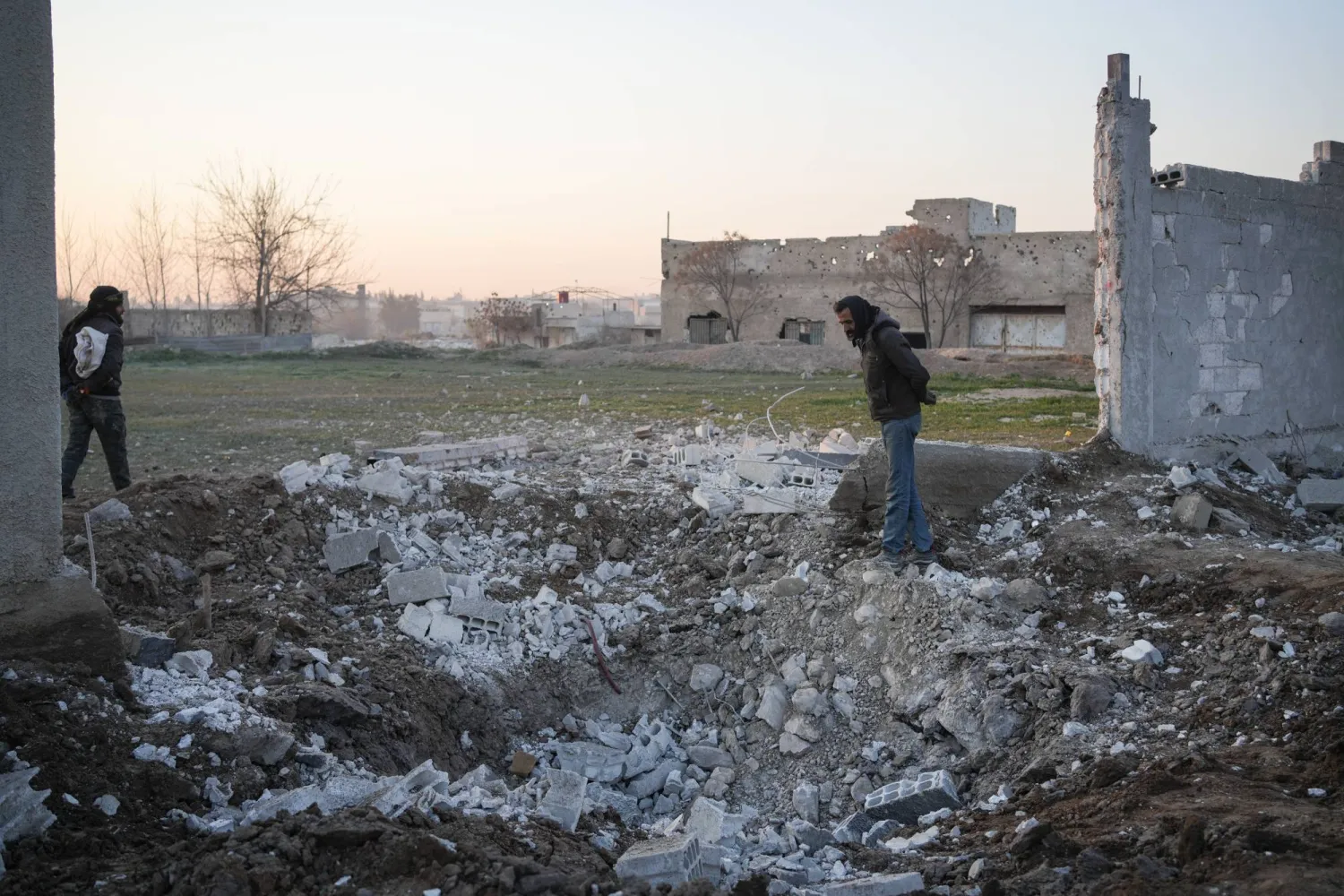
02 March 2026, Syria, Ain Terma: People watch the damage after an intercepted missile fell in a residential building in Ain Tarma town. Photo: Moawia Atrash/dpa
TT

Despite Keeping its Distance, Syria Still Feels the Fallout of the Iran War

02 March 2026, Syria, Ain Terma: People watch the damage after an intercepted missile fell in a residential building in Ain Tarma town. Photo: Moawia Atrash/dpa

Syria’s efforts to remain largely outside the direct line of fire in the war between the United States and Israel on one side and Iran on the other have not spared it the consequences rippling across the region.

Missile debris has fallen on scattered parts of the country, gas and electricity shortages have resurfaced, border crossings with Lebanon have become crowded with Syrians returning home, and cargo shipments have been disrupted.

Long electricity outages, shortages of household cooking gas and rising prices have again cast a heavy shadow over daily life, only months after a period of relative improvement.

The Syrian Ministry of Energy said Monday that the reduction in electricity supply hours was due to a decline in natural gas volumes arriving through Jordan and allocated to operate power-generation stations. The ministry said the shortfall was tied to the current regional escalation, which has temporarily made it impossible to maintain gas flows under previous agreements.

In a statement published on its official channels, the ministry said technical teams are continuing to manage the electricity system using available domestic gas production. It added that rationing is being set according to available capacity to ensure grid stability and continued operation, while efforts continue to boost local gas output to support the power system and improve supply in the next phase.

Jordan Temporarily Halts Gas Deliveries

In what was described as an early direct reflection of the regional escalation, Jordan has temporarily halted gas deliveries to Syria, according to a report published Monday by the energy platform Al-Taqa.

Citing unnamed sources, the report said Israel’s cutoff of gas supplies to Jordan pushed Amman to prioritize domestic demand.

Syria relies in part on gas coming from Jordan to support electricity generation, amid weak local production and infrastructure worn down over recent years.

The Syrian government began receiving natural gas through Jordan on Jan. 8 at a rate of 4 million cubic meters per day under an agreement linked to the Arab Gas Pipeline. Damascus also signed an agreement with Jordan to supply Syria with about 140 million cubic feet per day in an effort to ease the country’s electricity crisis.

Missile Debris and Growing Caution

On Monday, authorities in Damascus said a transformer at the Al-Otaybah industrial substation in the Damascus countryside was knocked out of service after it was hit by falling missile debris resulting from the exchange of strikes between Israel and Iran.

Caution has spread across parts of rural Damascus and southern Syria after missile remnants fell over the past two days, injuring civilians. Local sources in Daraa province said schools were closed and residents were urged to limit movement and gatherings and to avoid unfamiliar objects.

Syrian Civil Defense teams responded Monday to an incident involving the fall of military objects in the village of Al-Futaih, in the Ain Al-Sharqiyah area of the Jableh countryside on Syria’s coast. The Ministry of Emergency Situations said the incident was linked to the ongoing regional developments and urged citizens to follow safety guidance.

Israeli Arrest and Crowded Border Crossings

Amid heightened tensions, Israel has continued violations inside Syrian territory, according to the report. Israeli forces detained a shepherd on Monday west of the village of Kudna in the southern Quneitra countryside.

The Syrian Arab News Agency, SANA, said “occupation forces escorted the young man into the occupied territories,” with no further information available on his fate.

As the escalation widens and Hezbollah in Lebanon comes under attack, Syrian-Lebanese border crossings have seen heavy movement, with large numbers of Syrians leaving Lebanon and returning to Syria.




Lebanese Army Says Soldier Killed in Israeli Attack in Southern Lebanon

A Lebanese army soldier inspects the site of an Israeli airstrike that targeted their checkpoint in Aamriyeh, south of the coastal city of Tyre, on March 30, 2026. (Photo by KAWNAT HAJU / AFP)
TT

Lebanese Army Says Soldier Killed in Israeli Attack in Southern Lebanon

A Lebanese army soldier inspects the site of an Israeli airstrike that targeted their checkpoint in Aamriyeh, south of the coastal city of Tyre, on March 30, 2026. (Photo by KAWNAT HAJU / AFP)

The Lebanese army said on Sunday that a soldier had been killed in an Israeli strike on southern Lebanon.

Meanwhile, an Israeli strike hit south Beirut on Sunday, Lebanese state media reported, with a medical source telling AFP it made impact about 100 metres away from a public hospital.

The strike hit Beirut's Jnah neighborhood near Rafik Hariri University Hospital, the largest public medical facility in the country.

Israel's military earlier warned it was carrying out strikes on Beirut.


Israeli Fire Kills Four Palestinians in Gaza, Medics Say

Palestinians inspect a vehicle targeted by an Israeli strike in Maghazi camp for Palestinian refugees in the central Gaza Strip on April 4, 2026. (AFP)
TT

Israeli Fire Kills Four Palestinians in Gaza, Medics Say

Palestinians inspect a vehicle targeted by an Israeli strike in Maghazi camp for Palestinian refugees in the central Gaza Strip on April 4, 2026. (AFP)

An Israeli airstrike ‌killed four Palestinians in the northern Gaza Strip on Sunday, local health authorities said, in the latest violence to overshadow a fragile ceasefire amid a new push by mediators to bolster the agreement.

Medics said the airstrike targeted a group of people in Jaffa Street, near the Darraj neighborhood in Gaza City, killing four people and wounding others.

The Israeli military did not immediately comment on ‌the incident.

Palestinian ‌group Hamas and Israel have ‌traded blame ⁠for violations of ⁠the ceasefire agreed last October, which halted two years of full-blown war.

The Gaza health ministry says Israeli fire has killed at least 700 people since the ceasefire began. Israel says four soldiers have been killed by gunmen in Gaza ⁠over the same period.

A Hamas delegation met ‌Egyptian, Qatari and ‌Turkish mediators in Cairo last week to give its initial ‌response to a disarmament proposal presented to the ‌group last month, two Egyptian sources and a Palestinian official said.

The group has told mediators it will not discuss giving up arms without guarantees that Israel ‌will fully quit Gaza as laid out in a disarmament plan from ⁠US President ⁠Donald Trump's "Board of Peace", three sources told Reuters on Thursday.

Hamas' disarmament is a sticking point in talks to implement Trump's plan for the Palestinian enclave and cement the ceasefire.

Hamas' October 7, 2023, attacks on Israel killed 1,200 people, according to Israeli tallies.

Israel's ensuing two-year campaign killed more than 72,000 Palestinians, most of them civilians, according to Gazan health authorities, and has spread famine, demolished most buildings, and displaced most of the territory's population, in many cases numerous times.


Easter in Jerusalem Disrupted by War and Restrictions at Holy Sepulchre

 Members of the clergy make their way to the Church of the Holy Sepulchre for prayers on Palm Sunday, following restrictions on gatherings in large groups, amid the US-Israel conflict with Iran, in Jerusalem's Old City April 5, 2026. (Reuters)
Members of the clergy make their way to the Church of the Holy Sepulchre for prayers on Palm Sunday, following restrictions on gatherings in large groups, amid the US-Israel conflict with Iran, in Jerusalem's Old City April 5, 2026. (Reuters)
TT

Easter in Jerusalem Disrupted by War and Restrictions at Holy Sepulchre

 Members of the clergy make their way to the Church of the Holy Sepulchre for prayers on Palm Sunday, following restrictions on gatherings in large groups, amid the US-Israel conflict with Iran, in Jerusalem's Old City April 5, 2026. (Reuters)
Members of the clergy make their way to the Church of the Holy Sepulchre for prayers on Palm Sunday, following restrictions on gatherings in large groups, amid the US-Israel conflict with Iran, in Jerusalem's Old City April 5, 2026. (Reuters)

In the usually lively alleyways of Jerusalem's Old City, silence reigned on Easter Sunday, with the holiday overshadowed by war and restrictions on access to the Holy Sepulchre, where the faithful commemorate Christ's crucifixion and resurrection.

On routes approaching the church, police at checkpoints screened a small number of worshippers allowed near the site.

All shops in the area were closed, heightening the sense of emptiness.

"Happy Easter," said the Latin Patriarch of Jerusalem, Cardinal Pierbattista Pizzaballa, shortly after dawn as he entered the church surrounded by a modest group of clergy, according to AFP journalists at the site.

Outside, a few Catholics and Orthodox Christians tried to reach the church but were kept at a distance by security forces.

"How can you tell me I cannot go to church, it is unacceptable," said one Catholic from Tel Aviv who had attended Easter worship at the site in previous years.

Security has been stepped up in the Old City, located in annexed east Jerusalem and home to sites sacred to Jews, Christians and Muslims.

Israel has also imposed restrictions on large gatherings as a security precaution due to the constant threat of strikes during the ongoing Middle East war.

On Palm Sunday, Cardinal Pizzaballa was prevented by Israeli police from entering the Holy Sepulchre for mass, provoking outrage, before Prime Minister Benjamin Netanyahu ordered he be allowed in.

Since the start of the war on February 28, debris from Iranian missiles or interceptors has fallen in the Old City, including near the Holy Sepulchre, Al-Aqsa Mosque, and in the Jewish Quarter.

Most Palestinian Christians belong to the Orthodox faith, which celebrates Easter on April 12.

But for many other Christians, the curbs on worship have stripped the Easter celebrations of substance.

"It's very hard for all of us because it's our holiday... It's really hard to want to pray but to come here and find nothing. Everything is closed," said Christina Toderas, 44, from Romania.

Like many other worshippers, she had resigned herself to watching the mass at the Holy Sepulchre on television.

Father Bernard Poggi, who was preparing to attend mass in another church near the holy site, said he understood the security measures but added that "it seems to be more and more that there's an unevenness in how the laws are put into practice".

Inside the Holy Sepulchre, the celebrations were being held behind closed doors in front of a very small congregation, far removed from the crowds that usually gather.

Around the Old City, where hymns and processions usually dominate at Easter, only whispers could be heard among the faithful moving discreetly through its passages.