



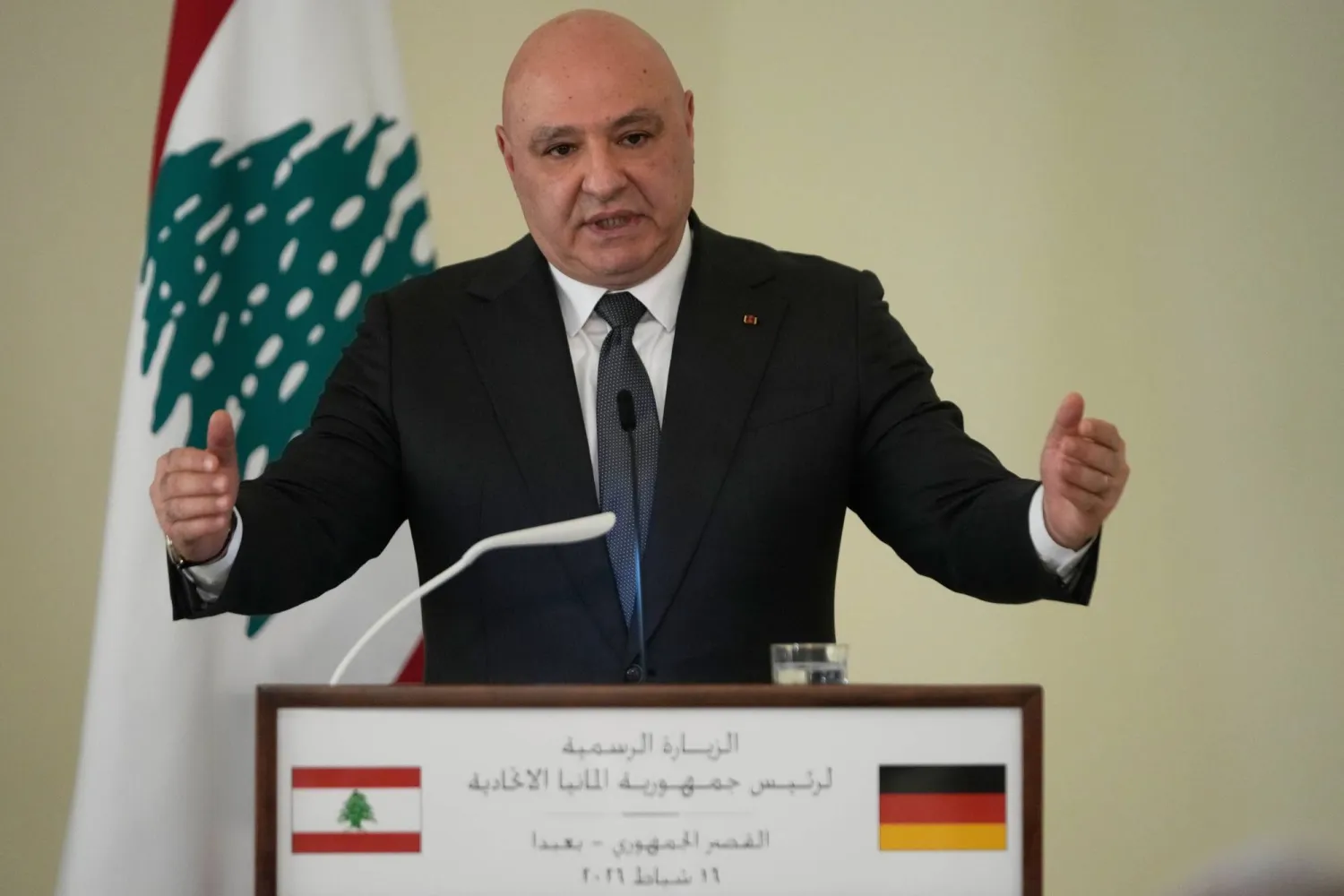

Lebanon’s government has entered a decisive test phase after banning the military and security activities of Hezbollah, a move President Joseph Aoun on Tuesday described as “sovereign and final, with no turning back,” despite open rejection from the group and rising domestic pressure for swift enforcement.
Aoun said the Lebanese army and security forces had been tasked with implementing the decision across all Lebanese territory. The judiciary has begun pursuing those responsible for launching rockets from Lebanon.
Calls are mounting for the move to go further, extending to everything linked to Hezbollah militarily, politically and financially.
Israel announced on Tuesday "broad-scale strikes" against Hezbollah after the group fired missiles on Israel to avenge the killing of Iran’s supreme leader Ali Khamenei during US-Israeli strikes on Saturday.
Ministerial sources said implementation of the decision targeting Hezbollah’s military wing is underway, adding that enforcement now covers all armed manifestations of any kind across Lebanon. Previous discussions had focused only on areas south and north of the Litani River.
A judicial source told Asharq Al-Awsat that authorities had identified the missile launch site, specifically north of the Litani, and were tracking those behind the attack. Their names and identities have not yet been determined, the source said, although their affiliation is known.
Hezbollah rejected what it called the government’s “reckless decision.”
The head of its parliamentary bloc, MP Mohammed Raad, in a statement issued hours after reports indicated he had been assassinated in an Israeli strike on Monday, described it as a “decision to ban the rejection of aggression,” accusing the government of failing to carry out the “decision of war and peace.”
Criminal prosecutions and administrative action
Constitutional expert Dr. Saeed Malek said the government’s move “does not become fully effective unless followed by implementing decrees and measures issued by the competent ministries.”
Declaring a ban, he said, effectively places the party’s military and security wings outside the law, with all the consequences that entails.
Malek told Asharq Al-Awsat that the decision requires immediate criminal prosecutions before the Public Prosecutor at the Court of Cassation on charges including crimes against state security, forming an association aimed at undermining state authority, membership in an illegal armed organization, possession of military weapons without a license, and exposing Lebanon to hostile acts outside state authority.
These steps could lead to arrest warrants, travel bans and precautionary measures in line with legal procedures.
He said the move also requires administrative action by the Interior Ministry, including dissolving and closing headquarters and offices affiliated with the military and security wings, withdrawing licenses from linked associations and bodies, revoking the legal status of entities operating for their benefit directly or indirectly, and banning any related organizational activity under any name.
Administrative, political and financial impact
Implementation extends to the administrative and political spheres, Malek said, by treating affiliation with wings deemed outside the law as a legal obstacle to holding public office, running for elections or occupying ministerial and administrative posts, subject to due judicial process.
Financially, he said, it requires assigning Banque du Liban and the Special Investigation Commission to freeze accounts and assets, block any direct or indirect financing, subject linked individuals to special financial scrutiny when illicit funding is suspected, and bar any contracting or support from public institutions, municipalities and official bodies.
Pressure to move fast
Political pressure to enforce the decision immediately is intensifying.
Sami Gemayel, head of the Kataeb Party and an MP, said after meeting Aoun that while the decisions were “historic,” the real test lay in implementation.
Gemayel demanded that all military and security forces be placed at the disposal of the judiciary to enforce the decisions by force; otherwise, these judicial decisions remain without follow-up.
“The test is mobilizing all state capabilities to implement the decision, starting with arresting any Hezbollah security cell that may move in the coming period,” he said.
He called for activating army intelligence to monitor any such cells.
Lebanese Forces party chief Samir Geagea urged security and judicial authorities to take immediate, clear, practical steps to enforce the decision, warning of the dangerous consequences of hesitation.
MP Michel Moawad, after meeting Aoun, said “the state has effectively begun initial steps,” citing the arrest of individuals and the dismantling of some weapons depots.
Former MP Fares Soaid questioned whether arrest warrants in absentia should be issued against party leaders if rocket launches continue. MP Fadi Karam said there could be no state or stability under “consensual security,” urging security and judicial authorities to assume their responsibilities.


