

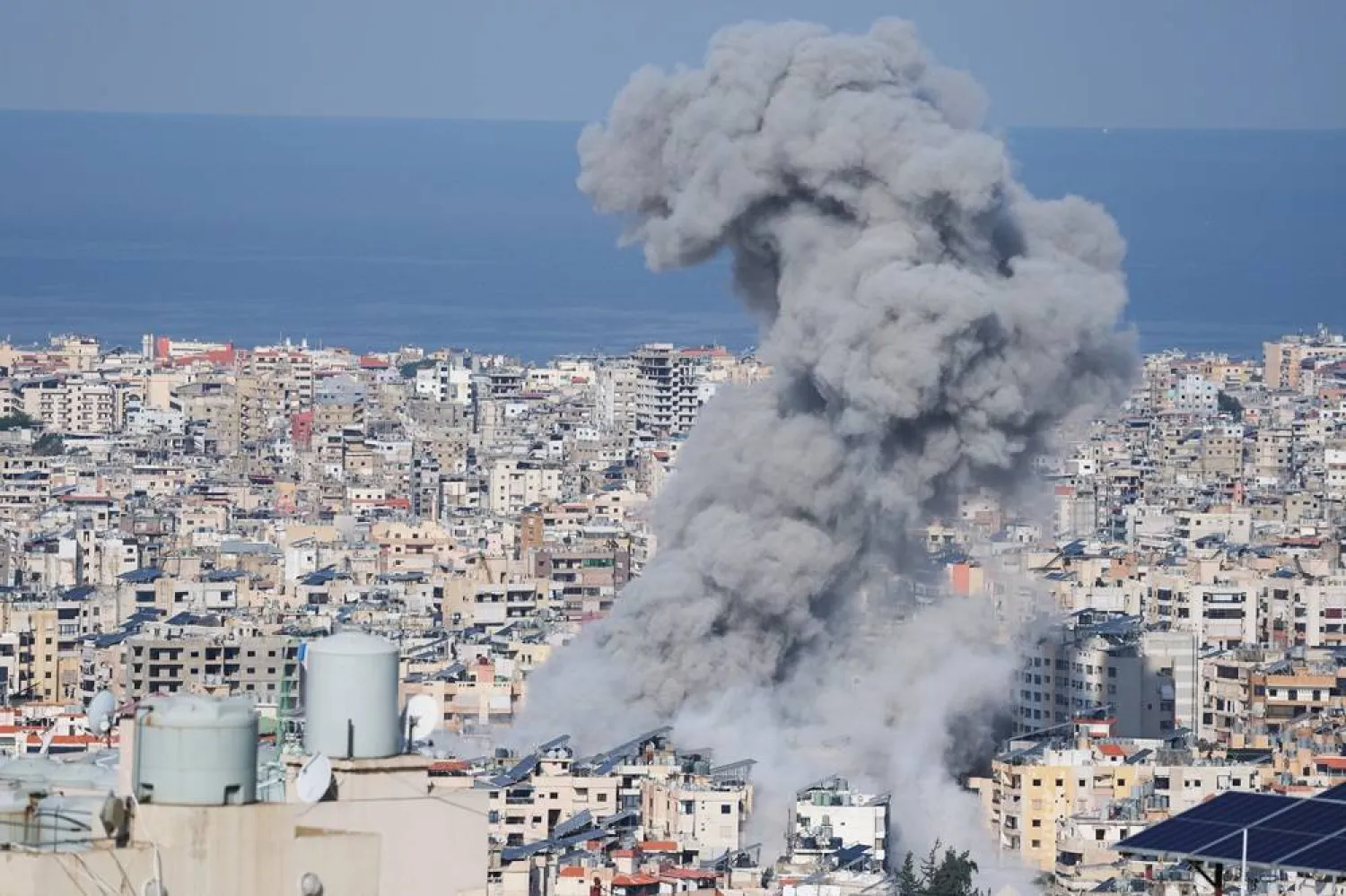

Israel Expands Lebanon Strikes, Killing 11

Smoke rises after an Israeli strike on Beirut's southern suburbs, following an escalation between Hezbollah and Israel amid the US-Israeli conflict with Iran, Lebanon, March 4, 2026. (Reuters)
TT

Israel Expands Lebanon Strikes, Killing 11

Smoke rises after an Israeli strike on Beirut's southern suburbs, following an escalation between Hezbollah and Israel amid the US-Israeli conflict with Iran, Lebanon, March 4, 2026. (Reuters)

Israel expanded its air strikes in Lebanon on Wednesday, targeting the area around the presidential palace near Beirut and other areas south of the capital as well as strongholds of the Iran-backed Hezbollah party, killing at least 11 people.

Lebanon was drawn into the Middle East war on Monday when Hezbollah attacked Israel in response to the killing of Iranian supreme leader Ali Khamenei during US-Israeli strikes over the weekend.

An air strike hit a hotel in Hazmieh on Wednesday, the first reported Israeli attack on the predominantly Christian area in Beirut's suburbs near the presidential palace and several embassies.

Some rooms were gutted in the strike, while wounded people received treatment in the lobby, AFP images showed.

People also fled through debris carrying suitcases past the Comfort Hotel's sign, which had fallen broken to the ground. It was not possible to determine who was targeted in the attack.

The southern suburbs of Beirut, a Hezbollah stronghold, were targeted again on Wednesday morning, following an evacuation order from Israel's military.

Smoke rose over the densely populated area, where some residents fled when the violence erupted.

In Aramoun and Saadiyat south of Beirut -- two towns outside Hezbollah's traditional strongholds -- the health ministry said Israeli strikes killed six people and wounded eight others. It cautioned that this was a "preliminary toll".

AFP footage from Aramoun showed damaged cars and rescue workers carrying a wounded person on a stretcher.

Strikes also targeted a four-storey building in the city of Baalbek, in Lebanon's east far from the border where Hezbollah also has a strong presence.

Five people were killed, 15 were wounded and three remain missing, Lebanon's state-run National News Agency reported.

One side of the building collapsed. AFP correspondents saw rescue workers searching through the rubble for survivors.

- Ground incursion -

The Israeli military called on people to "immediately" leave 13 towns and villages in southern Lebanon on Wednesday morning ahead of strikes against Hezbollah, the military's Arabic-language spokesman Avichay Adraee said on X.

A similar evacuation warning had earlier been issued for 16 other southern towns and villages.

Hezbollah carried out a series of strikes against Israel on Tuesday, claiming to have targeted sites including the northern Haifa naval base in retaliation for Israeli strikes in southern Beirut.

Since Monday, Israeli strikes have killed at least 50 people and wounded 335 in Lebanon, the health ministry said before the overnight strikes.

World Health Organization chief Tedros Adhanom Ghebreyesus said three paramedics were killed and six injured "while recovering people injured by explosions" in Lebanon's southern Tyre district.

"Warring parties must abide by international humanitarian law and protect health workers, facilities and patients," he said on X.

Lebanese authorities on Monday recorded the displacement of more than 58,000 people from areas targeted by strikes.

The Israeli military has said it will continue to strike Hezbollah until the Lebanese group disarms.

Israeli forces also launched a ground incursion on Tuesday, advancing into a border area in southern Lebanon, a Lebanese army source told AFP.



Iraq Says it is Directly Affected by the War: ‘We are Under Attack from Both Sides’

Smoke and flames rise near Erbil International Airport in Iraq’s Kurdistan Region following explosions caused by intensive interception operations carried out by air defense systems (dpa)
TT

Iraq Says it is Directly Affected by the War: ‘We are Under Attack from Both Sides’

Smoke and flames rise near Erbil International Airport in Iraq’s Kurdistan Region following explosions caused by intensive interception operations carried out by air defense systems (dpa)

Military escalation across Iraq continues following the outbreak of the Israeli-US war on Iran, as the country is now facing a series of reciprocal attacks by multiple actors on its territory, along with mounting economic damage caused by disruptions to its oil exports.

“Iraq has become one of the countries directly affected by the ongoing conflict,” Iraqi Foreign Minister Fuad Hussein said, noting that the country was “being subjected to attacks from both sides of the conflict.”

Iraqi military and security bases, as well as positions belonging to factions affiliated with the Popular Mobilization Forces (PMF), have been targeted by Israeli and US airstrikes. At the same time, Iran and pro-Iranian factions have targeted American interests and military bases in the Kurdistan Region and other parts of the country.

Hussein made the remarks during a phone call with Russian Foreign Minister Sergei Lavrov, during which the two discussed rapidly evolving military developments in the region and their political and economic repercussions, according to a statement from the Iraqi Foreign Ministry.

Hussein ruled out an immediate ceasefire, saying the widening scope of the confrontation and the intensification of attacks have become daily features of the conflict.

He also warned that the closure of the Strait of Hormuz and ongoing military operations “have disrupted maritime navigation in the region.”

“Iraq is facing increasing difficulties in exporting its oil,” he underlined, a situation shared by several countries in the region and one that could have serious consequences for global energy markets.

He cautioned that the war will lead to a crisis in the energy market and rising prices, which will negatively affect the economies of the region and the world.

New Attacks

Iran and allied factions targeted Erbil International Airport and the nearby Harir Air Base with dozens of rockets and drones on Wednesday. Groups calling themselves the “Islamic Resistance factions” announced that they had carried out more than 28 attacks against US and local targets inside Iraq.

Meanwhile, Camp Victoria, near Baghdad International Airport, was also targeted by rocket attacks launched by armed factions, though Iraqi security forces said they thwarted the strikes.

Kurdistan

On Wednesday, an Iranian Kurdish fighter was reportedly killed in a missile strike targeting a headquarters of the Kurdistan Freedom Party (PAK) in Iraq’s Kurdistan Region, according to a source within the party cited by AFP.

The autonomous Kurdistan Region hosts camps operated by Iranian Kurdish opposition groups.

A party spokesperson, Khalil Kani Sanani, accused “the Iranian regime” of launching three missiles at a camp housing the families of party members, killing one camp guard and wounding three others. The camp lies east of Erbil, the capital of the Kurdistan Region.

On Tuesday, a camp housing Iranian Kurdish fighters and their families in Kurdistan was struck by a drone attack that left one person injured, according to Mohammad Nazif Qader, a member of the opposition Kurdistan Democratic Party of Iran (KDPI).

Iran classifies these Kurdish parties as “terrorist organizations” and accuses them of serving “Western or Israeli interests.”


Sudan Drone Strike Kills 18 People

File photo: A view shows a large plume of smoke and fire rising from fuel depot in Port Sudan, Sudan, May 6, 2025. (Reuters)
TT

Sudan Drone Strike Kills 18 People

File photo: A view shows a large plume of smoke and fire rising from fuel depot in Port Sudan, Sudan, May 6, 2025. (Reuters)

A drone strike on a Sudanese city under paramilitary control killed 18 people, a medic working in the area told AFP on Thursday, while blaming the army for the attack.

Both sides in Sudan's war have resorted to drone warfare, sparking frequent and strong condemnation from the UN, AFP said.

The strike on Al-Mojlad on Wednesday killed 18 people and wounded 25 others, according to a medic working at the city hospital who added that he blamed the military for the attack.

The paramilitary RSF have been fighting the army for nearly three years, and had accused the military of conducting a drone strike on a market in Al-Mojlad.


Israel Launches ‘Large-scale Wave of Strikes against Iran Infrastructure,’ Hits Lebanon

Smoke rises following an Israeli airstrike in Dahiyeh, Beirut's southern suburbs, Lebanon, Thursday, March 5, 2026. (AP Photo/Hassan Ammar)
TT

Israel Launches ‘Large-scale Wave of Strikes against Iran Infrastructure,’ Hits Lebanon

Smoke rises following an Israeli airstrike in Dahiyeh, Beirut's southern suburbs, Lebanon, Thursday, March 5, 2026. (AP Photo/Hassan Ammar)

The Israeli military said it launched a wave of strikes on the Iranian capital Tehran on Thursday.

The army “has just begun a large-scale wave of strikes against infrastructure of the Iranian terror regime across Tehran," a military statement said.

Meanwhile, the Israeli military said it began new strikes against Hezbollah in Lebanon.

An overnight Israeli drone strike targeted a vehicle on a coastal highway in southern Lebanon, killing three people, Lebanon’s state news agency said.

The highway connects the city of Tyre to Naqoura, a border town near Israel.

On Wednesday, the Israeli military warned residents to move north of the Litani River, which serves as a key buffer line with villages south of it lying closest to the Israeli border.

The number of people killed in Israeli strikes in Lebanon in the four days since the conflict between Israel and Hezbollah reignited has risen to more than 70, with over 430 people wounded, Lebanon’s Health Ministry said Wednesday.

It is not clear how many of those killed in Lebanon were civilians, but the Health Ministry said Tuesday that they included seven children.