
Iran’s War Casts Shadow on Gaza’s Political Horizon

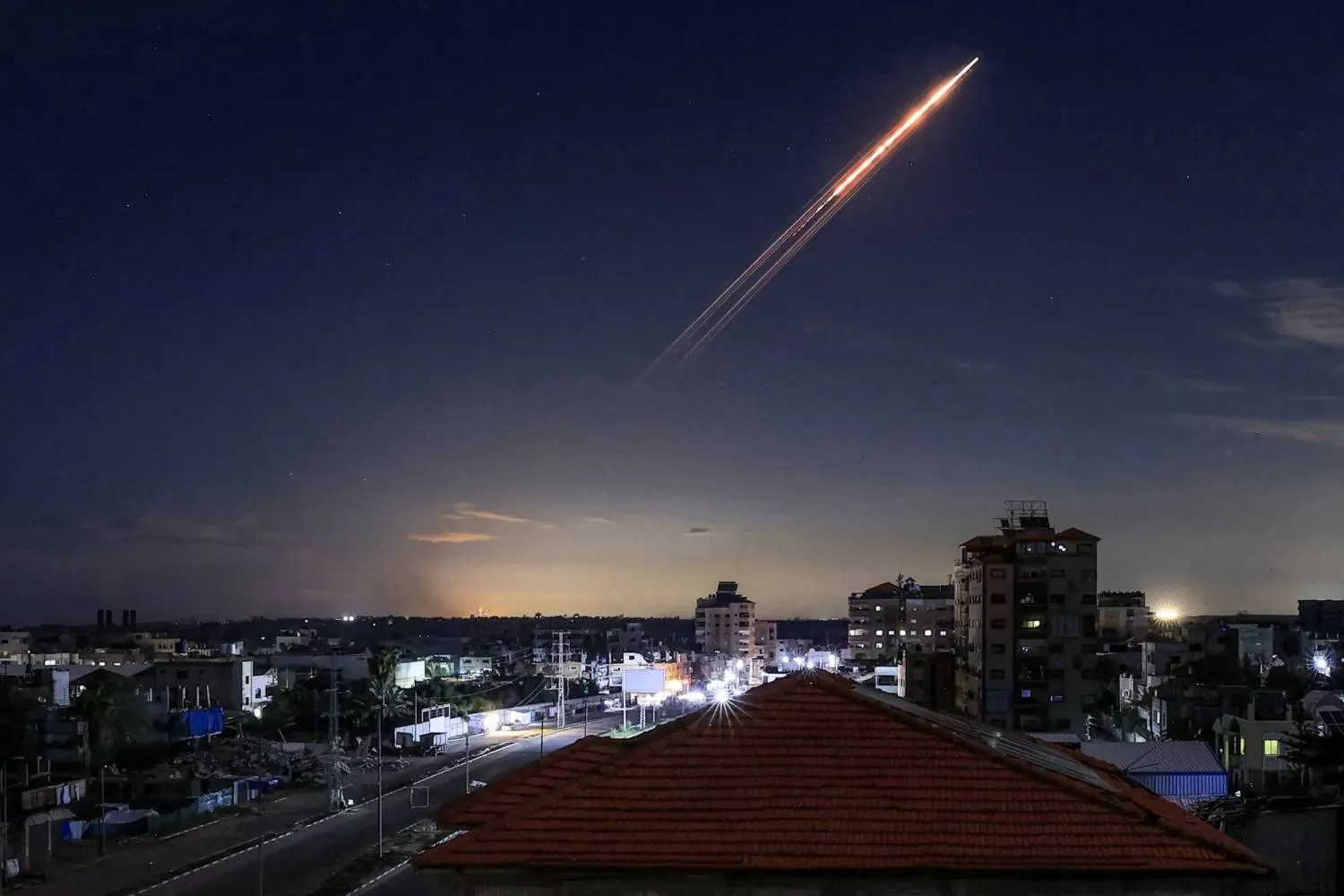
A missile launched from Iran is seen in the sky over the Bureij Palestinian refugee camp in central Gaza (AFP)
TT

Iran’s War Casts Shadow on Gaza’s Political Horizon

A missile launched from Iran is seen in the sky over the Bureij Palestinian refugee camp in central Gaza (AFP)

While attention is focused on the US-Israeli war against Iran, Gaza is facing increasingly complex conditions marked by a freeze in political efforts aimed at implementing the terms of a ceasefire reached in October last year.

Hamas and other Palestinian factions had hoped to move more quickly to the second phase of the so-called Trump plan, but the fallout from the war with Iran has clouded that path.

Since the ceasefire agreement was reached, Israel has delayed several key steps. These include preventing the “National Committee for the Administration of Gaza” from entering the enclave to assume its governmental duties, disputing its slogan and its connection to the Palestinian Authority, and pressing for the disarmament of Palestinian factions. The war against Iran has added further disruption.

Limited contact with mediators

Sources from Hamas told Asharq Al-Awsat that there has been only limited and partial communication with mediators regarding the situation in Gaza.

One source said that the Qatari and Turkish mediators in particular were “more preoccupied and engaged with the war crisis,” while Hamas remains primarily in contact with the Egyptian mediator, who is also involved in regional developments but continues to follow the Palestinian file.

Hamas sources confirmed that since the start of the war against Iran, there has been no new communication between the movement’s leadership and the US administration, either directly or through mediators.

They also agreed that “nothing official has been presented to the movement regarding the issue of weapons.”

The sources did not hide their concerns about the impact of the ongoing war on the situation in Gaza, especially as Israel has sought to take advantage of it by closing crossings that had been reopened at Washington’s request following mediation efforts.

They warned that a prolonged war could have a broader impact on the Gaza issue as a whole, particularly as negotiations related to Iran are likely to follow, at a time when the Palestinian file may be sidelined for a longer period.

Condemnation in one direction

Since the war on Iran began, Hamas and other Palestinian factions have condemned the attacks on Tehran and the killing of Iran’s Supreme Leader Ali Khamenei, while remaining officially silent, even in individual comments, regarding attacks targeting Gulf countries.

Hamas leaders have also avoided answering some journalists’ questions about their position on the attacks, particularly as some of them continue to live in Gulf states, especially Qatar, which has faced a series of Iranian strikes.

Sources from Hamas inside and outside Gaza told Asharq Al-Awsat that the movement currently prefers “to remain silent about what is happening” and does not wish to take a position.

What is happening has left its leadership “uncertain about adopting a stance that could later be held against it,” the sources said, adding: “That is why the movement chose to condemn only the aggression against Iran.”

One source acknowledged that the movement’s leadership “cannot condemn Iran’s attacks on Gulf states while Tehran says it is targeting only US bases in the region. At the same time, it does not want to endorse them because Gulf states view them as a threat to their security.”

The source added that the movement is keen to maintain relations with all parties and does not want to involve itself in the political dispute unfolding amid the ongoing military conflict in the region.

Internal divisions and heightened security

The divergence has also been reflected among field-level and grassroots members of Hamas inside Gaza, where views on the attacks have been divided.

However, at the level of Palestinian factions’ media outlets, “directives consistently emphasize strong support for the Iranian narrative in the current war,” according to a Hamas source inside Gaza.

Platforms linked to Hamas have repeatedly circulated speeches by its late political bureau chief, Yahya Sinwar, who said in a speech before Oct. 7, 2023, that “a regional war will occur,” at a time when he was counting on the intervention of parties belonging to the so-called “Axis of Resistance.”

There has also been a noticeable focus on prayers for Iran’s victory in mosques — whether those still standing or temporary prayer spaces set up in tents in areas controlled by Hamas and other Palestinian factions in Gaza.

Asharq Al-Awsat has learned that Hamas leadership has taken strict security measures amid the wave of attacks across the region, fearing a surprise Israeli strike targeting its leaders.

Such an attack occurred early Thursday when an apartment in the Beddawi refugee camp in Lebanon was struck, killing Wasim al-Ali, a prominent operative in the Izz al-Din al-Qassam Brigades. His brother, also a commander in the group, was killed in a similar attack about a year ago.


Iraq, Kurds Say Country Not a Launchpad Against Neighbors

Smoke rises after an explosion near Erbil International Airport in Erbil on March 6, 2026. (AFP)
TT

Iraq, Kurds Say Country Not a Launchpad Against Neighbors

Smoke rises after an explosion near Erbil International Airport in Erbil on March 6, 2026. (AFP)

The Iraqi government and the autonomous Kurdistan region said Friday that Iraq must not be a launchpad for attacks against neighboring countries, following reports that militants might attempt to cross into Iran.

Prime Minister Mohammed Shia al-Sudani and Kurdistan's regional president Nechirvan Barzani agreed in a phone call "that Iraqi territory must not be used as a launching point for attacks against neighboring countries", the premier's media office said.

Tehran threatened Friday to target "all the facilities" of Iraq's autonomous region if exiled Kurdish Iranian militants were allowed to enter Iran.


Kurdish Iranian Dissidents in Iraq Deny Attack Plans but Say They Would Join a US Invasion of Iran

Members of the Kurdistan Freedom Party PAK stand guard in Erbil, Iraq, Thursday, March 5, 2026. (AP)
TT

Kurdish Iranian Dissidents in Iraq Deny Attack Plans but Say They Would Join a US Invasion of Iran

Members of the Kurdistan Freedom Party PAK stand guard in Erbil, Iraq, Thursday, March 5, 2026. (AP)

Officials with one of the armed Kurdish Iranian dissident groups based in northern Iraq told The Associated Press that they are not planning an imminent cross-border attack on Iran but would join a ground invasion if the US were to launch one.

The comments appeared to be aimed at reassuring Iraqi Kurdish officials, who have said they do not want attacks to be launched against Iran from their territory, fearing that they will be further dragged into the war in the Middle East sparked by the US and Israel’s strikes on Iran.

In the event of a US ground operation, “then we would enter alongside the coalition forces,” said Khalil Nadiri, an official with the Kurdistan Freedom Party PAK, in an interview with the AP Thursday. But he said, “The Kurds must not place themselves as the spearhead of the attack.”

He added that his group also has armed members already present inside of Iran and that they would not necessarily require cross-border support if they were to stage an uprising.

Nadiri said the Kurdish groups have been in contact with the US and Israel but denied having received any material aid from them.

The comments came after Kurdish officials said earlier this week that the Kurdish Iranian dissident groups based in northern Iraq are preparing for a potential cross-border military operation in Iran, and the US had asked Iraqi Kurds to support them

Rebaz Sharifi, a military commander with the PAK, said it would be “a very positive development” if the US and its allies were to arm the Kurdish groups, but also denied that they have received any such support so far.

Sharifi said he expects that at some point, US President Donald Trump “might want the peshmerga forces of Eastern Kurdistan to participate in the conflict during a ground invasion” and “if it reaches that point, we, for our part, would be pleased with it.”

However, the two officials sought to dispel the fears of Iraqi Kurdish officials that Iraq’s semiautonomous Kurdish region would be used as a launching pad.

Peshawa Hawramani, spokesperson for the Kurdistan Regional Government, said in a statement earlier this week that “allegations claiming that we are part of a plan to arm and send Kurdish opposition parties into Iranian territory are completely unfounded” and that the Iraqi Kurdish parties do not want to “expand the war and tensions in the region.”

Already Iran and allied Iraqi militias have launched dozens of missiles and drone attacks into northern Iraq, targeting the US bases and consulate in Irbil as well as bases of the Iranian Kurdish dissident groups.

Sharifi said PAK's bases have been attacked twice with ballistic missiles and four times with drones since the start of the war, killing one of their fighters and wounding three others.

Nadiri said that “since the (Iraqi) Kurdistan region has adopted a policy of not becoming a part of this conflict and because we do not want to disrupt the stability and security here and we respect the laws of this region, consequently, the environment has not yet been established for us to move our forces back into Eastern Kurdistan.”

He was using the term used by Kurdish groups to refer to the Kurdish region of Iran.

The potential military involvement of the Kurds has raised tensions with other Iranian opposition groups - notably the faction led by the former shah’s son, Reza Pahlavi, who has accused the Kurds of being separatists aiming to carve up Iran.

Sharifi said that his group's “ultimate goal is the statehood of the Kurds in all four regions and the reunification of Kurdistan,” referring to the Kurdish areas that are currently split among Iran, Iraq, Türkiyeand Syria.

Nadiri said that a confederal system could be a “viable solution” that would allow the Kurdish area to remain part of Iran while maintaining its “own sovereignty, identity, and unique characteristics.”


UN Demands Swift Probe into Israeli Strikes on Lebanon

A fireball ascends from the site of an Israeli airstrike that targeted an area in Beirut's southern suburbs on March 6, 2026. (AFP)
TT

UN Demands Swift Probe into Israeli Strikes on Lebanon

A fireball ascends from the site of an Israeli airstrike that targeted an area in Beirut's southern suburbs on March 6, 2026. (AFP)

The United Nations on Friday demanded swift investigations into fatal Israeli strikes across Lebanon to decide if they complied with international law.

"Lebanon is becoming a key flashpoint," UN rights chief Volker Turk told reporters in Geneva.

"I call for an immediate cessation of hostilities."

Lebanon has been engulfed by the expanding Middle East war, after the Iran-backed group Hezbollah on Monday fired missiles at Israel to avenge the death of Iranian supreme leader Ali Khamenei.

Israel responded with waves of air strikes, and Thursday night it escalated its response by hitting Beirut's southern suburbs where Hezbollah is active -- after warning the area's hundreds of thousands of residents to flee.

Lebanese Prime Minister Nawaf Salam has warned that "a humanitarian disaster is looming" due to the mass displacement.

Turk said he was particularly worried about Israel's "blanket, massive displacement orders" for Beirut's southern suburbs, the Bekaa region and the full area to the south of the Litani river.

These orders were impacting "hundreds of thousands of people", he said, raising "serious concern under international humanitarian law and in particular when it comes to issues around forced transfer".

Turk's spokeswoman Ravina Shamdasani cautioned that the orders risked amounting to "prohibited forced displacement" under international law.

The mass displacement, coupled with "continued air strikes on different parts of the country, are bringing more misery and suffering to an already weary civilian population", she told reporters.

The Israeli military announced Friday that it had carried out 26 waves of strikes on Beirut's southern suburbs in the past four days.

Late Thursday, Lebanon's health ministry said Israeli strikes since Monday had killed 123 people.

Shamdasani pointed to reports that at least eight people were killed in a strike on a residential building in Baalbek on Wednesday, including three girls and two women, and a family of four reportedly died when a building was struck in the Nabatyeh district on Thursday.

"Prompt and thorough investigations must be conducted, particularly to determine whether such attacks complied with the principles of distinction, proportionality and precaution," she said.

Shamdasani highlighted that "Hezbollah has continued launching barrages of rockets into Israel, striking residential areas in the north and the center of the country, with at least three people reportedly injured".

This, she said, raised "concerns, once again, about indiscriminate attacks against civilians".

She called for "urgent de-escalation", insisting "the sovereignty of Lebanon and the human rights of its people must be respected", she said.