
Bahrain, US, and UK Hold Emergency Consultations on Regional Security

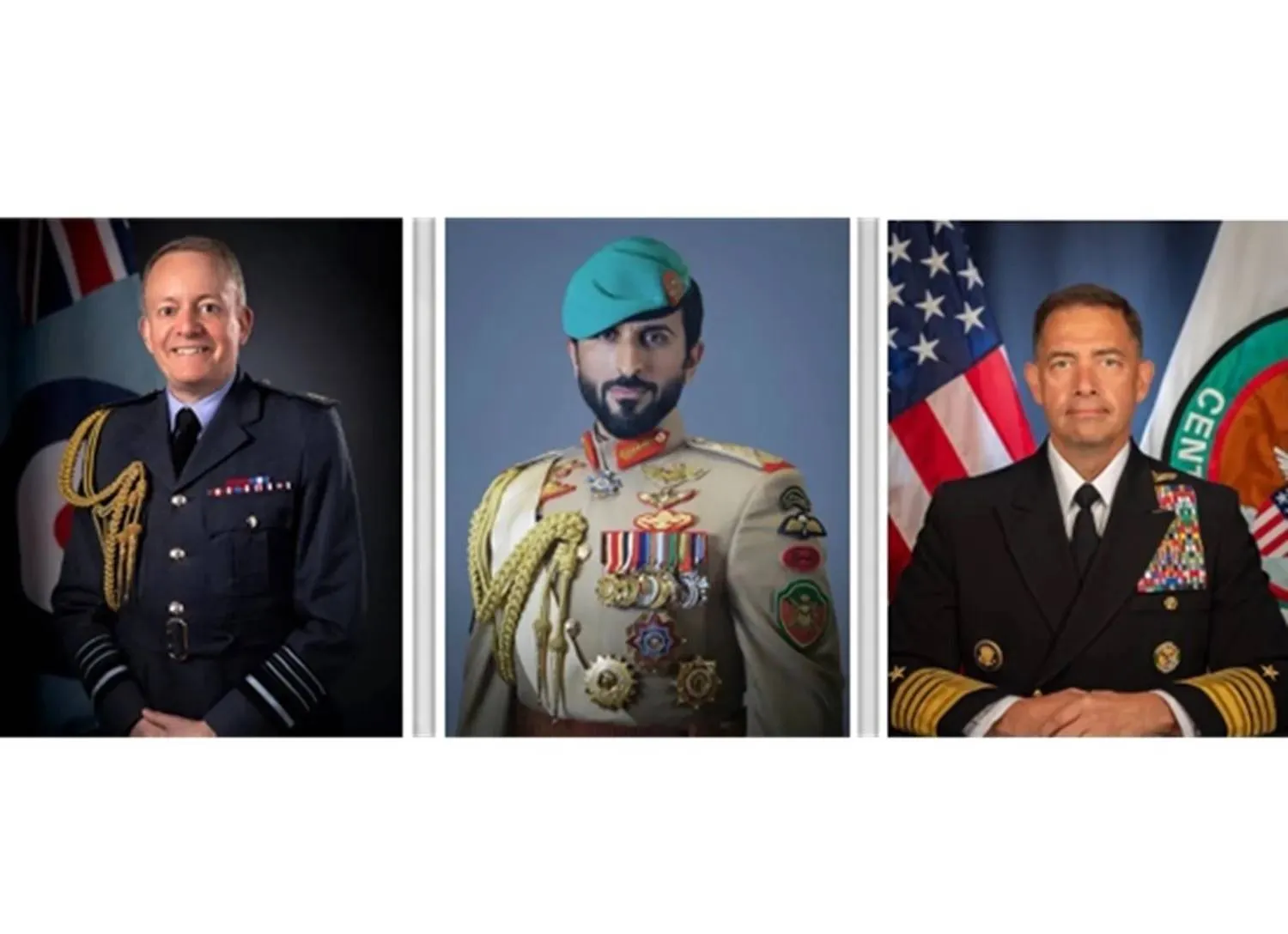
The consultations brought together Sheikh Nasser bin Hamad, Brad Cooper, and Richard Knighton (BNA). 
TT

Bahrain, US, and UK Hold Emergency Consultations on Regional Security

The consultations brought together Sheikh Nasser bin Hamad, Brad Cooper, and Richard Knighton (BNA). 

Bahrain, the United States, and the United Kingdom held emergency consultations under Article Two of the Comprehensive Security Integration and Prosperity Agreement (C-SIPA) to review the region’s current security situation, with a focus on Iranian actions aimed at destabilizing regional security and stability.

According to a statement from Bahrain’s National Communication Center, Manama activated Article Two of the agreement, triggering exceptional consultations on Thursday within the framework of the pact’s Defense Working Group.

The move came in response to Iranian missile and drone attacks that Bahraini authorities said deliberately targeted civilian and residential areas in the kingdom.

The Bahrain News Agency reported late Friday that Lt. Gen. Sheikh Nasser bin Hamad Al Khalifa, Bahrain’s national security adviser and secretary-general of the Supreme Defense Council, held the consultations with US Central Command (CENTCOM) Commander, Admiral Brad Cooper and the United Kingdom’s Air Chief Marshal Richard Knighton, chief of the defense staff.

Participants discussed the urgent need for a coordinated allied response to what they described as a direct threat to Bahrain’s sovereignty and territorial integrity. They emphasized the strength of the partnership among the member states and reaffirmed their commitment to collectively addressing threats to regional security and stability.

The meeting also underscored the strategic partnership established under the agreement, which includes commitments to strengthen security cooperation and collective deterrence against external threats. Officials reaffirmed their determination to work jointly to counter any external aggression targeting the sovereignty or territorial integrity of member states.

Separately, Cooper condemned the Iranian attacks in a post on the official CENTCOM account on the social media platform X, describing them as unacceptable.

He added that the United States would continue working with regional partners to counter threats endangering civilians in the region.

In a phone call Thursday with Bahrain’s King Hamad bin Isa Al Khalifa, British Prime Minister Keir Starmer said the United Kingdom would deploy four additional Typhoon fighter jets to the region, to be stationed in Qatar, to provide defensive air cover for Bahrain and help strengthen the protection of its airspace.

Bahrain reiterated its commitment to regional stability, the protection of its citizens, and the defense of its sovereignty. It also urged the international community to recognize the seriousness of what it described as Iran’s deliberate targeting of civilian areas and the importance of a unified allied response, which it said reflects the strength of its security partnerships.


UAE, Qatar, Bahrain Repel Iran Rocket Attacks

 Boats are docked at Dubai Creek Harbor as the Dubai skyline, including the Burj Khalifa, is seen in the background amid the U.S.-Israel conflict with Iran, in Dubai, United Arab Emirates, March 6, 2026. (Reuters)
Boats are docked at Dubai Creek Harbor as the Dubai skyline, including the Burj Khalifa, is seen in the background amid the U.S.-Israel conflict with Iran, in Dubai, United Arab Emirates, March 6, 2026. (Reuters)
TT

UAE, Qatar, Bahrain Repel Iran Rocket Attacks

 Boats are docked at Dubai Creek Harbor as the Dubai skyline, including the Burj Khalifa, is seen in the background amid the U.S.-Israel conflict with Iran, in Dubai, United Arab Emirates, March 6, 2026. (Reuters)
Boats are docked at Dubai Creek Harbor as the Dubai skyline, including the Burj Khalifa, is seen in the background amid the U.S.-Israel conflict with Iran, in Dubai, United Arab Emirates, March 6, 2026. (Reuters)

Dubai airport, the world's busiest for international traffic, suspended operations Saturday before partially resuming services, after an air defense interception in the area during attacks from Iran.

"We have partially resumed operations from today, 7 March, with some flights operating out of DXB and DWC," it said, referring to Dubai's main airport as well as the city's Dubai World Central - Al Maktoum International.

"Please do not travel to the airport unless you have been contacted by your airline that your flight is confirmed, as schedules continue to change," it told passengers.

Earlier, the government had said operations had been suspended after the aerial interception of an object near the airport, with a witness telling AFP of a loud explosion followed by a cloud of smoke.

"For the safety of passengers, airport staff, and airline crew, operations at Dubai International (DXB) have been temporarily suspended," the government's Dubai Media Office said in a social media post.

The government said in a separate post that there had been "a minor incident resulting from the fall of debris after an interception", which caused no injuries.

"The air defenses of the United Arab Emirates are currently responding to missile and drone threats coming from Iran," the Emirati Ministry of Defense had said.

The Flightradar24 tracking website earlier showed planes circling above the airport in an apparent holding pattern.

Flights from Dubai's main airport had partially resumed on Monday despite daily drone attacks targeting sites in the United Arab Emirates.

Last Saturday, four employees were injured and a terminal was damaged as war broke out in the Middle East following US-Israeli strikes on Iran.

Iranian attacks have also hit Abu Dhabi airport, the upmarket Palm Jumeirah development and the Burj Al Arab luxury hotel, while drone debris caused a fire at the US consulate in Dubai on Tuesday.

Meanwhile, Qatar’s Defense Ministry said it repelled a rocket attack against the state.

Bahrain’s Defense Force said it had intercepted and destroyed 86 rockets and 148 drones since the attacks from Iran started.


UAE Defenses Destroy 109 Drones, 9 Ballistic Missiles from Iran

A view of Jumeirah Beach Residence (JBR ) in Dubai on March 3, 2026. (AFP)
TT

UAE Defenses Destroy 109 Drones, 9 Ballistic Missiles from Iran

A view of Jumeirah Beach Residence (JBR ) in Dubai on March 3, 2026. (AFP)

United Arab Emirates defenses intercepted and destroyed nine ballistic missiles and 109 drones. Three drones, meanwhile, fell inside UAE territory, reported the country’s state news agency WAM.

The Defense Ministry said that defenses “have intercepted 205 ballistic missiles since Iran’s flagrant violations began last Saturday.” A total of 190 have been destroyed, while 13 fell at sea and two inside the UAE.

It also detected 1,184 drones, intercepting 1,110, while 74 crashed inside the country.

Three civilians have been killed, foreign workers from Nepal, Bangladesh and Pakistan, while 112 people have been injured. They include people from the Emirates, Egypt, Ethiopia, Philippines, Pakistan, Iran, India, Bangladesh, Sri Lanka, Azerbaijan, Yemen, Uganda, Eritrea, Lebanon, Afghanistan, Bahrain, the Comoros, and Türkiye.

The Defense Ministry said it was prepared to confront any threat and firmly deal with anything that aims to destabilize the country’s security. It vowed to maintain the UAE's sovereignty, security and stability and protect its interests.

Meanwhile, authorities in Fujairah said they have contained a fire that had erupted in the Fujairah Oil Industry Zone (FOIZ). The fire was sparked by shrapnel from the interception of a drone.

No one was injured in the incident.


Qatar Airways to Operate Repatriation Flights from Doha to Europe as Air Traffic Stays Shut

 04 March 2026, Qatar, Doha: A general view shows buildings in the West Bay district of Doha. (dpa)
04 March 2026, Qatar, Doha: A general view shows buildings in the West Bay district of Doha. (dpa)
TT

Qatar Airways to Operate Repatriation Flights from Doha to Europe as Air Traffic Stays Shut

 04 March 2026, Qatar, Doha: A general view shows buildings in the West Bay district of Doha. (dpa)
04 March 2026, Qatar, Doha: A general view shows buildings in the West Bay district of Doha. (dpa)

Qatar Airways plans to operate ‌a few repatriation flights from Doha to Europe on Saturday, but commercial flights remained suspended as the US-Israel war on Iran has forced the closure of Qatari airspace since last week.

The state-owned airlines' flights to London, Paris, Madrid, Rome and Frankfurt will be its first out of its home base Doha since the war escalated last week.

Commercial flights remained suspended due to the closure of Qatari airspace, and overall air traffic remained largely absent across much of the region, with major Gulf hubs — including Dubai, the world's busiest airport for international passengers — largely shut for the ‌seventh straight day, ‌in the biggest travel disruption since the COVID-19 ‌pandemic.

Air ⁠Canada said it ⁠had extended cancellations of its Toronto-Tel Aviv flights until May 2 due to the war.

Qatar Civil Aviation Authority had confirmed a safe operating corridor, the company said in a post on social media platform X in the wee hours on Saturday.

Governments in the region had started operating repatriation flights on Wednesday as they rushed to bring home tens of ⁠thousands of stranded citizens.

Industry experts say that even if a ‌ceasefire were declared immediately, normal service ‌would not return overnight. Airlines would still need time to reposition aircraft, reassign crews, rebuild ‌schedules and secure clearance to resume flying safely.

With airspace severely ‌constrained, airlines have been forced to reroute flights, carry extra fuel or make additional refueling stops to guard against sudden diversions or longer flight paths through safer corridors.

COSTS SURGE FOR AIRLINES

Carriers have started to count the cost of the ‌conflict as jet fuel prices have surged. Any hit to bottom lines will depend largely on how long ⁠the war ⁠drags on, but Delta Air CEO Scott Kirby said the rising fuel prices will have a "meaningful" hit on its quarterly results.

Delta and the other three big US carriers are looking at a combined $5.8 billion in additional fuel costs if jet fuel prices remain at these elevated levels all year, according to Reuters calculations. These carriers, unlike their European rivals, do not hedge against jet fuel spikes.

In a dramatic escalation on Friday, US President Donald Trump demanded Iran's "unconditional surrender," remarks that could complicate any quick path to ending the conflict that has interrupted global energy and commodity supplies, and rattled financial markets.

Trump made the remarks on social media just hours after Iran's president announced that unspecified countries had begun mediation efforts.