


Kurdish Rebels Say Ready to Resist Iran, Await Uprising

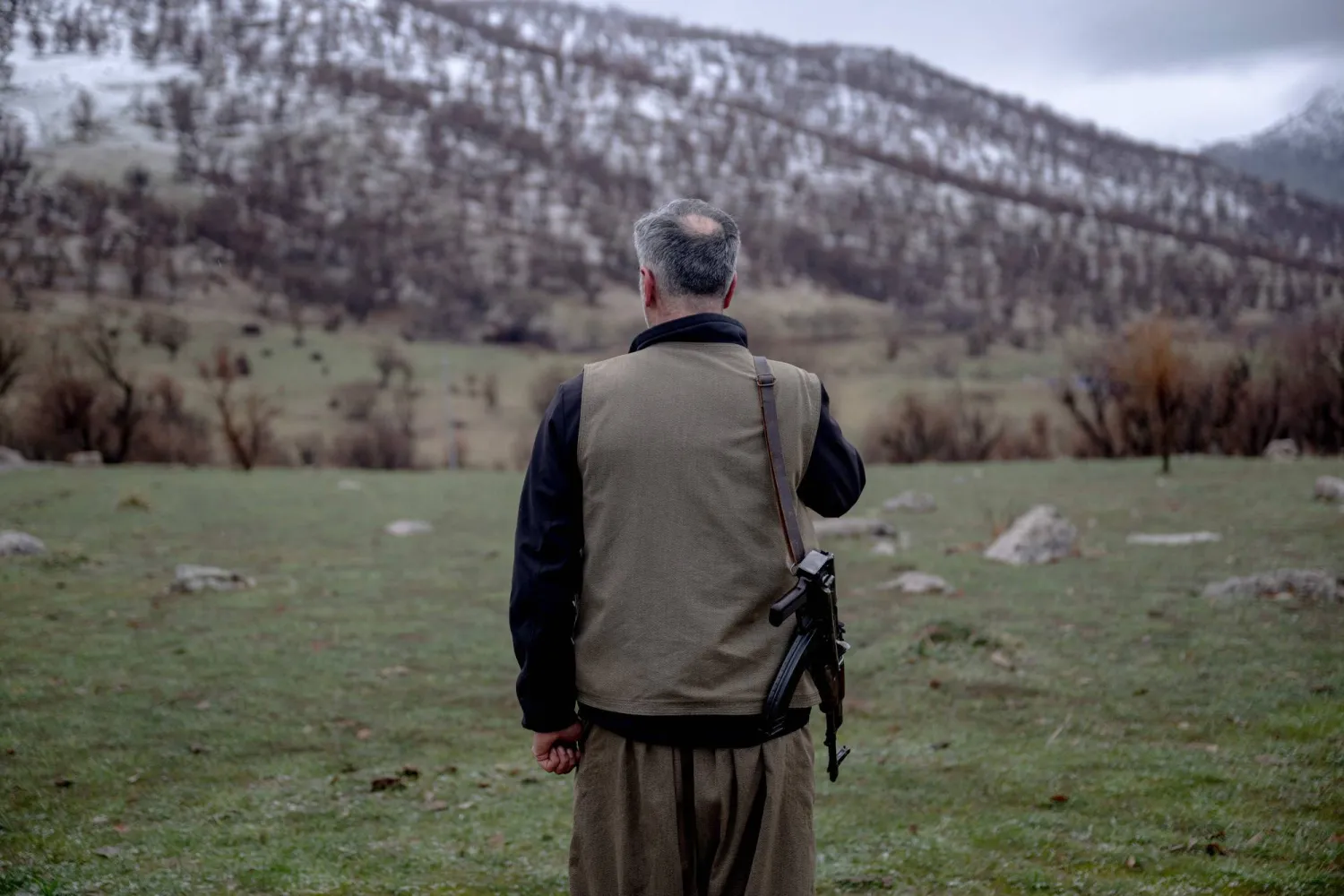
A Kurdish fighter from the Iranian Kurdish armed faction Kurdistan Free Life Party (PJAK) stands with his rifle at a site near the Iraqi border with Iran in Iraq's autonomous Kurdistan region, on March 8, 2026. (AFP)
TT

Kurdish Rebels Say Ready to Resist Iran, Await Uprising

A Kurdish fighter from the Iranian Kurdish armed faction Kurdistan Free Life Party (PJAK) stands with his rifle at a site near the Iraqi border with Iran in Iraq's autonomous Kurdistan region, on March 8, 2026. (AFP)

From their hideouts in the Iraqi mountains near Iran, leftist Kurdish rebels say they are ready to fight the country, but hope for an uprising before they intervene, with or without US support.

After saying that he would be "all for" a Kurdish offensive on Iran, US President Donald Trump appeared to backtrack Saturday, saying he did not want such an attack.

Senior commander Roken Nerada of the Party of Free Life of Kurdistan (PJAK) told AFP: "If there is an attack on the Kurdish people... then with every means... we are ready to resist as we always have."

"I think we can achieve our rights without the help of the US or any other country," said Nerada, 39, who joined the rebels 17 years ago.

Like other Iranian Kurdish rebel groups, PJAK has bases in the mountains of Iraq's northern autonomous Kurdistan region, but it also maintains hideouts in majority-Kurdish areas inside Iran.

Iran has designated Kurdish rebels groups as terrorist organizations, and many have previously fought its security forces in Kurdish-majority areas along the border.

But in recent years, under political pressure mostly from their Iraqi hosts, they have largely refrained from armed activity -- raising questions about their current capacity to lead an armed offensive against Iran.

AFP journalists met 30 PJAK fighters in a bunker adorned with photos of fallen comrades, with a television inside showing war coverage with smoke rising from Tehran and Beirut.

Since the Middle East war began late last month with a wave of US-Israeli strikes on Iran, Tehran has repeatedly struck Kurdish militants' positions in Iraq, accusing them of serving Western or Israeli interests.

- Ground attack, not yet -

Just before the war, and after anti-government protests in Iran, PJAK joined a coalition of Kurdish rebel parties seeking to overthrow the Tehran regime and secure self-determination.

"We are ready to fight, especially after what they did 50 days ago," PJAK fighter Shwan said, referring to the crackdown on the protests in Iran that left thousands dead.

Amid reports that rebels might collaborate with the US, Tehran threatened to target "all facilities" in Iraq's Kurdistan if Kurdish militants cross the border.

But on Saturday, Trump said "we're not looking to the Kurds going in".

"We don't want to make the war any more complex than it already is," he added.

Amir Karimi, another commander in PJAK, told AFP last week that the "Americans are already in the area, and we have had a dialogue".

It was "a political exchange... to get to know each other," Karimi said, adding that "a ground attack is not on the table at this stage".

"From a strategic and tactical point of view, we believe it wouldn't be a good idea," he added, warning that Iranian forces have reinforced the borders.

"The most important thing is that the population itself becomes a driving force. There must be a popular uprising" in Iran, Karimi said.

"We are not waiting for Iran or the United States to give us the green light. But the population needs support from the outside," he added.

The Kurds will need guarantees to secure a democratic Iran, he said.

"Who can say that, tomorrow, they won't support another dictator and bring him to power," Karimi said, referring to the US.

Commander Nerada said: "What is important... is to change this current darkness into a democratic Iran."



Israel Will Target Anyone Promoting Radical Ideas Against It, Says UN Envoy

 05 March 2026, US, New York: Israel's ambassador to the UN, Danny Danon, gives a press conference on ongoing military campaign against Iran at the UN Headquarters in New York. (dpa)
05 March 2026, US, New York: Israel's ambassador to the UN, Danny Danon, gives a press conference on ongoing military campaign against Iran at the UN Headquarters in New York. (dpa)
TT

Israel Will Target Anyone Promoting Radical Ideas Against It, Says UN Envoy

 05 March 2026, US, New York: Israel's ambassador to the UN, Danny Danon, gives a press conference on ongoing military campaign against Iran at the UN Headquarters in New York. (dpa)
05 March 2026, US, New York: Israel's ambassador to the UN, Danny Danon, gives a press conference on ongoing military campaign against Iran at the UN Headquarters in New York. (dpa)

Israel's UN ambassador Danny Danon said on Monday that the new supreme leader of Iran, Mojtaba Khamenei, has the same radical ideas as in the past and Israel will target anyone who promotes radical ideas against it.

"Changing the man at the top does not change the regime," Danon told reporters at the United Nations when asked about Iran's naming of Khamenei to replace his ‌father Ali Khamenei, who ‌was killed on the first ‌day ⁠of the war ⁠the US and Israel launched against Iran at the end of last month.

"The new leader, unfortunately, is more of the same ideology, the same radical ideas, and ... anyone who will promote those radical ideas against us, we will target them, we will ⁠find them," Danon said.

Danon said the ‌people of Iran ‌should rise up to choose their next leader and added: "We ‌will have to create the conditions for them, ‌and that is what we are doing now."

Asked about the threat to crucial energy traffic in the Strait of Hormuz and Iran's attacks against neighboring countries, Danon ‌said Israel and the US were hunting Iran's missile launchers and degrading its ⁠capabilities.

"So it's ⁠going to be harder for them to attack vessels in the Strait of Hormuz. It doesn't mean it will be 100% guaranteed, but it will be harder for them to do that.

"So I'm optimistic about that. Every day we see the numbers of attacks, going down," Danon said.

The war has effectively shut the Strait of Hormuz, where a fifth of global oil and liquefied natural gas is shipped along Iran's coast.


Türkiye Says NATO Defenses Shot Down Second Incoming Iranian Missile

This handout photograph taken and released on March 9, 2026, by Turkish news agency DHA (Demiroren News Agency) shows part of a second Iranian ballistic missile destroyed by NATO in Turkish airspace. (Photo by Handout / DHA (Demiroren News Agency) / AFP)
TT

Türkiye Says NATO Defenses Shot Down Second Incoming Iranian Missile

This handout photograph taken and released on March 9, 2026, by Turkish news agency DHA (Demiroren News Agency) shows part of a second Iranian ballistic missile destroyed by NATO in Turkish airspace. (Photo by Handout / DHA (Demiroren News Agency) / AFP)

Türkiye said on Monday that NATO air defenses shot down a second Iranian ballistic missile that had entered its airspace and warned that it would move against any such threats, which increasingly pose a test for Ankara and the alliance.

The incident in southern Türkiye marks the second intercepted missile from Iran in the last week.

Türkiye, NATO's second-largest army and Iran's neighbor, had warned Tehran on Saturday against attacking again, but it has not suggested it wants to formally call on bloc members for further protection.

A NATO spokesperson confirmed that the alliance had intercepted a missile heading to Türkiye, and that it stood firm in its readiness to defend allies.

Unlike last ‌week's incoming ‌missile, which was downed outside Türkiye, the latest missile entered Turkish airspace. ‌Its fragments ⁠fell in a ⁠region sitting between a critical airbase to the west and a radar base to the east, both of which are used by the United States and NATO.

"We once again emphasize that all necessary measures will be taken decisively and without hesitation against any threat directed at our country's territory and airspace," the Turkish Defense Ministry said, adding there had been no casualties in the incident.

"We also reiterate that it is in everyone's interest to heed Türkiye’s warnings in this regard," it said.

President Recep Tayyip Erdogan said Türkiye had delivered the necessary warnings ⁠to Iran after the missile incident.

"Iran continues to take wrong and ‌provocative steps," Erdogan said after a cabinet meeting in Ankara.

He ‌said that Türkiye would continue to take additional measures after deploying six F-16 fighter jets to northern Cyprus earlier on ‌Monday, adding that Türkiye’s main goal was to keep the country out of the "blaze" of ‌the Iran war.

RELIANCE ON NATO DEFENSES

Türkiye, an emerging leader in the global defense industry, lacks its own fully fledged air defenses despite development efforts, and has relied on NATO air defenses stationed in the eastern Mediterranean Sea in both incidents in the last week.

Türkiye did not immediately comment on any formal steps within NATO. It had previously said ‌it had no intention of invoking the bloc's Article 4 that would call allies to consult if a member is threatened. That could lead ⁠to Article 5, which ⁠would call NATO to defend its attacked ally.

Erdogan's office said Ankara was strongly reiterating its warning to all parties, namely Iran, to avoid endangering regional stability and civilians.

It was unclear where the missile was headed.

US air forces are stationed at Türkiye’s Incirlik base, and there is a NATO radar base in Malatya province to the northeast that provides vital protection for the alliance.

Ankara said the missile debris fell in empty fields in Gaziantep, which sits roughly between the two.

The US embassy in Türkiye ordered non-emergency government employees and families to leave its southern Adana consulate, where service was suspended, and it strongly encouraged Americans to leave southeast Türkiye.

Ankara says that Washington has not used Incirlik in its air assault, alongside Israel, on Iran, which triggered Tehran's missile and drone attacks.

Iran did not immediately comment on the incident, but it has said repeatedly that it is not at war with regional countries and is not explicitly targeting Türkiye.

Türkiye had sought to mediate US-Iran talks before the air war that began 10 days ago.


Russia Ready to Supply Energy to Europe if It Asks, Putin Says

 Russian President Vladimir Putin delivers a video address to congratulate Russia's women on International Women's Day at the Kremlin in Moscow, Sunday, March 8, 2026. (Gavriil Grigorov/Sputnik, Kremlin Pool Photo via AP)
Russian President Vladimir Putin delivers a video address to congratulate Russia's women on International Women's Day at the Kremlin in Moscow, Sunday, March 8, 2026. (Gavriil Grigorov/Sputnik, Kremlin Pool Photo via AP)
TT

Russia Ready to Supply Energy to Europe if It Asks, Putin Says

 Russian President Vladimir Putin delivers a video address to congratulate Russia's women on International Women's Day at the Kremlin in Moscow, Sunday, March 8, 2026. (Gavriil Grigorov/Sputnik, Kremlin Pool Photo via AP)
Russian President Vladimir Putin delivers a video address to congratulate Russia's women on International Women's Day at the Kremlin in Moscow, Sunday, March 8, 2026. (Gavriil Grigorov/Sputnik, Kremlin Pool Photo via AP)

Russia would supply oil and gas to European buyers, provided such cooperation was "long-term" and did not put political pressure on Moscow, President Vladimir Putin said Monday.

Oil prices have skyrocketed since the United States and Israel began striking Iran on February 28, trading above $100 this week for the first time since Russia launched its Ukraine offensive in 2022.

In a televised meeting, Putin said Moscow would continue to supply oil to "reliable" partners in Asia, as well as EU members Hungary and Slovakia.

"If European companies and European buyers suddenly decide to reorient themselves and provide us with long-term, sustainable cooperation, devoid of political pressures, free from political pressures, then go ahead. We've never refused," Putin said.

"We're ready to work with Europeans, but we need some signals from them that they're ready and willing to work with us and will ensure this sustainability and stability," he added.

The European Union banned maritime imports of Russian crude in 2022, while Russia's pipeline exports to Hungary and Slovakia have been effectively halted since January due to damage to the Druzhba oil pipeline via Ukraine.

Putin's comments came hours after Hungarian Prime Minister Viktor Orban urged the European Union to suspend sanctions on Russian oil and gas to counter prices sent soaring by the war in the Middle East.