
Trump Says Iran War Could Be Over Soon, but Oil Disruption Would Trigger Harsher US Strikes

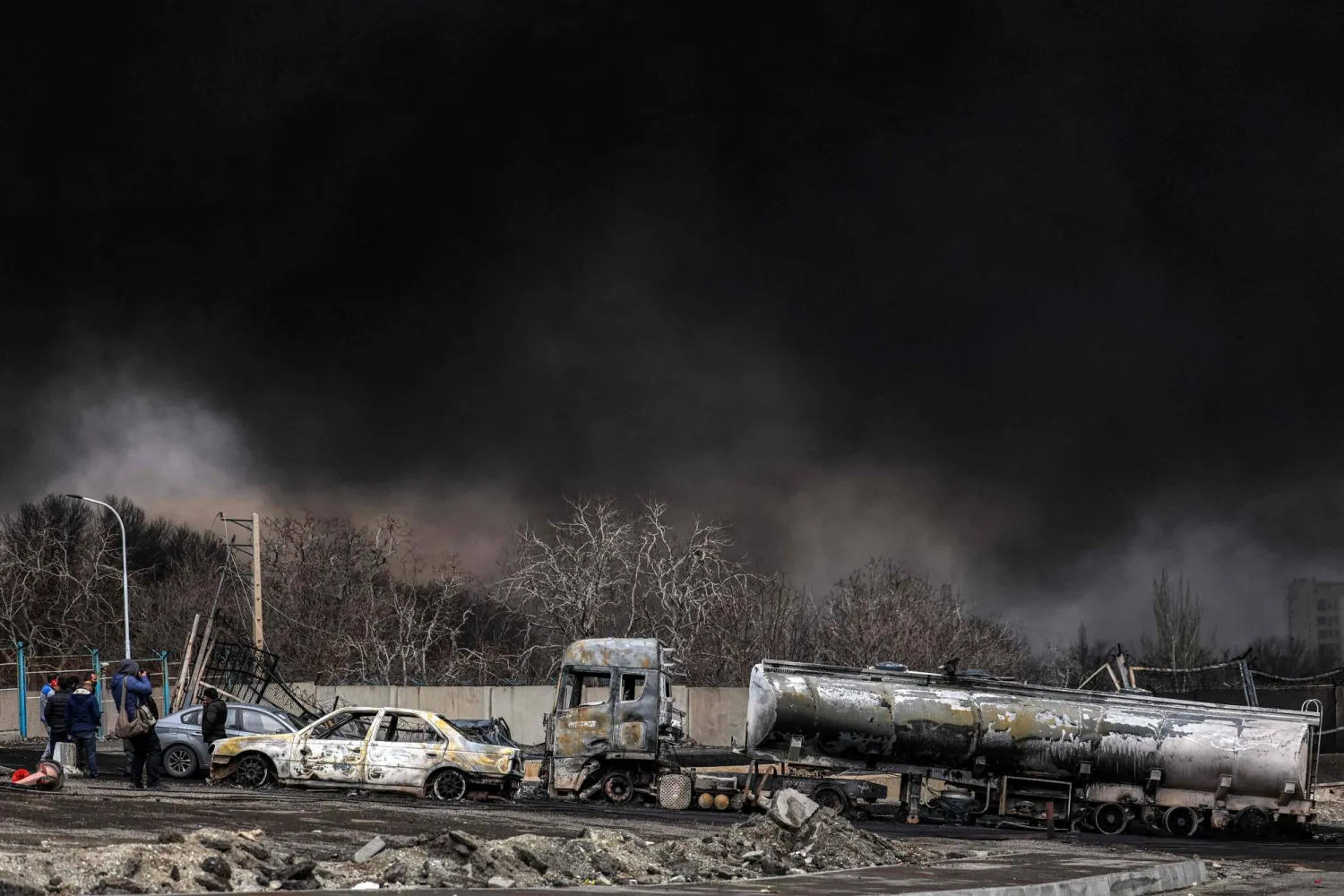
A dark smoke cloud engulfs destroyed vehicles near an ongoing fire following an overnight airstrike on the Shahran oil refinery in northwestern Tehran on March 8, 2026. (AFP)
TT

Trump Says Iran War Could Be Over Soon, but Oil Disruption Would Trigger Harsher US Strikes

A dark smoke cloud engulfs destroyed vehicles near an ongoing fire following an overnight airstrike on the Shahran oil refinery in northwestern Tehran on March 8, 2026. (AFP)

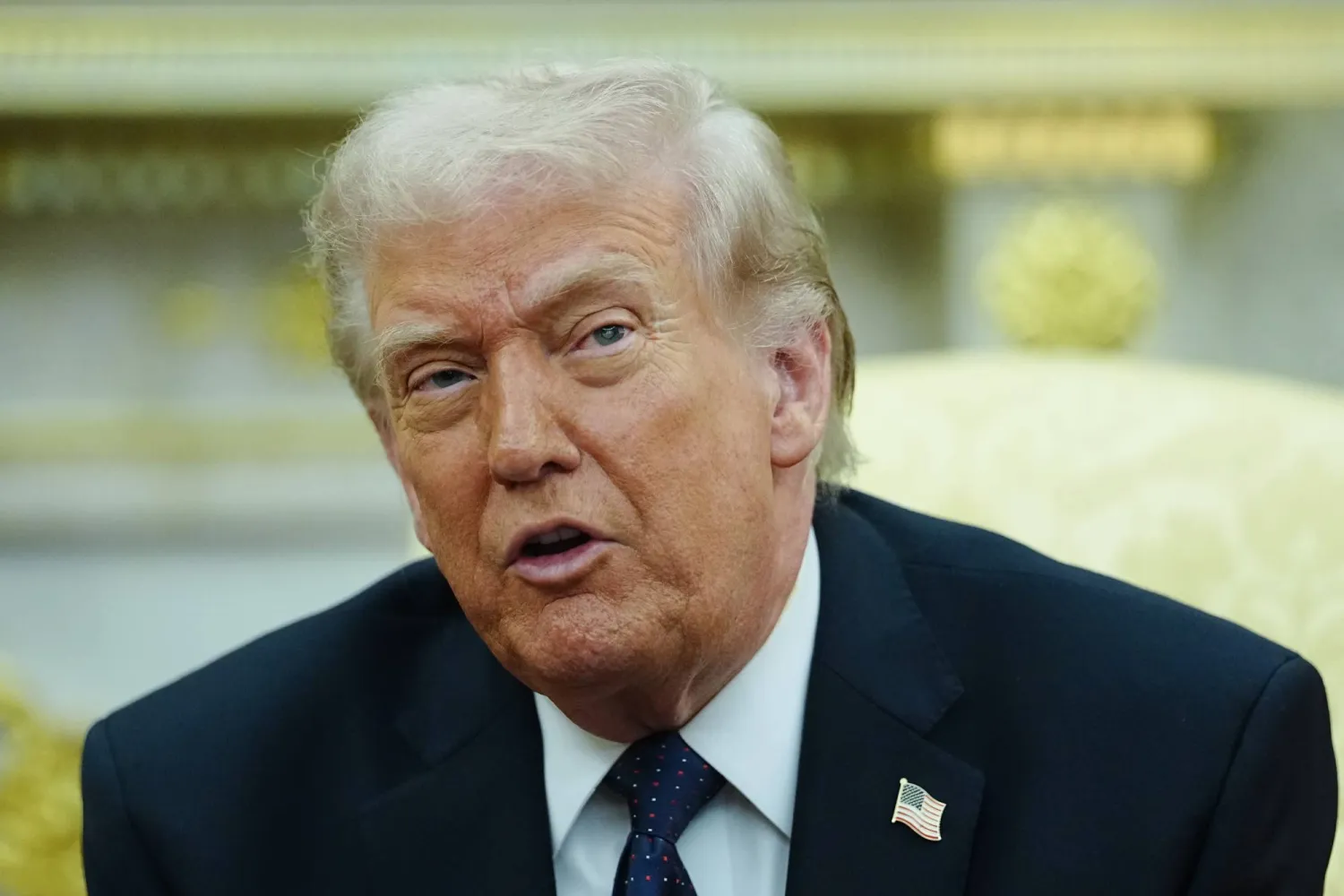
US President Donald Trump said Monday that the war against Iran could be short-lived, but he left open the possibility of an escalation in fighting if global oil supplies are disrupted by Tehran, which chose a new hard-line supreme leader. 

Oil prices briefly shot to their highest level since 2022 a day after Iran selected Mojtaba Khamenei to succeed his late father as Iran’s supreme leader. Investors saw it as a signal that Iran was digging in 10 days into the war launched by the United States and Israel. 

But prices later fell and US stocks rose on hopes that the war with Iran may not last much longer. 

“We took a little excursion” to the Middle East “to get rid of some evil. And, I think you’ll see it’s going to be a short-term excursion,” Trump told Republican lawmakers at his golf club near Miami. 

Hours later, Trump posted on social media: “If Iran does anything that stops the flow of Oil within the Strait of Hormuz, they will be hit by the United States of America TWENTY TIMES HARDER than they have been hit thus far." 

In an apparent response to Trump’s remarks published in Iranian state media, a spokesperson for the paramilitary Revolutionary Guard, Ali Mohammad Naini, said “Iran will determine when the war ends.” 

The war has choked off major supplies of oil and gas to world markets and sent fuel prices rising across the US. The fighting has also led foreigners to flee from business hubs and prompted millions to seek shelter as bombs hit military bases, government buildings, oil and water installations, hotels and at least one school. 

Trump also had a call Monday with Russian President Vladimir Putin to discuss the war and other issues. Putin’s foreign affairs adviser, Yuri Ushakov, said Putin “voiced a few ideas regarding a quick political and diplomatic settlement” of the conflict following his conversations with Gulf leaders and Iranian President Masoud Pezeshkian. 

Khamenei, a secretive 56-year-old cleric, is only the third supreme leader in the history of the republic. He has close ties to the paramilitary Revolutionary Guard, which has been firing missiles and drones at Israel and Gulf Arab states since his father, Ali Khamenei, who had ruled since 1989, was killed during the war’s opening salvo. 

Multiple strikes shake Tehran 

Dozens of explosions were heard in Tehran in what was considered the heaviest air raid on the capital since the war started Feb. 28. Iranian media did not report on damages and casualties. 

Israel said Monday that it was carrying out “a wide-scale wave of strikes” on the Iranian city of Isfahan, as well as Tehran and in southern Iran. The Israeli military said it hit dozens of infrastructure sites, including the drone headquarters of the Revolutionary Guard. 

Meanwhile, Israel’s military alerted the population throughout the day about incoming missiles from Iran. From Lebanon, Iran-backed Hezbollah also fired rockets into Israel on Monday. 

Trump said the United States was nearing its goal to eliminate Iran’s ballistic missile stockpile and its ability to produce and launch them. The administration has offered shifting rationales and timelines since the start of the conflict. 

He also talked about "building a new country,” a comment that seemed to suggest the US might be engaged in the building of a new Iran. 

Trump likes idea of another ‘internal’ candidate to lead Iran  

Thousands poured into a central square in the capital, Tehran, and other locations in a show of allegiance to the new supreme leader, waving flags and shouting phrases like “Death to America” and “Death to Israel.” 

The younger Khamenei, who has not been seen in public since the war started, was long considered a potential successor — even before the killing of his 86-year-old father. 

Trump told reporters that he was “disappointed” that Mojtaba Khamenei was picked and that he liked “the idea” of a leader drawn from an “internal” group of candidates, saying that worked well with Venezuela. 

The younger Khamenei is seen as even less compromising than his late father. As supreme leader, he has the final say on all major policies, including Tehran’s disputed nuclear program. 

Though Iran’s key nuclear sites are in tatters after the US bombed them during the 12-day Israel-Iran war in June, it still has highly enriched uranium that’s a technical step away from weapons-grade levels. Khamenei could choose to do what his father never did — build a nuclear bomb. 

Trump told reporters the war with Iran started because that country was working on a new site for developing material for nuclear weapons to replace one bombed last year by the US. 

Israel has already described Khamenei as a potential target. Trump said Monday it “would be inappropriate” to say whether he would be targeted. 

US market seesaws over uncertainty of war  

The US stock market careened through a manic Monday, going from a steep early loss to a solid gain as worries turned into hope that the war with Iran may not last that long. Oil prices whipped from nearly $120 per barrel, the highest since 2022, back toward $90. 

Iran’s attacks in the Strait of Hormuz have all but stopped tankers from using the shipping lane through which a fifth of the world’s oil is carried, and Iranian drones and missiles have targeted oil and gas infrastructure in major producers. Attacks on merchant ships near the strait have killed at least seven mariners, according to the International Maritime Organization. 

Kamal Kharazi, foreign policy adviser to the office of the supreme leader, told CNN on Monday that Iran is prepared for a long war. He said he sees no “room for diplomacy anymore” unless economic pressure prompts other countries to intervene and stop the “aggression of Americans and Israelis against Iran.” 

Türkiye, meanwhile, said NATO defenses had intercepted a ballistic missile that entered the country’s airspace for the second time since the war started. 


EU Ready to ‘Enhance’ Operations Protecting Middle East Shipping

Greek Prime Minister Kyriakos Mitsotakis speaks during a joint press conference with Cyprus' and France's presidents at Paphos military airport, in Paphos, Cyprus, 09 March 2026, (EPA)
TT

EU Ready to ‘Enhance’ Operations Protecting Middle East Shipping

Greek Prime Minister Kyriakos Mitsotakis speaks during a joint press conference with Cyprus' and France's presidents at Paphos military airport, in Paphos, Cyprus, 09 March 2026, (EPA)

The European Union said on Monday it was ready to bolster its maritime operations in the Middle East to protect shipping routes, after holding talks with regional leaders.

The EU has been discussing reinforcing its naval mission in the Red Sea after US-Israeli attacks on Iran triggered a broader regional war, causing maritime traffic in the Strait of Hormuz to all but halt.

European Council President Antonio Costa and European Commission President Ursula von der Leyen "expressed their openness to further tailor and enhance these operations in order to better respond to the situation", the bloc said in a statement.

They held video talks with leaders from countries in the region including Saudi Arabia, Bahrain, Iraq, Jordan, Lebanon, Qatar, Syria, Türkiye and the United Arab Emirates.

A fifth of global crude passes through the Strait of Hormuz.

The EU has two maritime defensive operations in the region -- anti-piracy naval force Atalanta and Aspides.

The latter was launched in the Red Sea in 2024 to prevent attacks on trade vessels by Iran-backed Houthi militants.

Aspides is based in Greece but under Italy's operational military command. It currently has three warships -- one French, one Greek and one Italian.

Operation Atalanta has two ships, one in Oman and the other in Djibouti.

Greek Prime Minister Kyriakos Mitsotakis urged his European counterparts "to strengthen this operation (Aspides) with more naval assets".

"Few of us are participating at present but we must demonstrate European solidarity on a concrete level," he said.

He was speaking alongside French President Emmanuel Macron during a visit to Cyprus on Monday.

Macron said France would contribute to Aspides "over the long term" with two additional frigates.


Israel Says Iran’s New Supreme Leader a ‘Tyrant’ Who Will Continue ‘Regime’s Brutality’

A person holds a picture of the new Iranian Supreme Leader Mojtaba Khamenei during a gathering in support of him in Tehran, Iran, 09 March 2026. (EPA)
TT

Israel Says Iran’s New Supreme Leader a ‘Tyrant’ Who Will Continue ‘Regime’s Brutality’

A person holds a picture of the new Iranian Supreme Leader Mojtaba Khamenei during a gathering in support of him in Tehran, Iran, 09 March 2026. (EPA)

Israel's foreign ministry said Monday that Iran's new supreme leader Mojtaba Khamenei was a "tyrant" like his slain father, and would continue what it described as the Iranian "regime's brutality". 

In a post on X featuring a picture of Mojtaba Khamenei and his father Ali Khamenei, holding guns, the ministry wrote: "Mojtaba Khamenei. Like Father Like Son". 

"Mojtaba Khamenei's hands are already stained with the bloodshed that defined his father's rule. Another tyrant to continue the Iranian regime's brutality," the ministry said, in Israel's first reaction to Mojtaba Khamenei's selection as supreme leader following the killing of his father on February 28 in Israeli strikes. 

Earlier, Israel's UN ambassador Danny Danon said Mojtaba Khamenei has the same radical ideas as in the past and Israel will target anyone who promotes radical ideas against it.

"Changing the man at the top does not change the regime," Danon told reporters at the United Nations when asked about Iran's naming of Khamenei to replace his ‌father.

"The new leader, unfortunately, is more of the same ideology, the same radical ideas, and ... anyone who will promote those radical ideas against us, we will target them, we will ⁠find them," Danon said.

He said the ‌people of Iran ‌should rise up to choose their next leader and added: "We ‌will have to create the conditions for them, ‌and that is what we are doing now."

Asked about the threat to crucial energy traffic in the Strait of Hormuz and Iran's attacks against neighboring countries, Danon ‌said Israel and the US were hunting Iran's missile launchers and degrading its ⁠capabilities.

"So it's ⁠going to be harder for them to attack vessels in the Strait of Hormuz. It doesn't mean it will be 100% guaranteed, but it will be harder for them to do that.

"So I'm optimistic about that. Every day we see the numbers of attacks, going down," Danon said.

The war has effectively shut the Strait of Hormuz, where a fifth of global oil and liquefied natural gas is shipped along Iran's coast.


Türkiye Says NATO Defenses Shot Down Second Incoming Iranian Missile

This handout photograph taken and released on March 9, 2026, by Turkish news agency DHA (Demiroren News Agency) shows part of a second Iranian ballistic missile destroyed by NATO in Turkish airspace. (Photo by Handout / DHA (Demiroren News Agency) / AFP)
TT

Türkiye Says NATO Defenses Shot Down Second Incoming Iranian Missile

This handout photograph taken and released on March 9, 2026, by Turkish news agency DHA (Demiroren News Agency) shows part of a second Iranian ballistic missile destroyed by NATO in Turkish airspace. (Photo by Handout / DHA (Demiroren News Agency) / AFP)

Türkiye said on Monday that NATO air defenses shot down a second Iranian ballistic missile that had entered its airspace and warned that it would move against any such threats, which increasingly pose a test for Ankara and the alliance.

The incident in southern Türkiye marks the second intercepted missile from Iran in the last week.

Türkiye, NATO's second-largest army and Iran's neighbor, had warned Tehran on Saturday against attacking again, but it has not suggested it wants to formally call on bloc members for further protection.

A NATO spokesperson confirmed that the alliance had intercepted a missile heading to Türkiye, and that it stood firm in its readiness to defend allies.

Unlike last ‌week's incoming ‌missile, which was downed outside Türkiye, the latest missile entered Turkish airspace. ‌Its fragments ⁠fell in a ⁠region sitting between a critical airbase to the west and a radar base to the east, both of which are used by the United States and NATO.

"We once again emphasize that all necessary measures will be taken decisively and without hesitation against any threat directed at our country's territory and airspace," the Turkish Defense Ministry said, adding there had been no casualties in the incident.

"We also reiterate that it is in everyone's interest to heed Türkiye’s warnings in this regard," it said.

President Recep Tayyip Erdogan said Türkiye had delivered the necessary warnings ⁠to Iran after the missile incident.

"Iran continues to take wrong and ‌provocative steps," Erdogan said after a cabinet meeting in Ankara.

He ‌said that Türkiye would continue to take additional measures after deploying six F-16 fighter jets to northern Cyprus earlier on ‌Monday, adding that Türkiye’s main goal was to keep the country out of the "blaze" of ‌the Iran war.

RELIANCE ON NATO DEFENSES

Türkiye, an emerging leader in the global defense industry, lacks its own fully fledged air defenses despite development efforts, and has relied on NATO air defenses stationed in the eastern Mediterranean Sea in both incidents in the last week.

Türkiye did not immediately comment on any formal steps within NATO. It had previously said ‌it had no intention of invoking the bloc's Article 4 that would call allies to consult if a member is threatened. That could lead ⁠to Article 5, which ⁠would call NATO to defend its attacked ally.

Erdogan's office said Ankara was strongly reiterating its warning to all parties, namely Iran, to avoid endangering regional stability and civilians.

It was unclear where the missile was headed.

US air forces are stationed at Türkiye’s Incirlik base, and there is a NATO radar base in Malatya province to the northeast that provides vital protection for the alliance.

Ankara said the missile debris fell in empty fields in Gaziantep, which sits roughly between the two.

The US embassy in Türkiye ordered non-emergency government employees and families to leave its southern Adana consulate, where service was suspended, and it strongly encouraged Americans to leave southeast Türkiye.

Ankara says that Washington has not used Incirlik in its air assault, alongside Israel, on Iran, which triggered Tehran's missile and drone attacks.

Iran did not immediately comment on the incident, but it has said repeatedly that it is not at war with regional countries and is not explicitly targeting Türkiye.

Türkiye had sought to mediate US-Iran talks before the air war that began 10 days ago.