Türkiye Says NATO Defenses Shot Down Second Incoming Iranian Missile

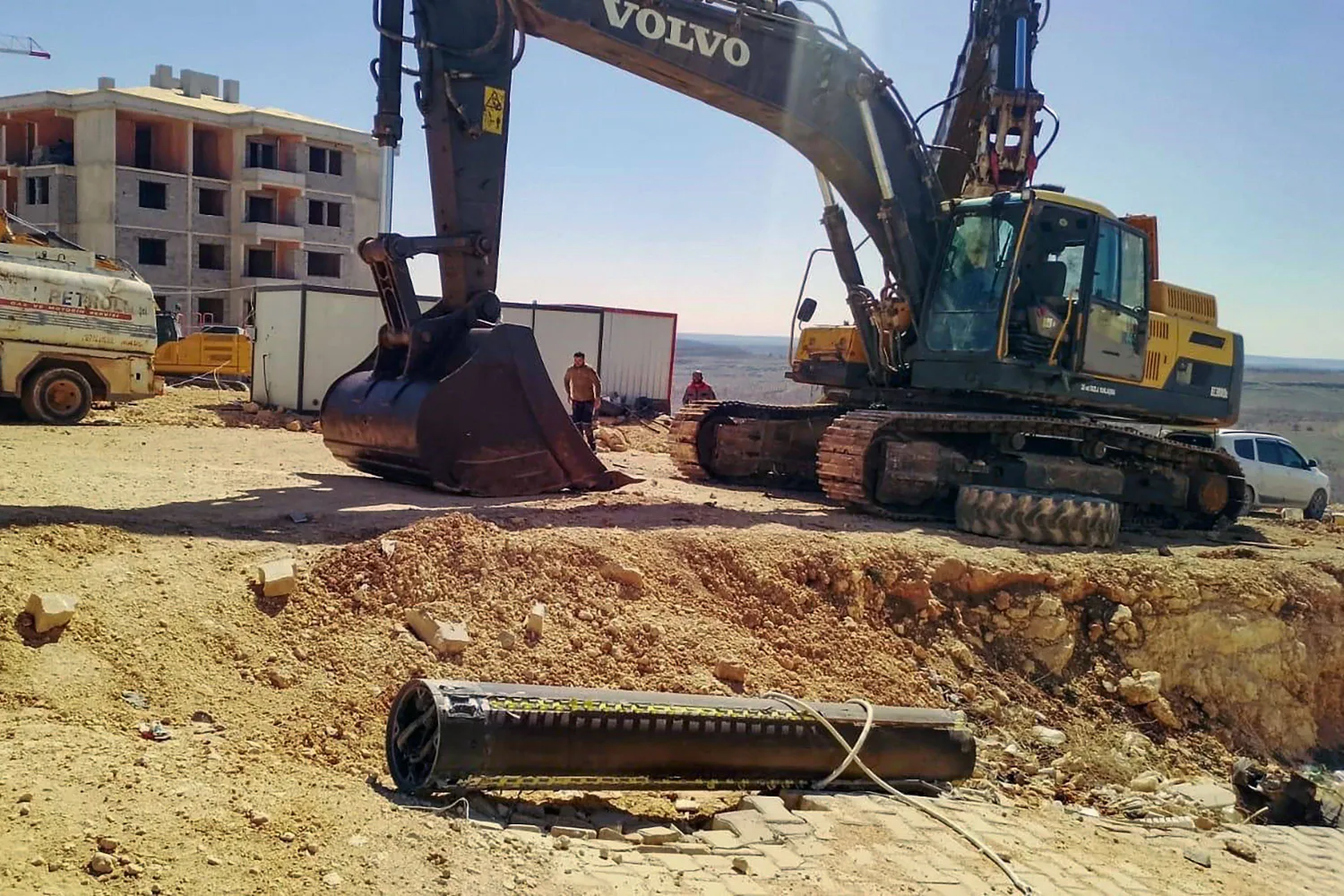
This handout photograph taken and released on March 9, 2026, by Turkish news agency DHA (Demiroren News Agency) shows part of a second Iranian ballistic missile destroyed by NATO in Turkish airspace. (Photo by Handout / DHA (Demiroren News Agency) / AFP)
TT

Türkiye Says NATO Defenses Shot Down Second Incoming Iranian Missile

This handout photograph taken and released on March 9, 2026, by Turkish news agency DHA (Demiroren News Agency) shows part of a second Iranian ballistic missile destroyed by NATO in Turkish airspace. (Photo by Handout / DHA (Demiroren News Agency) / AFP)

Türkiye said on Monday that NATO air defenses shot down a second Iranian ballistic missile that had entered its airspace and warned that it would move against any such threats, which increasingly pose a test for Ankara and the alliance.

The incident in southern Türkiye marks the second intercepted missile from Iran in the last week.

Türkiye, NATO's second-largest army and Iran's neighbor, had warned Tehran on Saturday against attacking again, but it has not suggested it wants to formally call on bloc members for further protection.

A NATO spokesperson confirmed that the alliance had intercepted a missile heading to Türkiye, and that it stood firm in its readiness to defend allies.

Unlike last ‌week's incoming ‌missile, which was downed outside Türkiye, the latest missile entered Turkish airspace. ‌Its fragments ⁠fell in a ⁠region sitting between a critical airbase to the west and a radar base to the east, both of which are used by the United States and NATO.

"We once again emphasize that all necessary measures will be taken decisively and without hesitation against any threat directed at our country's territory and airspace," the Turkish Defense Ministry said, adding there had been no casualties in the incident.

"We also reiterate that it is in everyone's interest to heed Türkiye’s warnings in this regard," it said.

President Recep Tayyip Erdogan said Türkiye had delivered the necessary warnings ⁠to Iran after the missile incident.

"Iran continues to take wrong and ‌provocative steps," Erdogan said after a cabinet meeting in Ankara.

He ‌said that Türkiye would continue to take additional measures after deploying six F-16 fighter jets to northern Cyprus earlier on ‌Monday, adding that Türkiye’s main goal was to keep the country out of the "blaze" of ‌the Iran war.

RELIANCE ON NATO DEFENSES

Türkiye, an emerging leader in the global defense industry, lacks its own fully fledged air defenses despite development efforts, and has relied on NATO air defenses stationed in the eastern Mediterranean Sea in both incidents in the last week.

Türkiye did not immediately comment on any formal steps within NATO. It had previously said ‌it had no intention of invoking the bloc's Article 4 that would call allies to consult if a member is threatened. That could lead ⁠to Article 5, which ⁠would call NATO to defend its attacked ally.

Erdogan's office said Ankara was strongly reiterating its warning to all parties, namely Iran, to avoid endangering regional stability and civilians.

It was unclear where the missile was headed.

US air forces are stationed at Türkiye’s Incirlik base, and there is a NATO radar base in Malatya province to the northeast that provides vital protection for the alliance.

Ankara said the missile debris fell in empty fields in Gaziantep, which sits roughly between the two.

The US embassy in Türkiye ordered non-emergency government employees and families to leave its southern Adana consulate, where service was suspended, and it strongly encouraged Americans to leave southeast Türkiye.

Ankara says that Washington has not used Incirlik in its air assault, alongside Israel, on Iran, which triggered Tehran's missile and drone attacks.

Iran did not immediately comment on the incident, but it has said repeatedly that it is not at war with regional countries and is not explicitly targeting Türkiye.

Türkiye had sought to mediate US-Iran talks before the air war that began 10 days ago.


France Criticizes ‘Demagogic’ Move by Israel to Ban Hard-Left Leader Melenchon

 09 November 2026, France, Paris: France's Foreign Minister Jean-Noel Barrot, speaks during a G7 foreign ministers' meeting in Paris. (dpa)
09 November 2026, France, Paris: France's Foreign Minister Jean-Noel Barrot, speaks during a G7 foreign ministers' meeting in Paris. (dpa)
TT

France Criticizes ‘Demagogic’ Move by Israel to Ban Hard-Left Leader Melenchon

 09 November 2026, France, Paris: France's Foreign Minister Jean-Noel Barrot, speaks during a G7 foreign ministers' meeting in Paris. (dpa)
09 November 2026, France, Paris: France's Foreign Minister Jean-Noel Barrot, speaks during a G7 foreign ministers' meeting in Paris. (dpa)

France has ‌criticized as "demagogic" a decision by Israel to ban French hard-left presidential candidate Jean-Luc Melenchonand another leading figure in his France Unbowed (La France Insoumise) party from entering the country.

Israel's Foreign Ministry said on Thursday it would bar Melenchon and Mathilde Panot, the party’s parliamentary group chair, over "the extreme anti-Israel stance of La France Insoumise party and the outrageous statements made by ‌its leaders."

"This demagogic ‌decision, coming from a ‌government ⁠that has repeatedly violated international ⁠law, plays into the hands of those who, like La France Insoumise, thrive on exploiting the Israeli-Palestinian conflict," Foreign Minister Jean-Noel Barrot said on X.

"France will continue to work tirelessly toward a two-state solution and the ⁠peaceful coexistence of the Israeli and ‌Palestinian peoples,” he ‌said.

The Israeli Foreign Ministry said in a ‌statement on Thursday that both Melenchon and ‌Panot had made statements spreading "blood libels" against Israel, and that Melenchon had called for French ships to escort illegal flotillas to Gaza.

"Israel will respond ‌firmly to those who seek to harm it and will not allow ⁠individuals ⁠who act against Israel and incite against its citizens to enter the country," it said.

Melenchon told Franceinfo radio: "I am banned from entering a territory I did not ask to enter...I regret that the Israeli government is pursuing me like this."

In a campaign speech last Saturday, Melenchon made clear that, if he were elected president, French vessels would accompany activists hoping to force aid into the Gaza Strip.


UN Hails Progress in Ebola Response, Cites Insecurity as Biggest Challenge

Congolese workers wearing personal protective equipment (PPE) walk outside the Ebola Treatment Center at the Bunia General Referral Hospital following a resurgence of Ebola involving the Bundibugyo strain, in Bunia, Ituri province, the Democratic Republic of Congo, November 2, 2026. (Reuters)
TT

UN Hails Progress in Ebola Response, Cites Insecurity as Biggest Challenge

Congolese workers wearing personal protective equipment (PPE) walk outside the Ebola Treatment Center at the Bunia General Referral Hospital following a resurgence of Ebola involving the Bundibugyo strain, in Bunia, Ituri province, the Democratic Republic of Congo, November 2, 2026. (Reuters)

UN health officials on Friday hailed progress in the Ebola response six months after the outbreak first prompted global concerns, but cautioned that the disease continues to spread to more remote and dangerous parts of Congo.

With the number of confirmed cases now surpassing 11,000, the outbreak is the second-worst for Ebola on record and ‌has spread to parts ‌of east, central and ‌west ⁠Africa.

Flagged by health ⁠authorities in mid-May, the outbreak is driven by the rare Bundibugyo species of the virus, for which there are no approved treatments or vaccines.

"We do see encouraging signs," said Chikwe Ihekweazu, head of ⁠the World Health Organization's Health Emergencies Program, ‌citing falling ‌cases in former hotspots like Bunia in eastern Democratic ‌Republic of Congo.

“But what we have ‌seen now is the emergence of cases in more rural and more difficult-to-reach areas ... The biggest challenge the response faces right now ‌is the rising insecurity," he said, citing WHO data showing 80 attacks ⁠on health ⁠sites and workers so far.

French medical charity Médecins Sans Frontières has been more downbeat on the Ebola response, saying that supplies are missing and the virus is still spreading out of control.

Julien Harneis, the UN's special Ebola coordinator, said in response to the criticism: "The area of operation is vast, just unimaginable vast...But 80% of the time, and across this vast area, we're able to operate."


Five Facts About APEC with Trump, Putin and Xi Set to Attend

Workers install signage for the upcoming Asia-Pacific Economic Cooperation (APEC) China 2026 summit on the wall of a building in Shenzhen, China's Guangdong province on November 12, 2026. (AFP)
TT

Five Facts About APEC with Trump, Putin and Xi Set to Attend

Workers install signage for the upcoming Asia-Pacific Economic Cooperation (APEC) China 2026 summit on the wall of a building in Shenzhen, China's Guangdong province on November 12, 2026. (AFP)

Attention will focus next week ‌on a summit of US, Chinese and Russian leaders set for the 21-member gathering of the Asia-Pacific Economic Cooperation (APEC) forum in China's southern technology hub of Shenzhen.

WHAT IS APEC?

Founded as an informal 12-member dialogue effort in 1989 in the Australian capital of Canberra, it has become the region's premier economic forum to foster ties on advancing growth, trade and investment.

Accounting for about 62% of global GDP and roughly half of global trade, the grouping of "member economies" rather than nations allows participation by Chinese-ruled Hong Kong and democratically governed Taiwan, which Beijing claims as its own territory.

It does not include India, the world's most populous nation, however.

APEC operates on non-binding commitments reached strictly by consensus, with commitments undertaken on a voluntary basis.

The APEC Economic Leaders' Meeting is set for November 18 and 19, preceded by an annual summit of CEOs on November 17-18.

WHY SHENZHEN?

China is ‌hosting the summit ‌for the third time, after events in the commercial hub of Shanghai ‌in ⁠2001 and the ⁠capital, Beijing, in 2014.

Both domestic and international reasons govern the choice of Shenzhen, adjacent to the financial center of Hong Kong, said Chim Lee, senior analyst at the Economist Intelligence Unit.

As part of China's Greater Bay Area home to Hong Kong and Macau, which Beijing seeks to establish as a global hub for technology and innovation, the city offers a platform to showcase China's vision for development and trade.

It also highlights Shenzhen's resilience to geopolitical turbulence, Lee added.

The city is the base of several leading Chinese auto and tech giants, such as BYD, ⁠Huawei and Tencent .

WHO WILL BE THERE?

China has said President Xi Jinping ‌will chair the leaders' meeting and deliver remarks. US President Donald ‌Trump, Russian President Vladimir Putin and Philippine President Ferdinand Marcos Jr. are among those expected.

The leaders of Canada, Australia, Mexico ‌and Indonesia are also due to attend, along with those of Malaysia, South Korea and Vietnam among ‌Asia-Pacific nations.

Taiwan has designated Stan Shih, founder of Acer, as its envoy.

WHAT TO WATCH AND KEY STICKING POINTS

Middle East Instability: The economic ripple effects of conflict, such as risks to energy security, trade flows, supply chains and inflation are ‌major concerns expected to figure in talks.

Tripartite Dynamics: All eyes are on the possible meeting of Chinese, Russian and US leaders. China is hesitant to ⁠engage in talks on nuclear ⁠disarmament, as it has fewer such weapons than the other two, analysts said.

The US and Russia will also be keen to discuss the Ukraine war, but not necessarily China, they said.

China-US Relations: A key focus to see if ties can stay stable. Both sides are falling short on commitments to an extended trade truce, analysts said. Rare earth supplies, artificial intelligence and tariffs are also likely to figure on the agenda, with US arms sales to Taiwan closely watched.

China's ties with Japan and the Philippines: Strains in Japan and China ties have persisted since Prime Minister Sanae Takaichi angered Beijing in November 2025 by suggesting that Japan could deploy its military if a Chinese move against neighboring Taiwan also threatened its territory.

China-Philippines relations will likewise be closely watched amid continuing tension in the disputed waterway of the South China Sea.

WHO ARE APEC'S MEMBERS?

These are Australia, Brunei, Canada, Chile, China, Hong Kong, Indonesia, Japan, South Korea, Malaysia, Mexico, New Zealand, Papua New Guinea, Peru, the Philippines, Russia, Singapore, Taiwan, Thailand, the United States and Vietnam.