


Iraqi Judiciary Signals Action Against Factions Over Embassy Attacks

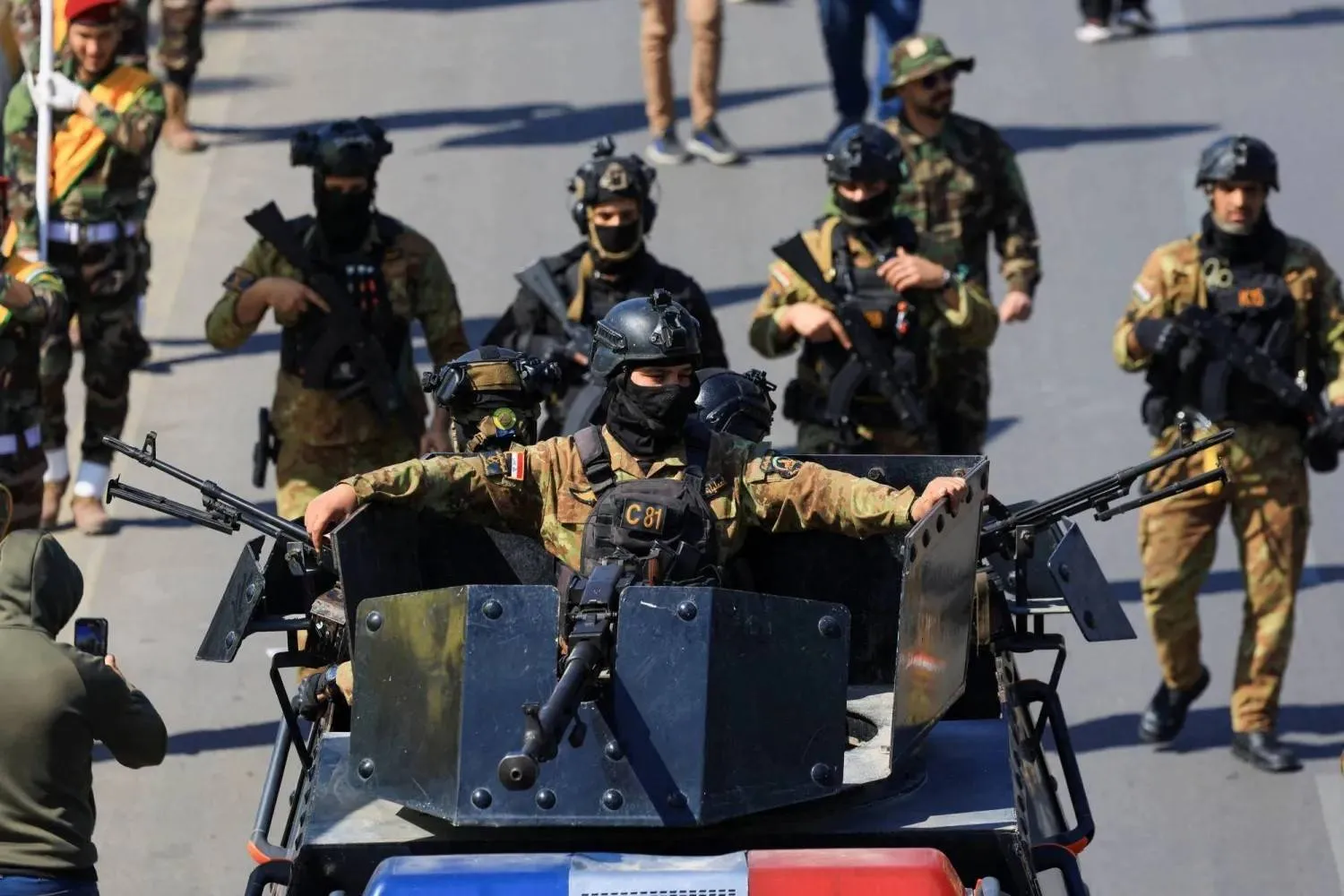
Members of Kataeb Hezbollah attend the funeral in Baghdad of comrades killed in a strike on the Syrian border (file photo – Reuters)
TT

Iraqi Judiciary Signals Action Against Factions Over Embassy Attacks

Members of Kataeb Hezbollah attend the funeral in Baghdad of comrades killed in a strike on the Syrian border (file photo – Reuters)

Pro-Iran factions are facing possible prosecution and conviction by Iraq’s Supreme Judicial Council, as US strikes continue to target their positions in areas suspected of launching attacks on diplomatic missions and American interests in the Kurdistan region.

On Monday evening, an attack targeted the United Arab Emirates consulate and Erbil airport near a US base, according to videos and eyewitnesses, while the Iraqi government is moving toward announcing the names of those responsible after attempts to halt the attacks, which have continued for about a week, failed.

A drone struck the UAE consulate in the Mass City area on the road linking Erbil with the Salahaddin district, without causing any reported damage.

Condemnations

Iraq’s foreign ministry on Tuesday condemned attacks targeting diplomatic missions and consulates in Baghdad and the Kurdistan region, reaffirming its rejection of any assault on diplomatic missions and saying the competent authorities would take legal action against those involved.

In a statement, the ministry said Iraq’s position was firm in rejecting any attacks against diplomatic and consular missions and stressed its commitment to providing full protection to ensure they can continue operating and carrying out their duties in a safe environment, in line with relevant international obligations.

The ministry added that Iraqi authorities were closely monitoring any incidents affecting diplomatic missions and would take the necessary legal measures against those responsible to safeguard their security and prevent such attacks from recurring.

The UAE also condemned the drone attack on its consulate in the Kurdistan region, saying the targeting of diplomatic missions and premises constituted a violation of international norms and laws.

It called on the governments in Baghdad and Erbil to reveal the circumstances of the attack and hold those responsible accountable.

Saudi Arabia’s foreign ministry on Tuesday expressed solidarity with the UAE and likewise condemned the targeting of the Emirati consulate general in the Kurdistan region, saying the attack violated international norms and laws and stressing the need to respect the sanctity of diplomatic mission buildings.

Judicial measures

In a later development, Iraqi Foreign Minister Fuad Hussein met on Tuesday with Faiq Zaidan, head of Iraq’s Supreme Judicial Council, to discuss “judicial and legal measures taken against the perpetrators of terrorist crimes represented by attacks on diplomatic missions, institutions and citizens in Iraq,” according to a statement.

It is one of the rare occasions in Iraq when firm positions are voiced against the conduct of the factions, while observers note that the targeting of diplomatic missions could turn into a judicial case leading to trials of members and leaders of these Iran-aligned groups.

However, observers doubt the government’s ability to confront the Iran-backed armed factions that continue launching rockets and drones at various sites across Iraq. Many of the attacks have focused on the Kurdistan region, which has been hit by more than 200 strikes targeting various locations, infrastructure and foreign consulates.

The group known as the Islamic Resistance in Iraq said on Tuesday it had carried out 37 military operations within the past 24 hours inside Iraq and elsewhere in the region.

As the attacks persist, reliable sources say the failure of attempts to curb the factions may push the Iraqi government to “expose the groups involved in the attacks by name,” according to Iraqi officials cited by sources.

The government of Prime Minister Mohammed Shia al-Sudani, whose term is ending, is facing local, regional and international pressure to rein in the armed groups. Authorities have shown little capacity to act effectively and often limit their responses to mere condemnations, placing the government in an embarrassing position before citizens and the international community.

On Sunday, Bafel Talabani, leader of the Patriotic Union of Kurdistan party, presented Baghdad with what he said was a list of names of some of the armed groups attacking the region, though federal authorities have yet to take serious action.

The US Consulate General in Erbil confirmed on Tuesday that US Secretary of State Marco Rubio spoke by phone with al-Sudani.

It said Rubio strongly condemned the terrorist attacks carried out by Iran and terrorist militias allied with it in Iraq, including the Kurdistan region, referring to attacks targeting US diplomatic missions and facilities in Iraq and the Kurdistan region.

Both sides stressed the importance of the Iraqi government taking all necessary measures to protect US personnel and diplomatic facilities.

“Deep state”

Kifah Mahmoud, media adviser to Masoud Barzani, leader of the Kurdistan Democratic Party, said he doubted the federal government’s ability to confront the armed factions.

“What is strange about these attacks is that the government forms investigation committees involving parliament and security agencies — most of them from influential Shiite forces — then they investigate and identify those responsible, but they do not announce the results or take any action against them,” Mahmoud told Asharq Al-Awsat.

Mahmoud said Iraqi actors may be deliberately covering up the results of investigations or are too weak to hold the perpetrators accountable.

“It is difficult to hold these groups accountable because they form a deep state that possesses all the means necessary to practice its terrorism against the state and its legitimate institutions,” he said.

Kidnapping risk

Meanwhile, the US embassy in Baghdad warned American citizens in Iraq on Tuesday of rising security risks, saying they face threats including kidnapping and attacks targeting US citizens and their interests, and urging them to leave the country when conditions permit.

In a security alert, the embassy said Iran and armed groups loyal to it continue to pose a serious threat to public security, urging US citizens to exercise caution, avoid drawing attention to themselves and stay away from locations associated with the US or where Americans gather.

The alert said previous attacks had targeted American citizens and interests in Iraq, warning that US nationals face kidnapping risks. US companies, hotels frequented by foreigners and other facilities linked to the United States have also been attacked in the past.

The embassy added that citizens who choose to remain in Iraq should be prepared to shelter in place for extended periods and ensure they have food, water, medicines and other essential supplies.



States Backing UN Peacekeepers in Lebanon Voice 'Deep Alarm' at Hostilities

Members of the UNIFIL peacekeeping force enter a bus at the site of an Israeli strike at the northern entrance of the southern city of Sidon, on November 7, 2024, amid the ongoing war between Israel and Hezbollah.  (Photo by Mahmoud ZAYAT / AFP)
Members of the UNIFIL peacekeeping force enter a bus at the site of an Israeli strike at the northern entrance of the southern city of Sidon, on November 7, 2024, amid the ongoing war between Israel and Hezbollah. (Photo by Mahmoud ZAYAT / AFP)
TT

States Backing UN Peacekeepers in Lebanon Voice 'Deep Alarm' at Hostilities

Members of the UNIFIL peacekeeping force enter a bus at the site of an Israeli strike at the northern entrance of the southern city of Sidon, on November 7, 2024, amid the ongoing war between Israel and Hezbollah.  (Photo by Mahmoud ZAYAT / AFP)
Members of the UNIFIL peacekeeping force enter a bus at the site of an Israeli strike at the northern entrance of the southern city of Sidon, on November 7, 2024, amid the ongoing war between Israel and Hezbollah. (Photo by Mahmoud ZAYAT / AFP)

Around 30 countries, including those with United Nations peacekeepers in Lebanon, voiced concern Wednesday over renewed fighting after Israel launched strikes in retaliation for attacks by Hezbollah.

"We troop contributing countries to the UN peacekeeping force in Lebanon, joined by several other member states, express our deep alarm at the escalation of hostilities in Lebanon," Jerome Bonnafont, the French ambassador to the United Nations, told reporters in New York, Reuters reported.

"Faced with war, Lebanon must be supported. Its sovereignty and territorial integrity must be preserved. We express our full solidarity with Lebanon and the Lebanese people," he added in the joint statement.

Bonnafont said the countries he represented, including France, Britain, Germany, India and Korea, "condemn in the strongest terms" Hezbollah's attacks.

He spoke as the Security Council was to meet at the UN headquarters to discuss the uptick in fighting in Lebanon, which has left 570 people dead, according to the country's health ministry.

Israel's UN envoy Danny Danon said Wednesday that Israeli forces will continue to operate in Lebanon "as long (as) there will be a threat against us."

"Israel does not want to be operating, but Israel will not accept rockets fired at our people, and we will do whatever is necessary to stop them," Danon told reporters.


Shrapnel from Bombing Kills Woman in Iraq

Members of Kataeb Hezbollah attend the funeral in Baghdad of comrades killed in a strike on the Syrian border (file photo – Reuters)
TT

Shrapnel from Bombing Kills Woman in Iraq

Members of Kataeb Hezbollah attend the funeral in Baghdad of comrades killed in a strike on the Syrian border (file photo – Reuters)

Shrapnel killed a woman following a strike on an arms depot belonging to an Iran-backed armed group in Iraq, health and security officials told AFP.

A security source said "a bombing targeted an arms depot at a military base", which mainly hosts the powerful Asaib Ahl al-Haq group, near the town of Al-Suwaira, southeast of Baghdad.

He added that "a woman was martyred when shrapnel from a rocket fell near her after the strike" in the town in Wasit province.

A local health official confirmed her death and said another person was seriously wounded.

The military base belongs to the Hashed al-Shaabi, or the Popular Mobilization Forces, a former paramilitary coalition now integrated into Iraq's regular army.

It also encompasses brigades from Iran-backed groups, including the US-blacklisted Asaib Ahl al-Haq.

Since the start of the Middle East war, bases belonging to the Hashed al-Shaabi have been hit several times by strikes blamed on the US and Israel.

At least 20 fighters have been killed so far, according to an AFP tally based on figures from the armed groups.


Israeli Settler Violence Rises in West Bank Under Iran War Curbs

Mourners carry the bodies of three Palestinians killed in a reported attack by Israeli settlers in the town of Abu Falah, northeast of Ramallah in the occupied West Bank, during the funeral on March 8, 2026. (Photo by Zain JAAFAR / AFP)
TT

Israeli Settler Violence Rises in West Bank Under Iran War Curbs

Mourners carry the bodies of three Palestinians killed in a reported attack by Israeli settlers in the town of Abu Falah, northeast of Ramallah in the occupied West Bank, during the funeral on March 8, 2026. (Photo by Zain JAAFAR / AFP)

Israeli settlers in the occupied West Bank are taking advantage of curbs on movement imposed during the war on Iran to attack Palestinians, with military roadblocks preventing ambulances reaching victims quickly, rights groups and medics say.

Settlers have killed at least five Palestinians in the West Bank since the United States and Israel began airstrikes against Iran on February 28, according to the Palestinian health ministry. A sixth man died after inhaling teargas fired during an attack, according to Israeli rights group B'Tselem.

Israel's military blocked many West Bank roads with iron gates and mounds of earth on the first day of the war, and has largely shut crossings with Israel.

The Israeli military says the curbs are preemptive measures while it is carrying out airstrikes on Iran and against Lebanese group Hezbollah, which has fired missiles at Israel in solidarity with Tehran.

Palestinians in remote West Bank villages say the roadblocks have left them increasingly exposed to settler violence.

The Israeli military has also continued to carry out the raids it frequently conducts in Palestinian cities and towns during peacetime to arrest Palestinians, often without charge, they say.

A spokesperson for the Yesha Council, which represents Jewish settlements, did not immediately respond to a Reuters request for comment on the attacks.

Malak ⁠Beirat's husband, Thaer, ⁠was one of two Palestinians who residents and the Palestinian health ministry say were shot dead by settlers before dawn on Sunday in Abu Falah, north of the city of Ramallah.

"Thaer loved life. I never expected he would die," said Beirat, fighting back tears as she sat with her two children.

Witnesses told Reuters that when over 100 settlers gathered on the outskirts of Abu Falah, a local WhatsApp group rallied men to protect the small village. The initial confrontation involved stone throwing, but armed settlers arrived later and began shooting, they said.

Beirat's husband was shot dead while trying to protect a house from attack, a man who helped defend the village said.

Blood could still be seen on Monday in olive groves at the scene of the attack, where villagers have erected ⁠two Palestinian flags at the spots where the two men were killed - one for each victim.

A third Palestinian died after the attack. B'Tselem said his death was probably caused by the effect of teargas fired by Israeli troops deployed to the village during the attack.

The Israeli military says an investigation has been launched into the incident and that it condemns "violence of any kind".

Medics say the new roadblocks have led to delays in reaching injured Palestinians.

"There are obstacles - and even attacks by settlers and the military on the (medical) crews," said Ahmed Jibril, spokesman for the Palestinian Red Crescent ambulance service.

There have been over 109 reports of settler violence against Palestinians in the West Bank since the start of the war with Iran including shootings, physical assaults, property damage, and threats, said Israeli monitoring group Yesh Din.

All the reported killings of Palestinians by settlers this year were in the last week, B'Tselem said.

Settlers shot dead Amir Muhammad Shanaran in a village near the city of Hebron on Saturday, and brothers Muhammad and Fahim ‘Azem were shot dead in Qaryut southeast of the city of Nablus last Monday, the Palestinian health ministry said.

"Taking advantage of the war, armed settler ⁠militias, often operating with support from the ⁠army, continue to attack and harass Palestinian communities across the West Bank in an effort to force them out," B'Tselem said.

In three of the settler shootings, the settlers were wearing Israeli army uniform, Yesh Din said. The Israeli military did not immediately respond to a request for comment.

Palestinians accuse the military of protecting settlers rather than villagers. Israel's military denies this.

Israeli indictments of settler violence are rare. At the end of 2025, Yesh Din said that of the hundreds of cases of settler violence it had documented since the Hamas-led attacks on Israel in October 2023 that led to the Gaza war, only 2% resulted in indictments.

The United Nations says nearly 700 Palestinians were displaced by settler violence from the start of 2025 through early February 2026.

Israel's government has expanded settlements in a construction push that Finance Minister Bezalel Smotrich says is aimed at burying the idea of a Palestinian state.

Right-wing Israeli minister Yossi Dagan announced on Wednesday the establishment of a new settlement in a strategic position in the mountain overlooking Nablus, one of 22 new settlements announced by the Israeli government last May.

Palestinians have long sought an independent state in the West Bank, Gaza and East Jerusalem, territories Israel captured and occupied in the 1967 Middle East war.

Over 700,000 settlers live in East Jerusalem and the West Bank among more than 3 million Palestinians, according to a European Union report in 2024.
Most of the world considers Israel's settlement activity in the West Bank illegal under international law relating to military occupations. Israel disputes this view.