


Air Freight Rates Soar as Middle East Conflict Blocks Trade Routes

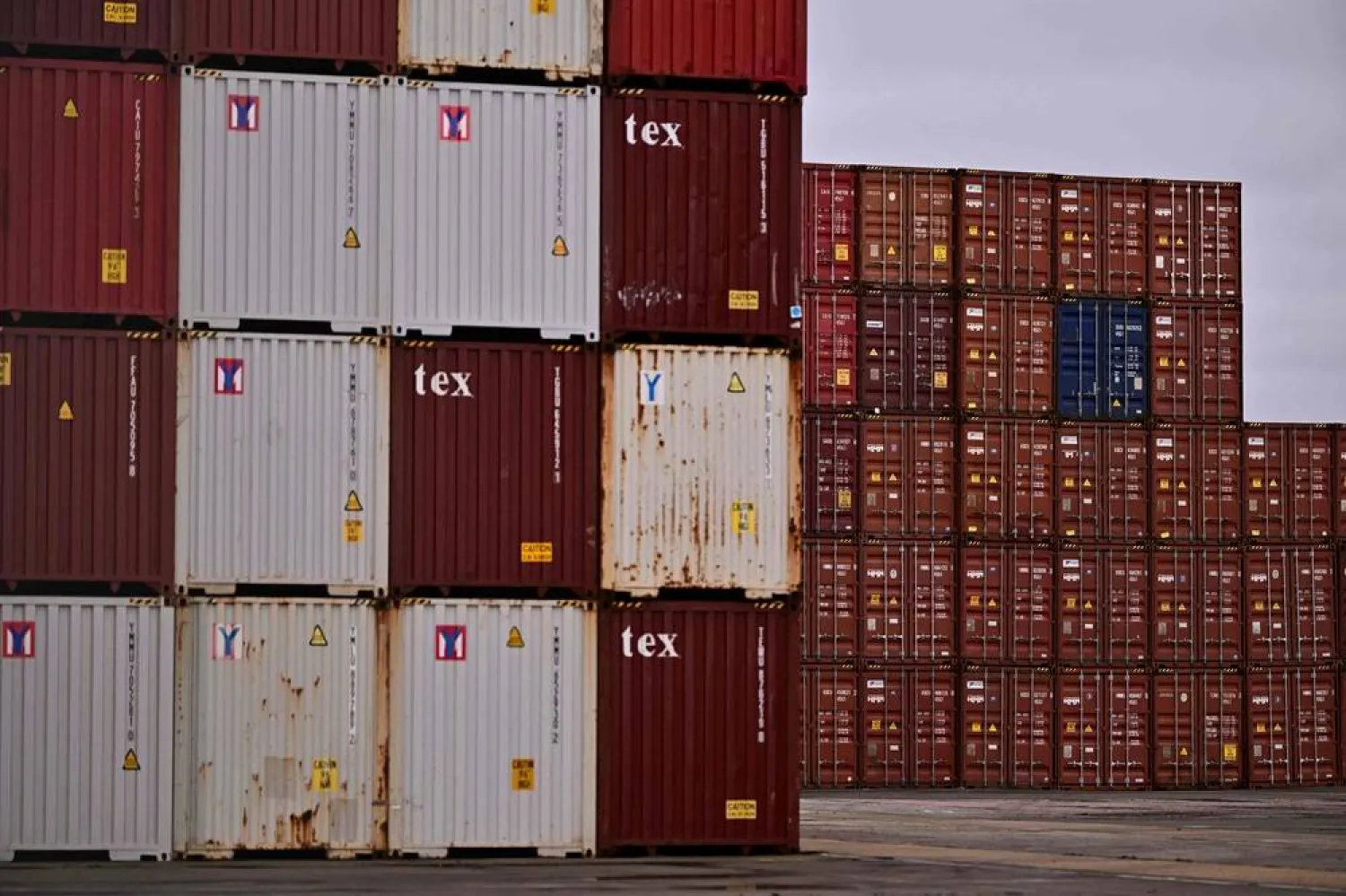
Shipping containers are pictured at the UK's largest freight port, in Felixstowe on the East coast of England, on March 12, 2026. (AFP)
TT

Air Freight Rates Soar as Middle East Conflict Blocks Trade Routes

Shipping containers are pictured at the UK's largest freight port, in Felixstowe on the East coast of England, on March 12, 2026. (AFP)

Air freight rates have risen by as much as 70% on some routes since the start of the US-Israeli war on Iran, data shows, as the conflict limits flights, blocks some ocean shipments and pushes up jet fuel costs.

Rates on routes between South Asia and Europe have been the most affected by Middle Eastern airspace closures and security issues, industry experts said, after the conflict has stranded more than 100 container ships in the area around the critical Strait of Hormuz oil export corridor.

Products like inexpensive generic medicines from India destined for the European Union, Africa and some Arab countries like Saudi Arabia and the United Arab Emirates typically move on container ships through the strait, said pharmaceutical supply chain expert Prashant Yadav.

"The main shift I’ve heard about involves companies moving generic ‌medicines from ocean ‌freight to air cargo," said Yadav, a senior fellow at the Council on ‌Foreign ⁠Relations.

The shift to ⁠air cargo is significant because air freight handles about one-third of global trade by value, making rate spikes a potential inflationary pressure on goods ranging from fresh food to pharmaceuticals and electronics.

"Customers are shifting freight from ocean to air, however it is extremely expensive - typically 5x to 10x higher - and those costs are climbing as capacity tightens," said Steve Blough, chief supply chain strategist at logistics software firm Infios. "More often, shippers are moving a limited quantity by air to bridge a gap."

JET FUEL PRICE DOUBLES

The jet fuel price has doubled since the start of the conflict, and Danish container ⁠shipping giant Maersk said this week its own air cargo service is now applying ‌fuel surcharges and war risk levies.

The airspace closures have also cut ‌cargo capacity in freighters and passenger planes as airlines take longer routes to avoid the conflict zone, further pressuring rates.

Dubai and ‌Doha are normally among the world's busiest air cargo hubs, but operations at those airports have been ‌severely limited by the Middle Eastern conflict.

Niall van de Wouw, chief air freight officer at transportation pricing platform Xeneta, attributed higher air cargo rates to a "dramatic reduction" in capacity at key Middle East transshipment hubs more than higher fuel prices.

Ronald Lam, the CEO of Hong Kong's Cathay Pacific Airways, said many of its freighter flights to Europe normally stop in Dubai to refuel ‌and pick up more cargo.

"But because of the situation in Dubai, we're now skipping that stopover and we are flying direct from Hong Kong to ⁠Europe with some payload restriction, ⁠because we couldn't uplift fuel in between," he said on an earnings call on Wednesday.

According to an air freight index from freight booking and payments platform Freightos, off-contract spot rates from South Asia to Europe have soared 70% to $4.37 per kg from $2.57 per kg just before the war began.

South Asia-North America rates are up 58% to $6.41 per kg, and Europe-Middle East rates have risen 55% to $2.79 per kg.

A significant share of air cargo exports from South Asia usually travels through Gulf hubs and some has had to reroute through East Asia, said Judah Levine, Freightos' head of research.

"That being said, we have seen the price increases on many of these lanes slow, level off or even decline slightly in the last couple days," he said.

"These trends may reflect Asian and European carriers adding capacity to these long-haul lanes to make up for the missing Gulf capacity, and they may also reflect some of the Gulf carriers - most importantly Emirates - having restarted operations and increasing the number of flights that are now leaving and arriving at these important Gulf hubs."



Middle East War Presents ‘Serious Risk’ for Africa, Warns Report

Festus Mwirotsi, 34, scouts for pests and diseases in roses meant for export at Isinya Roses farm in Kajiado, Kenya, March 24, 2026, as Kenya's flower industry is losing up to $1.4 million a week as the Iran war cuts demand and disrupts shipping. (AP)
TT

Middle East War Presents ‘Serious Risk’ for Africa, Warns Report

Festus Mwirotsi, 34, scouts for pests and diseases in roses meant for export at Isinya Roses farm in Kajiado, Kenya, March 24, 2026, as Kenya's flower industry is losing up to $1.4 million a week as the Iran war cuts demand and disrupts shipping. (AP)

The Middle East war "presents a serious risk to Africa", the African Union and the African Development Bank (AfDB) said in a report seen by AFP Saturday.

The conflict threatens to increase the cost of living and curtail growth on the continent, the report warned.

The Middle East accounts for 15.8 percent of Africa's imports and 10.9 percent of its exports, the report noted.

"The conflict, which already has triggered a trade shock, could quickly turn into a cost-of-living crisis across Africa through higher fuel and food prices, rising shipping and insurance costs, exchange rate pressures, and tighter fiscal conditions," it added.

The growth rate of most African countries continues to be slower than before the Covid pandemic, it noted.

"A loss in output growth of 0.2 percentage points on Africa's GDP is projected for 2026 if it (the conflict) exceeds six months," it said.

"The longer the conflict lasts and the more severe the disruption to shipping routes and energy and fertilizer supplies, the greater the risk of a significant growth slowdown across the continent."

Reduced deliveries of liquefied natural gas (LNG) from the Gulf will impact fertilizer production, limiting its availability during the crucial planting period up to May, it added.

- Currencies hit -

The report was compiled by the UN Development Program (UNDP) and the United Nations Economic Commission for Africa (UNECA).

According to recent data from the AfDB, the currencies of 29 African countries have already depreciated, increasing the cost of servicing external debt, making imports more expensive and reducing foreign exchange reserves,

Some countries could see some short-term gains, such as Nigeria for its oil exports or Mozambique for its LNG.

The rerouting of ships around Cape of Good Hope could benefit ports in Mozambique, South Africa, Namibia and Mauritius.

Kenya is establishing itself as a logistics hub in East Africa, while Ethiopian Airlines, the leading carrier in Africa, is serving as an "emergency air bridge" between the continent, Asia, and Europe, the report noted.

But these gains are likely to be uneven and will not offset the consequences for inflation, budgets, and food security in Africa, they warned.

Above all, the current crisis could hit the costs of humanitarian aid and divert donor funds towards other priorities.


Taiwan Says It Has Assurances over LNG Supplies from 'Major' Country

The Taipei 101 skyscraper is seen lit up before the Earth Hour in Taipei, Taiwan, Saturday, March 28, 2026. (AP Photo/ Chiang Ying-ying)
TT

Taiwan Says It Has Assurances over LNG Supplies from 'Major' Country

The Taipei 101 skyscraper is seen lit up before the Earth Hour in Taipei, Taiwan, Saturday, March 28, 2026. (AP Photo/ Chiang Ying-ying)

Taiwan has received ‌supply assurances from the energy minister of a "major" liquefied natural gas-producing country, the island's economy minister said on Saturday, speaking about the Iran war's impact on Middle East energy imports.

Taiwan, a major semiconductor producer, had relied on Qatar for around a third of its LNG before the conflict, and has said it has secured alternate supplies for the months ahead from countries including Australia and the United States, said Reuters.

Speaking to ‌reporters in Taipei, ‌Economy Minister Kung Ming-hsin said that ‌because ⁠Taiwan has good ⁠relationships with its crude oil and natural gas suppliers, neither adjusting shipment origins nor purchasing additional spot cargoes would be a problem.

Kung said that about two weeks ago the energy minister of a certain "major energy-producing country" proactively contacted him.

The person "explained to us that they ⁠would fully support our natural gas needs. ‌If we have any ‌demand, we can let them know," he added.

"Another country even ‌said that some countries have released strategic petroleum ‌reserves, and they could also help coordinate matters if Taiwan needs assistance," Kung said.

"This shows that Taiwan has in fact earned considerable goodwill internationally through the long-term trust ‌it has built over the years," he said.

He declined to name the countries involved.

Angela ⁠Lin, ⁠spokesperson for state-owned refiner CPC, said at the same news conference that crude oil inventories were being maintained at pre-conflict levels and overall petrochemical feedstock supplies have remained stable.

CPC Chairman Fang Jeng-zen said that to reduce dependence on the Middle East, a new contract with the US will see 1.2 million metric tons of LNG supplied annually, with even more to come in the future, including eventually from Alaska.

However, Taiwan is not considering importing crude or LNG from Russia, he added.


India Says Crude Oil Supplies Secured, No Payment Issues for Iran Imports

The Indian-flagged carrier Jag Vasant, carrying liquefied petroleum gas (LPG) via the Strait of Hormuz, arrives at Mumbai Port in Mumbai, India, 01 April 2026. EPA/DIVYAKANT SOLANKI
TT

India Says Crude Oil Supplies Secured, No Payment Issues for Iran Imports

The Indian-flagged carrier Jag Vasant, carrying liquefied petroleum gas (LPG) via the Strait of Hormuz, arrives at Mumbai Port in Mumbai, India, 01 April 2026. EPA/DIVYAKANT SOLANKI

India's petroleum ministry said in a post on X on ‌Saturday ‌that the ‌country's ⁠refiners have secured their ⁠crude requirements, including from Iran, ⁠and ‌there are ‌no payment hurdles ‌for ‌Iranian imports.

India's crude oil ‌requirements remain fully secured ⁠for the coming ⁠months, the ministry added.