


Türkiye’s Foreign Minister Hakan Fidan Talks Diplomatic Efforts as Regional War Rages

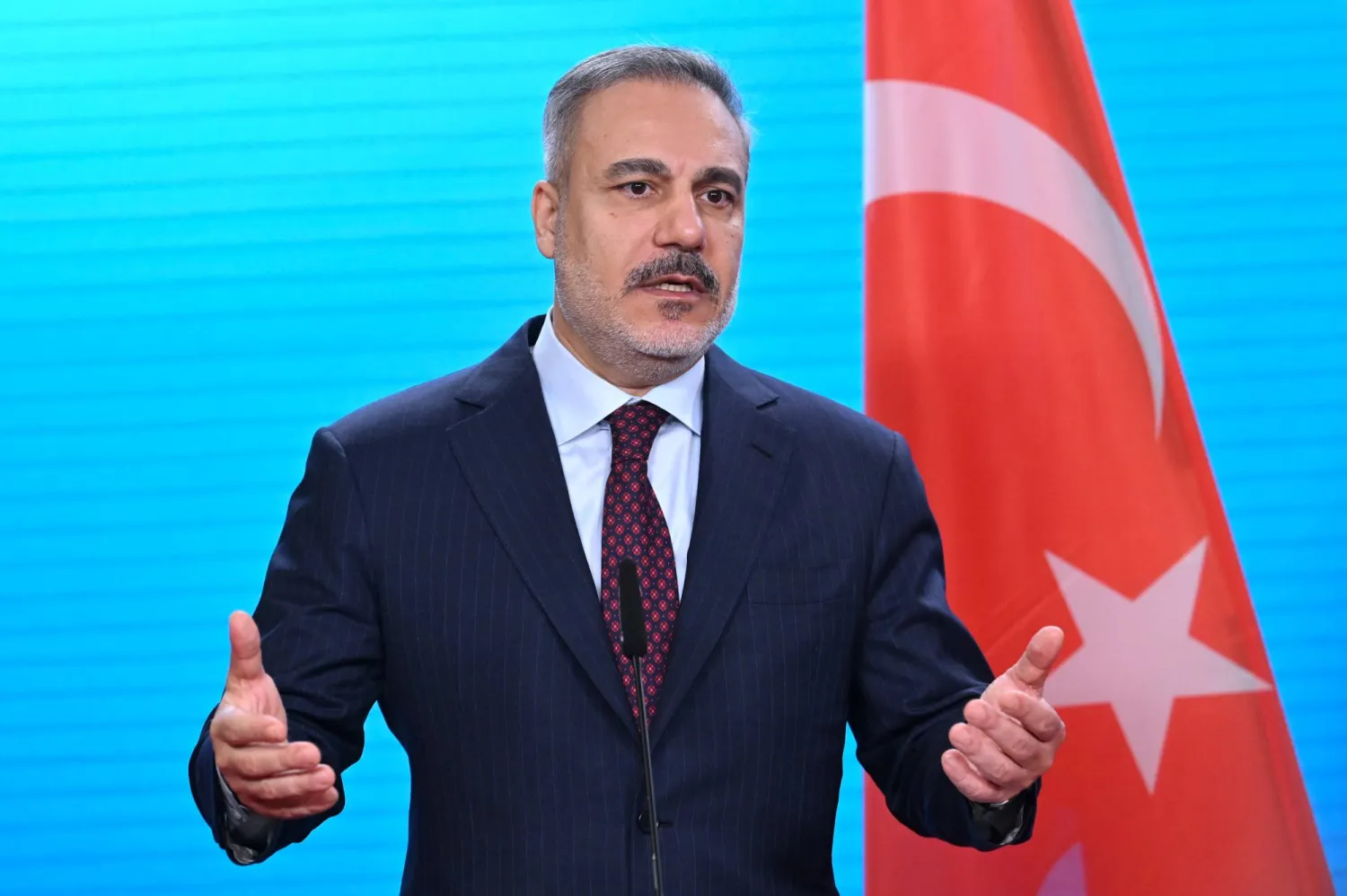
FILED - 28 November 2025, Berlin: Turkish Foreign Minister Hakan Fidan speaks at a press conference in Berlin. Photo: Soeren Stache/dpa
TT

Türkiye’s Foreign Minister Hakan Fidan Talks Diplomatic Efforts as Regional War Rages

FILED - 28 November 2025, Berlin: Turkish Foreign Minister Hakan Fidan speaks at a press conference in Berlin. Photo: Soeren Stache/dpa

Türkiye’s powerful foreign minister said Saturday that there is no serious initiative to resume negotiations between the United States and Iran but that he believes Iran is open to back-channel talks.

The comments by Foreign Minister Hakan Fidan to The Associated Press in an exclusive interview came as Ankara is striving to stay out of the widening war in the Middle East.

Ankara, which has good relations with both Washington and Tehran, had attempted to mediate a solution between them before the US and Israel attacked Iran two weeks ago, triggering the war.

“The conditions are not very much conducive” to diplomacy now, Fidan said. The Iranians “feel betrayed” because for a second time they were attacked while in active negotiations with the US over their nuclear program, he said, but added, “I think they are open to any sensible back-channel diplomacy.”

Fidan, 57, served as Türkiye’s intelligence chief for more than a decade before being appointed foreign minister in 2023.

Key role in formulating Türkiye’s Middle East policy

In that role, he played a key part in shaping Türkiye’s policy in the Middle East, particularly toward Syria, Iraq and Iran. He is considered to be one of President Recep Tayyip Erdogan ’s most trusted advisers and one of the potential candidates to succeed him.

Türkiye has maintained a neutral position in the war, criticizing both the US and Israeli strikes against Iran and Tehran’s retaliatory actions against Gulf states that host US bases. Fidan said he has been attempting to persuade the Iranians to halt those attacks.

Fidan said Türkiye’s top priority is to remain outside of the conflict, even after three missiles believed to come from Iran were intercepted over Türkiye by NATO defenses. Türkiye is a NATO member and an air base in southern Türkiye is used by NATO forces, including US troops.

Iranian officials have insisted that they did not fire at Türkiye, although the available data shows that the missiles came from Iran, the Turkish foreign minister said.

He ruled out a military response at this stage, saying that NATO’s defenses were effective and that Ankara’s “primary objective” is to stay out of the conflict.

“I know that we are being provoked and we will be provoked, but this is our objective,” he said. “We want to stay out of this war.”

Fidan, who has regular contact with Iranian officials, said he does not know the severity of the wounds suffered by Iran’s new Supreme Leader Mojtaba Khamenei in a strike earlier in the war, but that “what we know is that he is alive and functioning.”

Khamenei was appointed to replace his father, Ali Khamenei, who was killed Feb. 28 during the war’s opening salvo.

Fidan said “the process of electing a new leader and the medical conditions of the new leader, it created a gap” in Iran’s power structure and “I think that gap has been filled by the high command of the Revolutionary Guards,” referring to the paramilitary force reporting to the Supreme Leader.

A failed peace initiative

Before the conflict, Türkiye tried to avert a war by offering to host talks in Istanbul that would have brought US, Iran and other regional countries together. Iran later opted for talks mediated by Oman, without the participation of regional actors and focusing solely on its nuclear program — talks that ultimately failed.

Fidan said that Iran had refused to discuss its missile program and the proxy armed groups it backs in the region, including the Lebanese Hezbollah and a group of Iraqi militias — both of which have now waded into the regional war.

Türkiye had proposed that “the Americans and the Iranians can discuss fully the nuclear issue and we as regional countries can come together to discuss the other two with Iran” as part of an initiative to build trust within the region.

Tensions with Israel

Türkiye and Israel have tense relations, with Erdogan becoming one of the most vocal critics of Israel’s actions in Gaza. Türkiye has cut trade ties with Israel and frequently accuses Israel of committing genocide. Israel in turn accuses Türkiye of supporting Hamas, the Palestinian militant group that launched the deadly Oct. 7, 2023 attack in southern Israel.

Since Israel launched its strikes on Iran, some have gone as far as to suggest that Türkiye could be the next target. Fidan dismissed that possibility, while acknowledging that the war in Iran gave Türkiye an increased incentive to step up its own production of weapons and air defenses.

“As long as Netanyahu is there, (Israel) will always identify somebody as an enemy,” he said. “Because they need it to advance their own agenda. If not Türkiye, they would name some other country in the region.”

He criticized Israel’s role elsewhere in the region, including in Syria, where both countries have strategic interests.

Türkiye has been a strong backer of the current government in Damascus led by interim President Ahmad al-Sharaa.

Israel regards al-Sharaa’s government with suspicion and, since it took power in December 2024, Israeli forces have seized control of a swathe of land in southern Syria and launched airstrikes on Syrian military facilities, wiping out much of the country’s arsenal. Israel has said its presence in Syria is meant to secure its border from another Oct. 7-style attack.

“They are after not security, they are after more land,” Fidan said. “So as long as they don’t give up this idea, there will always be a war in the Middle East.”

An ongoing role in Gaza

Türkiye has also sought to play an active role in postwar Gaza. It has joined US President Donald Trump’s Board of Peace — boycotted by many other countries that see it as an attempt to supplant the United Nations and criticize the lack of a role for Palestinians — and has offered to supply troops for an international stabilization force in the battered enclave.

Fidan said it was important for Türkiye to join the Board of Peace, as an “opportunity” to stop the war, although “we are not under the illusion that the Board of Peace will address all the existing issues.”

Fidan said Türkiye has not received a request to contribute troops to the stabilization force, which he attributed to the Israeli opposition, but added, “I think the Americans are quietly trying to settle the issue with the Israelis to allow Türkiye to participate.”

Fidan said however, that Türkiye’s priority was the establishment of an administration committee for Gaza, which is to be made up of 15 politically independent Palestinian administrators.

“We expect them to go into Gaza and start their work,” he said. “This has not started yet, so we need to start from somewhere.”



IAEA Raises 'Proliferation' Fears Over Iran Sites

Director General of the International Atomic Energy Agency (IAEA) Rafael Mariano Grossi speaks during a press conference in Abu Dhabi, United Arab Emirates, June 2, 2026. REUTERS/Amr Alfiky
TT

IAEA Raises 'Proliferation' Fears Over Iran Sites

Director General of the International Atomic Energy Agency (IAEA) Rafael Mariano Grossi speaks during a press conference in Abu Dhabi, United Arab Emirates, June 2, 2026. REUTERS/Amr Alfiky

The UN nuclear agency reaffirmed in a confidential report on Thursday that a lack of access to verify nuclear material in Iran posed a "proliferation concern,” calling on the country to "engage the agency constructively.”

The International Atomic Energy Agency (IAEA) has not had access to some key nuclear facilities in Iran since Israel and the United States launched a 12-day conflict in June 2025 that saw strikes on nuclear sites.

Nuclear sites have also been struck in the war that erupted on February 28. The IAEA has repeatedly urged access.

"While the agency acknowledged that the military attacks on Iran's nuclear facilities and sites have created an unprecedented situation, it is critical for the agency to conduct verification activities in Iran without delay," the IAEA said in the report.

The report is to be discussed at an IAEA board of governors' meeting next week.

Prior to US strikes in June 2025, the IAEA calculated that Iran possessed approximately 440 kilograms of uranium enriched to 60 percent, which is close to the 90 percent needed to make a bomb and well above the 3.67-percent limit set by a 2015 now-defunct agreement with Iran.

Since June 2025, the fate of this stockpile has remained uncertain, with Tehran refusing access to IAEA inspectors at sites ravaged by US and Israeli strikes.

"The agency's lack of access to verify the previously declared highly enriched uranium and low enriched uranium for nearly a year -- which is long overdue according to standard safeguard practices -- is a matter of proliferation concern," it added.

"The director general (Rafael Grossi) calls on Iran to engage the agency constructively in order to facilitate the full and effective implementation of safeguards in Iran," it added.

Grossi has also emphasized to Iran that “it is indispensable and urgent to implement effectively the NPT (Non-Proliferation Treaty) Safeguards ⁠Agreement ... ⁠and that its implementation cannot be suspended by Iran under any circumstances," the confidential report seen by Reuters and AFP said.


Trump Says He will Nominate Todd Blanche as US Attorney General

FILED - 03 March 2026, US, Washington: FILE PHOTO - US President Donald Trump speaks during a meeting in the White House. Photo: Kay Nietfeld/dpa
TT

Trump Says He will Nominate Todd Blanche as US Attorney General

FILED - 03 March 2026, US, Washington: FILE PHOTO - US President Donald Trump speaks during a meeting in the White House. Photo: Kay Nietfeld/dpa

President Donald Trump said he would move to nominate acting US Attorney General Todd Blanche on Thursday to permanently lead the Justice Department, which would make his former personal lawyer the nation's top law enforcement officer.

"He's acting attorney general. Tomorrow. I'm instructing Dan (Scavino) and everybody else that's involved in that very complicated process - which is going to go, I think, very quickly - that we are going to make him permanent attorney general," Trump said at a White House event, according to a video posted on X late on Wednesday by his aide Scavino, Reuters reported.

Blanche, 51, took over leadership of the Justice Department after Trump fired Pam Bondi in April amid tension over the agency's release of files related to convicted child sex offender Jeffrey Epstein and frustration that the department was not moving forcefully enough against the White House's supposed political enemies.

Blanche has faced backlash from Republican senators, and even some White House aides, over the Justice Department's now-scuttled plan to create a $1.8 billion fund for victims of alleged government "weaponization."

To be confirmed, Blanche would need near-unanimous Republican support in the Senate, which Republicans control by a narrow 53-47 margin. He said on Tuesday that the DOJ would not be moving forward with the plan, which sparked fierce bipartisan opposition and threatened to derail a $72 billion funding package for Trump's immigration crackdown.

But Trump on Wednesday would not say whether the fund had been terminated or was on hold, saying, "I'd have to ask the lawyers. I don't know."

"I love it. I think it's so important," Trump told reporters at the White House. "The weaponization fund, as far as I'm concerned, was a beautiful thing."

Some lawmakers have called for a ban on the fund to be documented in writing or codified into law. Blanche told members of Congress this week that he would not commit to putting anything into writing. Trump said in an interview broadcast on Wednesday that he was likely to nominate Blanche to the permanent position.

Blanche has moved quickly as acting attorney general to ingratiate himself to Trump and his political movement. In addition to the fund, the DOJ under Blanche has removed press releases detailing cases arising from the January 6, 2021, attack on the US Capitol, released a report condemning past prosecutions of anti-abortion activists and secured criminal charges against the Southern Poverty Law Center civil rights group and former FBI Director James Comey, a longtime Trump foe.


Norway Aid Group: Sudan, DR Congo Top World's Most Neglected Crises

Sudanese refugees from Al-Fashir, displaced by ongoing conflict in Sudan, gather at sunset at the Tine transit camp in eastern Chad, November 23, 2025. REUTERS/Amr Abdallah Dalsh
TT

Norway Aid Group: Sudan, DR Congo Top World's Most Neglected Crises

Sudanese refugees from Al-Fashir, displaced by ongoing conflict in Sudan, gather at sunset at the Tine transit camp in eastern Chad, November 23, 2025. REUTERS/Amr Abdallah Dalsh

Sudan, the Democratic Republic of Congo and Colombia top the list of the world's most neglected displacement crises, the Norwegian Refugee Council aid group said on Thursday.

Sudan, which since 2023 has been ravaged by a bloody conflict between two rival generals competing for power, has more than nine million internally displaced people, the prominent aid organization said in a statement.

A further four million Sudanese have fled to neighboring countries and nearly 19.5 million people there are also suffering from hunger, the NRC said.

"It is incomprehensible that a displacement crisis of similar proportions to the crises in Syria and Ukraine at their peak can continue to worsen almost unnoticed," NRC chief Jan Egeland said.

"Countries have become much more inward-looking, more nationalist.

Rearmament is now an absolute priority because we have to ensure our own security in Europe. There is Putin threatening us, and so on," Egeland said in comments to the NRK broadcaster.

"But people then forget that there will be pandemics, migratory movements, and enormous loss of human life if we don't invest in hope on other continents."

"Africa is just across the Mediterranean, where we go on holiday. And if the continent collapses, we will also suffer the consequences."

Relatives mourn during the funeral of a person who died of Ebola in Bunia, Ituri Province, Democratic Republic of the Congo, 03 June 2026. EPA/DIEUDONNE DIROLE

The Democratic Republic of Congo, where an Ebola epidemic has added turmoil to the east of the country ravaged by decades of conflict, appears on NRC's list for the 10th year in a row.

In 2025, only 27.4 percent of the funding needed for DR Congo has been secured, leaving more than 21 million people in need, according to the NRC.

"This is a testament to the world's failure to respond to crises that are not regarded as strategically important for rich countries," Egeland said in the NRC statement.

"Millions of people are being abandoned because we have chosen not to act, not because we cannot."

The NGO's list is based on three criteria: lack of humanitarian funding, lack of media coverage, and lack of political will within the international community.

Several African countries -- Burkina Faso, Cameroon, Central African Republic, Mali and Nigeria -- have featured on NRC's list six or more times, pointing to "a systemic pattern of deliberate neglect", NRC said.

The 10 most neglected crises for 2025 are Sudan, the Democratic Republic of Congo, Colombia, Yemen, Afghanistan, Honduras, Ecuador, Cameroon, Nigeria and Mozambique, spanning three continents and tens of millions of people.