



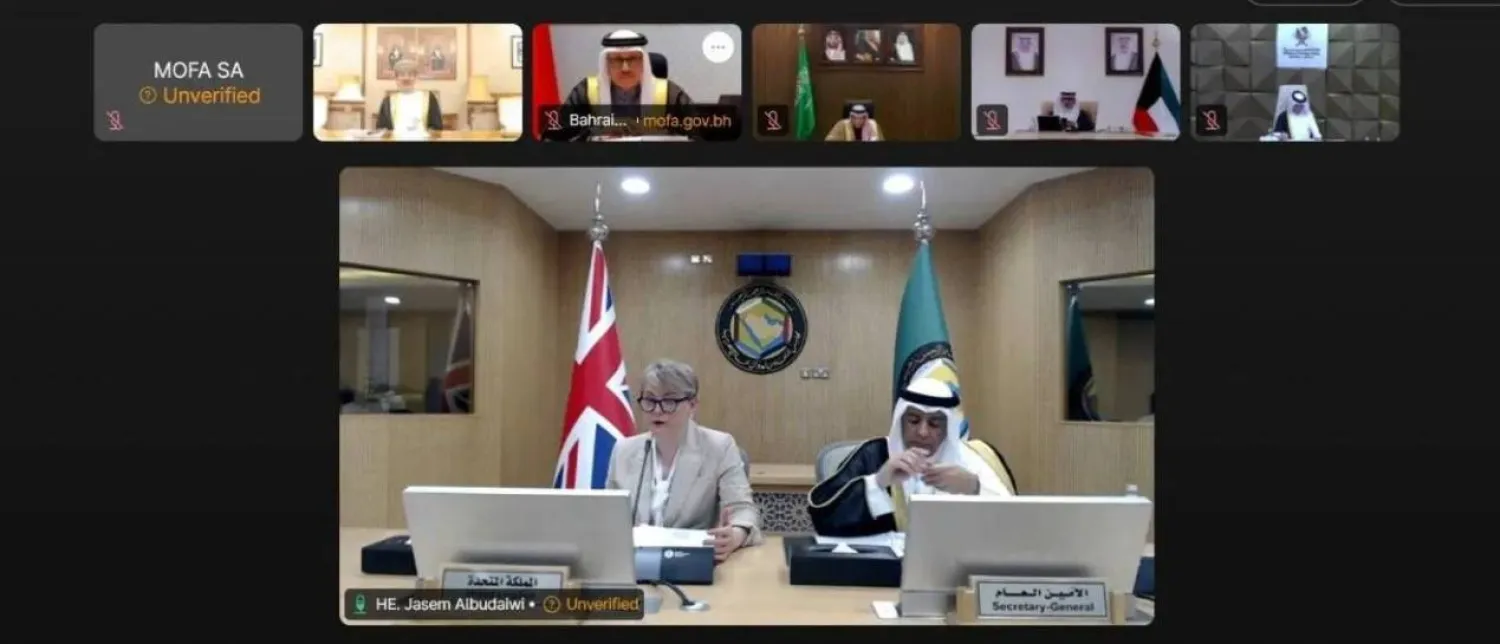

The Gulf Cooperation Council and the United Kingdom have stressed that the security of the Gulf region are fundamental pillars of the global economy’s stability, rejecting threats to close the Strait of Hormuz or threaten maritime security in the Bab el-Mandeb.
Their stance came in a joint statement after the Foreign Ministers of the GCC and the UK held an extraordinary meeting via videoconference last Thursday “to discuss the escalation in the Middle East and the blatant aggression by Iran and its regional proxies against the GCC countries and Jordan.”
The joint statement reaffirmed the importance of safeguarding regional air space, maritime routes, and freedom of navigation, noting that UN Security Council Resolution 2817 that was adopted last week “condemned any Iranian actions or threats aimed at closing, obstructing, or otherwise interfering with international navigation through the Strait of Hormuz or threatening maritime security in the Bab el-Mandeb.”
“The Ministers stressed that the security and stability of the Gulf region are fundamental pillars of the stability of the global economy, intrinsically linked to UK and global security,” the statement that was issued on Sunday added.
The Ministers welcomed the adoption of Resolution 2817 that condemned in the strongest terms the egregious attacks carried out by Iran on GCC countries and Jordan, considering them a violation of international law and a serious threat to international peace and security.
They noted that the Resolution also condemned Iran’s targeting of residential areas and civilian infrastructure.
The statement demanded that Iran immediately cease all attacks on the GCC States and Jordan and unconditionally stop any provocations or threats to neighboring states, including the use of proxies across the region.
The Ministers reiterated their commitment to regional stability and called for the protection of civilians and full respect of international law, international humanitarian law and the obligations on UN Member States to abide by the principles of the UN Charter.
They recalled that they consistently urged Iran to curb its nuclear program and ballistic missile program, and refrain from destabilizing activities across the region, including the use of proxies and meddling in the local affairs of states.
The Ministers “recalled the inherent right of the GCC countries, in accordance with Article 51 of the UN Charter, to defend themselves, individually and collectively, against the armed attacks of Iran, as recognized in UN Security Council resolution 2817.”
“They affirmed that the GCC states have the right to take all necessary measures to defend their security and stability and protect their territories, citizens and residents” and recalled the Security Council’s responsibility in maintaining international peace and security.
According to the statement, the Ministers “agreed to undertake joint diplomatic efforts to bring about a lasting solution to prevent Iran from acquiring a nuclear weapon, to cease development and proliferation of ballistic missiles, unmanned aerial vehicles and any technologies that threaten the security of the region and beyond, and to refrain from destabilizing activities in the region and beyond.”


