


Israel Doubles Troops in Hezbollah Fight, Searches Homes in South Lebanon

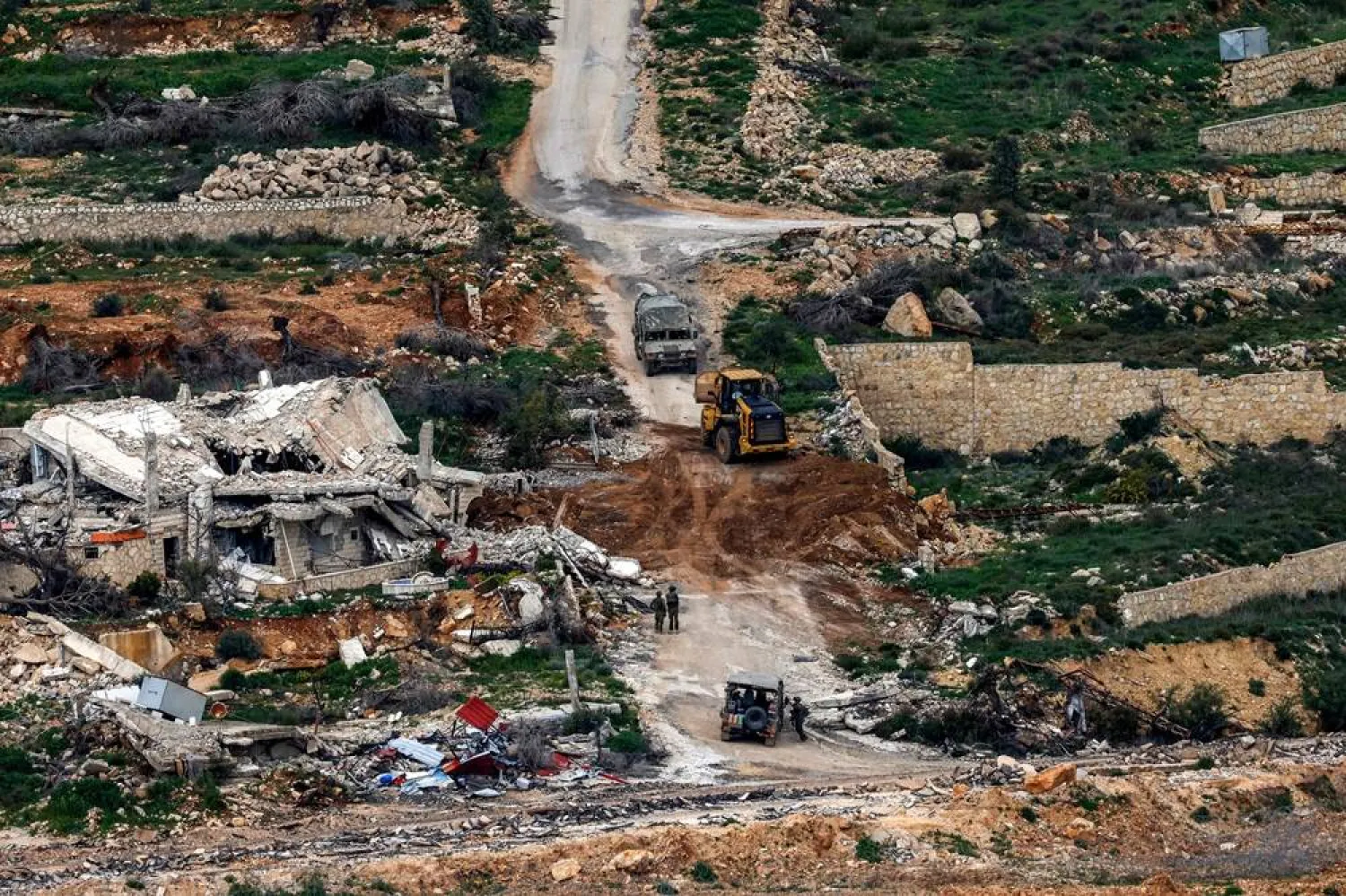
Israeli soldiers and a bulldozer conduct an operation in a southern Lebanese village along the border, as seen from a position in the Upper Galilee in northern Israel on March 18, 2026. (AFP)
TT

Israel Doubles Troops in Hezbollah Fight, Searches Homes in South Lebanon

Israeli soldiers and a bulldozer conduct an operation in a southern Lebanese village along the border, as seen from a position in the Upper Galilee in northern Israel on March 18, 2026. (AFP)

Israel has more than doubled the number of troops along its border with Lebanon since March 1 and they are searching homes in southern Lebanese villages that the military has ordered evacuated, a senior Israeli commander said on Wednesday.

As Israeli warplanes pound Beirut in operations against Hezbollah that have become the deadliest spillover of the US-Israeli war on Iran, heavy smoke could be seen rising from villages in southern Lebanon as troops fired artillery across the border.

Hundreds of thousands of Lebanese have fled southern Lebanon since Israel ordered people to clear the area south of the Litani River, viewed by Israel as a stronghold of Iran-backed Hezbollah. The group has been firing rockets toward Israel since joining the war in support of Iran on March 2.

'DEFENSIVE POSITIONS' INSIDE LEBANON

"The plan is to make sure that Hezbollah does not have military infrastructure," said the commander, whose name was withheld by the Israeli military on security grounds.

Speaking to Reuters in Eilon, an ‌Israeli town four kilometers ‌from the border, the commander, who is responsible for infantry warfare in Lebanon, declined to ‌say ⁠how many troops Israel ⁠had now deployed in the area.

Describing the military's fortifications inside Lebanon as "defensive positions", he said troops were searching "the villages to see if Hezbollah hid weapons or communications centers".

Asked if that included searching houses that residents had fled following Israeli orders, the commander said: "In some of the cases they hid their weapons in houses. We have no choice but to make sure that house is not a military installation."

Hezbollah has publicly denied using civilian infrastructure to store weapons. It accuses Israel of destroying homes to prevent Lebanese from returning, something Israel denies. Many villages in southern Lebanon have been completely destroyed.

Two Israeli soldiers have been killed since the start of operations ⁠in southern Lebanon, the Israeli military says.

At least 968 people in Lebanon have been ‌killed since the start of Israel's attacks, Lebanese authorities say.

Hezbollah has not provided ‌regular updates on deaths among its fighters. On Monday, a Hezbollah official told Reuters that at least 46 had been killed so far.

LEBANESE ‌VILLAGE OF KHIYAM AN INITIAL TARGET

The Israeli military is advancing slowly through southern Lebanon, aiming to completely clear the ‌town of Khiam as a first step before advancing toward the Litani River, according to a Lebanese security source and a foreign official tracking developments on the ground.

In response to a question on whether Israel intended to establish positions up to the Litani, the commander said it was not his decision. If troops receive orders, he added, they are "prepared to do all kinds of operations".

The Israeli military did not ‌immediately comment on its operations in Khiam, five kilometers inside the Lebanese border from the Israeli town of Metula.

Along the border near Metula, Reuters saw several Israeli military fortifications dug ⁠into hillsides, filled with rows ⁠of tanks, armed personnel carriers, and bulldozers.

Smoke rose from Khiam throughout the day on Wednesday, and many of the buildings on the southern side of the town had been reduced to rubble. A neighboring town remains in ruins from Israel's attacks in 2024.

'EVERY FIVE MINUTES YOU CAN HEAR THE BOMBS'

Israel's northern border area with Lebanon is known as the Upper Galilee, its rolling hills offering vantages into southern Lebanese villages now occupied and bombarded by Israeli troops.

Near Metula, Israeli Apache helicopters and jets were making near-constant sorties on Tuesday and Wednesday, with the sounds of rocket fire from Lebanon interspersed with the booms of Israeli artillery fire.

For residents of Israel's far north, the current war with Hezbollah has seen less rocket fire than during a year of fighting that ended in 2024.

Hezbollah's ability to launch missiles has largely been degraded, but it still retains capacity to strike areas deep inside Israel, Israeli officials say.

Ofer Moskovitz, 60, who works at an avocado farm in the area, and said being so close to the border meant he had little time to run to a bomb shelter when sirens signaled incoming Hezbollah fire.

Near his farm, the military dug out a muddy fortification from where troops fired artillery across the border.

"Every five minutes you can hear the bombs," he said.


EU Hosts Palestinian Leader in Conference About Security and Peace in Gaza and the West Bank

(L-R) High Representative of the European Union for Foreign Affairs and Security Policy Kaja Kallas, Palestinian Prime Minister Mohamed Mustafa, and Norwegian Foreign Minister Espen Barth Eide during the Global Alliance for the Implementation of the Two-State Solution 9th meeting in Brussels, Belgium, 20 April 2026. (EPA)
TT

EU Hosts Palestinian Leader in Conference About Security and Peace in Gaza and the West Bank

(L-R) High Representative of the European Union for Foreign Affairs and Security Policy Kaja Kallas, Palestinian Prime Minister Mohamed Mustafa, and Norwegian Foreign Minister Espen Barth Eide during the Global Alliance for the Implementation of the Two-State Solution 9th meeting in Brussels, Belgium, 20 April 2026. (EPA)

More than 60 nations are sending representatives to Brussels to discuss with Palestinian Prime Minister Mohamed Mustafa stability, security and long-term peace in Israel, the West Bank and Gaza, as global attention largely remains focused in the Middle East on the ongoing crises in Iran and Lebanon.

Ongoing attacks in the West Bank and continued devastation in Gaza dims the prospect for a two-state solution, said Belgian Foreign Minister Maxime Prévot ahead of the meeting Monday. He is co-hosting the meeting with the EU’s top diplomat, Kaja Kallas.

“We observe without naivety that the two-state solution is being made more difficult by the day," Prévot said. “But Belgium and many European and Arab partners continue to believe that this remains the only realistic path to a lasting peace, for Israelis, for Palestinians and for the stability of the entire region.”

The 27-nation European Union is the largest single donor to the Palestinian Authority, with its 90-year-old president Mahmoud Abbas ruling from Ramallah for two decades. And while the EU has avoided directly joining the Board of Peace created by United States President Donald Trump, preferring the multilateralism of the United Nations and global legal norms, the bloc is eager to not be sidelined in diplomacy in a volatile region just across the Mediterranean.

Outrage in Europe over the humanitarian catastrophe in Gaza drove many EU leaders to condemn Israel’s war conduct and to pressure Prime Minister Benjamin Netanyahu’s government.

With the recent ouster of long-serving Hungarian Prime Minister Viktor Orbán, a close ally of Netanyahu, there might now be enough political support within the bloc for stronger actions like targeted sanctions on Israeli settlers or even the suspension of some ties to Israel.

Palestinians in the West Bank say that Israel has used the cover of the Iran war to tighten its grip over the territory, as settler attacks surge and the military imposes additional wartime restrictions on movement, citing security.

Gaza requires “one state, one government, one law and one goal,” Mustafa said on Monday in Brussels.

“Our common objective of achieving one security structure under the legitimate authority should guide the effective coordination between the International Stabilization Force, the Palestinian Authority, security institutions and other international actors. Security must not be fragmented," he said.

He also called for “the gradual and responsible collection of arms from all armed groups and also the full Israeli withdrawal from Gaza.”


Israeli Army Brings in Demolition Contractors to Raze Dozens of Lebanese Villages

Israeli military vehicles and armored units in front of destroyed buildings in southern Lebanon on April 15. (AFP)
TT

Israeli Army Brings in Demolition Contractors to Raze Dozens of Lebanese Villages

Israeli military vehicles and armored units in front of destroyed buildings in southern Lebanon on April 15. (AFP)

The Israeli army is using the ceasefire period to accelerate large-scale destruction in areas it occupies in southern Lebanon, which have been largely emptied of residents displaced by the conflict, according to local accounts.

Working around the clock across an area estimated at more than 800 square kilometers — about 8 percent of Lebanon’s territory — Israeli forces are systematically flattening buildings.

Confronted with the scale of the task and racing against time, the military engineering corps has enlisted private sector “demolition contractors,” some with experience in Gaza, to carry out operations in dozens of villages.

Using heavy machinery, including bulldozers and D9 units, they have begun what sources describe as a coordinated clearing campaign.

The occupied zone stretches from the Litani River to the internationally recognized border and has been divided into three sectors.

The first is a “total destruction” zone running along the entire Lebanese border strip, from the expanded Shebaa Farms area and the town of Khiam in the east, through Deir Siryan, to the coastal town of Bayyada in the west. Its depth ranges from about 3 kilometers at its narrowest point near Odaisseh to as much as 10 kilometers near Khiam.

This area is referred to by the Israeli army as the “yellow belt,” in reference to a similarly named line in Gaza. Civilian presence is effectively prohibited, with entry posing a serious risk to life.

The second sector extends from the “yellow belt” to the Litani River. Israeli forces have positioned this line along hilltops and elevated terrain to maintain direct visual oversight of the river corridor, despite advanced surveillance capabilities. Armed presence is banned in this zone, and civilian presence is strongly discouraged.

The area remains highly volatile, with Israeli troops on constant alert.

Reports indicate sporadic resistance operations, as well as the presence of minefields and ambushes. Tactics developed by Hezbollah since the 2006 war are being employed here. Most Israeli casualties reported in this area — 12 killed and around 30 wounded — occurred in this sector, which has also seen fire reach as far as the Tyre region.

The third sector extends from the Litani River northward to the Zahrani River. While not officially designated as occupied, it is subject to continuous aerial and maritime surveillance.

Israel believes Hezbollah uses this area as a launching ground for operations, including short- and medium-range rocket fire. Drones are reported to operate overhead day and night. Israeli assessments indicate that more than half of the roughly 8,000 rockets and shells fired from Lebanon originated from this zone.

Israeli military doctrine since Oct. 7, 2023, calls for layered security zones along each front — Lebanon, Syria and Gaza — including a fortified area inside Israel, a no-go “security belt” inside enemy territory, and a broader demilitarized zone.

Within Israel’s far-right leadership, some officials have embraced this approach as a precursor to expanding territorial control. Finance Minister Bezalel Smotrich has called for further expansion and the establishment of Israeli military bases elsewhere in the region.

On the ground, Israeli forces appear intent on consolidating control over the “yellow belt” by erasing all structures above and below ground, from homes to schools and public buildings, a strategy critics say is aimed at preventing displaced residents south of the Litani from returning, or ensuring they find nothing left if they do.

The army also faces domestic criticism, particularly from residents of northern Israel, who say it has failed to provide adequate security despite months of fighting. Israeli officials argue that such operations could help secure longer-term calm on the northern front through a political agreement.

The Haaretz newspaper quoted a senior officer as saying the goal is “not a return to rounds of fighting, but achieving long-term security,” adding that Hezbollah has been significantly weakened compared with its position before Oct. 7, 2023.


Hamas Gives ‘Positive Response’ in Cairo, Raising Hopes of Near-Term Deal

Palestinians in Khan Younis, southern Gaza Strip, on Saturday (AFP)
TT

Hamas Gives ‘Positive Response’ in Cairo, Raising Hopes of Near-Term Deal

Palestinians in Khan Younis, southern Gaza Strip, on Saturday (AFP)

Sources within Hamas said the group’s delegation in Cairo has delivered a “positive response” to a revised proposal from mediators, particularly Egypt, potentially paving the way for an agreement on Gaza soon.

Negotiations on the deal remain stalled. Hamas and other factions insist Israel must first meet its phase-one ceasefire commitments, including humanitarian relief and the entry of aid trucks into the enclave, before they undertake further obligations. Israel, backed by the US, is pressing to move directly to the central element of phase two: disarmament.

A senior Hamas source told Asharq Al-Awsat that Zaher Jabarin and Ghazi Hamad, members of the group’s political bureau and its negotiating delegation, have returned to Cairo after leaving last Tuesday for internal consultations. Khalil al-Hayya, who heads Hamas’s negotiating team, remained in Egypt to continue talks.

The delegation returned with a “positive answer” to a proposal for handling phases one and two in parallel, the source told Asharq Al-Awsat.

The mediators’ plan stipulates the immediate start of phase-one steps while discussions continue on phase two, with no second-phase measures implemented before full completion of the first. Progression within phase two would also be conditional on completing each preceding step.

Hamas has set conditions, including the swift entry of a Gaza administrative committee to assume agreed responsibilities, along with “clear and credible guarantees” within a defined timeline to ensure Israel carries out its obligations in both phases.

Sources said Hamas held broad consultations in recent days, inside and outside Gaza, involving all its internal bodies, including religious frameworks that have historically played a key role in decision-making.

They described a “consensus,” including from the group’s armed wing, the Qassam Brigades, in support of the mediators’ proposal and negotiations over potential amendments related to weapons.

Mediators are aiming for rapid negotiations on phase two while phase one is completed, with expectations that international actors, including the US, will press Israel to comply.

A Palestinian faction source in Cairo said “contacts and meetings are ongoing at all levels,” adding that many expect a breakthrough that could lead to a deal.

However, the outcome ultimately depends on Israel’s government, which has signaled through international envoy Nikolay Mladenov and US representatives that acceptance of the bridging proposal should include Hamas agreeing to disarmament.

Sources said mediators had asked the group to approve the proposal, while officials linked to the administration of Donald Trump and Mladenov had pushed for Hamas to sign a disarmament document before negotiations proceed — a demand the group fears could be used to impose terms it opposes.

During discussions, some factions proposed reducing phase two from eight months to three or four to accelerate humanitarian improvements and reconstruction in Gaza, particularly for displaced residents living in harsh conditions.

A senior Hamas official said the group has no objection to shortening the timeline, stressing its priority is to ensure implementation of any agreement to ease civilian suffering, including by enabling the Gaza administrative committee to begin relief and service delivery.
