


Japan Ski Paradise Faces Strains of Global Acclaim

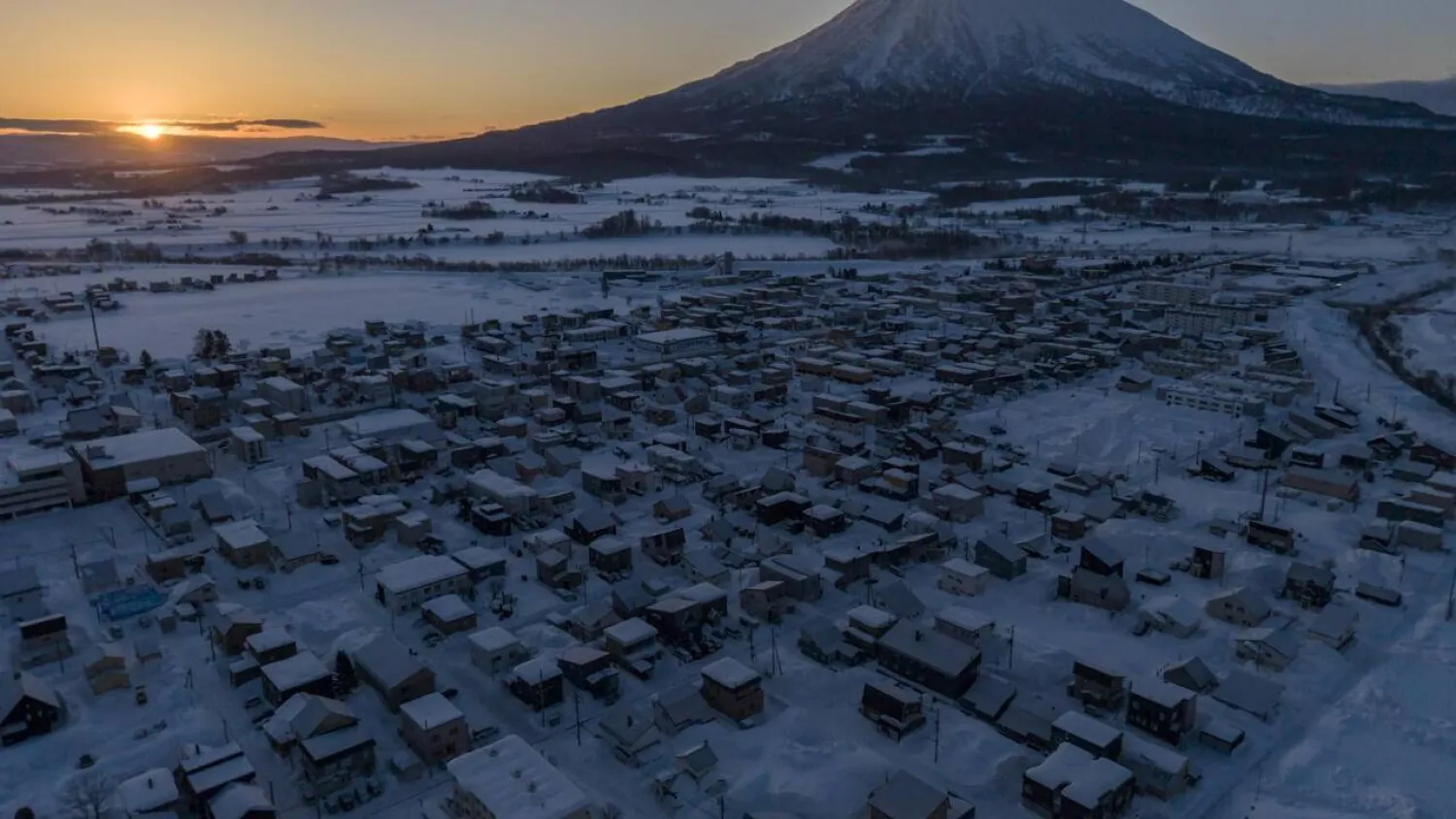
The scenic ski resorts in Kutchan, Hokkaido have become a flashpoint for immigration after an influx of foreign workers. Yuichi YAMAZAKI / AFP
TT

Japan Ski Paradise Faces Strains of Global Acclaim

The scenic ski resorts in Kutchan, Hokkaido have become a flashpoint for immigration after an influx of foreign workers. Yuichi YAMAZAKI / AFP

Beneath the powder snow at internationally popular Japanese ski resort Niseko, anxiety is mounting among residents over soaring prices and a massive influx of overseas workers.

At a time when Prime Minister Sanae Takaichi is talking tough on immigration, upscale Niseko has never been more popular with seasonal workers, investors and skiers from across the globe.

The snow "is the best in the world", said Gideon Masters, a 29-year-old Australian tourist.

"It's just soft, powder fluff. You can pick it up with your bare hands, it doesn't even feel cold... It's just a shame that it's become so populated," he told AFP at the foot of the slopes, snowboard in hand.

Built in the 1960s on the northern island of Hokkaido, the resort began attracting foreigners, mainly Australians, in the 1990s and became a popular destination after the 9/11 terrorist attacks in 2001 for those wanting to avoid the United States.

They gradually opened more shops and acquired property, and were later joined by Asian investors from Hong Kong, Malaysia and Singapore, among others, pushing land prices ever higher.

In Hirafu, one of the four resorts that make up Niseko, land prices jumped 70 percent between 2020 and 2025.

"If ski resorts in Japan had stayed the way they used to be, they would never have gained such worldwide renown," said Hiroshi Hasegawa, director of a local real estate agency.

"It's thanks to the taste and sensibilities of Australians and New Zealanders that this town has grown."

They are no longer alone, with "funds based in tax havens and all kinds of investors (who) have started pouring money in. Hollywood stars and artists come here, and owners of multinationals are buying second homes," he added.

"All of this is driving prices up even further," a trend that will likely continue, according to the agent.

- Unaffordable for locals -

For residents, inflated property prices and living costs are leaving a bitter taste.

"Land is being sold at prices that are no longer affordable for locals," explained 42-year-old Masatoshi Saito, who runs a painting company.

"In the supermarket, you find luxury products, sea urchins or Dom Perignon champagne, and vegetables have become extremely expensive," pushing some people to do their shopping in a neighboring town.

To attract staff, hotels and restaurants are raising wages, but local businesses are struggling to keep up.

"In construction, paying that much is very difficult because market prices are fixed. Raising wages is a huge risk for bosses," Saito said.

Meanwhile, "care workers sometimes prefer jobs in hotels," which pay better, creating a risk of labor shortages in social services", warned Hasegawa.

Driven by tourist demand, the region sees thousands of seasonal workers arrive each year, most of them foreigners.

In Kutchan, a large town in the area, the non-Japanese population doubles in winter to 3,000 people from 70 countries, making up nearly 20 percent of residents.

"Young people in their twenties come here from all over the world (...), which creates a very lively atmosphere," but also causes problems with neighbors, admitted Kutchan Mayor Kazushi Monji.

Saito and other residents, meanwhile, have complained about littering.

A plan to build housing for 1,200 foreign workers that was approved last autumn sparked outcry among locals.

"Cultures are different, not to mention the language barrier," the mayor said, urging "mutual support and consideration".

- 'Harmonious coexistence' -

Reflecting growing anti-immigration sentiment, the far-right "Japanese First" Sanseito party made gains in February's general election.

Prime Minister Takaichi, meanwhile, has promised tougher rules for foreigners in the name of "harmonious coexistence" between communities.

Her government is proposing stricter checks on foreigners entering the country, lengths of stay and illegal work.

It also wants to revise rules on land purchases by foreigners for "national security" reasons.

While acknowledging the need to adapt legislation to current realities, Monji rejects "the somewhat extreme view" that foreigners could "take over".

The interest Niseko is generating "boosts the economy and greatly contributes to the town's development", Kutchan's mayor said.

And with births falling again in 2025 for the tenth year in a row in Japan, the country desperately needs foreign workers.

Hokkaido is experiencing extreme polarization, hosting both the localities that saw the sharpest land-price increases in the country last year due to tourism and foreign investment, and those where prices fell the most, due to population decline.

"If we want to share the beauty of this region with the whole world, we must move beyond nationality divides," Monji said.



Beijing-backed Brain Chip Firm Says it is 3 years behind Musk's Neuralink

Beinao-1, a semi-invasive brain-machine interface system also known as the NeuCyber Matrix BMI system, is displayed during a media briefing as part of an organised media tour to the Chinese Institute for Brain Research in Beijing, China March 19, 2026. REUTERS/Florence Lo
TT

Beijing-backed Brain Chip Firm Says it is 3 years behind Musk's Neuralink

Beinao-1, a semi-invasive brain-machine interface system also known as the NeuCyber Matrix BMI system, is displayed during a media briefing as part of an organised media tour to the Chinese Institute for Brain Research in Beijing, China March 19, 2026. REUTERS/Florence Lo

Leading Chinese state-backed brain-computer interface (BCI) startup NeuCyber Neurotech said its most cutting-edge product is still three years behind Elon Musk's Neuralink, as Beijing races to expand clinical trials.

Last week, China became the first country in the world to approve an invasive BCI medical device for commercial use. It is the second country to launch BCI human trials after the US.

NeuCyber's frontier Beinao-2 product is an invasive BCI with flexible electrodes that fully implant into the brain, currently undergoing large-scale animal implantation, Reuters reported.

Neuralink's technical advantage is that its surgical robot can insert hundreds of electrodes into the brain in minutes for its invasive N1 chip.

"The benchmark for Beinao-2 is Neuralink. I have to say, (there is) about three years' lag because they have over 20 patients using it already," Li Yuan, rotating CEO of NeuCyber, a startup affiliated with the Beijing-based Chinese Institute for Brain Research (CIBR), said on Thursday.

"We have just finished the first product and have to go through animal testing, then early-feasibility clinical trials, and then the real trials. That's maybe about two years later for the real trial."

Beijing elevated BCIs to a core future strategic industry in its latest five-year plan, published this month, placing it alongside sectors such as quantum technology, embodied AI and nuclear fusion.

The BCI device approved by Chinese regulators last week is a coin-sized wireless implant by Shanghai-based private firm Neuracle, which sits on the brain's outer membrane and controls a robotic glove. It is intended for patients with spinal cord injuries.

NeuCyber has achieved seven human implantations so far of the earlier Beinao-1, a semi-invasive BCI consisting of a mesh with electrodes implanted on the brain's outer membrane, Li said.

Patients include quadriplegic car accident survivors who reported improvements in regaining hand motor function and could remotely control computer cursors after six months of use, she added.

NeuCyber hopes to expand clinical trials of Beinao-1 to 50 patients this year, an important precursor to regulatory approval for commercial use, its chief scientist told Reuters a year ago.

That could make Beinao-1 the brain chip with the highest number of patients in the world, underlining China's determination to catch up with leading foreign BCI developers.

Neuralink, by contrast, has 21 participants enrolled in human clinical trials worldwide, the company said in January.

Li estimates it could take two to three years before NeuCyber's BCI products could be commonly available on the domestic market, once they secure approval from China's health commission, medical insurance authorities and medical product regulators.

"When we translate this into a real medical device, going through registration (for) large-scale trials, we will focus on motor function restoration for the spinal cord," said Li.

The startup has received around 200 million yuan ($29 million) in funding from the Beijing government, Li added.


Early Southwest Heat is Latest in Parade of Weather Extremes as Earth Warms

A helicopter battles a forest fire in the Biobio region, where multiple wildfires have prompted emergency evacuations, in Florida, Chile, January 21, 2026. (Reuters)
TT

Early Southwest Heat is Latest in Parade of Weather Extremes as Earth Warms

A helicopter battles a forest fire in the Biobio region, where multiple wildfires have prompted emergency evacuations, in Florida, Chile, January 21, 2026. (Reuters)

The dangerous heat wave shattering March records all over the US Southwest is more than just another extreme weather blip. It’s the latest next-level weather wildness that is occurring ever more frequently as Earth’s warming builds.

Experts said unprecedented and deadly weather extremes that sometimes strike at abnormal times and in unusual places are putting more people in danger. For example, the Southwest is used to coping with deadly heat, but not months ahead of schedule, including a 110-degree Fahrenheit (43.3 Celsius) reading in the Arizona desert on Thursday that smashed the highest March temperature recorded in the US.

On Thursday, sites in Arizona and southern California had preliminary readings of 109 F (about 43 C), which would be the hottest March day on record for the United States.

“This is what climate change looks like in real time: extremes pushing beyond the bounds we once thought possible,” said University of Victoria climate scientist Andrew Weaver. “What used to be unprecedented events are now recurring features of a warming world.”

March's heat would have been virtually impossible without human-caused climate change, according to a report Friday by World Weather Attribution, an international group of scientists who study the causes of extreme weather events.

More than a dozen scientists, meteorologists and disaster experts queried by The Associated Press put the March heat wave in a kind of ultra-extreme classification with such events as the 2021 Pacific Northwest heat wave, the 2022 Pakistan floods and killer hurricanes Helene, Harvey and Sandy.

The area of the US being hit by extreme weather in the past five years has doubled from 20 years ago, according to the National Oceanic and Atmospheric Administration's Climate Extremes Index, which includes various types of wild weather, such as heat and cold waves, downpours and drought.

The United States is breaking 77% more hot weather records now than in the 1970s and 19% more than the 2010s, according to an AP analysis of NOAA records. In the United States, the number and average cost of inflation-adjusted billion-dollar weather disasters in the last couple years is twice as high as just 10 years ago and nearly four times higher than 30 years ago, according to records kept by NOAA and Climate Central, a nonprofit group of scientists and communicators who research and report on climate change.

Trying to keep up with extremes and failing “It’s really hard to even keep up with how extreme our extremes are becoming,” said Climate Central Chief Meteorologist Bernadette Woods Placky. “It’s changing our risk, it’s change our relationship with weather, it’s putting more people in risky situations and at times we’re not used to. So yes, we are pushing extremes to new levels across all different types of weather.”

For government officials who have to deal with disaster it's been a huge problem.

Craig Fugate, who directed the Federal Emergency Management Agency until 2017, said he saw extremes increasing.

“We were operating outside the historical playbook more and more. Flood maps, surge models, heat records — events kept showing up outside the envelope we built systems around. That’s just what we saw,” Fugate said via email.

He added: “We built communities on about 100 years of past weather and assumed that was a good guide going forward. That assumption is starting to break. And the clearest signal isn’t the science debate. It’s insurers walking away.”

‘Virtually impossible’ without climate change Climate scientists at World Weather Attribution did a flash analysis — which is not peer-reviewed yet — of whether climate change was a factor in this Southwest heat wave. They compared this week's expected temperatures to what's been observed in the area in March since 1900 and computer models of a world with climate change. They found that “events as warm as in March 2026 would have been virtually impossible without human-induced climate change.”

That warming, from the burning of coal, oil and natural gas, added between 4.7 degrees to 7.2 degrees F (2.6 to 4 degrees C) to the temperatures being felt, the report found.

“What we can very confidently say is that human-caused warming has increased the temperatures that we’re seeing as a result of this heat dome, and it’s going to be pushing those temperatures from what would have been very uncomfortable into potentially dangerous,” said report co-author Clair Barnes, an Imperial College of London attribution scientist.

Examples abound of high heat and extreme weather The Southwest heat wave is solidly in the category of “giant events,” with temperatures up to 30 degrees Fahrenheit (16.7 degrees Celsius) above normal, said Stanford University climate scientist Chris Field.

He listed five others in the last six years: a 2020 Siberia heat wave, the 2021 Pacific Northwest heat wave that had British Columbia warmer than Death Valley, the summer of 2022 in North America, China and Europe, a 2023 western Mediterranean heat wave and a 2023 South Asian heat wave with high humidity.

And that doesn't include the East Antarctica heat wave of 2022 when temperatures were 81 degrees (45 degrees Celsius) warmer than normal. That's the biggest anomaly recorded, said weather historian Chris Burt, author of the book “Extreme Weather.”

Worsening wild weather influenced by climate change isn't just superhot days, but includes deadly hurricanes, droughts and downpours, scientists told AP.

Devastating floods hit West Africa in 2022 and again in 2024. Iran is in the midst of a six-year drought. And the deadly Typhoon Haiyan hitting the Philippines in 2013 shocked the world.

Superstorm Sandy, which in 2012 flooded New York City and neighbors, had tropical storm-force winds that covered an area nearly one-fifth the area of the contiguous United States. It spawned 12-foot seas over 1.4 million square miles, about half the size of the US, with energy equivalent to five Hiroshima-sized atomic bombs, said Yale Climate Connections meteorologist Jeff Masters.

And don't forget wildfires that are worsened by heat and drought, so recent extremes should include 2025's Palisades and Eaton wildfires, which were the costliest weather disaster in the United States last year, said Climate Central meteorologist and economist Adam Smith.

“This is due to climate change, that we see more extreme events, and more intense ones and have so many records being broken,” said Friederike Otto, an Imperial College of London climate scientist who coordinates World Weather Attribution.


Trump Gets Approval for Gold Coin in His Likeness

A phone displaying the commemorative gold coin featuring Trump to mark America's 250th anniversary. Chris DELMAS / AFP
TT

Trump Gets Approval for Gold Coin in His Likeness

A phone displaying the commemorative gold coin featuring Trump to mark America's 250th anniversary. Chris DELMAS / AFP

An advisory commission hand-picked by President Donald Trump has approved the design of a commemorative gold coin featuring his image, officials said Thursday, in a move slammed by Democratic opponents.

The US Commission of Fine Arts declined to comment when asked by AFP after several media outlets showed the proposed design in reporting on the approval.

The coin is supposed to mark the 250th anniversary of the founding of the United States.

One side of it shows a glaring Trump standing with his fists bunched on a desk, and the other features an eagle perched with wings spread on what appears to be a bell.

The coin does not have a monetary value and its sale price has not been disclosed, but similar commemorative coins sold by the US Mint can cost over $1,000.

"We are thrilled to prepare coins that represent the enduring spirit of our country and democracy, and there is no profile more emblematic for the front of such coins than that of our serving president," US Treasurer Brandon Beach said in a statement.

Beach noted that the design would differ from Trump images being planned for two other coins, a $1 piece that would be in circulation, and a one-ounce gold one.

Trump fired all six members of the US Commission of Fine Arts last October and replaced them with hand-picked people as he embarks on a series of renovation and building projects since returning to power in January.

Most controversial are a ballroom he is building at the White House, and the renovation of the famed Kennedy Center for the arts in Washington, which he has renamed after himself.

Another advisory panel, the Citizens Coinage Advisory Committee, had refused in February to put Trump's coin on the agenda for debate.

Since the signature of the Declaration of Independence in 1776, "no nation on earth has issued coins with the image of a democratically elected leader during the time of their service," one of the committee members, Donald Scarinci, said at the time.