


‘Ending Soon’: Netanyahu Shifts Iran War Goals

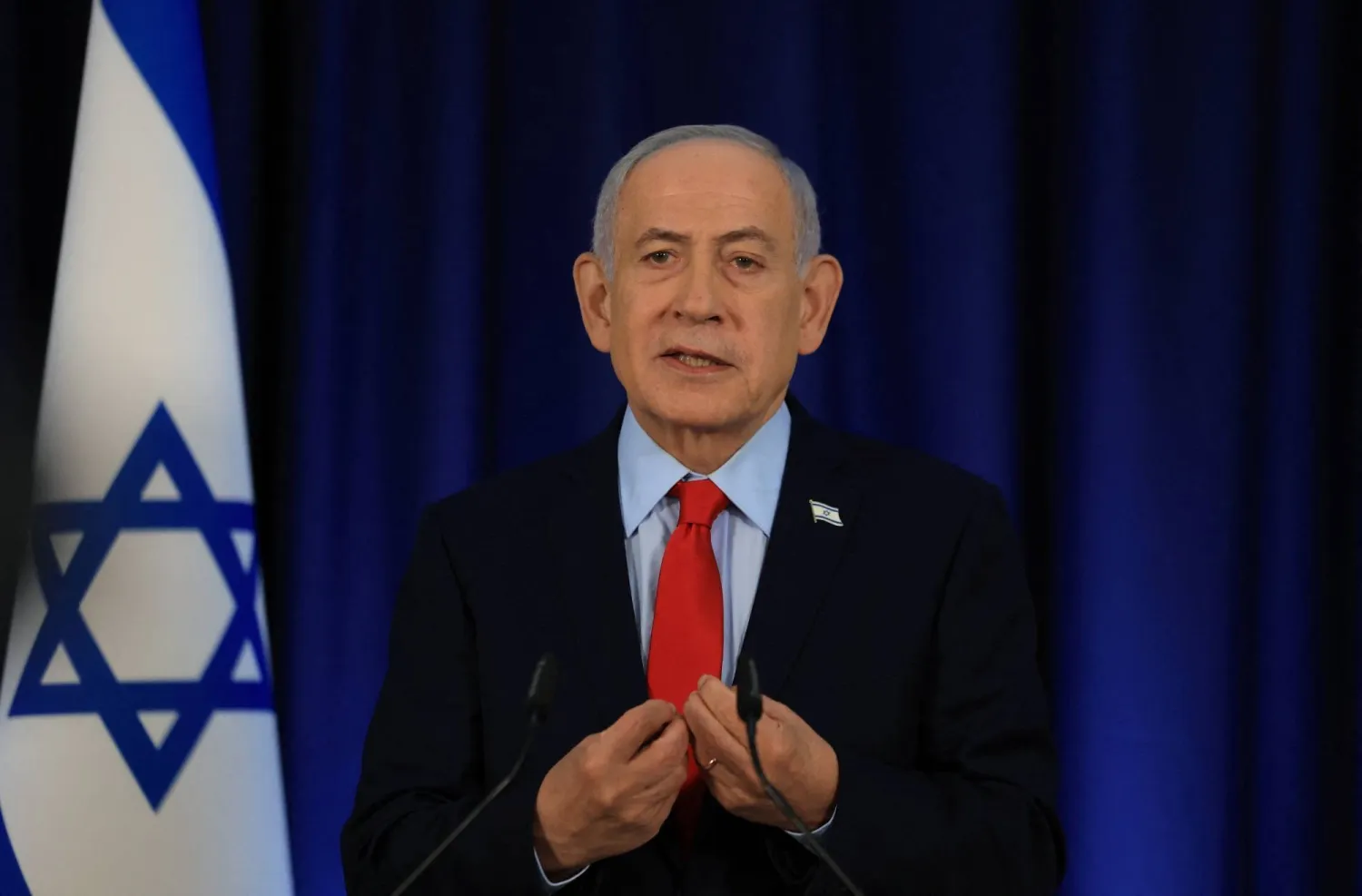
 Israeli Prime Minister Benjamin Netanyahu speaks at a press conference (Reuters)
Israeli Prime Minister Benjamin Netanyahu speaks at a press conference (Reuters)
TT

‘Ending Soon’: Netanyahu Shifts Iran War Goals

 Israeli Prime Minister Benjamin Netanyahu speaks at a press conference (Reuters)
Israeli Prime Minister Benjamin Netanyahu speaks at a press conference (Reuters)

Israeli Prime Minister Benjamin Netanyahu is gradually scaling back his sweeping ambition to end the war with Iran by toppling its regime, bringing his rhetoric closer to that of US President Donald Trump.

Netanyahu now speaks of “achieving tremendous gains” through three objectives: curbing Iran’s nuclear program, halting its ballistic missile program, and creating conditions that would allow the Iranian people to take control of their own future.

He acknowledged that overthrowing the Iranian regime from the air is not possible, drawing criticism from Israeli opposition leader Yair Lapid, who accused him of manipulating public sentiment.

Lapid noted that, only weeks ago, Netanyahu had pledged to completely destroy the nuclear project, the missile industry, and the ability to repair damage, topple the regime, and eliminate Lebanon’s Hezbollah.

“The question is not what Iran can do today, but what it will be able to do tomorrow, at the end of the war or in a year,” Lapid wrote in a post on X.

Netanyahu held a press conference late Thursday into Friday, his second since the start of the Israeli-US war on Iran, addressing international audiences in English and Israelis in Hebrew.

His appearance seemed aimed at responding to debate in the United States and its echoes in Israel, particularly accusations that he had drawn Trump into the war and was now pushing to expand and prolong it.

War paradoxes

As Netanyahu spoke of dismantling Iran’s nuclear and missile capabilities, Iranian missiles were falling on Jerusalem, oil refineries in Haifa, as well as Ashdod and the Galilee.

The prevailing impression in Israel is that Netanyahu convened the conference to counter accusations that he had succeeded in drawing Trump into a war with Iran, similar to the 2018 US withdrawal from the nuclear deal.

While Netanyahu may see such accusations as flattering, portraying him as influential in shaping international policy, many in Israel are concerned about their implications for future relations between Tel Aviv and Washington.

Many believe Israel’s critics in Washington, whose numbers are growing and whose rhetoric is sharpening, even within the Republican Party, are using this narrative to fuel hostility toward Israel and antisemitism.

Israel’s strike on Iran’s South Pars gas field and joint Iranian-Qatari energy facilities has also triggered a crisis in Gulf countries, particularly since such an operation could hardly have taken place without US knowledge.

The strike has raised questions about Washington’s conduct and its potentially hostile implications. While the United States denied prior knowledge, semi-official Israeli sources said the attack was carried out in full coordination with the Americans through a joint war command room.

Netanyahu appeared to defend Trump on both issues.

Netanyahu forcefully rejected claims Thursday that he misled President Trump into a potential conflict with Iran, calling the notion “fake news” and insisting the president made his own decisions based on American interests.

“Does anyone really think that someone can tell President Trump what to do? Come on,” Netanyahu said at a press conference on Thursday, adding that Trump “always makes his decisions based on what he thinks is good for America.”

“I misled no one, and I didn’t have to convince President Trump about the need to prevent Iran from developing its nuclear program, putting it underground, and being able to launch nuclear-tipped missiles at the United States. He understood that,” he added.

Addressing American journalists, Netanyahu cast speculation around how Iran would behave if it acquired nuclear weapons after decades of slogans such as ‘Israel is the lesser Satan and America the greater Satan,’ ‘Death to America’ and ‘Death to Israel.’

He then reiterated his accusations against Iran on its overt goal of erasing Western civilization. He said Iran tried to assassinate Trump twice and now it is engaging in blackmail.

On the second issue, Netanyahu said Israel had “acted alone” in striking the South Pars facility before President Trump requested a halt to any further attacks. Netanyahu then said Israel was complying with his request.

His remarks came shortly before Trump confirmed that he had asked the Israeli prime minister not to strike Iran’s energy facilities, and that he agreed.

Who will topple Iran’s regime?

Responding to further questions, Netanyahu said Iran’s Supreme Leader Ali Khamenei, who was killed at the start of the war, had ordered the resumption of missile and nuclear programs and their burial deep underground.

He added that Israel was targeting the industries enabling the production of such programs, rather than remaining missiles.

After 20 days of war, Netanyahu said he can confirm that Iran has no capability to enrich uranium or produce ballistic missiles.

He added that it was “too early to predict” whether the Iranian people would take advantage of the conditions Israel is trying to create and take to the streets, though he expressed hope that they would, stressing that “it is entirely up to them.”

Netanyahu said he sees “cracks” within Iran’s leadership and on the ground, adding that Israel is working to deepen these divisions.

With the war entering its 20th day, Israel is seeking to intensify these fractures, he said, noting that he does not know exactly who is currently leading the country.

Netanyahu said that what Israel is seeing in Iran is significant tension among rivals for power, avoidance of confrontation, and abandonment of responsibility by many officials, as well as chaos in governance and contradictions in decision-making.

Israel will continue efforts to deepen these divisions “as quickly as possible,” not only within the top leadership but also on the ground, he added.



US Allows 30-Day Sale of Iran Oil at Sea in Bid to Tame Prices

US Treasury Secretary Scott Bessent looks on as he speaks to the media after two days of meetings with a Chinese delegation, in Paris, France March 16, 2026. (Reuters)
TT

US Allows 30-Day Sale of Iran Oil at Sea in Bid to Tame Prices

US Treasury Secretary Scott Bessent looks on as he speaks to the media after two days of meetings with a Chinese delegation, in Paris, France March 16, 2026. (Reuters)

The Trump administration waived sanctions on the purchase of Iranian oil at sea for 30 days on Friday in its latest attempt to ease oil prices that have been driven up by the US-Israeli war on Iran.

The waiver will bring some 140 million barrels of oil to global markets and help relieve pressure on energy supply, Treasury Secretary Scott Bessent posted on X.

The move reflects White House worries that the surge in oil prices after nearly three weeks of US and Israeli strikes on Iran will hurt US businesses and consumers ahead of the November midterm elections, when President Donald Trump's fellow Republicans hope to retain control of Congress.

THIRD SANCTIONS WAIVER DURING IRAN WAR

The license, posted to the Treasury Department's website after market hours, says Iranian oil can be imported into the United States under the waiver when necessary to complete its sale or delivery.

The US has not meaningfully imported Iranian oil since Washington imposed ‌measures after the ‌1979 revolution. It was unclear whether any Iranian oil would end up in the country ‌as ⁠a result of the ⁠waiver.

Cuba, North Korea and Crimea are among regions excluded from the license, which will remain in effect until April 19.

The move is expected to benefit Asia, the top buyer of Middle Eastern oil. Energy Secretary Chris Wright said supplies could get to Asia within three or four days and hit the market after being refined over the coming month and a half.

Independent Chinese refiners have been the main buyers of sanctioned Iranian oil, taking advantage of deep discounts as others avoided such purchases. India, South Korea, Japan, Italy, Greece, Taiwan and Türkiye were also major buyers of Iranian crude before US sanctions were reimposed in 2018.

This is the third time the Treasury Department has temporarily waived ⁠sanctions on oil from US adversaries in a little more than two weeks. The moves ‌are part of the administration's attempts to tame energy prices that have soared above $100 ‌a barrel to the highest levels since 2022.

The US previously eased sanctions on Russian oil and on Friday issued a general license allowing ‌the sale of Iranian crude oil and petroleum products loaded on vessels by Friday.

"In essence, we will be using the ‌Iranian barrels against Tehran to keep the price down as we continue Operation Epic Fury," Bessent said.

Bessent had telegraphed the move in an interview with Fox Business on Thursday, saying the release of the sanctioned Iranian oil into global supplies would help keep oil prices down for 10 to 14 days.

He said on Friday that Iran will have difficulty accessing any revenue generated by the move and Washington will maintain maximum pressure on Iran and ‌its ability to access the international financial system.

'RUNNING OUT OF OPTIONS'

Oil prices have jumped about 50% since the US and Israel launched their attacks on February 28. Tehran has responded ⁠with attacks on Israel and Gulf ⁠states that host US bases.

Vital energy infrastructure in Iran and neighboring Gulf states has been attacked, and Iran has effectively closed the Strait of Hormuz, conduit for some 20% of the world's oil and liquefied natural gas.

In its effort to tame oil prices, the Trump administration on Wednesday announced a 60-day waiver of the Jones Act shipping law, temporarily allowing foreign-flagged vessels to move fuel, fertilizer and other goods between US ports.

Energy analysts including Brett Erickson, a managing principal at Obsidian Risk Advisors, have said the administration's efforts to control prices will not have a meaningful impact until the strait is opened to vessels.

"The easing of sanctions raises concerns about the rapid depletion of Washington's economic toolkit," to dampen oil prices, Erickson said. "If we've reached the point of loosening sanctions on the country we are at war with, we're really running out of options."

The US issued a 30-day waiver for countries to buy sanctioned Russian oil stranded at sea after a 30-day license on March 5 specifically for India to buy Russian oil.

Mark Dubowitz, CEO of the Foundation for the Defense of Democracies, a nonprofit research institute considered hawkish on Iran, praised the decision.

"We've worked on sanctioning Iran’s oil industry for years. This is a smart move ... to help win the fight against the regime," Dubowitz said on X.


Report: Iran Ready to Let Japanese Vessels Transit Hormuz

 Cargo ships sail in the Arabian Gulf towards Strait of Hormuz in the United Arab Emirates, Thursday, March 19, 2026. (AP)
Cargo ships sail in the Arabian Gulf towards Strait of Hormuz in the United Arab Emirates, Thursday, March 19, 2026. (AP)
TT

Report: Iran Ready to Let Japanese Vessels Transit Hormuz

 Cargo ships sail in the Arabian Gulf towards Strait of Hormuz in the United Arab Emirates, Thursday, March 19, 2026. (AP)
Cargo ships sail in the Arabian Gulf towards Strait of Hormuz in the United Arab Emirates, Thursday, March 19, 2026. (AP)

Iran is ready to let Japanese-related vessels pass through the Strait of Hormuz, a vital artery for global oil supplies, Kyodo news reported, citing Iranian Foreign Minister Abbas Araqchi.

Tehran has started talks with Tokyo, including with Foreign Minister Toshimitsu Motegi, about possibly opening the strait, Araqchi told the Japanese news agency in a phone interview on Friday.

Japan's foreign and trade ministries and the Prime Minister's Office did not pick up calls from Reuters on Saturday seeking comment on ‌the report.

"Iran ‌is, of course, ready to support ‌the ⁠passing of Japan-related vessels ⁠through the Strait of Hormuz," if Japan seeks its reopening of the strait, Araqchi told Kyodo.

Japan gets around 90% of its oil shipments via the strait, which Tehran has largely closed during the US-Israeli war on Iran. A spike in global oil prices sparked by the war, which enters ⁠its fourth week on Saturday, has prompted ‌Japan and other countries to ‌release oil from their reserves.

US President Donald Trump met Japanese Prime ‌Minister Sanae Takaichi on Thursday, urging her to "step up" ‌as he presses allies - so far unsuccessfully - to send warships to help open the strait.

Takaichi told reporters after the Washington summit that she had briefed Trump on what support Japan could and could ‌not provide in the strait under its laws.

Japan's actions are limited under its postwar ⁠pacifist constitution, but ⁠2015 security legislation allows Japan to use force overseas if an attack, including on a close security partner, threatens Japan's survival and no other means are available to address it.

Araqchi, a former ambassador to Japan, said Tokyo has a friendly relationship with Tehran, expressing hope that it would play a role in ending what he called unjustifiable and illegal "invasion" of his country.

The US does not seem ready to open conversations, Araqchi said, adding that Iran wants an end to the war, not a ceasefire, and is seeking a commitment that it would not be attacked.


Trump Hints at Wind-Down of War as US Sends More Troops and Iran Threatens Tourism Sites

 An Iranian missile with cluster munitions flies over the city, amid the US-Israeli conflict with Iran, in Jerusalem, March 20, 2026. (Reuters)
An Iranian missile with cluster munitions flies over the city, amid the US-Israeli conflict with Iran, in Jerusalem, March 20, 2026. (Reuters)
TT

Trump Hints at Wind-Down of War as US Sends More Troops and Iran Threatens Tourism Sites

 An Iranian missile with cluster munitions flies over the city, amid the US-Israeli conflict with Iran, in Jerusalem, March 20, 2026. (Reuters)
An Iranian missile with cluster munitions flies over the city, amid the US-Israeli conflict with Iran, in Jerusalem, March 20, 2026. (Reuters)

US President Donald Trump said he was considering “winding down” military operations in the Middle East even as the United States is sending three more amphibious assault ships and roughly 2,500 additional Marines to the region.

Trump’s post Friday on social media followed an Iranian threat to attack recreational and tourist sites worldwide and another day of the airstrikes and drone and missile attacks that have engulfed the region.

The mixed messages from the United States came after another climb in oil prices plunged the US stock market, and was followed by a Trump administration announcement it was lifting sanctions on Iranian oil already loaded on ships, a move aimed at wrangling soaring fuel prices.

The three-week-old war has shown no signs of abating, with Israel saying Iran continued to fire missiles at it early Saturday, while Saudi Arabia said it downed 20 drones in the country's Eastern Region.

The attacks came a day after Israeli airstrikes hit in Tehran as Iranians celebrated the Persian New Year, known as Nowruz, a normally festive holiday that has been muted by the war.

Trump says US near completion of its goals

The US and Israel have offered shifting rationales for the war, from hoping to foment an uprising that topples Iran’s leadership to eliminating its nuclear and missile programs. There have been no public signs of any such uprising and no end to the war in sight.

On social media, Trump said, “We are getting very close to meeting our objectives as we consider winding down our great Military efforts in the Middle East.”

That seemed at odds with his administration’s move to bolster its firepower in the region and request another $200 billion from Congress to fund the war.

The United States is deploying three more amphibious assault ships and roughly 2,500 additional Marines to the Middle East, an official told The Associated Press. Two other US officials confirmed that ships were deploying, without saying where they were headed. All three spoke on condition of anonymity to discuss sensitive military operations.

Days earlier the US redirected another group of amphibious assault ships carrying another 2,500 Marines from the Pacific to the Middle East. The Marines will join more than 50,000 US troops already in the region.

Trump has said he has no plans to send ground forces into Iran but also has asserted that he retains all options.

Iran threatens attacks beyond the Middle East

Iran’s top military spokesperson, Gen. Abolfazl Shekarchi, warned Friday that “parks, recreational areas and tourist destinations” worldwide will not be safe for the country’s enemies. The threat renewed concerns that Tehran may revert to using militant attacks beyond the Middle East as a pressure tactic.

Supreme Leader Mojtaba Khamenei praised Iranians’ steadfastness in the face of war in a written statement read on Iranian television to mark Nowruz. Khamenei has not been seen in public since he became supreme leader following Israeli strikes that killed his father, Ali Khamenei, and reportedly wounded him.

With little information coming out of Iran, it was not clear how much damage its arms, nuclear or energy facilities have sustained in the punishing US and Israeli strikes, which began Feb. 28 — or even who was truly in charge of the country. But Iran’s attacks are still choking off oil supplies and raising food and fuel prices far beyond the Middle East.

Israel continues wave of strikes against Hezbollah

The Israeli military said early Saturday that it began a wave of strikes targeting Iran-backed Hezbollah in Beirut’s southern suburbs.

Smoke was seen rising, fires broke out and loud explosions were heard across parts of central Beirut, hours after the Israeli army renewed evacuation warnings for seven neighborhoods.

Israeli strikes targeting Hezbollah in Lebanon have killed more than 1,000 people and displaced more than 1 million, according to the Lebanese government.

More than 1,300 people have been killed in Iran during the war. In Israel, 15 people have been killed by Iranian missiles and four others have died in the occupied West Bank. At least 13 US military members have been killed.

US pauses sanctions on Iranian oil

Brent crude oil, the international standard, has soared during the fighting and was around $106 per barrel, up from roughly $70 before the war.

The newly announced US pause in sanctions applies to Iranian oil loaded on ships as of Friday and is set to end April 19.

The new move does not increase the flow of production, a central factor in the surging prices. Iran has managed to evade US sanctions for years, suggesting that much of what it exports already reaches buyers.

Looking for ways to boost global oil supplies during the Iran war, the Trump administration has previously paused sanctions on certain Russian oil shipments for 30 days, which critics said rewarded Moscow while having only a modest effect on markets.