


Refiners in India, Elsewhere in Asia Look to Buy Iranian Oil after US Waives Sanctions

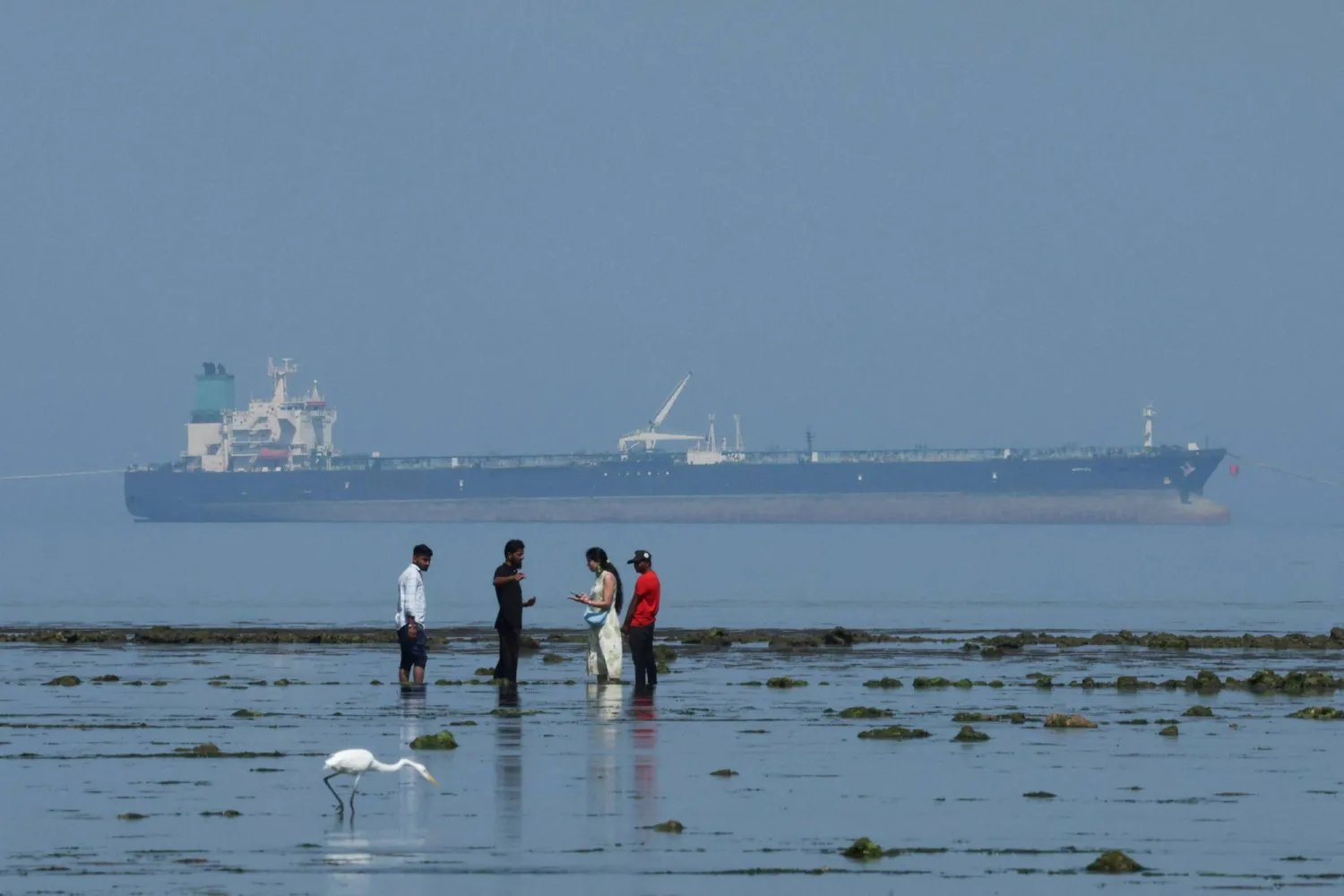
FILE PHOTO: Tourists watch marine life, with the MT Desert Kite oil tanker carrying Russian oil in the background, at Narara Marine National Park in the Arabian Sea, Gujarat, India March 11 , 2026. REUTERS/Amit Dave/File Photo
TT

Refiners in India, Elsewhere in Asia Look to Buy Iranian Oil after US Waives Sanctions

FILE PHOTO: Tourists watch marine life, with the MT Desert Kite oil tanker carrying Russian oil in the background, at Narara Marine National Park in the Arabian Sea, Gujarat, India March 11 , 2026. REUTERS/Amit Dave/File Photo

Indian refiners plan to resume buying Iranian oil while refiners elsewhere in Asia are examining such a move after Washington temporarily removed sanctions to alleviate an energy crunch caused by the US-Israeli war on Iran, traders said on Saturday.

Three Indian refining sources said they will buy Iranian oil and are awaiting government directions and clarity from Washington on details such as payment terms.

Refiners in India, which has much smaller crude stockpiles than other big Asian oil importers, rushed to book Russian oil after the US recently lifted sanctions temporarily. The Indian government could not be immediately reached for comment outside office hours.

Other Asian refiners are making checks to see if they can purchase the oil, several ⁠people with knowledge ⁠of the matter said.

The Trump administration on Friday issued a 30-day sanctions waiver for the purchase of Iranian oil already at sea, US Treasury Secretary Scott Bessent said.

The waiver applies to oil loaded on any vessel, including sanctioned tankers, on or before March 20 and discharged by April 19, according to the Office of Foreign Assets Control. It is the third time the US has temporarily waived sanctions on oil since the start of the war.

About ⁠170 million barrels of Iranian crude are at sea, said Emmanuel Belostrino, Kpler’s senior manager for crude oil market data, on ships scattered from the Middle East Gulf to the waters near China.

Consultancy Energy Aspects on March 19 estimated 130 million to 140 million barrels of Iranian oil on water, equivalent to less than 14 days of current Middle East production losses.

Asia relies on the Middle East for 60% of its crude supply and the near-closure of the Strait of Hormuz this month is forcing refineries across the region to run at lower rates and cut fuel exports.

Trump re-imposed sanctions on Iran in 2018 over its nuclear program. Since then, China has become Iran's main client with its independent refiners buying 1.38 million barrels per day (bpd) ⁠last year, Kpler ⁠data showed, attracted by deep discounts as most countries shunned the crude due to the sanctions.

Potential complications for buying Iranian oil include uncertainty over how to pay for it and the fact that a large share of it is aboard aging shadow fleet ships, traders said.

Also, some former purchasers of Iranian oil were contractually obligated to buy from National Iranian Oil Co., two refining sources said. However, since the US re-imposed sanctions in late 2018, Iranian oil has been sold in significant part by third-party traders.

"It usually takes some time to work through compliance, administration and banking, etc., but I guess people will try to work ASAP," a Singapore-based trader said.

According to Reuters, the sources declined to be named due to company policy.

Other than China, major buyers of Iranian crude before sanctions were re-imposed included India, South Korea, Japan, Italy, Greece, Taiwan and Türkiye.



Asian Stocks Tumble as Trump Gives Iran 48-hour Ultimatum

The surge in oil prices since the war began have fanned concerns about a fresh spike in inflation. Brandon Bell / GETTY IMAGES NORTH AMERICA/AFP
TT

Asian Stocks Tumble as Trump Gives Iran 48-hour Ultimatum

The surge in oil prices since the war began have fanned concerns about a fresh spike in inflation. Brandon Bell / GETTY IMAGES NORTH AMERICA/AFP

Stocks tumbled Monday and oil prices rose after Donald Trump and Iranian leaders traded threats over the key Strait of Hormuz, while Israel said the Middle East war could last several more weeks.

With the conflict now in its fourth week and showing no sign of ending, the head of the International Energy Agency warned of the worst global energy crisis in decades and said the world economy was under "major threat" from the crisis.

Observers, meanwhile, have also raised the prospect of a surge in inflation that could force central banks to hike interest rates, while the choking off of fertilizer shipments has also fanned concerns about global food security.

The US president on Saturday gave Iran 48 hours to reopen the Strait of Hormuz to shipping or face the destruction of its energy infrastructure, reported AFP.

The ultimatum, made just a day after the US leader said he was considering "winding down" military operations, came as the waterway -- through which a fifth of global oil and gas flows -- remained effectively closed.

Trump wrote on Truth Social that the US would "hit and obliterate" Iranian power plants -- "starting with the biggest one first" -- if Tehran did not fully reopen the strait within 48 hours, or 23:44 GMT on Monday, according to the time of his post.

That came a day after Trump ruled out a ceasefire agreement, saying Washington had the upper hand.

Iran warned Hormuz "will be completely closed" if Trump acted on his threat.

And powerful parliament speaker Mohammad Bagher Ghalibaf threatened to irreversibly destroy vital infrastructure across the region, which he said would cause oil prices to rise "for a long time", if Tehran's own infrastructure was hit.

The latest escalation came as Israel's military said it will expand its ground operations in Lebanon against Iran-backed militant group Hezbollah, while a spokesman said the country faced "weeks" more fighting against Iran and Hezbollah.

The escalation hammered stock markets, with Seoul and Tokyo -- which had been the standout performers before the war started -- taking the brunt of the selling, shedding as much as six and five percent, respectively, at one point.

Hong Kong shed more than three percent, while Shanghai, Taipei and Manila all lost more than two percent. Sydney, Singapore and Wellington were also deep in negative territory.

South Korea's won dropped to 1,510 won per dollar, its weakest level since 2009.

Oil prices edged up, with Brent sitting around $112 and West Texas Intermediate just below $100.

- Deadline focus -

"The outcome and Trump's next steps, particularly in the event of escalation, would have significant implications for markets through the remainder of the week and into month and quarter end," wrote Pepperstone's Chris Weston.

He added that while the president has often pulled back from the brink on issues in the past "has also shown credibility in following through with military action when demands are not met, so markets will place weight on his weekend post on Truth Social".

"If we move past the deadline, focus will quickly shift to the scale of any action against Iran and the nature of Iran's response, particularly toward US bases and its allies."

Meanwhile, IEA boss Fatih Birol said Monday: "The global economy is facing a major, major threat today, and I very much hope that this issue will be resolved as soon as possible.

"No country will be immune to the effects of this crisis if it continues to go in this direction. So there is a need for global efforts."

His remarks came as central banks reconsider their monetary policies amid expectations that the surge in oil prices will send inflation soaring, with the Reserve Bank of Australia last week hiking interest rates.

The prospect of higher borrowing costs has hammered non-yielding gold, which has fallen for eight straight days and just suffered its worst weekly drop since 1983.

Bullion was sitting around $4,350 Monday, having hit a record high of almost $5,600 at the end of January.


China's Sinopec Posts 36.8% Drop in 2025 Net Profit

People walk past SINOPEC petrol station, in Shanghai, China, 19 March 2026.  EPA/ALEX PLAVEVSKI
People walk past SINOPEC petrol station, in Shanghai, China, 19 March 2026. EPA/ALEX PLAVEVSKI
TT

China's Sinopec Posts 36.8% Drop in 2025 Net Profit

People walk past SINOPEC petrol station, in Shanghai, China, 19 March 2026.  EPA/ALEX PLAVEVSKI
People walk past SINOPEC petrol station, in Shanghai, China, 19 March 2026. EPA/ALEX PLAVEVSKI

China Petroleum & Chemical Corp, known as Sinopec, reported a 36.8% decline in 2025 net profit on Sunday, citing rising substitution by new energy sources, and weak petrochemical margins, according to the company's filing.

The world's largest oil refiner by capacity posted net income attributable to shareholders of 31.8 billion yuan ($4.62 billion), based on Chinese accounting standards, in a filing to the Shanghai stock exchange.

Refinery throughput fell 0.8% last year to 250.33 million metric tons, equivalent to 5 million barrels per day. The company forecast refinery throughput would remain stable at about 250 million tons in 2026.

Gasoline and diesel production fell 2.4% and 9.1%, respectively, to 62.61 million tons and 52.64 million tons, while kerosene production rose 7.3% year-on-year to 33.71 million tons.

Annual refining ⁠gross margin was ⁠330 yuan ($47.93) per ton, up 27 yuan year-on-year, mainly due to sharply improved margins for refining by-products such as sulfur and petroleum coke, which offset the impact of high import crude premiums and freight costs.

The company's gasoline sales fell 2.5% year-on-year to 61.1 million tons, with the average price falling 7.7%, while diesel sales fell 9.1% to 51.2 million tons, and the average price fell 8% in ⁠2025, Reuters reported.

Kerosene sales were 24.2 million tons, up 4% year-on-year, while the average price was down 9.9% from 2024.

In 2025, the company's domestic crude oil output reached 255.75 million barrels, up 0.7% year-on-year, while overseas crude oil output was 26.65 million barrels.

Sinopec expects domestic crude oil output to reach 255.6 million barrels in 2026, remaining largely stable, while overseas output is expected to drop to 25.31 million barrels.

Natural gas production rose 4% year-on-year to 1,456.6 billion cubic feet in 2025 and is expected to reach 1,471.7 billion cubic feet in 2026.

The company's ethylene production rose 13.5% year-on-year to 15.28 million tons in 2025.

In 2025, the ⁠company's external sales ⁠revenue from chemical products totaled 378.0 billion yuan, down 9.6% year-on-year, mainly because of lower product prices.

Sinopec's capital spending was 147.2 billion yuan in 2025 with 70.9 billion yuan on exploration and development.

Sinopec said it plans capital spending from 131.6 billion to 148.6 billion yuan this year, including 72.3 billion yuan for exploration and development, mainly for crude oil capacity expansion at Jiyang and Tahe, natural gas capacity projects in western and southern Sichuan, and oil and gas storage and transport facilities.

Sinopec's Hong Kong-listed shares have risen 0.21% year-to-date, outperforming a 1.38% drop in the Hang Seng Index , while lagging behind its peers PetroChina and CNOOC, which have posted 17.58% and 42.63% gains year-to-date, respectively.


Egypt Says it Will Pay $1.3 Billion in Arrears to Oil Companies by June

Egypt had accumulated about $6.1 billion in arrears to foreign oil companies by June 30, 2024  (Ministry of Petroleum)
Egypt had accumulated about $6.1 billion in arrears to foreign oil companies by June 30, 2024 (Ministry of Petroleum)
TT

Egypt Says it Will Pay $1.3 Billion in Arrears to Oil Companies by June

Egypt had accumulated about $6.1 billion in arrears to foreign oil companies by June 30, 2024  (Ministry of Petroleum)
Egypt had accumulated about $6.1 billion in arrears to foreign oil companies by June 30, 2024 (Ministry of Petroleum)

Egypt will settle $1.3 billion in arrears to international oil companies by June, the petroleum ministry said on Saturday, accelerating its previous timetable for repayments.

Egypt had accumulated about $6.1 billion in arrears to foreign oil companies by June 30, 2024 due to a prolonged foreign currency shortage that delayed payments and weighed on investment and gas output. The shortage has since eased, ⁠though some companies have ⁠said that arrears have been once again accumulating.

Under its prior timetable, announced in January this year, the government had expected to still have arrears of some $1.2 billion by June.

Clearing debt may encourage ⁠foreign oil and gas companies to resume drilling, which would boost local production that has been steadily falling since peaking in 2021.

More local production would help the country to reduce its energy imports.