


China's Premier Vows to Expand Global 'Trade Pie'

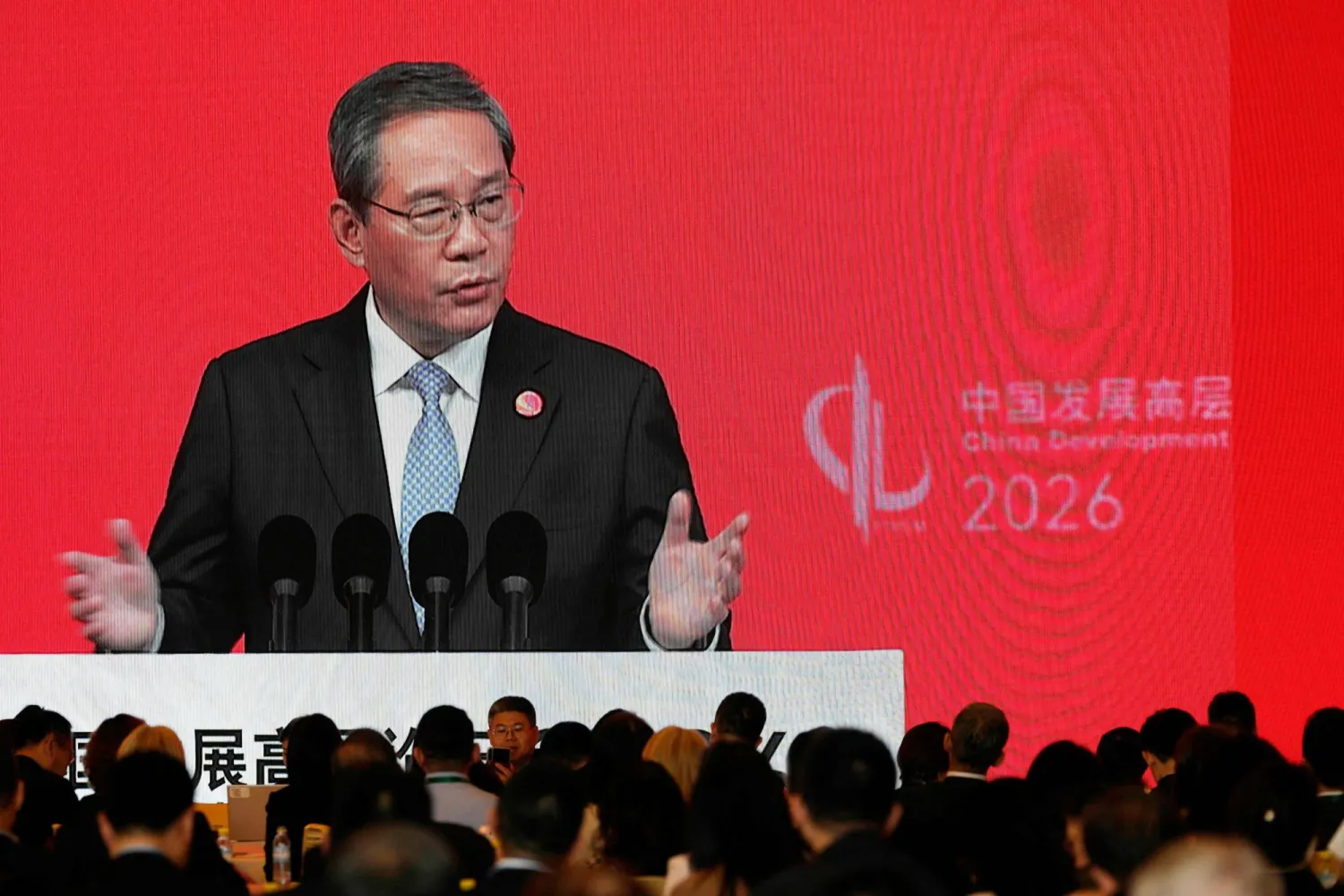
Chinese Premier Li Qiang is seen on a big screen live broadcasting his speech at the opening of the China Development Forum 2026 held at the Diaoyutai State Guesthouse in Beijing on March 22, 2026. (Photo by Ng Han Guan / POOL / AFP)
TT

China's Premier Vows to Expand Global 'Trade Pie'

Chinese Premier Li Qiang is seen on a big screen live broadcasting his speech at the opening of the China Development Forum 2026 held at the Diaoyutai State Guesthouse in Beijing on March 22, 2026. (Photo by Ng Han Guan / POOL / AFP)

China's number two leader Li Qiang said Sunday that his country was willing to help expand the global "trade pie" by further opening up, state media reported, while he slammed unilateralism from certain countries.

Many of China's key trading partners have increasingly called on Beijing to reduce its soaring trade surplus owing to its impact on local competition.

Its trade surged by a fifth in the first two months of the year, official data showed earlier this month, significantly outpacing forecasts.

China "will steadfastly advance high-level opening up, import more high-quality foreign goods, and work alongside all parties to promote the optimized and balanced development of trade", Premier Li Qiang told business executives in Beijing on Sunday, according to Xinhua.

Li was speaking at the opening of the annual China Development Forum, attended this year by prominent business leaders including Apple CEO Tim Cook, AFP reported.

The Chinese premier added that Beijing would work with other countries to "join forces to make the global economic and trade pie larger for everyone".

He slammed growing unilateralism and protectionism, which he said was "no panacea for resolving problems".

Beijing has been seeking to steer a shaky economy onto a more stable path since the end of the pandemic, particularly by boosting consumption.

It had been locked in a blistering trade war last year with Washington after President Donald Trump imposed tariffs on countries including China.

The recent trade boost is a lifeline for China, the world's second-largest economy, as domestic consumer activity has slumped, and adds to the record surplus achieved last year.

The China Development Forum convenes as the Middle East war, triggered by US and Israeli strikes on Iran, rages on.

Tehran has retaliated with strikes across the region and beyond in a conflict that has threatened global energy security as well as China's oil supplies.

Li told the Chinese officials and global business executives the international rules-based order was suffering "severe disruption" with power politics "running rampant".

Chinese Vice Premier He Lifeng met with senior representatives of multinational companies including HSBC, UBS, Schneider Electric and Standard Chartered on Saturday, Xinhua reported.



Hormuz Under Insurance Pressure as ‘War Premiums’ Violate Int’l Laws

A vessel at the Strait of Hormuz, off the coast of Oman’s Musandam province, April 12, 2026. (Reuters)
TT

Hormuz Under Insurance Pressure as ‘War Premiums’ Violate Int’l Laws

A vessel at the Strait of Hormuz, off the coast of Oman’s Musandam province, April 12, 2026. (Reuters)

As military tensions flare in the Strait of Hormuz, another battle is unfolding behind the scenes, one no less dangerous. Insurance companies have emerged as key players shaping the fate of global shipping.

With premiums surging to unprecedented levels, experts told Asharq Al-Awsat the world is approaching a “moment of truth.”

The closure of the waterway threatens not only oil flows, but also bread supplies in the world’s poorest countries, while putting the international legal framework that protects trade at risk of collapse.

War risk insurance premiums in the Strait have jumped to between 1% and 7.5% of vessel value, up from less than 1% before attacks escalated. In practical terms, insurance for a single voyage of a large oil tanker worth $100 million can now range between $2 million and $9 million, compared with about $250,000 before tensions intensified.

Rabih El-Amine, head of the Lebanese Executives Council, said the Strait of Hormuz is no longer just a narrow maritime passage, about 21 miles wide, but “it has become the single lung through which the global economy breathes.”

“When that lung is threatened, it is not only oil that suffocates, but food, medicine, and hope as well,” he told Asharq Al-Awsat.

He added that the situation is alarming, not just on a theoretical level, but because its consequences are already affecting companies and markets, with marine insurance premiums rising by 30% to 120% in a matter of months.

When major insurers withdraw entirely from covering vessels forced to transit the Strait, it signals not only higher costs, but a breakdown in the entire system of commercial trust, he warned.

Numbers tell the story

El-Amine said more than 230 loaded oil tankers are currently waiting for clearance to pass through the Strait and are unable to depart.

The International Energy Agency has described the situation as the largest disruption to oil supply in the global market's history. Natural gas prices in Europe have surged by more than 70%, while jet fuel prices have climbed 95%, forcing some European airports to ration fuel.

Some estimates suggest oil could approach $200 per barrel if the closure persists.

Yet El-Amine warned that wheat and fertilizers are an even greater concern. The Gulf region is not only a global energy hub, but also a key supplier for global agriculture, with 35% of global urea exports passing through the Strait.

India imports 70% of its needs from the region. Urea prices have jumped 26% to $585 per ton, a level not seen in years.

“When fertilizer prices rise, bread prices follow,” he said. “The heaviest burden is not borne by European or American farmers, but by poor families in Africa and South Asia, where an estimated 45 million people are now on the brink of acute food insecurity.”

He added that geopolitical crises carry costs that are unevenly distributed, as negotiators debate strategic interests behind closed doors while poorer nations face soaring commodity prices.

He stressed the need for insurers, companies, and governments to shift from crisis response to disaster prevention, calling for a flexible regional insurance system, emergency financing mechanisms, and dialogue channels that prioritize food and energy security over other considerations.

Testing the legitimacy of the international system

Saeed Salam, director of the Vision Center for Strategic Studies, said the current crisis in the strait has evolved beyond a military confrontation into a test of the legitimacy of the international system.

“The precise calculations of global insurance companies have become the real driver of trade flows, outweighing international laws and agreements,” he told Asharq Al-Awsat.

According to Salam, the escalation that began in late February, followed by Iran’s closure of the strait and attacks on 19 to 20 commercial vessels that did not comply with its transit conditions, has created a state of comprehensive “economic shutdown.”

Insurance costs have risen sharply due to unprecedented risks, making navigation through Hormuz commercially unviable.

Tankers have been forced to seek longer, more expensive alternative routes, while major powers and international actors attempt to secure supply flows through exceptional interventions that have so far failed to restore confidence.

Salam said this reality undermines the maritime legal system established in 1982, exposing a wide gap between the legal right of transit passage and the threats imposed by Tehran, which he said is attempting to reshape the rules of engagement in the region.

He added that the involvement of major powers in providing government guarantees to vessels further complicates the situation, giving commercial shipping a direct political dimension and turning ships into targets in conflicts they have no stake in.

This, he warned, could fragment the global maritime system into competing spheres of influence governed by power and coercion rather than freedom of trade.

At the same time, competition among global powers has extended into the insurance and technological domains.

While Western systems attempt to manage risk at high cost, China has begun offering parallel guarantees for vessels linked to it, potentially dividing the world into rival insurance blocs aligned with geopolitical agendas.

Salam pointed to cyber threats as the most dangerous emerging front. Maritime mines are no longer the only concern, he said, as digital systems that manage ports and control vessels have become vulnerable to disruptions that can halt global supply chains within moments, risks not covered by traditional insurance contracts.

Salam said the failure of the Islamabad talks signals a prolonged period of uncertainty. Companies will need to move beyond financial hedging and adopt hybrid strategies that combine insurance, cybersecurity, and strategic alliances to navigate these risks.

“The era of safe, internationally guaranteed navigation is over,” he said. “The world is entering a new reality where threat itself becomes the governing rule in the Strait.”

He added that companies that survive will be those with high flexibility and the ability to anticipate risks, while passive waiting is a gamble that could push the global system into inevitable stagflation, at a time when securing trade routes has become the only benchmark for sustaining production and growth.


IMF Says World Is Drifting Toward More Adverse Growth Scenario as Energy Disruptions Continue

Pierre-Olivier Gourinchas, Director of IMF Research Department, speaks during an economic outlook briefing during the 2026 IMF and World Bank Group Spring Meetings in Washington, DC, on April 14, 2026. (AFP)
TT

IMF Says World Is Drifting Toward More Adverse Growth Scenario as Energy Disruptions Continue

Pierre-Olivier Gourinchas, Director of IMF Research Department, speaks during an economic outlook briefing during the 2026 IMF and World Bank Group Spring Meetings in Washington, DC, on April 14, 2026. (AFP)

The world may be already drifting towards the International Monetary Fund's "adverse scenario" forecast of weaker 2.5% global growth in 2026 even as it released ‌on Tuesday ‌a more benign ‌reference ⁠forecast of 3.1% growth, ⁠IMF chief economist Pierre-Olivier Gourinchas said.

Gourinchas told a news conference that the reference forecast assumes that the conflict is ⁠resolved quickly and that energy ‌prices ‌normalize in the second ‌half of 2026, but acknowledged ‌that the war's developments are fluid and changing daily. He said the reference forecast ‌was "not quite yet" irrelevant.

"I would say that we ⁠are ⁠somewhere in between the reference scenario and the adverse scenario," Gourinchas said.

"And of course, every day that passes and every day that we have more disruption in energy, we are drifting closer towards the adverse scenario."


Iraq Says Has ‘Understandings’ to Bypass Hormuz Blockade

A worker rides a bicycle at the Zubair oil field in Basra, Iraq, April 6, 2026. (Reuters)
TT

Iraq Says Has ‘Understandings’ to Bypass Hormuz Blockade

A worker rides a bicycle at the Zubair oil field in Basra, Iraq, April 6, 2026. (Reuters)

Baghdad's oil ministry said Tuesday it has "understandings" with the United States and Iran to reduce the impact of the blockade of the Strait of Hormuz on Iraqi oil exports.

The ministry did not elaborate or say when these reported understandings were reached.

But Iran announced earlier this month -- before the fragile ceasefire was reached last Wednesday with the United States -- that it would allow Iraqi shipping to transit the key waterway.

Iraqi oil ministry spokesperson Saheb Bazoun told the Iraqi News Agency (INA) "there are understandings with the American and Iranian sides to circumvent the blockade imposed on the Strait of Hormuz, and with all parties to guarantee exports".

A founding member of the OPEC oil cartel, Iraq normally exports the majority of its crude through the strait, but like other exporters in the oil-rich region, it has been left scrambling for alternative routes.

Bazoun told INA that Iraq was continuing to use secondary export routes, including a pipeline to the Turkish port of Ceyhan and via Syria's Baniyas port.

Authorities announced earlier this month Iraq has begun exporting crude using tanker trucks through Syria, after resuming oil exports of 250,000 barrels per day through Ceyhan.

The Middle East war has wrought havoc on energy markets, especially after Iran tightened the screws on the Strait of Hormuz -- through which roughly a fifth of global oil and gas passes -- sharply slowing maritime traffic, and reportedly charging transit fees.

Despite the two-week ceasefire between the United States and Iran, and after a failed attempt to reach an agreement, Washington imposed a blockade on Iranian ports in the Strait of Hormuz, sending tremors through global energy markets.

Oil exports account for some 90 percent of Iraq's budget revenues, which plummeted more than 70 percent in March compared with February.