


China's Sinopec Posts 36.8% Drop in 2025 Net Profit

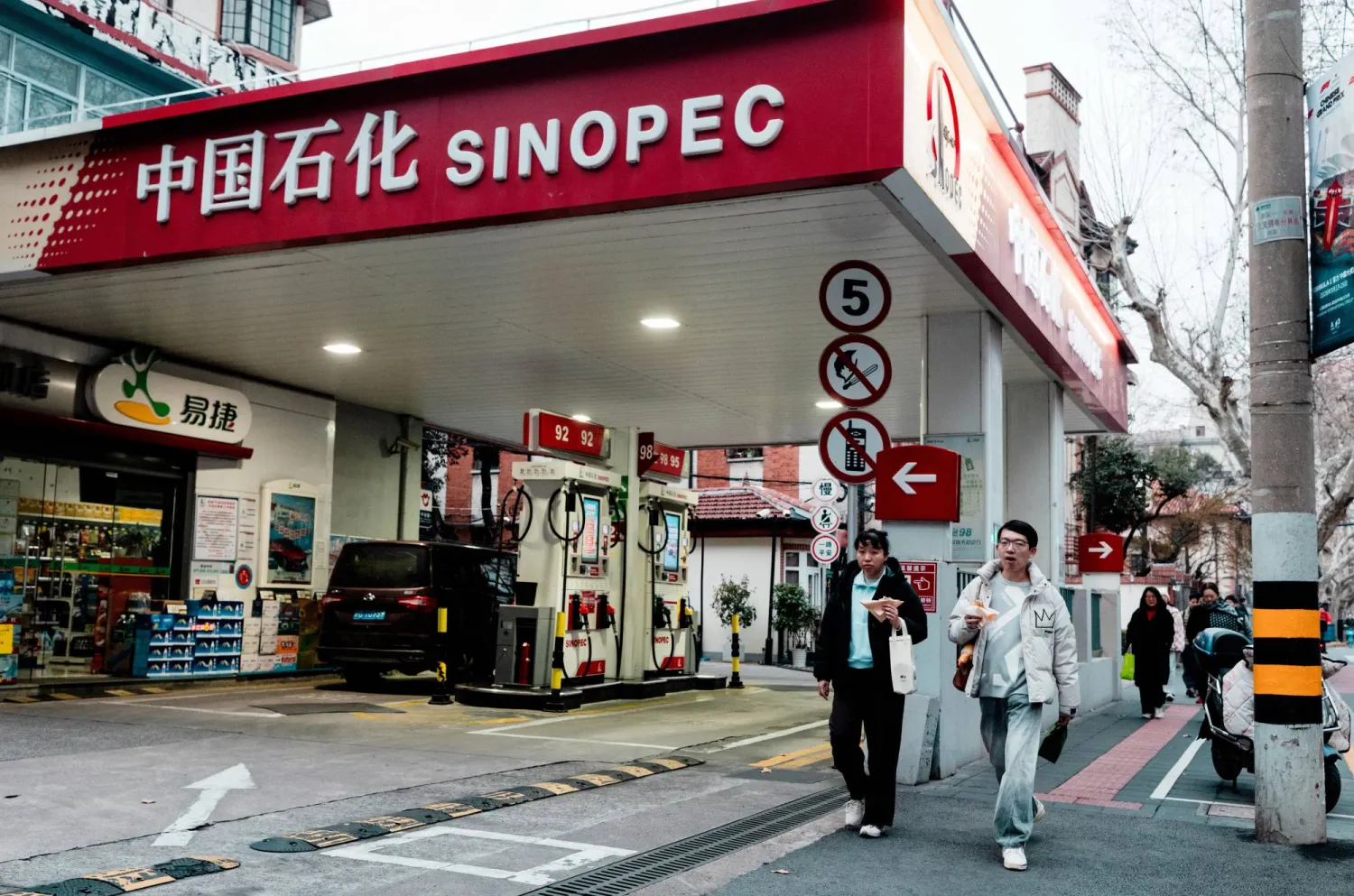
People walk past SINOPEC petrol station, in Shanghai, China, 19 March 2026.  EPA/ALEX PLAVEVSKI
People walk past SINOPEC petrol station, in Shanghai, China, 19 March 2026. EPA/ALEX PLAVEVSKI
TT

China's Sinopec Posts 36.8% Drop in 2025 Net Profit

People walk past SINOPEC petrol station, in Shanghai, China, 19 March 2026.  EPA/ALEX PLAVEVSKI
People walk past SINOPEC petrol station, in Shanghai, China, 19 March 2026. EPA/ALEX PLAVEVSKI

China Petroleum & Chemical Corp, known as Sinopec, reported a 36.8% decline in 2025 net profit on Sunday, citing rising substitution by new energy sources, and weak petrochemical margins, according to the company's filing.

The world's largest oil refiner by capacity posted net income attributable to shareholders of 31.8 billion yuan ($4.62 billion), based on Chinese accounting standards, in a filing to the Shanghai stock exchange.

Refinery throughput fell 0.8% last year to 250.33 million metric tons, equivalent to 5 million barrels per day. The company forecast refinery throughput would remain stable at about 250 million tons in 2026.

Gasoline and diesel production fell 2.4% and 9.1%, respectively, to 62.61 million tons and 52.64 million tons, while kerosene production rose 7.3% year-on-year to 33.71 million tons.

Annual refining ⁠gross margin was ⁠330 yuan ($47.93) per ton, up 27 yuan year-on-year, mainly due to sharply improved margins for refining by-products such as sulfur and petroleum coke, which offset the impact of high import crude premiums and freight costs.

The company's gasoline sales fell 2.5% year-on-year to 61.1 million tons, with the average price falling 7.7%, while diesel sales fell 9.1% to 51.2 million tons, and the average price fell 8% in ⁠2025, Reuters reported.

Kerosene sales were 24.2 million tons, up 4% year-on-year, while the average price was down 9.9% from 2024.

In 2025, the company's domestic crude oil output reached 255.75 million barrels, up 0.7% year-on-year, while overseas crude oil output was 26.65 million barrels.

Sinopec expects domestic crude oil output to reach 255.6 million barrels in 2026, remaining largely stable, while overseas output is expected to drop to 25.31 million barrels.

Natural gas production rose 4% year-on-year to 1,456.6 billion cubic feet in 2025 and is expected to reach 1,471.7 billion cubic feet in 2026.

The company's ethylene production rose 13.5% year-on-year to 15.28 million tons in 2025.

In 2025, the ⁠company's external sales ⁠revenue from chemical products totaled 378.0 billion yuan, down 9.6% year-on-year, mainly because of lower product prices.

Sinopec's capital spending was 147.2 billion yuan in 2025 with 70.9 billion yuan on exploration and development.

Sinopec said it plans capital spending from 131.6 billion to 148.6 billion yuan this year, including 72.3 billion yuan for exploration and development, mainly for crude oil capacity expansion at Jiyang and Tahe, natural gas capacity projects in western and southern Sichuan, and oil and gas storage and transport facilities.

Sinopec's Hong Kong-listed shares have risen 0.21% year-to-date, outperforming a 1.38% drop in the Hang Seng Index , while lagging behind its peers PetroChina and CNOOC, which have posted 17.58% and 42.63% gains year-to-date, respectively.



World Bank Chief Sounds Alarm about Looming Jobs Crisis Even after War Ends

World Bank President Ajay Banga gives remarks during a forum held at the Atlantic Council building in Washington, D.C., US, April 7, 2026. REUTERS/Aaron Schwartz
TT

World Bank Chief Sounds Alarm about Looming Jobs Crisis Even after War Ends

World Bank President Ajay Banga gives remarks during a forum held at the Atlantic Council building in Washington, D.C., US, April 7, 2026. REUTERS/Aaron Schwartz

The Middle East war will dominate global finance officials' talks this week in Washington, but World Bank President Ajay Banga is sounding the alarm about a bigger, looming crisis: a huge gap in jobs for the 1.2 billion people who will reach working age in developing countries in the next 10 to 15 years.

At current trajectories, those economies will generate only about 400 million jobs, leaving a deficit of 800 million jobs, Banga told Reuters.

The former Mastercard CEO admits that focusing people on the long-term is daunting, given a series of short-term shocks that have buffeted the global economy since the COVID-19 pandemic, the most recent being the war in the Middle East.

He says he's determined to ensure that finance officials stay focused on those longer-term challenges like creating jobs, connecting people to the electricity grid and ensuring access to clean water. "We have to walk and chew gum at the same time. ‌Short-velocity cycle is what ‌we're going through. Longer velocity is this jobs circumstance or water," Banga said in ‌an ⁠interview taped on Friday.

WAR ⁠OVERSHADOWS OTHER CONCERNS Thousands of finance officials from around the globe will gather in Washington this week for the spring meetings of the World Bank and the International Monetary Fund under the shadow of the US-Israel war with Iran that threatens to slow global growth and jack up inflation. The extent of the hit to the economy will depend on the durability of a two-week ceasefire announced by President Donald Trump last week, just hours before promised strikes that Trump said would destroy Iran's civilization. The ceasefire has halted most attacks. But it has not ended Iran's effective blockade of the Strait of Hormuz, which has caused the biggest-ever disruption to global energy ⁠supplies, or calmed a parallel war between Israel and Iran-backed Hezbollah in Lebanon.

IMPROVING JOB CREATION

The ‌World Bank's governing body, the Development Committee, outlined plans to work with developing ‌countries to streamline policy and regulatory conditions that have hampered investment and job creation for years.

Discussions will touch on transparency around permits, anti-corruption, labor ‌law, land law, impediments to opening a business, logistics, better trade systems, and non-price barriers in trade, Banga said.

He is ‌upbeat that solutions can be found to help find employment - and dignity - for young people and create opportunities for private companies catering to their needs. "I don't know that you can ever get to a situation of utopia and everybody is taken care of in the coming 15 years. I would doubt that's going to happen, but if you don't do it, the implications are quite severe in terms ‌of illegal migration and instability," Banga said. United Nations data showed more than 117 million people were displaced worldwide as of 2025.

Banga said companies in developing countries themselves were starting ⁠to expand globally, including India's ⁠Reliance Industries and the Mahindra Group, and Dangote in Nigeria.

Banga said his discussions with officials in developing countries showed their interest in creating more - and better jobs - for the next generation.

In addition to jobs, water will be a big focus. The World Bank, in conjunction with other development banks, is set to announce a push to ensure that one billion more people have secure access to clean water, adding to existing initiatives to connect 300 million households in Africa with electricity, and to improve health care.

PULLING IN THE PRIVATE SECTOR

The World Bank focused on human and physical infrastructure required for the jobs creation push during last fall's meetings of the IMF and World Bank, and will continue the cycle with an emphasis on attracting private sector investment during this fall's meetings in Bangkok, Banga said. The bank identified five sectors that would benefit from investment and are not reliant on global trade or outsourcing from developed countries: infrastructure, agriculture for small farmers, primary health care, tourism and value-added manufacturing. Those sectors are less likely to be immediately affected by advancements in artificial intelligence, he said.

"The problem is, we can't do this alone. We've got to get this snowball to roll downhill, gathering a lot of snow as it goes along, to reach that amazing number of 800 million," he said.


Gold Drops as Inflation Worries Linger on Failed US-Iran Talks

AFP a one-ounce gold bar is displayed at Witter Coins on October 07_ 2025 in San Francisco
TT

Gold Drops as Inflation Worries Linger on Failed US-Iran Talks

AFP a one-ounce gold bar is displayed at Witter Coins on October 07_ 2025 in San Francisco

Gold prices touched a near one-week low on Monday, pressured by a stronger dollar, while a surge in oil prices following failed US-Iran peace talks fueled inflation worries and dampened expectations for Federal Reserve interest rate cuts this year.

Spot gold was down 0.7% at $4,716.70 per ounce, as of 0445 GMT, its lowest level since April 7. US gold ‌futures for June ‌delivery fell 1% to $4,738.90. The dollar strengthened 0.4%, ‌while ⁠oil prices bounced ⁠back above $100 a barrel, as the US Navy prepared a blockade of the Strait of Hormuz that could restrict Iranian oil shipments, following the US and Iran's failure to reach a deal to end the war.

Iran's Revolutionary Guards responded by warning that military vessels approaching the Strait will be considered a ceasefire breach and ⁠dealt with harshly and decisively, reported Reuters.

"Ceasefire optimism has unwound ‌following the failure of the peace ‌talks, and the resulting push higher by the dollar and ‌oil prices has put gold on the back foot again," ‌said Tim Waterer, chief market analyst, KCM Trade.

Spot gold has fallen more than 11% since the US-Israeli war on Iran began on February 28. While inflation and geopolitical risks typically boost gold's appeal as a ‌hedge, elevated interest rates weigh on the non-yielding metal.

A stronger dollar also makes greenback-priced bullion more expensive ⁠for holders ⁠of other currencies.

"As soon as oil prices push back above $100, attention quickly turns to potential central bank rate hikes to curb inflation, and it is this interest rate outlook that is undermining gold's performance," Waterer said.

Traders now see little chance of a US rate cut this year, as higher energy prices threaten to feed into broader inflation and limit the scope for monetary easing.

Before the war in the Middle East began, there were expectations for two Fed rate cuts this year.

Among other metals, spot silver fell 2% to $74.35 per ounce, platinum lost 0.2% to $2,041.40, while palladium gained 0.7% to $1,530.80.


Euro Zone Bond Yields Rise After US-Iran Talks Collapse

A car drives along a road during sunset near Berlin, Germany, 09 April 2026, a few days after Iran and the US announced a two-week conditional ceasefire to halt military operations. (EPA)
TT

Euro Zone Bond Yields Rise After US-Iran Talks Collapse

A car drives along a road during sunset near Berlin, Germany, 09 April 2026, a few days after Iran and the US announced a two-week conditional ceasefire to halt military operations. (EPA)

Euro zone government bond ‌yields edged up on Monday towards recent peaks after the United States and Iran failed to secure a deal to end the war, pushing oil prices higher, fueling inflation concerns and reinforcing expectations of European Central Bank rate hikes. 

Brent crude futures climbed above $100 a barrel as the US Navy prepared to block ships to and from Iran via the Strait of Hormuz, a move that could restrict Iranian oil exports. 

Germany’s 10-year government bond yield rose 1.5 basis points (bps) to 3.06%. It reached 3.13% in late March, its highest level since June 2011. 

Analysts argued that ‌while the truce ‌was more fragile after the weekend, both parties ‌were ⁠unlikely to let ⁠full-blown war resume. 

Money markets priced in an ECB deposit facility rate at 2.69.% by year-end, implying two hikes and a 75% chance of a third move, from around 2.60% late on Friday. 

They also indicated a 45% chance of a rate increase in April from 25% late on Friday. The deposit facility rate is currently at 2%. 

“The temporary truce briefly ⁠reduced immediate tail risks, but the failure of negotiations ‌over the weekend has underscored that the ‌constraints that matter most for near-term (energy) pricing remain unresolved,” said Tobias Keller, ‌investment strategist at UniCredit. 

“Damaged infrastructure, higher insurance and freight costs and persistent ‌logistical frictions imply that any easing in physical tightness will be slow and uneven,” he added. 

Germany’s two-year yields, more sensitive to expectations for policy rates, were up 4 bps at 2.62%. They reached 2.771% in late March, its highest ‌level since July 2024. 

Italy’s 10-year government bond yields rose 3.5 bps to 3.86%. They reached 4.142% ⁠in late March, ⁠the highest since July 2024. 

The yield gap of Italian government bonds versus Bunds was at 79 bps. It was at 63 bps before the US-Israeli war with Iran began and hit 103.62 during the conflict, the highest since June 20, 2025. 

“We would probably need to see a more significant escalation for BTP-Bund spreads to test the March highs again,” said Hauke Siemssen, rate strategist at Commerzbank. 

“BTPs should also underperform OATs (French government bonds) again this week as they are more susceptible to energy prices, while we expect the spread to re-tighten over the long term,” he added. 

The French spread was at 64.50 bps from 58 bps before the conflict. Fitch confirmed on Friday A+ rating with outlook stable.