


UN: Planet Trapped Record Heat in 2025

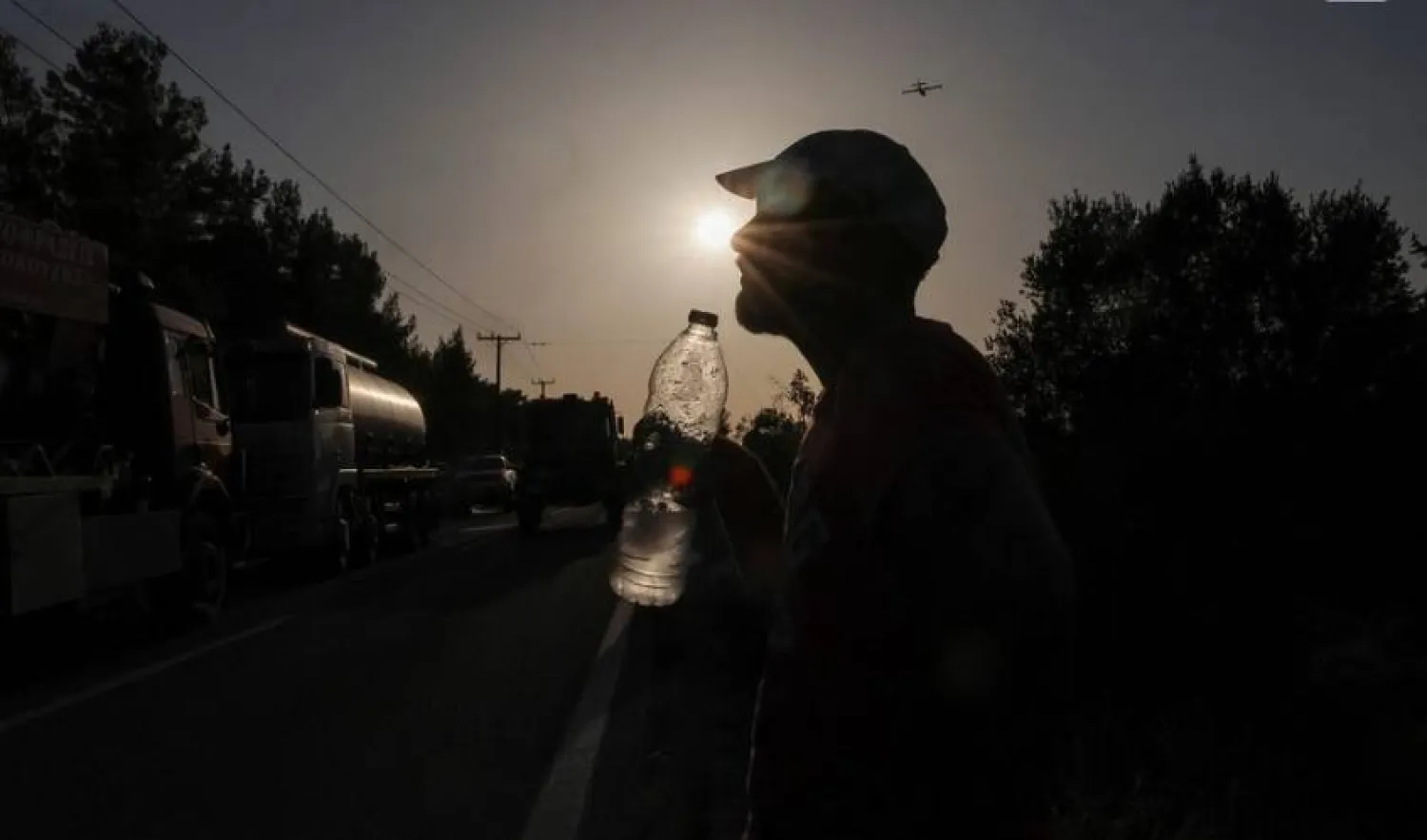
A volunteer holds a bottle of water as a wildfire burns in the village of Vati, on the island of Rhodes, Greece, July 26, 2023. REUTERS/Nicolas Economou/File photo
TT

UN: Planet Trapped Record Heat in 2025

A volunteer holds a bottle of water as a wildfire burns in the village of Vati, on the island of Rhodes, Greece, July 26, 2023. REUTERS/Nicolas Economou/File photo

The amount of heat trapped by the Earth reached record levels in 2025, with the consequences of such warming feared to last for thousands of years, the UN warned Monday.

The 11 hottest years ever recorded were all between 2015 and 2025, the United Nations' WMO weather and climate agency confirmed in its flagship State of the Global Climate annual report.

Last year was the second or third hottest year on record, at about 1.43 Celsius above the 1850-1900 average, the World Meteorological Organization said.

"The global climate is in a state of emergency. Planet Earth is being pushed beyond its limits. Every key climate indicator is flashing red," said UN Secretary-General Antonio Guterres.

"Humanity has just endured the 11 hottest years on record. When history repeats itself 11 times, it is no longer a coincidence. It is a call to act,” AFP quoted him as saying.

For the first time, the WMO climate report includes the planet's energy imbalance: the rate at which energy enters and leaves the Earth system.

Under a stable climate, incoming energy from the Sun is about the same as the amount of outgoing energy, the Geneva-based agency said.

However, the increase in concentrations of heat-trapping greenhouse gases -- carbon dioxide, methane and nitrous oxide -- "to their highest level in at least 800,000 years" has "upset this equilibrium", the WMO said.

"The Earth's energy imbalance has increased since its observational record began in 1960, particularly in the past 20 years. It reached a new high in 2025."

WMO chief Celeste Saulo said scientific advances had improved understanding of the energy imbalance and its implications for the climate.

"Human activities are increasingly disrupting the natural equilibrium and we will live with these consequences for hundreds and thousands of years," she said.

More than 91 percent of the excess heat is stored in the ocean.

"Ocean heat content reached a new record high in 2025 and its rate of warming more than doubled from 1960-2005 to 2005-2025," the WMO said.

Ocean warming has far-reaching consequences, such as degradation of marine ecosystems, biodiversity loss and reduction of the ocean carbon sink, the agency said.

"It fuels tropical and subtropical storms and exacerbates ongoing sea-ice loss in the polar regions."

The Antarctic and Greenland ice sheets have both lost considerable mass, and the annual average extent of Arctic sea ice in 2025 was the lowest or second-lowest ever recorded in the satellite era.

Last year, the global mean sea level was around 11 centimeters higher than when satellite altimetry records began in 1993.

Ocean warming and sea level rise are projected to continue for centuries.

WMO scientific officer John Kennedy said global weather is still under the influence of La Nina, a naturally occurring climate phenomenon that cools surface temperatures in the central and eastern equatorial Pacific Ocean. It brings changes in winds, pressure and rainfall patterns.

Conditions oscillate between La Nina and its warming opposite El Nino, with neutral conditions in between.

The warmest year on record, 2024, was around 1.55C above the 1850-1900 average, and started in a strong El Nino.

Forecasts indicate neutral conditions by the middle of 2026 with a possible El Nino developing before the end of the year, said Kennedy.

If so, "then we're likely to see maybe elevated temperatures again in 2027", he told a press conference.

The World Meteorological Organization's deputy chief, Ko Barrett, said the outlook was a "dire picture".

She said the WMO provided the evidence it sees, hoping that the information "will encourage people to take action".

But there was "no denying" that "these indicators are not moving in a direction that provides for a lot of hope", she said.

With war gripping the Middle East and fuel prices soaring, Guterres said the world should heed the alarm call.

"In this age of war, climate stress is also exposing another truth: our addiction to fossil fuels is destabilizing both the climate and global security," he said.

"Today's report should come with a warning label: climate chaos is accelerating and delay is deadly," he said.



Skydiver Left Dangling When Parachute Snags on Stadium Video Board

In this image from video, personnel on a lift work to secure a skydiver that crashed into the Lane Stadium scoreboard before Virginia Tech’s spring NCAA college football game, Saturday, April 18, 2026, in Blacksburg, Va. (Ben Walls/WRIC8 via AP)
TT

Skydiver Left Dangling When Parachute Snags on Stadium Video Board

In this image from video, personnel on a lift work to secure a skydiver that crashed into the Lane Stadium scoreboard before Virginia Tech’s spring NCAA college football game, Saturday, April 18, 2026, in Blacksburg, Va. (Ben Walls/WRIC8 via AP)

A skydiver ‌trailing a large American flag drifted off course and became tangled in the video board at a US college football game on Saturday, leaving him suspended above the field by his parachute until he was rescued.

Viral videos from inside ‌Virginia Tech's ‌Lane Stadium, confirmed ‌by ⁠Reuters, showed two ⁠skydivers descending into the arena before the school's spring game, when one of them missed the designated landing area, hit the electronic scoreboard and ⁠became entangled.

Fans watched in ‌distress as ‌the skydiver, whose name was not ‌immediately released, was left hanging ‌for 15 to 20 minutes before emergency crews using an aerial ladder brought him to safety.

"We ‌are grateful to report that the skydiver was safely ⁠secured ⁠and is currently stable. Our primary focus remains on their well-being," Virginia Tech officials posted on X.

"We extend our sincere appreciation to the first responders, event staff, and medical personnel for their swift, coordinated and professional response."

No injuries were reported during the incident.


Chernobyl’s Radioactive Landscape Is Testament to Nature’s Resilience and Survival Spirit

Wild Przewalski horses graze in a forest inside the Chernobyl exclusion zone, Ukraine, Wednesday, April 8, 2026. (AP)
TT

Chernobyl’s Radioactive Landscape Is Testament to Nature’s Resilience and Survival Spirit

Wild Przewalski horses graze in a forest inside the Chernobyl exclusion zone, Ukraine, Wednesday, April 8, 2026. (AP)

On contaminated land that is too dangerous for human life, the world’s wildest horses roam free.

Across the Chernobyl exclusion zone, Przewalski’s horses — stocky, sand-colored and almost toy-like in appearance — graze in a radioactive landscape larger than Luxembourg.

On April 26, 1986, an explosion at the nuclear power plant in Ukraine sent radiation across Europe and forced the evacuation of entire towns, displacing tens of thousands. It was the worst nuclear disaster in history.

Four decades on, Chernobyl — which is transliterated as “Chornobyl” in Ukraine — remains too dangerous for humans. But the wildlife has moved back in.

Wolves now prowl the vast no-man’s-land spanning Ukraine and Belarus, and brown bears have returned after more than a century. Populations of lynx, moose, red deer and even free-roaming packs of dogs have rebounded.

Przewalski’s horses, native to Mongolia and once on the brink of extinction, were introduced here in 1998 as an experiment.

Known as “takhi” in Mongolia (“spirit”), the horses are distinct from domestic breeds, with 33 pairs of chromosomes compared with 32 in domesticated horses. The modern name comes from the Russian explorer who first formally identified them.

“The fact that Ukraine now has a free-ranging population is something of a small miracle,” said Denys Vyshnevskyi, the zone’s lead nature scientist.

With human pressure gone, parts of the exclusion zone now resemble European landscapes from centuries past, he said, adding: “Nature recovers relatively quickly and effectively.”

The transformation is visible everywhere. Trees pierce abandoned buildings, roads dissolve into forest, and weathered Soviet-era signs stand beside leaning wooden crosses in overgrown cemeteries.

Hidden cameras show the horses adapting in unexpected ways. They seek shelter in crumbling barns and deserted homes, using them to escape harsh weather and insects — even bedding down inside.

The animals live in small social groups — typically one stallion with several mares and their young — alongside separate bands of younger males. Many died after their introduction, but others adapted.

Tracking them takes time. Vyshnevskyi often drives alone for hours, setting motion-sensitive camera traps in camouflaged casings attached to trees.

Despite persistent radiation, scientists have not recorded widespread die-offs, though subtler effects are evident. Some frogs have developed darker skin, and birds in higher-radiation areas are more likely to develop cataracts.

However, new threats have emerged.

Russia’s 2022 invasion brought fighting through the exclusion zone as troops advanced toward Kyiv, digging defenses into contaminated soil. Fires linked to military activity swept through forests.

Harsh wartime winters have also taken a toll. Damage to the power grid left surrounding managed areas without resources, and scientists report increases in fallen trees and dead animals — casualties of both extreme conditions and hastily built fortifications.

“Most forest fires are caused by downed drones,” said Oleksandr Polischuk, who leads a firefighting unit in the zone. “Sometimes we have to travel dozens of kilometers to reach them.”

Fires can send radioactive particles back into the air.

Today, the zone is no longer just an accidental refuge for wildlife. It has become a heavily monitored military corridor, marked by concrete barriers, barbed wire and minefields — a landscape of what some describe as grim beauty.

Personnel rotate in and out to limit radiation exposure. Chernobyl is likely to remain off-limits for generations — too dangerous for people, yet full of life.

“For those of us in conservation and ecology, it’s kind of a wonder,” Vyshnevskyi said. “This land was once heavily used — agriculture, cities, infrastructure. But nature has effectively performed a factory reset.”


British Royals Choose Historian to Write Queen Biography

Britain's Queen Elizabeth II arrives for a visit to the Royal Academy of Arts in Central London, Britain, 20 March 2018. (EPA)
TT

British Royals Choose Historian to Write Queen Biography

Britain's Queen Elizabeth II arrives for a visit to the Royal Academy of Arts in Central London, Britain, 20 March 2018. (EPA)

Britain's royal family said Sunday that historian Anna Keay would write an official biography of queen Elizabeth II, who died in September 2022 after over 70 years on the throne.

King Charles III had wanted a woman to write the definitive account of his mother's life, according to British media.

Keay, best known for her work chronicling Britain's Republican period between 1649 and 1660, said receiving the job was a "profound honor".

She will have access to Elizabeth's personal and official papers held in the Royal Archives, Buckingham Palace said in a statement.

She will also be able to talk to members of the royal family and the queen's friends and household staff, the palace added.

Keay described Elizabeth as "an extraordinary woman, whose life spanned a century of great change".

"I am deeply grateful to His Majesty The King for entrusting me with this responsibility and for granting me access to her papers, and will do all I can to do justice to her life and work," she said.

Official royal biographies can sometimes reveal unexpected details about the subject's life.

William Shawcross's official biography of Elizabeth's mother, the wife of George VI, revealed how she suffered from bowel cancer in her 60s but was successfully treated.